
How Many Calories in Garlic Bread?
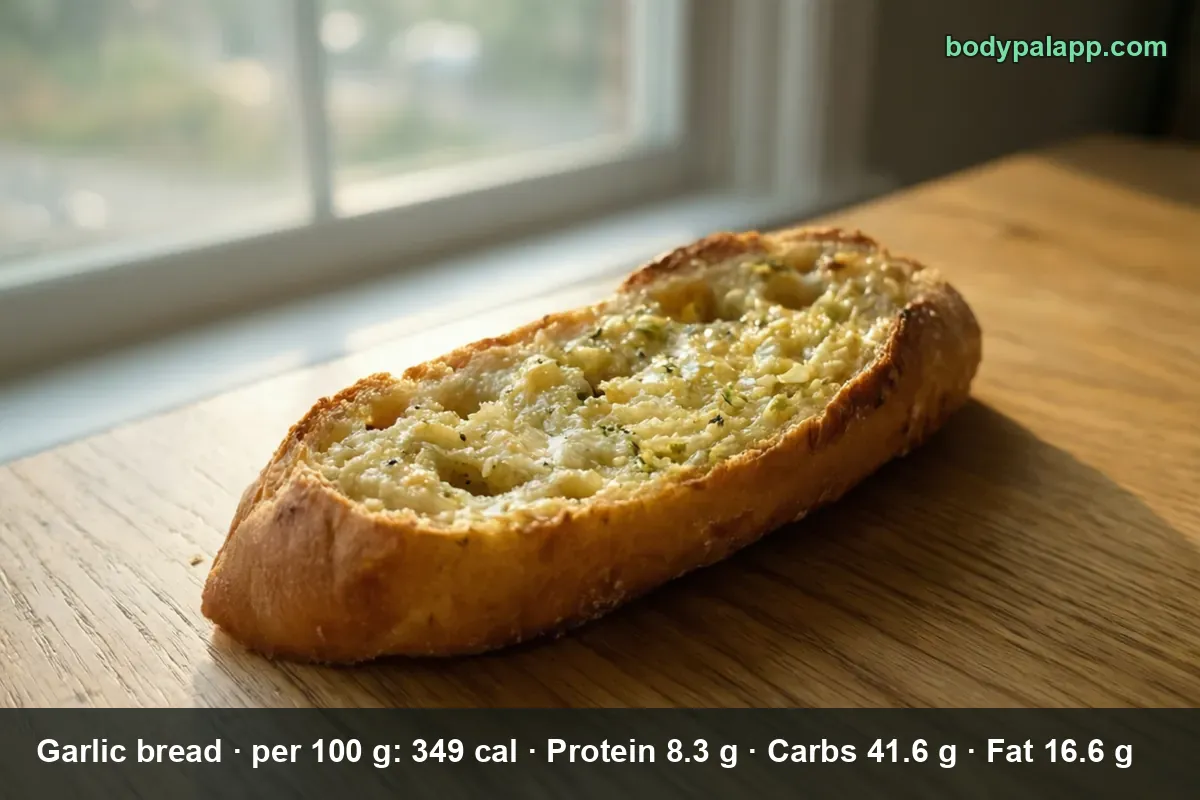
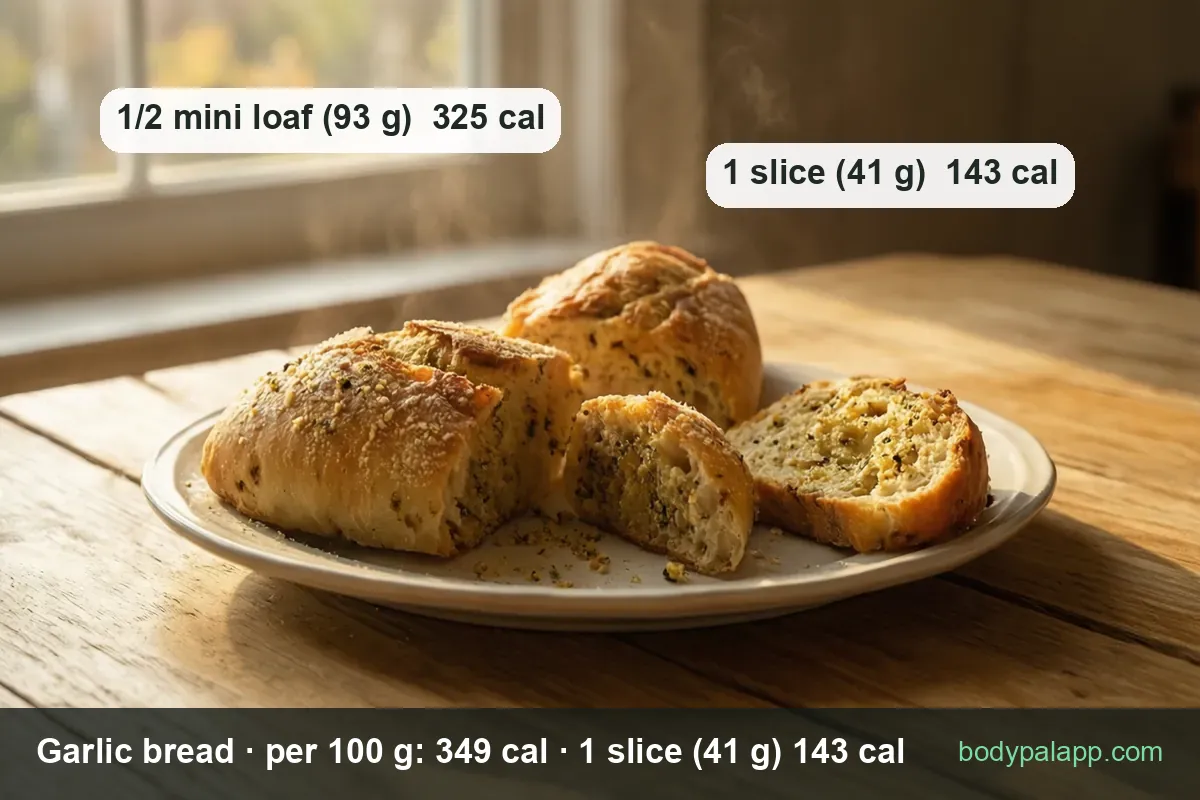
A slice of garlic bread is 143 calories — that is the 41 g Texas-toast cut, at 349 calories per 100 g. The thicker slice USDA treats as its default, 79 g, comes to 276 calories. Half a 9-inch mini loaf, 93 g of it, lands at 325.
On this page
- Garlic bread quick facts
- One slice, three different numbers
- Serving sizes from a frozen slice to a whole baguette
- Garlic toast and Texas toast
- The garlic butter is not butter
- Parmesan, melted cheese and the heavier slice
- Sodium is the bigger number here
- Garlic bread against the rest of the bread basket
- Most popular garlic bread brands
- FAQ
Garlic bread quick facts
The reference is USDA's garlic bread, NFS — the weighted average of what Americans actually eat, frozen slices and restaurant baskets together. The serving column is one Texas-toast slice, 41 g.
| Nutrient | Per 100 g | Per 1 slice (41 g) | % Daily Value |
|---|---|---|---|
| Calories | 349 | 143 | — |
| Total fat | 16.6 g | 6.8 g | 9% |
| Saturated fat | 5.3 g | 2.2 g | 11% |
| Carbohydrate | 41.6 g | 17.1 g | 6% |
| Dietary fiber | 2.5 g | 1.0 g | 4% |
| Total sugars | 3.7 g | 1.5 g | — |
| Protein | 8.3 g | 3.4 g | 7% |
| Sodium | 620 mg | 254 mg | 11% |
% Daily Value is based on a 2,000-calorie diet.
Verified nutrition data
Numbers on this page come from USDA FoodData Central, the U.S. Department of Agriculture’s food composition database, and from manufacturer labels where a branded product is named. Last verified September 2026. How we verify our data →
Total sugars have no Daily Value on the FDA label, so that row stays blank; only added sugars carry a percentage, and this USDA release does not break them out for garlic bread.
Two rows are worth a second look. Saturated fat is 11% of the day in one modest slice, and sodium is another 11% before anything else on the plate. Calories are the least interesting thing here.
One slice, three different numbers
Ask three people what a slice of garlic bread costs them and you get three honest, incompatible answers. They are all right, because "one slice" is not a unit.
- A frozen Texas-toast slice, 40 g: 140 calories
- USDA's default slice, 79 g: 276 calories
- A thick restaurant slice, 118 g: 412 calories
That is a 3× spread across a phrase people use as though it were precise. USDA's own historical frozen record adds two more slice weights to the pile: a pre-sliced 43 g piece at 151 calories and a 59 g piece at 207.
The practical fix is to log the weight of what is in front of you, or at least the shape of it. Rectangular slab cut from a square loaf, thin enough to hold flat: that is a Texas-toast slice, and 140 to 150 calories is the honest range. A wedge cut on the diagonal off a baguette, thick, with the crust curving: that is closer to 276, and possibly more.
Garlic bread is also the food people eat standing at the counter while something else finishes cooking. Two slices at 82 g is 286 calories — a number that arrives without ever feeling like a decision.
Serving sizes from a frozen slice to a whole baguette
| Serving | Weight | Calories |
|---|---|---|
| 1 oz | 28 g | 99 |
| 1 small slice | 39 g | 136 |
| 1 Texas-toast slice | 41 g | 143 |
| 2 slices | 82 g | 286 |
| 1 medium slice (USDA default) | 79 g | 276 |
| Half a mini loaf | 93 g | 325 |
| 1 large slice | 118 g | 412 |
| 1 mini baguette, about 9 inches | 185 g | 646 |
| 1 baguette, about 22 inches | 393 g | 1,372 |
One line in that table is ours rather than USDA's, and it should be labeled as such: the 93 g half loaf is simply USDA's 185 g mini baguette cut in two. Everything else is a measure USDA publishes with a gram weight attached.
The bottom two rows are the ones that catch people. A 9-inch mini loaf is a single-serving object in most kitchens — one person, one loaf, alongside pasta — and it is 646 calories with 9.8 g of saturated fat, half a day's worth. The full 22-inch baguette that gets torn up and passed around the table is 1,372 calories. Split four ways that is 343 each, which is a reasonable side. Split two ways it is a meal.
Frozen loaves run slightly smaller per slice. Using USDA's from-frozen record, the Texas-toast slice is 40 g and 140 calories, a medium slice 74 g and 259, and half a mini loaf 88 g and 308 — that last one is our halving again, of USDA's 176 g frozen loaf.
Garlic toast and Texas toast
In American usage, garlic toast and Texas toast with garlic are the same object: a thick-cut slice, spread on both faces, baked from frozen on a sheet pan. USDA does not keep a separate record for it, and it does not need one — the numbers are the same food at a different slice weight.
Generic garlic toast, one slice at 41 g, is 143 calories. Straight from the freezer aisle it is a touch lighter per piece at 40 g and 140 calories, because the frozen slices are cut marginally thinner than the restaurant average.
Labels in the freezer case land between roughly 130 and 170 calories per slice, depending on how thick the manufacturer cuts and how heavy the spread goes. That is a 30% swing between two boxes sitting on the same shelf, so the box in your hand beats any generic number, including this one.
Cheese garlic toast is its own thing. The generic frozen version with melted cheese is 343 calories per 100 g, but the slice is heavier at 48 g, so it works out to 165 calories a piece. Some cheese-topped toasts are cut much smaller — a 33 g slice comes to 120 calories — which is the whole reason per-piece numbers need a gram weight beside them.
The garlic butter is not butter
Here is the thing almost no calorie page mentions, and it is sitting in plain sight in the USDA record.
Butter has a chemical signature: butyric acid, the short-chain saturated fat (4:0) that essentially nothing else in the grocery store contains in quantity. USDA's stick butter carries 2.04 g of it per 100 g. USDA's garlic bread carries 0.008 g per 100 g — while also carrying 16.6 g of total fat. If that fat were dairy butter, the butyric number would be roughly fifty times higher.
What is in there instead shows up in the fatty acid profile: 3.343 g of palmitic acid (16:0) out of 5.27 g total saturated fat, and 5.371 g of linoleic acid (18:2). That is the fingerprint of palm and soybean oil, which is to say margarine.
The ingredient statements agree word for word. A major national garlic bread lists "enriched wheat flour, water, margarine (palm oil, water, soybean oil, salt, natural flavor, soy lecithin), soybean oil… dehydrated garlic" in its USDA Branded record. Margarine is the third ingredient. Butter does not appear at all.
Does this change the calorie count? Not much — margarine and butter are within a few calories of each other per gram. It changes two other things. It explains why the saturated fat is lower than a butter-based recipe would give, and it means the products that do use dairy butter say so loudly on the front of the box, because it costs them more to make.
Worth knowing how much spread is on there at all. Working backward from the fat content — plain French bread is 2.42 g fat per 100 g, spread is around 82 g per 100 g — a 100 g portion of garlic bread is roughly 82 g of bread carrying about 18 g of spread. On a 79 g restaurant slice that is around 14 g, or about one tablespoon. Recipes vary and this is arithmetic rather than a measurement, but it puts a real number on the layer.
Parmesan, melted cheese and the heavier slice
| Version | Per 100 g | 1 slice | Calories |
|---|---|---|---|
| Plain | 349 | 41 g | 143 |
| With parmesan, from frozen | 351 | 41 g | 144 |
| With parmesan, restaurant | 351 | 41 g | 144 |
| With melted cheese, from frozen | 343 | 48 g | 165 |
| With melted cheese, restaurant | 339 | 48 g | 163 |
Read that table too quickly and you reach the wrong conclusion. Melted cheese versions are lighter per 100 g than plain garlic bread — 343 against 349 — because mozzarella and provolone carry more water than a fat-heavy spread does.
Per slice they are heavier, by about 20 calories, because the cheese adds weight to the piece. USDA cuts the cheese-topped slice at 48 g rather than 41 g, and that is the whole difference. A per-gram comparison says cheese is the lighter choice; a per-slice comparison says the opposite. The slice is what you eat.
Cheese does buy you something. The melted-cheese restaurant version carries 11.4 g of protein per 100 g against 8.3 g for plain — the most protein of any garlic bread version here, though nobody eats garlic bread for the protein.
Parmesan barely registers. A 41 g slice with parmesan is 144 calories against 143 plain, which is a rounding difference. The parmesan is there for flavor, and it charges almost nothing for it.
Sodium is the bigger number here
Calories bring people to this page. Sodium is what they should take away from it.
- 1 slice, 41 g: 254 mg (11% DV)
- 2 slices, 82 g: 508 mg (22% DV)
- Half a mini loaf, 93 g: 577 mg (25% DV)
- 1 mini loaf, 185 g: 1,147 mg (50% DV)
- 1 full 22-inch baguette, 393 g: 2,437 mg (106% DV)
The FDA sets the Daily Value at 2,300 mg, and the CDC puts that at roughly one teaspoon of table salt for the entire day. A baguette of garlic bread passed around a table uses all of it, in a side dish, before the main course arrives.
USDA records one clean difference between the restaurant version and the frozen one, and it is not calories: 620 mg of sodium per 100 g in the restaurant record against 544 mg from frozen. Same calories, same fat, 14% more sodium out of the kitchen. Baking your own from the freezer aisle is the lower-sodium route, which is not the direction most people would guess.
There is a number on the plus side too. The enriched flour brings 3.04 mg of iron per 100 g — 17% of the Daily Value — plus 199 µg of folate. Garlic bread is not a health food and enrichment does not make it one, but that iron figure is real and no calorie chart bothers to print it.
Garlic bread against the rest of the bread basket
| Bread | Per 100 g | US serving | Calories |
|---|---|---|---|
| Garlic bread | 349 | 1 slice (41 g) | 143 |
| French or Vienna bread | 272 | 1 medium slice (64 g) | 174 |
| Italian bread | 259 | 1 medium slice (31 g) | 80 |
| White sandwich bread | 267 | 1 medium slice (28 g) | 75 |
| Focaccia, plain | 249 | 1 slice (57 g) | 142 |
Garlic bread is the most calorie-dense bread in the basket by a clear margin, and per slice it still comes second to a fat slab of French bread only because that slice is half again as heavy.
Our take: the number that actually separates them is saturated fat. Plain French bread has 0.53 g per 100 g. Garlic bread has 5.27 g. Calories go up by 28% when the spread goes on; saturated fat goes up roughly tenfold. So "I will just have a piece of bread" and "I will just have a piece of garlic bread" are not the same decision, even though both sentences feel equally casual. If you want the bread basket without the arithmetic, plain Italian at 80 calories a slice is the lightest slice on the table apart from plain sandwich white. If garlic bread is the point of the meal, take the slice and skip the second one — the second slice is where this food stops being a side.
Most popular garlic bread brands in the United States
Ranked by how widely each product appears among foods sold in the United States, from the BodyPal food database of over 3.3 million products. Calories are the figures printed on each Nutrition Facts label, checked against USDA FoodData Central.
| Product | Calories (per 100 g) |
|---|---|
| New York Bakery The Original Texas Toast with Real Garlic | 400 cal |
| Pepperidge Farm Garlic Texas Toast | 375 cal |
| Pepperidge Farm Garlic Bread | 360 cal |
| Kroger Garlic Bread | 351 cal |
| Furlani Garlic Bread | 340 cal |
| Cole’s Garlic Texas Toast | 340 cal |
Brand popularity: BodyPal food database. Nutrition: manufacturer labels / USDA FoodData Central.
Garlic bread FAQs
How many calories are in garlic bread?
349 calories per 100 g. A 41 g Texas-toast slice is 143 calories, USDA's default 79 g slice is 276, and a thick 118 g restaurant slice is 412. Half a 9-inch mini loaf, 93 g, comes to 325 calories.
How many calories in a slice of garlic bread?
Between 140 and 412, depending on the cut. A frozen Texas-toast slice at 40 g is 140 calories, a pre-sliced 43 g piece is 151, USDA's medium slice at 79 g is 276, and a large restaurant slice at 118 g is 412. Weigh it once and you will know which one you buy.
How many calories in garlic toast?
143 calories for a 41 g slice, the same food as garlic bread at a different thickness. Straight from frozen, a 40 g slice is 140 calories. Freezer-aisle labels sit between about 130 and 170 calories per slice.
How many calories in Texas toast garlic bread?
140 calories for one 40 g frozen slice, at 350 calories per 100 g. Thicker cuts push higher: the generic 41 g slice is 143 calories, and shelf labels range from roughly 130 to 170 per slice. Cheese-topped Texas toast runs about 165 calories for a 48 g slice.
How many calories in frozen garlic bread?
350 calories per 100 g, which is one calorie different from the restaurant version. Per piece: a 40 g slice is 140 calories, a 74 g medium slice is 259, half a mini loaf at 88 g is 308, and a whole 376 g loaf is 1,316 calories.
How much sodium is in garlic bread?
254 mg in one 41 g slice, or 11% of the 2,300 mg Daily Value. Two slices reach 508 mg (22%), half a mini loaf 577 mg (25%), and a full 22-inch baguette 2,437 mg — 106% of the day. The frozen version is lower at 544 mg per 100 g against 620 mg for restaurant garlic bread.
Is garlic bread healthy?
It is a refined-grain side with 5.3 g of saturated fat and 620 mg of sodium per 100 g, so it sits with the treats rather than the staples. One 41 g slice is modest: 143 calories, 11% of the Daily Value for saturated fat and 11% for sodium. The enriched flour does bring 3.04 mg of iron per 100 g, 17% of the Daily Value. MyPlate suggests making at least half your grains whole ones.
How much protein is in garlic bread?
3.4 g per 41 g slice, or 8.3 g per 100 g, which is 7% of the Daily Value for one slice. The melted-cheese version is the highest at 11.4 g per 100 g. Garlic bread is a carbohydrate and fat food; the protein is incidental.
Similar foods
- Garlic Knot — 133 cal per garlic knot
- Cake Pop — 210 cal per cake pop
- Beer Bread — 90 cal per mix serving
- Butter Biscuit — 212 cal per biscuit
- Chocolate Cake — 604 cal per slice, 2-layer cake
- Funnel cake — 318 cal per cake, 6-inch
Count it without the math
Point the camera at the slice and BodyPal reads the calories and the sodium in one shot, whichever size it turns out to be.


How long does it take to burn off garlic bread?
A 41 g Texas-toast slice is 143 kcal. Enter your weight and the amount you ate to see how long it takes you to burn that off:
lb
| Activity | Time to burn 143 kcal |
|---|---|
| Walking, brisk | 29 min |
| Cycling, moderate | 18 min |
| Swimming, moderate | 20 min |
| Jogging | 17 min |
| Weight training, moderate | 32 min |
Times are for a 155 lb adult at a steady pace; change the weight to see yours. The amount is set to the portion in the text (41 g); change it to what you actually ate. BodyPal works this out from your steps automatically.
This table assumes you know your daily total. If you do not, the daily calorie calculator works it out from five numbers.