
How many calories in a funnel cake?
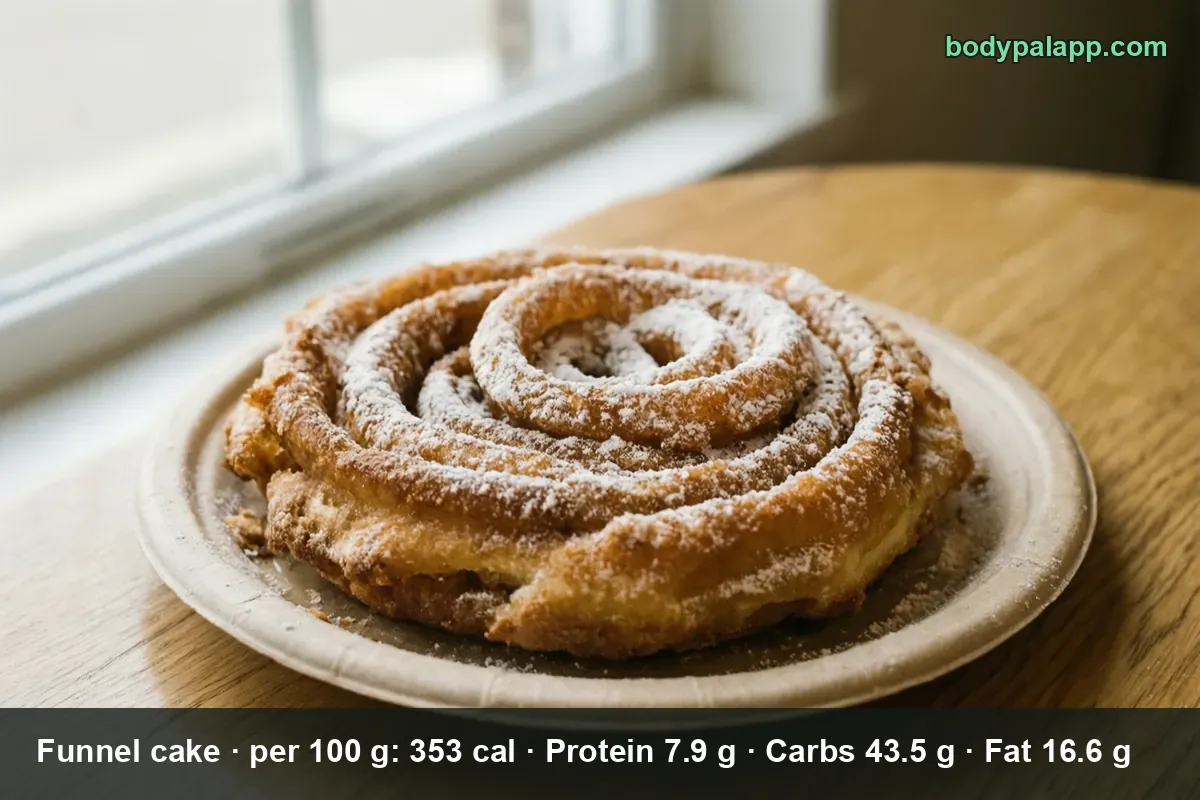
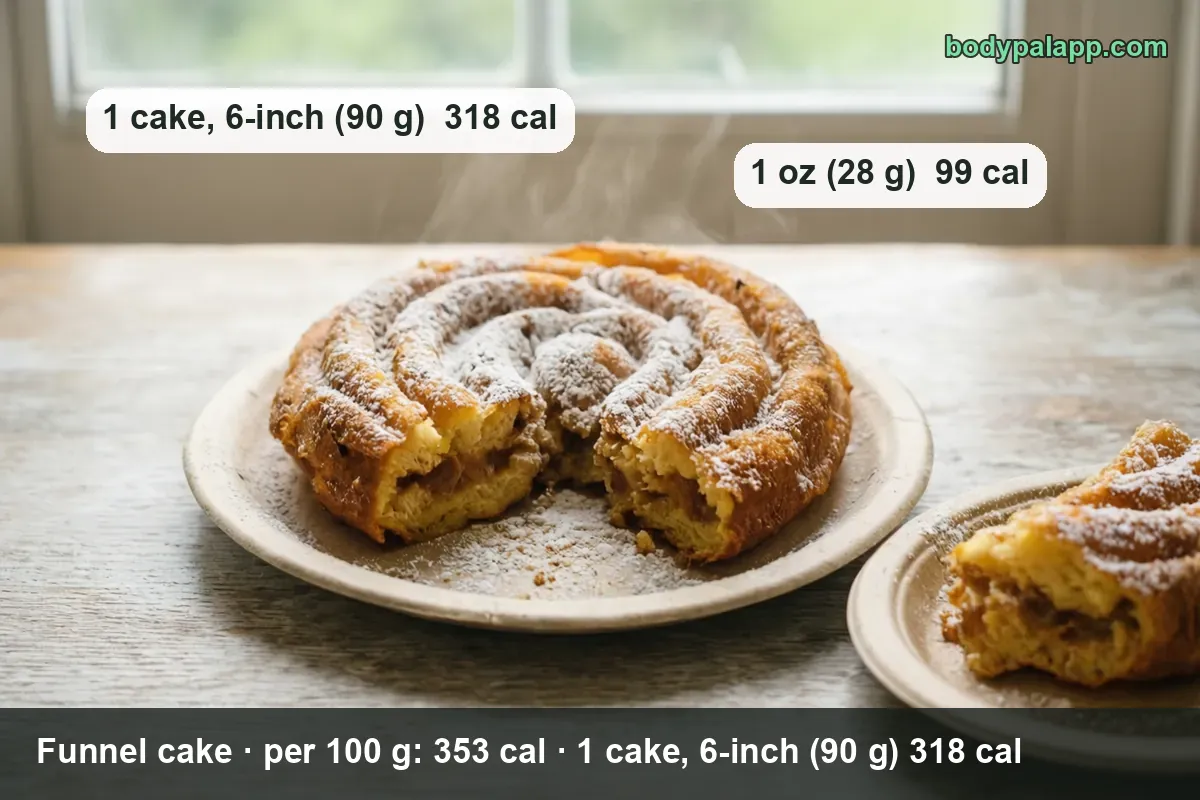
A funnel cake with powdered sugar is 318 calories for the 6-inch cake USDA weighs at 90 g, and 353 per 100 g. Split one two ways and your half is 159. An ounce of it is 99. The version that arrives under strawberries and cream is 513, and the reason is weight rather than width.
On this page
- Funnel cake quick facts
- The 6-inch cake that weighs 90 grams
- US servings, ounce by ounce
- Fruit on top adds 195 calories
- Boxed cakes and funnel cake sticks
- Fat carries 42% of the calories
- The sodium in a sugared dessert
- How does funnel cake compare?
- Most popular funnel cake brands
- FAQ
Funnel cake quick facts
Everything here comes from one USDA survey record: FNDDS 2708349, "Funnel cake with sugar", filed under doughnuts, sweet rolls and pastries. It describes the thing people mean by the phrase — batter poured in ribbons into hot oil, fried into a tangled disc, snowed with powdered sugar and handed over on a paper plate.
The serving column is USDA's own household measure for that record: one 6-inch cake, 90 g.
| Nutrient | Per 100 g | Per 1 cake, 6-inch (90 g) | % Daily Value |
|---|---|---|---|
| Calories | 353 | 318 | — |
| Total fat | 16.57 g | 14.9 g | 19% |
| Saturated fat | 3.12 g | 2.8 g | 14% |
| Carbohydrate | 43.49 g | 39.1 g | 14% |
| Dietary fiber | 1.0 g | 0.9 g | 3% |
| Total sugars | 15.87 g | 14.3 g | — |
| Protein | 7.87 g | 7.1 g | 14% |
| Sodium | 278 mg | 250 mg | 11% |
% Daily Value is based on a 2,000-calorie diet.
Verified nutrition data
Numbers on this page come from USDA FoodData Central, the U.S. Department of Agriculture’s food composition database, and from manufacturer labels where a branded product is named. Last verified September 2026. How we verify our data →
Two rows a packaged label would print are missing, and that is deliberate. This edition of the USDA survey database carries no added sugars figure and no trans fat figure for any of its prepared dishes, so there is nothing to quote. Borrowing either from a store label would mean stapling one food's numbers onto another food's record. Total sugars, meanwhile, carry no Daily Value on a US label at all, which is why that cell is blank rather than zero.
The same record holds two figures that sit outside the core label. Cholesterol is 64 mg per 100 g, about 21% of the 300 mg Daily Value, which is high for a dessert and comes from the eggs in the batter. Potassium is 174 mg per 100 g, 4% of the day, and does nothing for anybody.
The 6-inch cake that weighs 90 grams
Here is the trap, and it is unusual enough to be worth the whole section.
USDA uses the identical household measure — "1 cake, 6-inch" — for both funnel cake records it holds. For the plain sugared cake that measure weighs 90 g. For the version with fruit it weighs 135 g. Same stated diameter, 45 g more food, 195 more calories, because a topping sits on top of the cake instead of spreading it wider.
So the inch figure tells you almost nothing. A cake described as 6 inches can be a 318-calorie item or a 513-calorie one depending on what is piled on it, and neither number moves the ruler.
The second half of the problem is the fair itself. The cakes sold at a state fair or a boardwalk stand are routinely 8 to 10 inches across and heavier than USDA's reference cake, and there is no USDA record for one. This page will not invent a figure for it. What it can do is give you the unit that scales cleanly: one ounce is 99 calories. Weigh the cake, or estimate against the 90 g reference in your hand, and multiply from there. Half a cake — the way most of them are actually eaten, torn apart between two people — is 159 calories, with 7.5 g of fat, 19.6 g of carbohydrate and 3.5 g of protein.
Ask about the weight. The diameter is decoration.
US servings, ounce by ounce
| Serving | Weight | Calories |
|---|---|---|
| 1 oz | 28 g | 99 |
| Half a 6-inch cake, shared | 45 g | 159 |
| USDA reference amount | 70 g | 247 |
| 1 cake, 6-inch | 90 g | 318 |
| 100 g | 100 g | 353 |
Five ways to land on the same food, spanning 99 to 353 calories. Nothing about the recipe changes across those rows; only how much of it reaches you does. Only the 6-inch cake and the 70 g reference amount are USDA's own measures; the ounce, the half and the 100 g line are our own scaling of the same per-100-g record.
There is no raw-versus-cooked question on this page, unlike ground beef or rice, because a funnel cake only exists after the fryer and nobody eats the batter. The size question replaces it, and it is worth just as much. A person who logs "1 funnel cake" without a weight is guessing across a range of more than three to one.
Fruit on top adds 195 calories
The second USDA record, FNDDS 2708350, "Funnel cake with sugar and fruit", is the strawberry-and-glaze version every stand sells alongside the plain one.
| Nutrient | Per 100 g | Per 1 cake, 6-inch (135 g) | % Daily Value |
|---|---|---|---|
| Calories | 380 | 513 | — |
| Total fat | 15.70 g | 21.2 g | 27% |
| Saturated fat | 2.76 g | 3.7 g | 19% |
| Carbohydrate | 55.18 g | 74.5 g | 27% |
| Dietary fiber | 0.9 g | 1.2 g | 4% |
| Total sugars | 21.26 g | 28.7 g | — |
| Protein | 5.84 g | 7.9 g | 16% |
| Sodium | 211 mg | 285 mg | 12% |
Per 100 g the jump looks mild: 353 to 380, under 8%. Per cake it is 318 to 513.
The composition is the giveaway. Carbohydrate climbs from 43.49 g to 55.18 g per 100 g and total sugars from 15.87 g to 21.26 g, while fiber goes down, from 1.0 g to 0.9 g. Real fruit raises fiber. This does the opposite, which tells you the topping is mostly sweetened glaze and syrup with fruit suspended in it.
Protein falls too, 7.87 g to 5.84 g per 100 g, for the plain reason that the added weight contains none. The fried dough underneath is unchanged. Everything different about the fruit version is the layer on top.
Boxed cakes and funnel cake sticks
The supermarket freezer sells the same idea in smaller objects, and the labels look flattering until you read which column they are in.
| Version | Per 100 g | Serving | Calories |
|---|---|---|---|
| Fair-style cake with sugar (this page) | 353 | 1 cake, 6-inch (90 g) | 318 |
| Packaged snack cake | 319 | 1 cake (69 g) | 220 |
| Funnel cake sticks, or funnel cake fries | 296 | 9 sticks (54 g) | 160 |
Per 100 g the packaged cake is 319 and the sticks are 296, roughly 10% and 16% under the fair cake. That reads like a lighter recipe. It is not much of one: a boxed cake weighs 69 g against the fair cake's 90 g, and nine sticks weigh 54 g. The gap you see on the label is a portion, not a formula.
The sticks are the shape worth being careful with. Nine of them is 160 calories, which is genuinely modest, and they come out of a bag that holds several servings and gives you no reason to stop at nine. The fair cake at least ends.
Sodium runs the other way, and hard: the packaged cake carries 435 mg per 100 g and the sticks 407 mg, against 278 mg for the fair version. Whatever the freezer aisle saves you in calories, it charges back in salt.
Fat carries 42% of the calories
Multiply the fat by nine and the picture resolves. Per 100 g, 16.57 g of fat is 149 of the 353 calories — 42% of the food, arriving as oil.
That is the signature of deep frying, and it separates funnel cake from things that look identical on a calorie chart. Pan dulce, a baked Mexican sweet bread, reaches almost exactly the same 367 calories per 100 g with 11.6 g of fat. Same energy, five grams less fat per 100 g, because an oven does not add any.
Saturated fat is the more forgiving row here. A 6-inch cake holds 2.8 g, 14% of the 20 g FDA Daily Value, and the cake itself is about 16% of a 2,000-calorie day. Those two percentages sit close together, which is not what most deep-fried sweets do. The Dietary Guidelines for Americans put the ceiling for saturated fat under 10% of daily calories, roughly 22 g on a 2,000-calorie day, and one funnel cake spends about an eighth of it.
The frying oil, in other words, is the calorie story and not the saturated fat story. If you want the number to come down, the lever is the weight of the cake.
The sodium in a sugared dessert
A 6-inch funnel cake carries 250 mg of sodium, 11% of the 2,300 mg Daily Value, from 278 mg per 100 g.
Nobody guesses that. It is a dessert dusted in powdered sugar, and it quietly spends a ninth of the day's sodium before anything savory turns up. The source is not the sugar but the leavening — baking powder and baking soda are sodium compounds, and a batter that has to puff the instant it hits oil needs plenty of both.
Set against it, the fiber does nothing: 0.9 g in a cake, 3% of the 28 g Daily Value. That ratio, 11% of the sodium against 3% of the fiber, is the honest shape of this food. It sits in the MyPlate grain group the way a slice of white bread does, refined flour throughout, and contributes no more than that.
Protein is the one row that behaves better than expected. A cake gives 7.1 g, 14% of the day, which is more than most fried sweets carry and comes from the eggs and milk in a batter thin enough to pour.
How does funnel cake compare?
| Item | Per 100 g | Serving | Calories | Protein / Carbs / Fat |
|---|---|---|---|---|
| Funnel cake with sugar (this page) | 353 | 1 cake, 6-inch (90 g) | 318 | 7.1 / 39.1 / 14.9 g |
| Doughnut, custard-filled | 363 | 1 doughnut (80 g) | 290 | 4.2 / 34.3 / 15.1 g |
| Pan dulce, no topping | 367 | 1 medium (76 g) | 279 | 7.2 / 42.8 / 8.8 g |
| Cream puff, no filling or icing | 360 | 1 cream puff (27 g) | 97 | 2.4 / 6.2 / 7.0 g |
| Sopaipilla with syrup or honey | 361 | 1 sopaipilla, 1½ in (12 g) | 43 | 0.5 / 6.2 / 2.0 g |
All five are USDA survey records from the same pastry family, and the per-100-g column is nearly flat: 353 to 367, a spread of 4%. By density these are the same food. By serving they run from 43 calories to 318, a spread of more than seven to one, and every bit of that is the size of the object. A sopaipilla is 12 g. A funnel cake is 90 g and up.
Our take: funnel cake is the largest number on this list because it is the largest thing on it, not because it is richer, and the fix is the one that works at any fair — share it, and log 159. If you want a pastry with the best return on its calories, pan dulce carries 7.2 g of protein for 279 calories with 8.8 g of fat, the least fat per gram on this list by a wide margin, because it is baked. The custard doughnut is the one to skip if fat is what you track: 15.1 g in a smaller 80 g object than the funnel cake's 14.9 g in 90 g.
Most popular funnel cake brands in the United States
Ranked by how widely each product appears among foods sold in the United States, from the BodyPal food database of over 3.3 million products. Calories are the figures printed on each Nutrition Facts label, checked against USDA FoodData Central.
| Product | Calories (per 100 g) |
|---|---|
| Hostess Funnel Cake | 319 cal |
| Great Value Funnel Cake Sticks | 296 cal |
Brand popularity: BodyPal food database. Nutrition: manufacturer labels / USDA FoodData Central.
Funnel cake FAQs
How many calories are in a funnel cake?
318 calories in a 6-inch funnel cake with powdered sugar, weighing 90 g, which is 353 calories per 100 g. That serving carries 14.9 g of fat, 39.1 g of carbohydrate, 14.3 g of total sugars, 7.1 g of protein and 250 mg of sodium. One ounce is 99 calories.
How many calories in a funnel cake with powdered sugar?
318 calories. The USDA record behind this page, "Funnel cake with sugar", already includes the dusting, so the powdered sugar is inside the 353 calories per 100 g rather than on top of it. Total sugars come to 14.3 g in a 90 g cake, most of it from the batter and the coating together.
How many calories in a funnel cake from the fair?
At least 318, and often more, because fair cakes run 8 to 10 inches across while USDA's reference cake is 6 inches and 90 g. There is no USDA record for the larger size, so no honest figure exists for it. Scale from the per-ounce number instead: 1 oz is 99 calories, and 100 g is 353.
How many calories in half a funnel cake?
159 calories for 45 g, half of the 6-inch reference cake. That half carries 7.5 g of fat, 19.6 g of carbohydrate and 3.5 g of protein. Splitting one is the single largest saving available on this food, worth more than choosing a different pastry at the same stand.
How many calories in funnel cake sticks or funnel cake fries?
160 calories for nine sticks, a 54 g serving, at 296 calories per 100 g. Per 100 g that is about 16% under the fair-style cake's 353, but the real difference is the portion: 54 g against 90 g. Sodium goes the other way, 407 mg per 100 g against 278 mg.
How much sugar is in a funnel cake?
14.3 g of total sugars in a 90 g cake, from 15.87 g per 100 g. The fruit-topped version reaches 28.7 g in a 135 g cake. Total sugars carry no Daily Value on a US label, and the USDA survey edition holds no added sugars figure for this dish, so the split between batter sugar and dusting is not published.
Funnel cake or a doughnut — which has more calories?
The funnel cake, at 318 against 290 for a custard-filled doughnut, though the doughnut is denser per 100 g at 363 against 353. The gap is size: 90 g of funnel cake against an 80 g doughnut. The funnel cake wins clearly on protein, 7.1 g against 4.2 g.
Are funnel cakes bad for you?
A 6-inch cake is 318 calories, 16% of a 2,000-calorie day, with 2.8 g of saturated fat (14% of the Daily Value), 14.3 g of sugars, 250 mg of sodium and 0.9 g of fiber. Fat supplies 42% of the calories, which is what deep frying does. It is a dessert, priced like one, and a shared half is 159.
Similar foods
- Butter Biscuit — 212 cal per biscuit
- Black Rice — 160 cal per 1/4 cup
- Cake Pop — 210 cal per cake pop
- Garlic Bread — 143 cal per slice
- Garlic Knot — 133 cal per garlic knot
- Cake With Icing — 413 cal per slice, 1 layer cake
Count it without the math
Point the camera at the paper plate and BodyPal tells the whole cake from the half you actually ate.


How long does it take to burn off funnel cake?
A 6-inch cake (90 g) is 318 kcal. Enter your weight and the amount you ate to see how long it takes you to burn that off:
lb
| Activity | Time to burn 318 kcal |
|---|---|
| Walking, brisk | 1 hr 4 min |
| Cycling, moderate | 40 min |
| Swimming, moderate | 45 min |
| Jogging | 37 min |
| Weight training, moderate | 1 hr 11 min |
Times are for a 155 lb adult at a steady pace; change the weight to see yours. The amount is set to the portion in the text (90 g); change it to what you actually ate. BodyPal works this out from your steps automatically.
Burning it off is one side of it. The other is knowing your number: work out how many calories you need a day, with macros and a goal date.