
How many calories are in a slice of cake with icing?
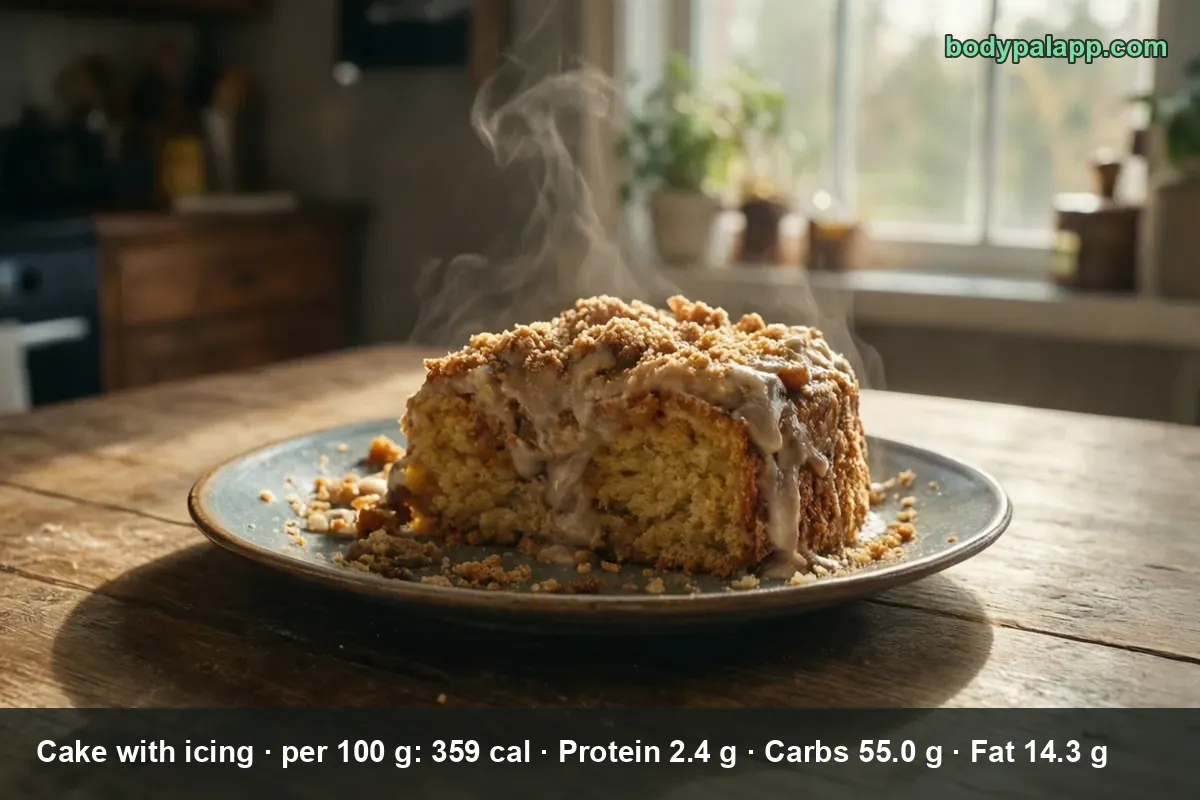
A regular bakery slice of white cake with white icing weighs 115 g and carries 413 calories. Per 100 g the frosted cake runs 359 calories, most of it sugar and fat: 41.26 g of sugars and 14.33 g of fat in every 100 g. A large slice pushes past 600.
On this page
- Cake with icing quick facts
- US servings, from one ounce to a two-layer slice
- White, chocolate, bakery or from a mix
- What the icing actually costs
- Sugar, sodium and the rows that surprise people
- How does cake with icing compare?
- Most popular cake icing brands
- FAQ
Cake with icing quick facts
The record that matches what most people are actually holding is FNDDS 2707891, "Cake or cupcake, white with white icing, bakery". That is a finished slice from a bakery case or a grocery store display, not a box of mix and not a naked sponge. USDA lists a regular slice of a one-layer cake at 115 g, and that is the serving this page runs on.
There are seven other iced cake records in the same database, and they differ by the batter and the frosting, not by the source of the data. All of them sit between 341 and 359 calories per 100 g, so the choice of record moves the answer by less than 20 calories per 100 g. The size of your slice moves it by hundreds.
| Nutrient | Per 100 g | Per 1 slice (115 g) | % Daily Value |
|---|---|---|---|
| Calories | 359 | 413 | — |
| Total fat | 14.33 g | 16.5 g | 21% |
| Saturated fat | 2.82 g | 3.2 g | 16% |
| Carbohydrate | 54.95 g | 63.2 g | 23% |
| Dietary fiber | 0.4 g | 0.5 g | 2% |
| Total sugars | 41.26 g | 47.4 g | — |
| Protein | 2.4 g | 2.8 g | 6% |
| Sodium | 313 mg | 360 mg | 16% |
% Daily Value is based on a 2,000-calorie diet.
Verified nutrition data
Numbers on this page come from USDA FoodData Central, the U.S. Department of Agriculture’s food composition database, and from manufacturer labels where a branded product is named. Last verified September 2026. How we verify our data →
Two rows you would see on a store label are missing here on purpose: USDA does not publish added sugars or trans fat for this record, so there is nothing honest to put in those cells. Total sugars have no Daily Value at all, which is why that cell shows a dash. The slice also carries 49 mg of cholesterol, 16% of the 300 mg Daily Value, and 49 mg of potassium, which is 1% of 4,700 mg — a dessert built on flour, sugar and shortening has almost no potassium in it. The %DV column follows the FDA Daily Values for a 2,000-calorie day.
US servings, from one ounce to a two-layer slice
| Serving | Weight | Calories |
|---|---|---|
| 1 oz | 28 g | 102 kcal |
| One regular cupcake, iced | 90 g | 323 kcal |
| One regular slice, one-layer cake | 115 g | 413 kcal |
| One large slice, one-layer cake | 170 g | 610 kcal |
| One regular slice, two-layer cake | 175 g | 628 kcal |
| Per 100 g | 100 g | 359 kcal |
Everything except the ounce row is a USDA household measure for this record, which is why the weights look uneven: a "regular" slice of a two-layer cake is 175 g, heavier than a large slice of a single-layer cake at 170 g, because the second layer and the filling of frosting between them ride along. The 1 oz row is our own arithmetic from the USDA 100 g figure, not a USDA serving.
That is the trap on a birthday table. Nobody cuts by weight, and the difference between the slice you meant to take and the one that landed on your plate is 215 calories — 413 against 628 — for cake that came out of the same kitchen. If you want a number you can log without weighing anything, use 413 for a normal wedge and 610 for the corner piece with the extra frosting on two sides.
White, chocolate, bakery or from a mix
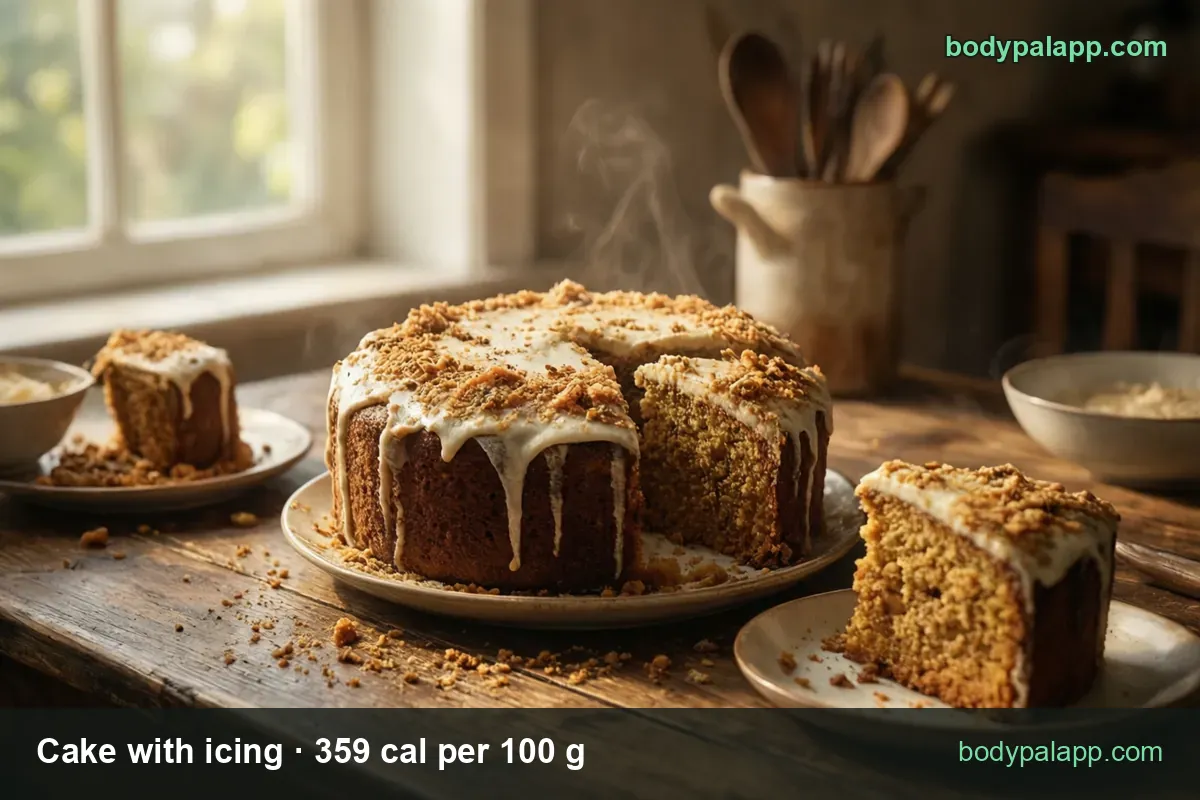
| Version | Per 100 g | Typical piece | Calories |
|---|---|---|---|
| White cake, white icing, bakery | 359 kcal | one slice, 115 g | 413 kcal |
| Chocolate cake, white icing, bakery | 355 kcal | one slice, 115 g | 408 kcal |
| White cake, chocolate icing, bakery | 349 kcal | one slice, 115 g | 401 kcal |
| White cake, white icing, from mix | 353 kcal | one slice, 100 g | 353 kcal |
| Chocolate cake, white icing, from mix | 349 kcal | one slice, 100 g | 349 kcal |
| White cake, chocolate icing, from mix | 345 kcal | one slice, 100 g | 345 kcal |
Chocolate does not make cake heavier. The chocolate-and-white-icing slice comes in at 355 calories per 100 g against 359 for the plain white version, and the darkest option in the database — chocolate cake with chocolate icing, bakery — is the lightest bakery record of the group at 345. Cocoa powder displaces some of the sugar, and the numbers follow.
Every from-mix record is lighter than its bakery twin, but only by 4 to 6 calories per 100 g. That is a rounding error next to slice size, so a homemade cake is not a lower-calorie cake. It is the same cake, cut by someone who can see the whole thing.
Where chocolate does change the label is saturated fat and fiber. Chocolate icing pushes saturated fat from 2.82 g to 3.96 g per 100 g on a white cake, and to 4.12 g on chocolate-on-chocolate. Fiber goes the other way in your favor: 1.6 to 1.7 g per 100 g for double-cocoa versions against 0.4 g for white cake. Still small, but four times as much.
What the icing actually costs
This is the number nobody publishes. The same white cake without icing is 310 calories per 100 g with 23.39 g of sugars. Add the white frosting and you get 359 calories and 41.26 g of sugars. So the icing is worth about 49 calories and nearly 18 g of extra sugar per 100 g of finished cake — call it about 56 calories on a 115 g slice, using our own arithmetic from the two USDA 100 g figures rather than a USDA serving.
Scraping the frosting off is therefore worth roughly one-seventh of the slice, not half of it. Cutting a smaller piece beats scraping, every time.
Packaged icing on its own tells the same story from the other end. USDA's branded database has no packaged frosted cakes in it, only tubs and tubes of decorating icing: the common white, pink and black decorating icings all list 417 calories per 100 g, which works out to 25 calories for a 1 tsp (6 g) label serving, while a fondant-style icing runs 400 calories per 100 g and 140 for a 2 Tbsp (35 g) serving. A softer tub-style decorating icing lands lower, at 343 per 100 g and 120 calories for its 2 Tbsp serving. Piping a name across a sheet cake costs almost nothing; the layer under the whole surface is what shows up in the totals above.
Sugar, sodium and the rows that surprise people
A 115 g slice carries 47.4 g of total sugars. USDA does not split that into natural and added sugars for this record, so no honest comparison against the 50 g added-sugars Daily Value is possible from this data — but the Dietary Guidelines for Americans advise keeping added sugars under 10% of daily calories, and a frosted cake is one of the clearest places that budget goes.
The row that actually catches people off guard is sodium. A dessert slice delivers 360 mg, or 16% of the 2,300 mg Daily Value — about a sixth of a day's sodium from something sweet. That is the baking soda, baking powder and salt in the batter doing their job, not a seasoning choice. If you are watching sodium closely and want something sweet, a piece of fruit or a plain cookie is the better pick.
Fiber and protein are where the slice gives back nothing: 0.5 g of fiber (2% DV) and 2.8 g of protein (6% DV) for 413 calories. MyPlate treats cake as a source of added sugars and saturated fat rather than a food group, and the numbers back that up. Practically: if you want the slice, plan for it and build the rest of the day around it. If you want to feel full, this is not the food that does it.
How does cake with icing compare?
| Cake | Per 100 g | US serving | Calories |
|---|---|---|---|
| Cake with icing, white, bakery | 359 kcal | 1 oz (28 g) | 102 kcal |
| Red velvet cake | 355 kcal | 1 oz (28 g) | 101 kcal |
| Pound cake | 353 kcal | 1 oz (28 g) | 100 kcal |
| Chocolate cake, no icing | 303 kcal | 1 oz (28 g) | 86 kcal |
The ounce column is our own arithmetic from the USDA 100 g figures, so every cake is measured the same way instead of by whatever slice its record happens to use.
Our take: among these four, only the unfrosted chocolate cake is meaningfully lighter, and it wins by 56 calories per 100 g. Red velvet and pound cake land within 6 calories per 100 g of an iced white cake, which means picking between them is a flavor decision, not a calorie decision. If you are cutting calories, cut the slice — going from 175 g to 115 g saves 215 calories, more than three times what you save by switching to the lightest cake on this table. If you want the frosting, take it and take less cake.
Most popular cake icing brands in the United States
Ranked by how widely each product appears among foods sold in the United States, from the BodyPal food database of over 3.3 million products. Calories are the figures printed on each Nutrition Facts label, checked against USDA FoodData Central.
| Product | Calories (per 100 g) |
|---|---|
| Betty Crocker Decorating Cake Icing | 343 cal |
| Betty Crocker Cake Icing White | 417 cal |
| Great Value White Decorating Cake Icing | 417 cal |
| Cake Mate Pink Cake Icing | 417 cal |
| Cake Boss Fabulous Fondant Cake Icing | 400 cal |
| Betty Crocker Cake Icing Black | 417 cal |
Brand popularity: BodyPal food database. Nutrition: manufacturer labels / USDA FoodData Central.
Cake with icing FAQs
How many calories are in a slice of cake with icing?
413 calories for a regular 115 g slice of white cake with white icing from a bakery, at 359 calories per 100 g. That slice also carries 47.4 g of sugars, 16.5 g of fat and 360 mg of sodium. A large 170 g slice comes to 610 calories.
How many calories does the icing add to cake?
About 49 calories per 100 g of finished cake. Unfrosted white cake is 310 calories per 100 g against 359 with white icing, and sugars climb from 23.39 g to 41.26 g. On a 115 g slice that is roughly 56 calories, using our own arithmetic from the USDA figures.
How many calories are in a large slice of layer cake with frosting?
610 calories for a large 170 g slice of a one-layer cake, and 628 calories for a regular 175 g slice cut from a two-layer cake. Both are USDA household measures for the same bakery record, and both are at least 197 calories above a regular 115 g slice.
How much sugar is in cake with icing?
47.4 g of total sugars in a 115 g slice, or 41.26 g per 100 g. USDA does not publish added sugars for this record, so there is no split between the sugar in the batter and the sugar in the frosting. Total sugars carry no Daily Value on a US label.
Is chocolate cake with icing higher in calories than white cake with icing?
No. Chocolate cake with white icing is 355 calories per 100 g against 359 for white cake with white icing, and chocolate cake with chocolate icing is the lightest bakery version at 345. Cocoa displaces sugar, so the darker cake reads slightly lower on every bakery record.
How many calories are in a cupcake with icing?
323 calories for one regular iced cupcake weighing 90 g, using the same 359 calories per 100 g. That is 90 calories less than a regular 115 g slice, though a bakery cupcake with a tall swirl of frosting weighs more than 90 g and will run higher.
Does bakery cake have more calories than cake from a mix?
Slightly. Bakery white cake with white icing is 359 calories per 100 g and the from-mix version is 353. The same 4 to 6 calorie gap per 100 g shows up across all four batter-and-icing combinations, which is far too small to matter next to how big you cut the slice.
How much sodium is in a slice of frosted cake?
360 mg in a 115 g slice, which is 16% of the 2,300 mg Daily Value, from 313 mg per 100 g. It comes from the baking soda, baking powder and salt in the batter. A large 170 g slice takes that to roughly 532 mg by our own arithmetic.
Similar foods
- Cupcake — 323 cal per cupcake
- Cupcake With Frosting — 323 cal per cupcake
- Boston Cream Donut — 307 cal per doughnut, oval
- Bread Flour — 495 cal per cup
- Black Rice — 160 cal per 1/4 cup
- Butter Biscuit — 212 cal per biscuit
Count it without the math
Point the camera at the plate and BodyPal counts the slice for you, frosting and all.


How long does it take to burn off 413 kcal of cake with icing?
One slice (115 g) is 413 kcal. Enter your weight and the amount you ate to see how long it takes you to burn that off:
lb
| Activity | Time to burn 413 kcal |
|---|---|
| Walking, brisk | 1 hr 23 min |
| Cycling, moderate | 52 min |
| Swimming, moderate | 59 min |
| Jogging | 49 min |
| Weight training, moderate | 1 hr 32 min |
Times are for a 155 lb adult at a steady pace; change the weight to see yours. The amount is set to the portion in the text (115 g); change it to what you actually ate. BodyPal works this out from your steps automatically.
One food is easy to picture; a whole day is harder. See how many calories you need a day and what a deficit actually looks like.