
How many calories are in a Boston cream donut?
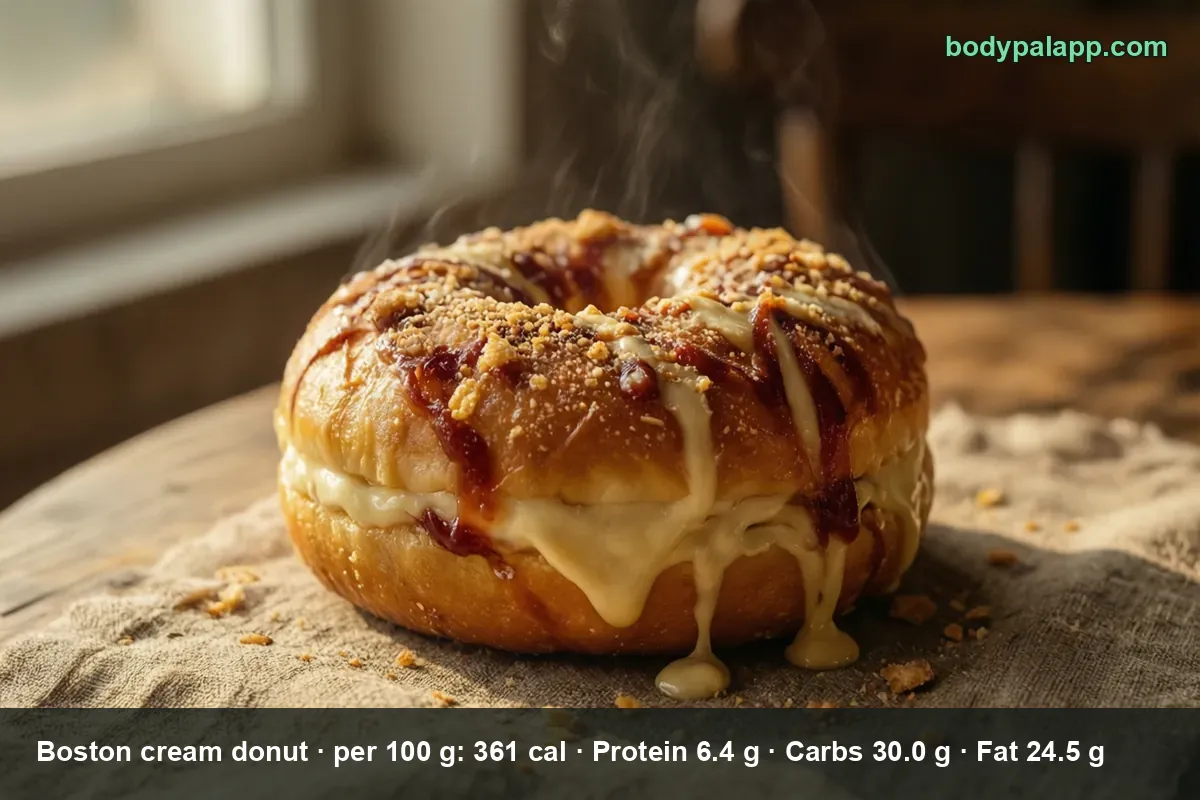
One bakery-size Boston cream donut weighs 85 g and carries 307 calories. Per 100 g the creme-filled yeast doughnut runs 361 calories. Fat does most of the work here, not sugar: 20.8 g in the piece against 12.4 g of total sugars. A packaged supermarket version is smaller and lands near 170.
On this page
- Boston cream donut quick facts
- US servings, from one ounce to two donuts
- Glazed, jelly-filled and the store package
- Saturated fat and sodium are the rows to watch
- How does a Boston cream donut compare?
- Most popular boston cream donut brands
- Boston cream donut FAQs
Boston cream donut quick facts
The record behind every number on this page is SR Legacy 172757, "Doughnuts, yeast-leavened, with creme filling". That is the only yeast-raised doughnut with a creme filling in the database, and it is exactly what a person means by a Boston cream donut: a soft raised shell, pastry cream inside, a sweet topping on the crown. The glazed records describe a different pastry with no filling at all, so pulling numbers from them would understate the fat by a wide margin.
The USDA household measure attached to this record is one oval doughnut, 3-1/2 by 2-1/2 inches, at 85 g. That is the bakery-counter size, the one that leaves cream on your thumb.
| Nutrient | Per 100 g | Per 1 doughnut (85 g) | % Daily Value |
|---|---|---|---|
| Calories | 361 | 307 | — |
| Total fat | 24.5 g | 20.8 g | 27% |
| Saturated fat | 5.43 g | 4.6 g | 23% |
| Carbohydrate | 30 g | 25.5 g | 9% |
| Dietary fiber | 0.8 g | 0.7 g | 2% |
| Total sugars | 14.55 g | 12.4 g | — |
| Protein | 6.4 g | 5.4 g | 11% |
| Sodium | 309 mg | 263 mg | 11% |
% Daily Value is based on a 2,000-calorie diet.
Verified nutrition data
Numbers on this page come from USDA FoodData Central, the U.S. Department of Agriculture’s food composition database, and from manufacturer labels where a branded product is named. Last verified September 2026. How we verify our data →
Two rows you would expect on a package label are missing here. USDA does not publish added sugars or trans fat for this SR Legacy record, so both are left out rather than guessed at. Total sugars have no Daily Value of their own, which is why that cell is a dash. Cholesterol comes to 20 mg per doughnut (7% DV) and potassium to 68 mg (1% DV), from 24 mg and 80 mg per 100 g.
One more thing worth saying plainly. This record is a plain creme-filled raised doughnut, matching a shop version topped with a sweet glaze rather than a slab of chocolate frosting. USDA publishes no separate chocolate-frosted creme-filled entry, so nothing on this page has been scaled up for chocolate.
US servings, from one ounce to two donuts
| Serving | Weight | Calories |
|---|---|---|
| 1 oz | 28 g | 102 kcal |
| Half a doughnut | 42.5 g | 153 kcal |
| One doughnut, oval bakery size | 85 g | 307 kcal |
| Two doughnuts | 170 g | 614 kcal |
| Per 100 g | 100 g | 361 kcal |
Only the 85 g oval is a USDA household measure. The ounce, the half and the pair are our own arithmetic from the USDA 100 g figure, scaled straight from 361 calories per 100 g.
That second row is the useful one. Cutting the doughnut in half and leaving the second piece is a 154-calorie decision, bigger than most people expect from a single pastry, and it takes the fat down from 20.8 g to 10.4 g at the same time. Two doughnuts with coffee is 614 calories, which is a full meal's worth of energy with 0.7 g of fiber per piece to show for it.
Weight is where this food plays tricks. A donut is mostly air by volume and dense by mass, so eyeballing it does not work. If you have a kitchen scale, weigh one once and you will know your bakery's size for good; most cake-counter ovals land between 70 g and 90 g, and the 85 g USDA figure sits in the upper half of that range.
Glazed, jelly-filled and the store package
| Version | Per 100 g | Typical piece | Calories |
|---|---|---|---|
| Boston cream, bakery oval | 361 kcal | 85 g | 307 kcal |
| Half a Boston cream donut | 361 kcal | 42.5 g | 153 kcal |
| Glazed doughnut, enriched | 421 kcal | 1 medium, 60 g | 253 kcal |
| Jelly-filled doughnut | 340 kcal | 1 oval, 85 g | 289 kcal |
| Glazed, unenriched flour | 403 kcal | 1 medium, 60 g | 242 kcal |
| Target Boston Cream Donuts | 340 kcal | 1 donut, 50 g | 170 kcal |
| Archer Farms Boston Cream Donuts | 312 kcal | 1 donut, 48 g | 150 kcal |
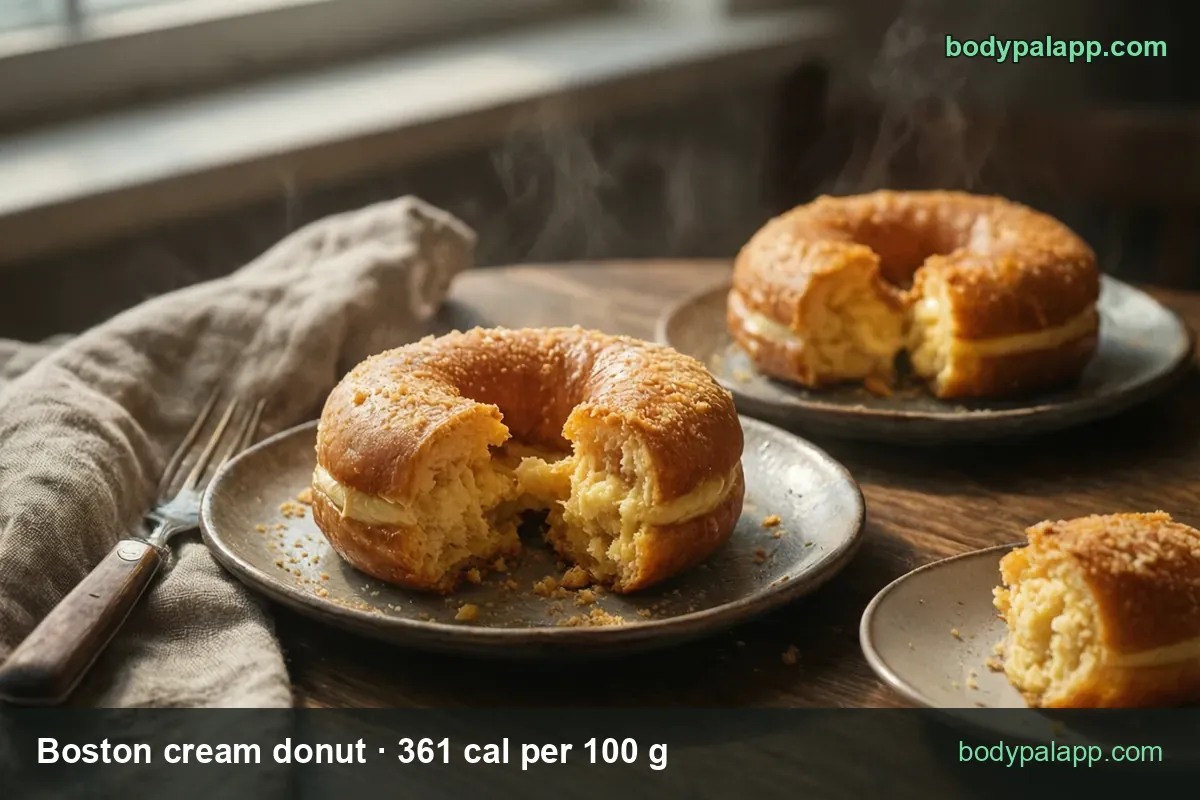
The packaged rows are the ones that change how you log this. A Target Boston Cream Donut is 50 g and 170 calories; the Archer Farms box works out to 150 for a 48 g donut. Same name, same filling, roughly half the calories of the bakery oval, purely because the piece is smaller. If you log "boston cream donut" from a generic list after eating one out of a plastic clamshell, you are probably overstating your day by well over 100 calories.
The jelly-filled doughnut is the closest sibling in shape and size: same 85 g oval, 289 calories, 18 fewer than the cream version. Jelly is sweeter but lighter, 21.1 g of sugars per 100 g against 14.55 g, with 18.7 g of fat against 24.5 g. The trade is sugar for fat, and on calories the fat wins narrowly.
The unenriched glazed record exists because some doughnuts are made with flour that has not been fortified. At 403 calories per 100 g it is a shade lighter than the enriched glazed at 421, and it carries 1.2 g of fiber per 100 g instead of 2.1 g. For counting purposes the difference is small; for micronutrients it matters more than the calorie line suggests.
Saturated fat and sodium are the rows to watch
Calories are not the interesting part of this doughnut. Saturated fat is. One 85 g piece delivers 4.6 g, or 23% of the Daily Value published by the FDA, and the Dietary Guidelines for Americans suggest keeping saturated fat below 10% of daily calories. Nearly a quarter of that budget, spent before 9 a.m., on something that is not lunch.
Sodium is the row nobody checks on a dessert. This doughnut carries 263 mg, 11% of the 2,300 mg Daily Value, which is about a tenth of a teaspoon of table salt sitting quietly under the sugar. Raised dough needs salt for flavor and structure, so most doughnuts on this page land in the same range. The jelly-filled one is the outlier in the wrong direction: at 455 mg per 100 g, an 85 g jelly doughnut works out to roughly 387 mg, or 17% DV, by our own arithmetic from the USDA figure. If sodium is the number you track, the cream filling is the better of the two.
Fiber is the row that barely registers: 0.7 g per doughnut, 2% DV, the lowest of the four yeast-raised records USDA publishes. Protein is more respectable than the pastry's reputation suggests, 5.4 g and 11% DV, but it will not hold you. If you want a doughnut to be a snack rather than a hole in the day, pairing it with a protein source is the practical move — a scan of MyPlate protein foods will give you the cheap options.
How does a Boston cream donut compare?
| Doughnut | Per 100 g | US serving | Calories |
|---|---|---|---|
| Boston cream (creme-filled) | 361 kcal | 1 oval, 85 g | 307 kcal |
| Glazed, enriched | 421 kcal | 1 medium, 60 g | 253 kcal |
| Jelly-filled | 340 kcal | 1 oval, 85 g | 289 kcal |
| Glazed, unenriched | 403 kcal | 1 medium, 60 g | 242 kcal |
Our take: the Boston cream is the lightest of these four gram for gram apart from the jelly-filled, and yet it is the biggest calorie hit on the plate, because it pairs the largest piece size, 85 g, with the most fat. That is the whole story of this food. Per 100 g it has the fewest carbs of the four, 30 g against 47.93 g for the glazed, the least total sugars of the three records that report them, and the least sodium, 309 mg. It also has the most fat, 24.5 g, and that is what pushes an 85 g piece past a 60 g glazed by 54 calories.
So if you are choosing at the counter with weight loss in mind, a medium glazed at 253 is the smaller spend, and half a Boston cream at 153 is smaller still. If you want the one that feels like it was worth the calories, the cream-filled oval is the pick, because the fat and the 5.4 g of protein make it read as food rather than candy. What you should not do is treat "one donut" as a fixed number: between a 48 g packaged one and an 85 g bakery one, the same three words mean anything from 150 to 307 calories.
Most popular boston cream donut brands in the United States
Ranked by how widely each product appears among foods sold in the United States, from the BodyPal food database of over 3.3 million products. Calories are the figures printed on each Nutrition Facts label, checked against USDA FoodData Central.
| Product | Calories (per 100 g) |
|---|---|
| Target Boston Cream Donuts | 340 cal |
| Archer Farms Boston Cream Donuts | 312 cal |
Brand popularity: BodyPal food database. Nutrition: manufacturer labels / USDA FoodData Central.
Boston cream donut FAQs
How many calories are in a Boston cream donut?
307 calories in one bakery-size doughnut, an oval about 3-1/2 by 2-1/2 inches weighing 85 g. Per 100 g the USDA creme-filled yeast doughnut runs 361 calories. Most of that comes from fat: 20.8 g in the piece, which is 27% of a day's value.
How many calories in a Boston cream donut from a store package?
170 calories for a Target packaged Boston cream donut, which weighs 50 g, and 150 calories for the 48 g Archer Farms version. Both are much smaller than the 85 g bakery oval, so the same name on a label can mean 307 calories or roughly half that.
How many carbs are in a Boston cream donut?
25.5 g of carbohydrate in one 85 g doughnut, 9% of the Daily Value, of which 12.4 g is total sugars. Per 100 g it is 30 g. That is the lowest carb count of the four yeast-raised doughnut records USDA publishes; the glazed one has 47.93 g per 100 g.
How much sugar is in a Boston cream donut?
12.4 g of total sugars in one 85 g doughnut, from 14.55 g per 100 g. USDA does not publish added sugars for this record, so there is no percentage to give against the 50 g Daily Value. A glazed doughnut is sweeter, at 22.75 g of sugars per 100 g.
Is a Boston cream donut worse than a glazed donut?
Per 100 g the glazed doughnut is heavier, 421 calories against 361, but a medium glazed piece is 60 g and 253 calories, while the creme-filled oval is 85 g and 307. The cream brings more fat, 24.5 g per 100 g; the glaze brings more sugar and more carbs.
How much protein is in a Boston cream donut?
5.4 g of protein in one 85 g doughnut, 11% of the Daily Value, from 6.4 g per 100 g. That is real but modest for 307 calories, and it comes from the wheat flour and the creme filling. It is not enough on its own to keep you full until lunch.
How many calories in half a Boston cream donut?
153 calories for half of the 85 g bakery doughnut, which is 42.5 g. That figure is our own arithmetic from the USDA 100 g value, not a USDA serving. Halving it also cuts the fat to 10.4 g and the sodium to about 132 mg, roughly 6% of a day.
How much saturated fat is in a Boston cream donut?
4.6 g of saturated fat in one 85 g doughnut, 23% of the Daily Value, from 5.43 g per 100 g. The Dietary Guidelines for Americans suggest keeping saturated fat under 10% of daily calories, so a single doughnut uses a sizeable share of a 2,000-calorie day.
Similar foods
- Bread Flour — 495 cal per cup
- Cake With Icing — 413 cal per slice, 1 layer cake
- Cupcake — 323 cal per cupcake
- Cupcake With Frosting — 323 cal per cupcake
- Black Rice — 160 cal per 1/4 cup
- Butter Biscuit — 212 cal per biscuit
Count it without the math
Point the camera at the plate and BodyPal counts the donut for you, cream filling and all.


How long does it take to burn off 307 kcal of Boston cream donut?
One doughnut (85 g) is 307 kcal. Enter your weight and the amount you ate to see how long it takes you to burn that off:
lb
| Activity | Time to burn 307 kcal |
|---|---|
| Walking, brisk | 1 hr 1 min |
| Cycling, moderate | 38 min |
| Swimming, moderate | 44 min |
| Jogging | 36 min |
| Weight training, moderate | 1 hr 8 min |
Times are for a 155 lb adult at a steady pace; change the weight to see yours. The amount is set to the portion in the text (85 g); change it to what you actually ate. BodyPal works this out from your steps automatically.
This table assumes you know your daily total. If you do not, the daily calorie calculator works it out from five numbers.