
How many calories are in bread flour?
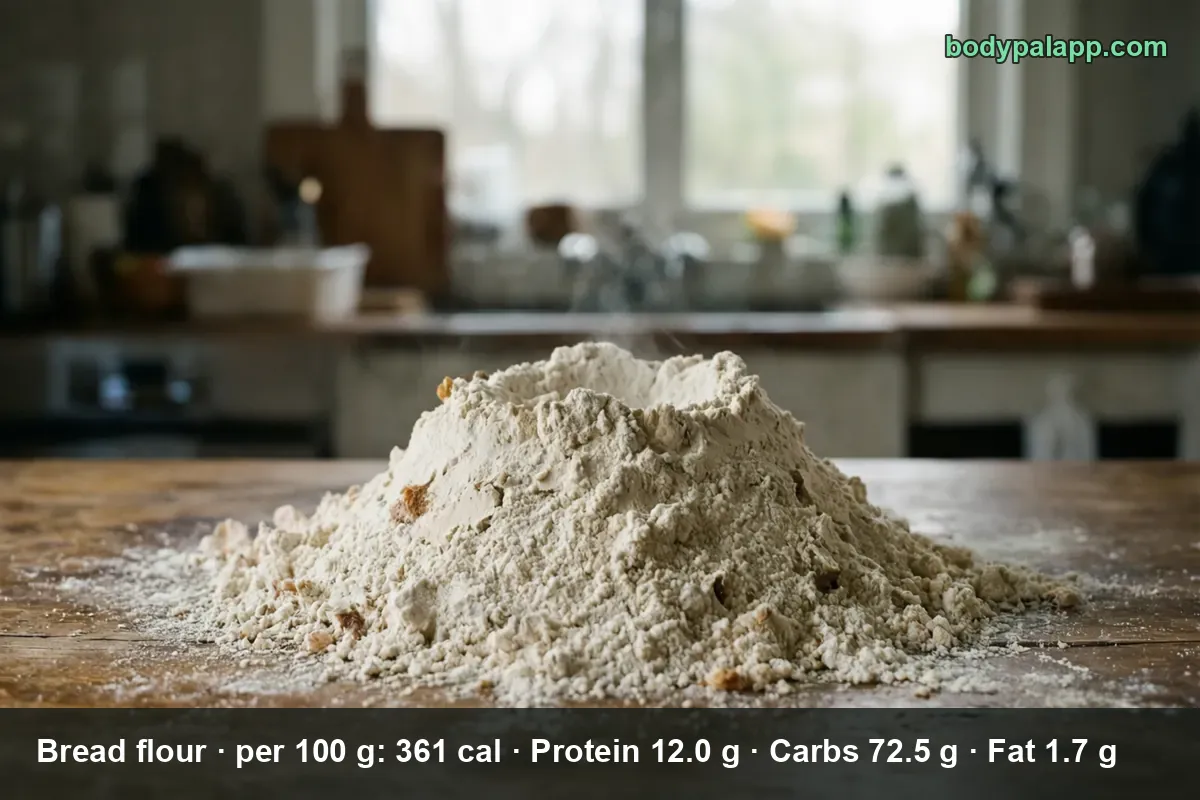
A cup of bread flour weighs 137 g and carries 495 calories. Per 100 g it runs 361 calories. Almost none of that weight is water, so the number climbs fast: 99.4 g of the cup is carbohydrate, 16.4 g is protein, and a quarter cup — what most recipes scoop at a time — is 123 calories.
On this page
- Bread flour quick facts
- Cups, quarter cups and ounces
- Enriched, unenriched and the Foundation sample
- From flour to a slice of bread
- Protein and carbs are the rows that move
- How does bread flour compare?
- Most popular bread flour brands
- Bread flour FAQs
Bread flour quick facts
The row behind every number here is SR Legacy 168896, "Wheat flour, white, bread, enriched". It is the record for the thing you actually have in your hand — a bag of enriched white bread flour — and it is the only one that carries a full nutrient set together with a household measure, 1 cup at 137 g. There is a newer Foundation record for unbleached bread flour, 790146, but it reports no sugars, no saturated fat and no fiber, so a Quick Facts table built on it would have holes in it.
| Nutrient | Per 100 g | Per 1 cup (137 g) | % Daily Value |
|---|---|---|---|
| Calories | 361 | 495 | — |
| Total fat | 1.66 g | 2.3 g | 3% |
| Saturated fat | 0.24 g | 0.3 g | 2% |
| Carbohydrate | 72.53 g | 99.4 g | 36% |
| Dietary fiber | 2.4 g | 3.3 g | 12% |
| Total sugars | 0.31 g | 0.4 g | — |
| Protein | 11.98 g | 16.4 g | 33% |
| Sodium | 2 mg | 3 mg | 0% |
% Daily Value is based on a 2,000-calorie diet.
Verified nutrition data
Numbers on this page come from USDA FoodData Central, the U.S. Department of Agriculture’s food composition database, and from manufacturer labels where a branded product is named. Last verified September 2026. How we verify our data →
Two rows you would see on the bag are missing on purpose: added sugars and trans fat are not published in the SR Legacy edition of this record, so there is nothing honest to put in those cells. Cholesterol is a flat 0 mg, as it is in anything milled from wheat. Potassium comes to 100 mg per 100 g, or 137 mg in the cup — about 3% of the Daily Value, which is why nobody counts flour as a potassium food.
Cups, quarter cups and ounces
| Serving | Weight | Calories |
|---|---|---|
| 1 tbsp | 8.6 g | 31 kcal |
| 1 oz | 28.35 g | 102 kcal |
| 1/4 cup | 34 g | 123 kcal |
| 1/2 cup | 68.5 g | 247 kcal |
| 1 cup | 137 g | 495 kcal |
| Per 100 g | 100 g | 361 kcal |
Only the 1-cup line is a USDA household measure. The tablespoon, the quarter cup, the half cup and the ounce are our own arithmetic from the USDA 100 g figure, not USDA servings — we split or scaled the cup and rounded once at the end.
Here is the trap, and it is a real one. USDA weighs a cup of bread flour at 137 g. Nearly every bag in an American supermarket prints its serving as 1/4 cup = 30 g, which works out to a 120 g cup. That is a 17 g gap, roughly 60 calories a cup, and it exists because a scooped cup packs more flour than a spooned-and-leveled one. If you are logging a recipe, weigh the flour or you will be off by about a slice of bread per loaf. Bag numbers, for reference: King Arthur Unbleached Bread Flour lists 110 calories per 30 g quarter cup, Pillsbury Enriched Bread Flour 110 per 31 g, and Bob's Red Mill Artisan Unbleached 130 per 36 g — all within a few calories per 100 g of the USDA figure once you correct for the weight they chose.
Enriched, unenriched and the Foundation sample
| Version | Per 100 g | Typical serving | Calories |
|---|---|---|---|
| Enriched bread flour (168896) | 361 kcal | 1 cup, 137 g | 495 kcal |
| Unenriched bread flour (168913) | 361 kcal | 1 cup, 137 g | 495 kcal |
| Foundation lab sample, unbleached (790146) | 363 kcal | 1 cup, 137 g | 497 kcal |
| Gluten-free bread flour blend (1925878) | 367 kcal | 1/4 cup, 30 g | 110 kcal |
Enriched and unenriched bread flour are, calorie for calorie, the same food. USDA lists both at 361 calories and 11.98 g protein per 100 g. Enrichment puts iron and B vitamins back into the flour after milling; it does not add energy, and no label claim about "enriched" should change how you log it.
The Foundation record is the interesting outlier. A newer lab batch of unbleached bread flour came in at 363 calories per 100 g — two calories different, statistical noise — but 14.3 g of protein instead of 11.98 g. Flour protein swings with the wheat crop and the mill, so treat 12–14 g per 100 g as the honest range and the calorie figure as fixed. The cup number for that record, 497 calories, is our own arithmetic from its 100 g value, not a USDA serving.
A gluten-free "bread flour" blend is a different food wearing the same name. The rice-and-starch blends sit near 367 calories per 100 g, close enough on energy, but they are not milled wheat and they behave nothing like it in a dough.
From flour to a slice of bread
The number people really want is what happens after the flour goes in the oven, and this is where flour stops being intuitive. Dry flour is 361 calories per 100 g. Bread, NS as to major flour — USDA's generic baked loaf — is 267 calories per 100 g. The bread did not lose calories. It gained water, and water weighs something while carrying nothing.
| Form | Per 100 g | Typical serving | Calories |
|---|---|---|---|
| Bread flour, dry | 361 kcal | 1 cup, 137 g | 495 kcal |
| Bread, generic loaf | 267 kcal | 1 medium slice, 28 g | 75 kcal |
| Bread, bakery or home recipe | 272 kcal | 1 medium slice, 44 g | 120 kcal |
| Bread, generic loaf, toasted | 293 kcal | 1 medium slice, 25 g | 73 kcal |
Toasting runs the process backward. Drive off more water and the density climbs again: 293 calories per 100 g toasted versus 267 untoasted. The slice does not get more fattening — it gets lighter, 25 g instead of 28 g, and lands at 73 calories instead of 75. Log the slice, never the percentage.
Sodium is the other thing the oven changes, and the size of the change is easy to miss. Bread flour has 2 mg of sodium per 100 g. The baked loaf has 450 mg — around 225 times the flour it started as — and a bakery or home-recipe loaf 565 mg. That salt comes from the dough, not the grain, which is why a homemade loaf is one of the few places where you personally control a number the FDA's Daily Value chart caps at 2,300 mg a day.
Protein and carbs are the rows that move
Two %DV numbers on a single cup are large enough to notice. Carbohydrate is 99.4 g, or 36% of a day's 275 g. Protein is 16.4 g, 33% of the 50 g Daily Value — an unusual figure for something nobody thinks of as a protein food, and the whole reason bread flour exists: more protein means more gluten, which means a chewier crumb.
Fiber is the row that disappoints. White bread flour has the bran sifted out, so a cup gives 3.3 g, 12% of the 28 g Daily Value, while MyPlate's grains guidance asks for half your grains to be whole. If you are baking for fiber, the fix is swapping part of the flour, not eating more of the loaf.
Everything else is quiet. Fat is 2.3 g a cup, 3% DV, and only 0.3 g of it saturated. Total sugars are 0.4 g in the whole cup — flour is not a sweet ingredient, and any sugar in your bread came from the sugar you added. Sodium at 3 mg a cup is effectively zero.
How does bread flour compare?
| Food | Per 100 g | US serving | Calories |
|---|---|---|---|
| Bread flour, enriched | 361 kcal | 1 cup, 137 g | 495 kcal |
| Bread flour, unenriched | 361 kcal | 1 cup, 137 g | 495 kcal |
| Bread, generic loaf | 267 kcal | 1 medium slice, 28 g | 75 kcal |
| Bread, bakery or home recipe | 272 kcal | 1 medium slice, 44 g | 120 kcal |
Our take: stop comparing flour to bread by the 100 g column, because the water content makes it meaningless. Compare by what you eat. A cup of flour at 495 calories is not a serving of anything — it is roughly six and a half generic slices of the bread it becomes, and only about four slices of the thicker bakery cut. For weight loss, the number that matters is the slice: 75 calories for a supermarket slice, 120 for a bakery one, so the bakery loaf costs you 60% more per slice for the same bread. For baking, the number that matters is the cup, and there the only accuracy you need is a scale.
Most popular bread flour brands in the United States
Ranked by how widely each product appears among foods sold in the United States, from the BodyPal food database of over 3.3 million products. Calories are the figures printed on each Nutrition Facts label, checked against USDA FoodData Central.
| Product | Calories (per 100 g) |
|---|---|
| King Arthur Unbleached Bread Flour | 367 cal |
| White Lily Unbleached Bread Flour | 333 cal |
| King Arthur 100% Organic Bread Flour | 367 cal |
| Bob's Red Mill Artisan Unbleached Bread Flour | 361 cal |
| Ahold Enriched Unbleached Bread Flour | 367 cal |
| Pillsbury Enriched Bread Flour | 355 cal |
Brand popularity: BodyPal food database. Nutrition: manufacturer labels / USDA FoodData Central.
Bread flour FAQs
How many calories are in 1 cup of bread flour?
495 calories in a USDA cup of enriched bread flour, which weighs 137 g. That cup holds 99.4 g of carbohydrate and 16.4 g of protein. If you scoop rather than spoon and level, you may be closer to a 120 g cup, which by the same USDA figure is about 433 calories.
How many calories are in 1/4 cup of bread flour?
123 calories for a quarter of the USDA cup, 34 g. That is our own arithmetic from the 361 calories per 100 g figure, not a USDA serving. Most bags print a smaller quarter cup of 30 g and list it at 110 calories, so both numbers are right for different scoops.
How many grams is a cup of bread flour?
137 g according to USDA, which is the weight behind the 495-calorie figure. American bags usually assume 30 g per quarter cup, a 120 g cup, because spooned and leveled flour packs looser than scooped flour. The 17 g gap is worth about 60 calories, so weigh the flour when it matters.
How much protein is in bread flour?
11.98 g per 100 g, or 16.4 g in a 137 g cup — 33% of the 50 g Daily Value. A newer USDA Foundation sample of unbleached bread flour measured 14.3 g per 100 g, so 12 to 14 g is the realistic range depending on the wheat and the mill. Protein is what makes it bread flour.
How many carbs are in bread flour?
72.53 g per 100 g, which is 99.4 g in a cup — 36% of the 275 g Daily Value in one measure. Of that, only 0.4 g per cup is sugar and 3.3 g is fiber; the rest is starch. A quarter cup carries roughly 24.7 g of carbohydrate.
Does enriched bread flour have more calories than unenriched?
No — USDA lists both at 361 calories and 11.98 g protein per 100 g, so a cup of either is 495 calories. Enrichment restores iron and B vitamins lost in milling; it adds no energy. Log enriched, unenriched, bleached and unbleached bread flour with the same number.
How many calories does bread flour add to a loaf of bread?
All of them: flour is 361 calories per 100 g and the baked loaf only 267, but nothing burned off — the dough absorbed water, which adds weight without calories. A 28 g slice of generic bread is 75 calories; toasting it drives water back out, raising the loaf to 293 calories per 100 g.
Does bread flour have sugar or sodium?
Barely: 0.31 g of total sugars and 2 mg of sodium per 100 g, which is 0.4 g and 3 mg in a whole cup. USDA does not publish added sugars for this record. The sodium in your finished bread comes from the dough — a generic loaf runs 450 mg per 100 g.
Similar foods
- Boston Cream Donut — 307 cal per doughnut, oval
- Cake With Icing — 413 cal per slice, 1 layer cake
- Cupcake — 323 cal per cupcake
- Cupcake With Frosting — 323 cal per cupcake
- Black Rice — 160 cal per 1/4 cup
- Butter Biscuit — 212 cal per biscuit
Count it without the math
Point the camera at the loaf and BodyPal counts the slice for you, so you never have to work backward from the flour.


How long does it take to burn off bread flour?
A 1-cup (137 g) serving is 495 kcal. Enter your weight and the amount you ate to see how long it takes you to burn that off:
lb
| Activity | Time to burn 495 kcal |
|---|---|
| Walking, brisk | 1 hr 39 min |
| Cycling, moderate | 1 hr 2 min |
| Swimming, moderate | 1 hr 11 min |
| Jogging | 58 min |
| Weight training, moderate | 1 hr 50 min |
Times are for a 155 lb adult at a steady pace; change the weight to see yours. The amount is set to the portion in the text (137 g); change it to what you actually ate. BodyPal works this out from your steps automatically.
This table assumes you know your daily total. If you do not, the daily calorie calculator works it out from five numbers.