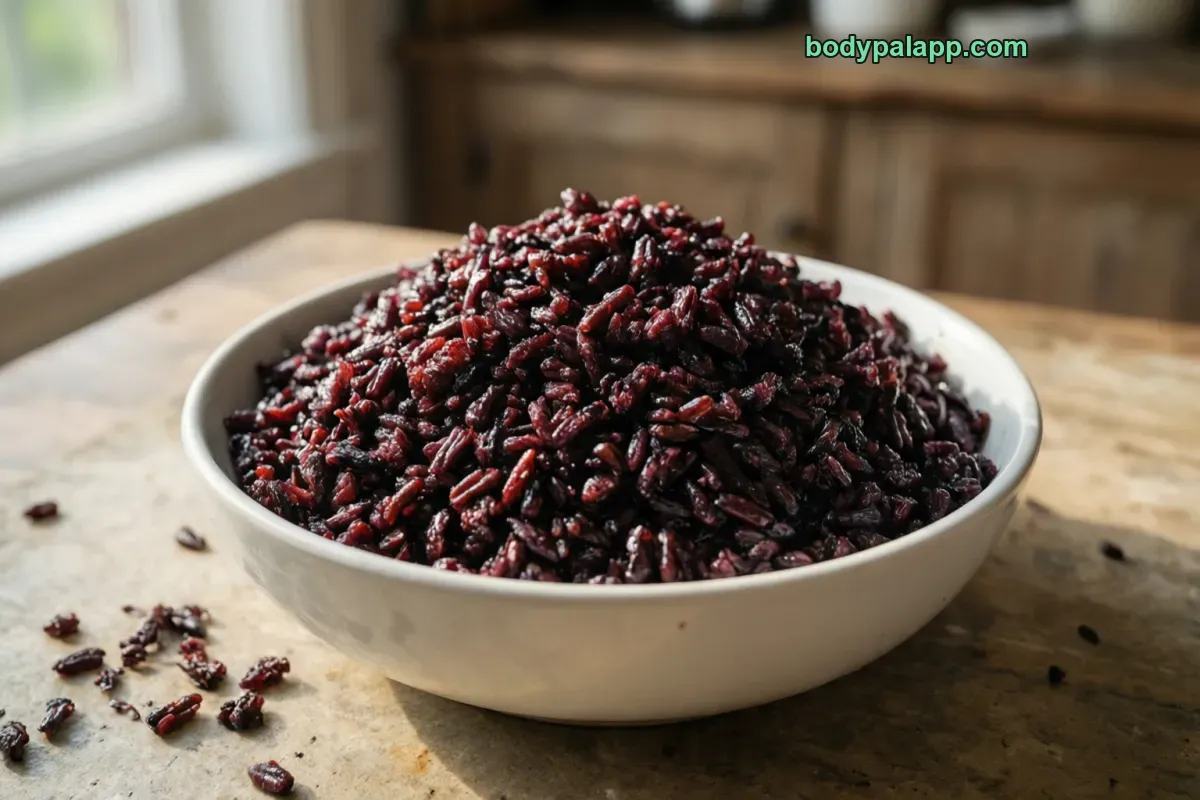
Black rice calories come to 160 for a 1/4 cup dry serving (45 g) and 356 per 100 g of dry rice. The thing to notice is the weight basis: these are uncooked figures from the package label, so a cooked bowl of the same rice weighs more and counts fewer calories per gram.
160kcal
1 1/4 cup of dry black rice · 45 g, packaged, per label
10%protein
4 gProtein
34 gCarbs
1.5 gFat
How to burn off 160 kcal
—Walking, brisk
—Jogging
—Cycling, moderate
—Swimming
Skip the math. BodyPal counts these calories from your steps and workouts automatically.
Nutrition facts
Packaged, per label · per 45 g
Calories
160 kcal
Protein
4 g
Carbohydrate
34 g
Fat
1.5 g
Saturated fat
0 g
Cholesterol
0 mg
Sodium
0 mg
Source: USDA FoodData Central
🛡️
Verified nutrition data
Numbers on this page come from USDA FoodData Central, the U.S. Department of Agriculture’s food composition database, and from manufacturer labels where a branded product is named. Last verified September 2026. How we verify our data →
Black rice: calories, protein and sodium by serving
Percent of daily value uses the FDA reference of 2,000 kcal a day.
Serving
kcal
Protein
Carbs
Fat
Sodium
% DV kcal
1/4 cup dry (45 g)
160
4 g
34 g
1.5 g
0 mg
8%
100 g
356
8.9 g
75.6 g
3.3 g
0 mg
18%
3 × 1/4 cup dry (45 g)
481
12 g
0 mg
5 × 1/4 cup dry (45 g)
801
20 g
0 mg
A quarter cup dry is a 160-calorie side
The label serving is 1/4 cup of dry rice, which weighs 45 g and carries 160 calories. That is 8% of the daily value for calories, with 4 g of protein, 34 g of carbs and 1.5 g of fat. Next to a protein and vegetables, it cooks up into a modest scoop.
The total climbs fast once you scale up. Two quarter cups (90 g dry) come to 320 calories, three (135 g) reach 481, and five (225 g), closer to a family pot, hit 801. Protein rises in step, from 8 g to 12 g to 20 g, but carbs stay the bulk of every spoonful.
The practical move is to measure before cooking. Dry rice is easy to weigh on a kitchen scale. Cooked rice varies with how much water it absorbed, so a cup scooped from the pot is a less reliable guide than the 45 g you poured from the bag.
Carbs supply 82% of every calorie
Per 100 g dry, black rice has 75.6 g of carbohydrate, 8.9 g of protein and 3.3 g of fat. In calorie terms that splits into 82% carbs, 10% protein and 8% fat. It is a starch first and everything else second.
Protein is respectable for a grain but not the main event. The 4 g in a quarter cup is 8% of the 50 g daily value, the same share the serving takes of your calories. To make the plate protein-forward, the rice needs a partner such as beans, eggs, fish or chicken.
Fat stays low at 1.5 g per serving, and the label lists 0 g of saturated fat. Sugar reads 0 g too, so the carbs here are starch rather than anything sweet. Fiber is modest: 2.2 g per 100 g, or about 1 g per quarter cup, against a 28 g daily value.
The label counts dry rice, not the cooked bowl
The 356 calories per 100 g on this page describe uncooked grains straight from the package. Rice soaks up water as it cooks, and water adds weight but no calories. So 100 g of cooked black rice holds far fewer calories than 100 g of dry, even though it is the same rice.
That is why any cooked-rice figure per 100 g or per cup sits well below the label number. Neither is wrong; they measure different things. The calories in your 45 g of dry rice stay at 160 no matter how much water goes into the pot.
If you log after cooking, the simplest route is to log the dry weight you measured and split the pot by portions. Guessing from a cooked scoop tends to drift. BodyPal can also log the bowl from a photo when you did not weigh anything.
Zero sodium makes it an easy base
The label lists 0 mg of sodium and 0 mg of cholesterol, so plain black rice adds nothing to either row. Whatever sodium ends up on the plate comes from salt in the cooking water, soy sauce, broth or toppings. If you watch sodium, that is where to look.
With 82% of its calories from carbs, the rice works best as the base rather than the whole meal. Pair a quarter cup dry with a protein and a pile of vegetables and the rice stays a 160-calorie part of the plate. It also suits grain bowls, stir-fries and a sweet pudding, though the pudding adds its own calories from milk and sugar.
Hinode Black Rice and Nature's Earthly Choice Black Rice sell it plain, while Uncle Ben's Brown, Red & Black Rice blends it with other grains. Check which one you have before you log it.
How does black rice compare?
Here is black rice next to white, sushi and instant rice, per 100 g and per usual serving.
Verdict: Black rice is listed dry while white, sushi and instant rice are listed cooked, so its bigger per-100 g figure mostly reflects missing water, not a heavier plate. If you want the lightest cooked scoop, instant rice at 205 calories per cup is the pick; if you want a darker, chewier grain, choose black rice and measure it dry.
Most popular black rice brands in the United States
Ranked by popularity in the BodyPal database
# Productkcal / 100 g
1Uncle Ben's Brown, Red & Black Rice1 cup · 152 g158 kcal
2Hinode Black Rice1/4 cup · 48 g354 kcal
3Nature's Earthly Choice Black Rice1/4 cup · 43 g372 kcal
A 1/4 cup (45 g) of dry black rice has 160 calories, and 100 g has 356 calories.
Is black rice good for weight loss?
A 1/4 cup dry portion (45 g) has 160 calories, 4.0 g protein and 1.0 g fiber.
Black rice vs white rice: which has more calories?
The figures are for different states: black rice here is 356 calories per 100 g dry, while cooked white rice is 130 calories per 100 g.
How many carbs are in black rice?
Dry black rice has 75.6 g carbs per 100 g, or 34.0 g per 1/4 cup (45 g), with 1.5 g fat.
How many calories are in 100 g of black rice?
Dry black rice has 356 calories per 100 g, which is 18% of the daily value for calories. That is the uncooked figure from the label; cooked rice holds water, so 100 g of cooked black rice counts much less.
What are the macros in black rice?
Per 100 g dry, black rice has 75.6 g of carbs, 8.9 g of protein and 3.3 g of fat. That works out to 82% of calories from carbs, 10% from protein and 8% from fat.
How much protein is in black rice?
A 1/4 cup dry serving (45 g) has 4 g of protein, and 100 g dry has 8.9 g. That covers 8% and 18% of the 50 g daily value, so pair it with a protein food for a fuller meal.
How many calories are in half a cup of black rice?
Half a cup of dry black rice, two 1/4 cup servings or 90 g, has 320 calories and 8 g of protein. Half a cup of cooked rice holds less rice and fewer calories, since part of the volume is water.
Is forbidden rice the same as black rice for calories?
Yes. Forbidden rice is another name for black rice, so use the same figures: 160 calories per 1/4 cup dry (45 g) and 356 per 100 g dry. Check the label if your package is a blend.
Does black rice have sodium or sugar?
Plain black rice lists 0 mg of sodium and 0 g of sugar per serving. Any sodium in your bowl comes from salt, broth or sauces added during cooking or at the table.