
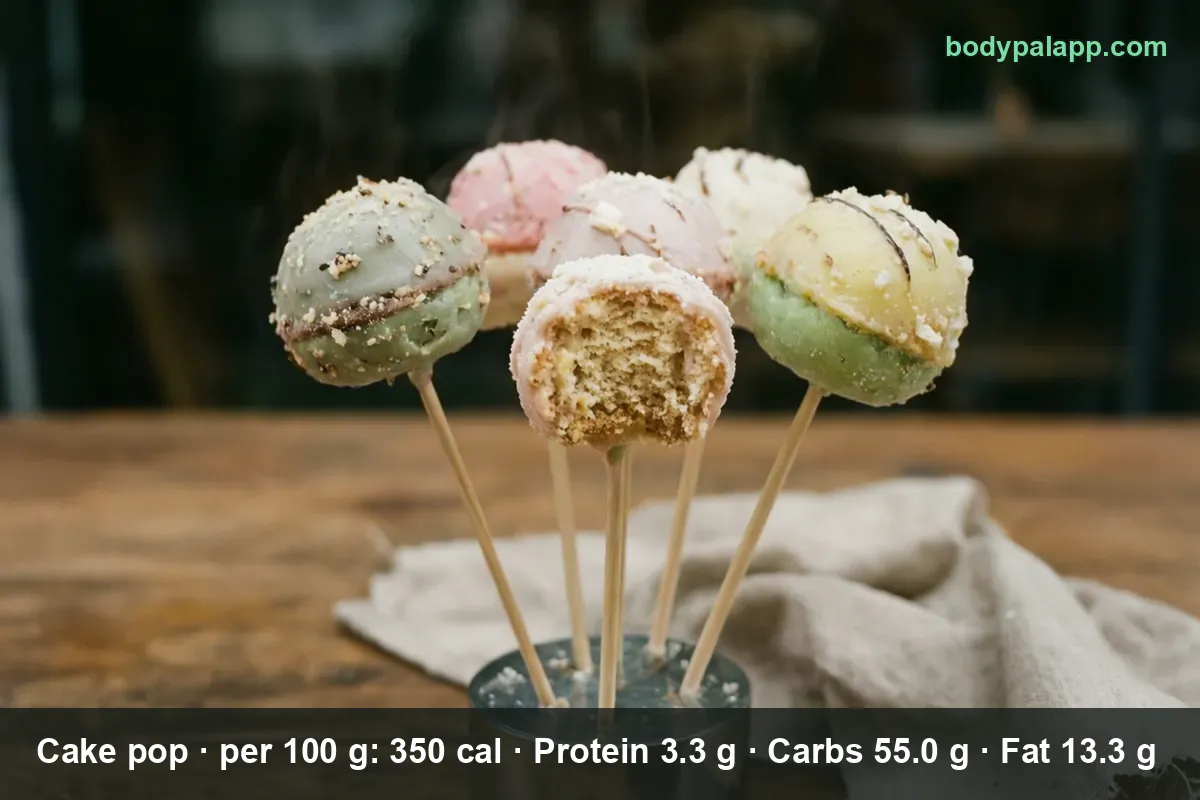
How many calories are in a cake pop?
One supermarket cake pop weighs 60 g and carries 210 calories, and the cake-and-frosting ball behind it runs 350 calories per 100 g. Two pops, the way they usually leave the box, are 420. What makes the number sting is not the calories but the 22 g of added sugar packed into that one bite-size ball.
On this page
- Cake pop quick facts
- US servings, from one ounce to a party pack
- Chocolate, birthday cake, red velvet and the mini bakery pop
- Added sugar is the row that matters
- How does a cake pop compare?
- Most popular cake pop brands
- FAQ
Cake pop quick facts
There is no generic cake pop in USDA's Foundation, SR Legacy or FNDDS databases. The only real records are packaged labels, so the number below comes from FoodData Central 2592481, "Vanilla Cake Pops", the Marketside line sold nationally at Walmart. It has a clean GTIN and, more usefully, a household serving written exactly the way people eat them: one cake pop, 60 g.
That 60 g is the whole ball including the candy coating, not counting the stick. A pop is cake crumbs bound with frosting and dipped, which is why the density lands at 350 calories per 100 g, above plain unfrosted cake.
| Nutrient | Per 100 g | Per 1 cake pop (60 g) | % Daily Value |
|---|---|---|---|
| Calories | 350 | 210 | — |
| Total fat | 13.33 g | 8.0 g | 10% |
| Saturated fat | 3.33 g | 2.0 g | 10% |
| Carbohydrate | 55 g | 33.0 g | 12% |
| Dietary fiber | 0 g | 0.0 g | 0% |
| Total sugars | 36.67 g | 22.0 g | — |
| Added sugars | 36.7 g | 22.0 g | 44% |
| Protein | 3.33 g | 2.0 g | 4% |
| Sodium | 317 mg | 190 mg | 8% |
% Daily Value is based on a 2,000-calorie diet.
Verified nutrition data
Numbers on this page come from USDA FoodData Central, the U.S. Department of Agriculture’s food composition database, and from manufacturer labels where a branded product is named. Last verified September 2026. How we verify our data →
Two rows worth reading twice. Fiber is a flat zero, so all 33 g of carbohydrate count as net carbs. And every gram of sugar on this label is added sugar: 22 g in one pop, with nothing from fruit or milk underneath it. The label also lists 20 mg of cholesterol (7% DV) and 40 mg of potassium (1% DV), plus 190 mg of sodium, which is less than a tenth of a teaspoon of table salt.
US servings, from one ounce to a party pack
| Serving | Weight | Calories |
|---|---|---|
| 1 oz | 28 g | 98 kcal |
| Half a cake pop | 30 g | 105 kcal |
| One cake pop, label serving | 60 g | 210 kcal |
| Two cake pops | 120 g | 420 kcal |
| Three cake pops | 180 g | 630 kcal |
| Per 100 g | 100 g | 350 kcal |
Only the 60 g row is a USDA household serving. The ounce, the half pop and the multi-pop rows are our own arithmetic from the USDA 100 g figure, not USDA servings, scaled straight off 350 calories per 100 g.
The multi-pop rows are the honest ones. Cake pops are almost never sold or eaten singly: the supermarket packs come in sixes and twelves, and a party tray gets grazed. Three pops is 630 calories, which is a full lunch, and the plate is still empty an hour later because each pop brings 2 g of protein and no fiber to hold it up.
Chocolate, birthday cake, red velvet and the mini bakery pop

| Version | Per 100 g | Typical piece | Calories |
|---|---|---|---|
| Vanilla cake pop | 350 kcal | 1 cake pop (60 g) | 210 kcal |
| Birthday cake pop | 350 kcal | 1 cake pop (60 g) | 210 kcal |
| Chocolate cake pop | 333 kcal | 1 cake pop (60 g) | 200 kcal |
| Red velvet cake pop | 342 kcal | 1 cake pop (60 g) | 205 kcal |
| Chocolate peanut butter pop | 371 kcal | 1 pop (35 g) | 130 kcal |
| Mini bakery cake pop | 429 kcal | 1 cake pop (28 g) | 120 kcal |
| Two cake pops, party pack | 350 kcal | 2 cake pops (120 g) | 420 kcal |
Flavor barely moves the calories. Across the four full-size supermarket pops the spread is 200 to 210 calories, a difference you would never notice. Birthday cake picks up sugar from the sprinkles, at 38.33 g per 100 g against vanilla's 36.67 g, though red velvet tops the range at 39.17 g. Red velvet is the sodium outlier at 383 mg per 100 g, from the cocoa and baking soda, not from anything you can taste as salty.
Chocolate is the interesting one. It is the lowest-calorie full-size pop in the table at 200, yet it carries 8.33 g of saturated fat per 100 g against 3.33 g in the vanilla record — 5 g in one pop versus 2 g. The chocolate coating trades sugar for cocoa fat. A second Marketside chocolate listing sits at 325 calories per 100 g, which works out to 195 for the same 60 g pop; that per-pop figure is our own arithmetic from the USDA 100 g number, not a USDA serving, and it looks like a recipe update rather than a different product.
Bakery pops are where the size trap lives. A dessert-shop pop weighs 28 to 35 g, half the supermarket one, so the piece is genuinely lighter — 120 or 130 calories. But per gram they are the two densest records in the table, 429 and 371 calories per 100 g. The mini is 23% more calorie-dense than the Marketside pop it looks like a shrunken version of. Small is not the same as light. One caution on that mini record: its label reports more saturated fat than total fat, which cannot happen, so we use only its calorie figure and ignore its fat rows. Chalet Desserts pops split the difference at 367 calories per 100 g and 220 for a 2.1 oz piece.
Added sugar is the row that matters
Calories are not the reason to think twice about a second pop. Sugar is. One 60 g pop delivers 22 g of added sugars, and the FDA Daily Value for added sugars is 50 g on a 2,000-calorie diet. So one pop is 44%, two are 88%, and three take you past a full day's worth before anything else you drank or ate is counted.
The Dietary Guidelines for Americans put the same idea a different way: keep added sugars under 10% of daily calories. That is the entire allowance for one small ball on a stick.
What the pop does not give you is anything to slow it down. Zero fiber, 2 g of protein, 4% of the protein Daily Value. Compare that with what MyPlate treats as a snack that carries you to the next meal and the gap is obvious. If you want the pop, have it after a meal with protein in it rather than on an empty stomach at 4 p.m.
How does a cake pop compare?
| Dessert | Per 100 g | US serving | Calories |
|---|---|---|---|
| Cake pop | 350 kcal | 1 cake pop, 60 g | 210 kcal |
| Doughnut, cake type, plain | 434 kcal | 1 doughnut, 60 g | 260 kcal |
| Muffin, NFS | 375 kcal | 1 oz, 28 g | 105 kcal |
| Popcorn cake | 384 kcal | 1 plain cake, 10 g | 38 kcal |
Our take: at 350 calories per 100 g the cake pop is the lightest per gram of these four, and gram for gram it beats a plain cake doughnut by a wide margin — the same 60 g of doughnut is 260 calories, with nearly double the fat per 100 g (24.93 g against 13.33 g). If a single sweet thing is going on the plate, the pop is the smaller decision. The catch is that a doughnut ends after one, while pops come six to a pack. Buy the pack and the comparison stops mattering: two pops already outrun the doughnut, and three outrun a day's added-sugar allowance.
Most popular cake pop brands in the United States
Ranked by how widely each product appears among foods sold in the United States, from the BodyPal food database of over 3.3 million products. Calories are the figures printed on each Nutrition Facts label, checked against USDA FoodData Central.
| Product | Calories (per 100 g) |
|---|---|
| Marketside Vanilla Cake Pops | 350 cal |
| Marketside Birthday Cake Pops | 350 cal |
| Marketside Chocolate Cake Pops | 333 cal |
| Marketside Red Velvet Cake Pop | 342 cal |
| Chalet Desserts Cake Pops | 367 cal |
| Tickebelly Chocolate Peanut Butter Cake Pops | 371 cal |
Brand popularity: BodyPal food database. Nutrition: manufacturer labels / USDA FoodData Central.
Cake pop FAQs
How many calories are in a cake pop?
A standard 60 g supermarket cake pop is 210 calories, from a base of 350 calories per 100 g. That is one ball of cake mixed with frosting, dipped in candy coating and set on a stick. Bakery pops are smaller, usually 28 to 35 g, so they land lower.
How many calories in 2 cake pops?
Two cake pops are 420 calories, our own arithmetic from the 210-calorie label serving. Packs are sold in sixes and twelves, which is where this gets away from people: three pops is 630 calories and 66 g of added sugar, more than a full Daily Value on a 2,000-calorie diet.
How much sugar is in a cake pop?
One 60 g cake pop carries 22 g of total sugars, and the label lists all 22 g as added sugars, or 44% of the Daily Value. Cake, frosting and candy coating are each sweetened separately, so more than a third of the pop's weight is sugar.
How many calories in a Starbucks cake pop?
USDA does not publish a record for Starbucks cake pops, so the only verified figure on this page is the 60 g supermarket pop at 210 calories. There is no USDA-backed number for the coffee-shop version. Those pops usually weigh less than 60 g, so treat 210 as the upper end rather than a match.
How many calories in a chocolate cake pop?
A chocolate cake pop is 200 calories for a 60 g piece, at 333 calories per 100 g, slightly under the vanilla version. The chocolate coating shifts the fat: 5 g of saturated fat in one pop against 2 g in the vanilla record, and it adds fiber the vanilla record lacks, 1.7 g per 100 g.
How many carbs are in a cake pop?
A 60 g cake pop has 33 g of carbohydrate, 12% of the Daily Value, and 22 g of that is sugar. Fiber is zero, so all 33 g count as net carbs. Per 100 g the record runs 55 g of carbohydrate, which is high even for a dessert.
How much does a cake pop weigh?
A supermarket cake pop weighs 60 g, the label serving on the USDA record. Bakery and dessert-shop pops run smaller, 28 to 35 g, roughly one ounce to an ounce and a quarter. The stick is not counted in either weight, and neither is the wrapper.
Are cake pops healthy?
One pop is 210 calories with 22 g of added sugars, 44% of the Daily Value, 2 g of protein and no fiber. It is candy in cake form, not a snack that holds you. As an occasional treat inside a day's calorie budget it fits; two of them use most of a day's added-sugar allowance.
Similar foods
- Garlic Bread — 143 cal per slice
- Garlic Knot — 133 cal per garlic knot
- Butter Biscuit — 212 cal per biscuit
- Funnel cake — 318 cal per cake, 6-inch
- Beer Bread — 90 cal per mix serving
- Chocolate Cake — 604 cal per slice, 2-layer cake
Count it without the math
Point the camera at the tray and BodyPal counts the pops for you, coating and all.


How long does it take to burn off a cake pop?
One cake pop (60 g) is 210 kcal. Enter your weight and the amount you ate to see how long it takes you to burn that off:
lb
| Activity | Time to burn 210 kcal |
|---|---|
| Walking, brisk | 42 min |
| Cycling, moderate | 26 min |
| Swimming, moderate | 30 min |
| Jogging | 25 min |
| Weight training, moderate | 47 min |
Times are for a 155 lb adult at a steady pace; change the weight to see yours. The amount is set to the portion in the text (60 g); change it to what you actually ate. BodyPal works this out from your steps automatically.
This table assumes you know your daily total. If you do not, the daily calorie calculator works it out from five numbers.