
How many calories are in a chocolate chip muffin?
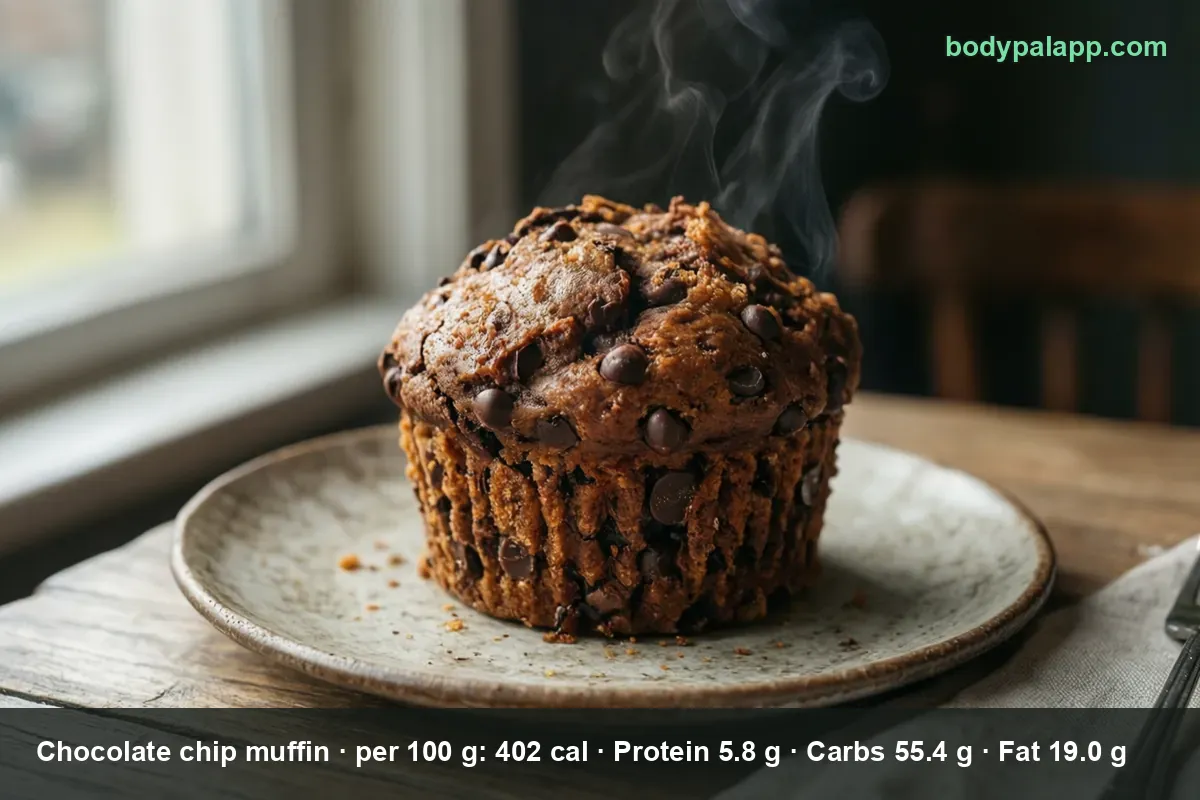
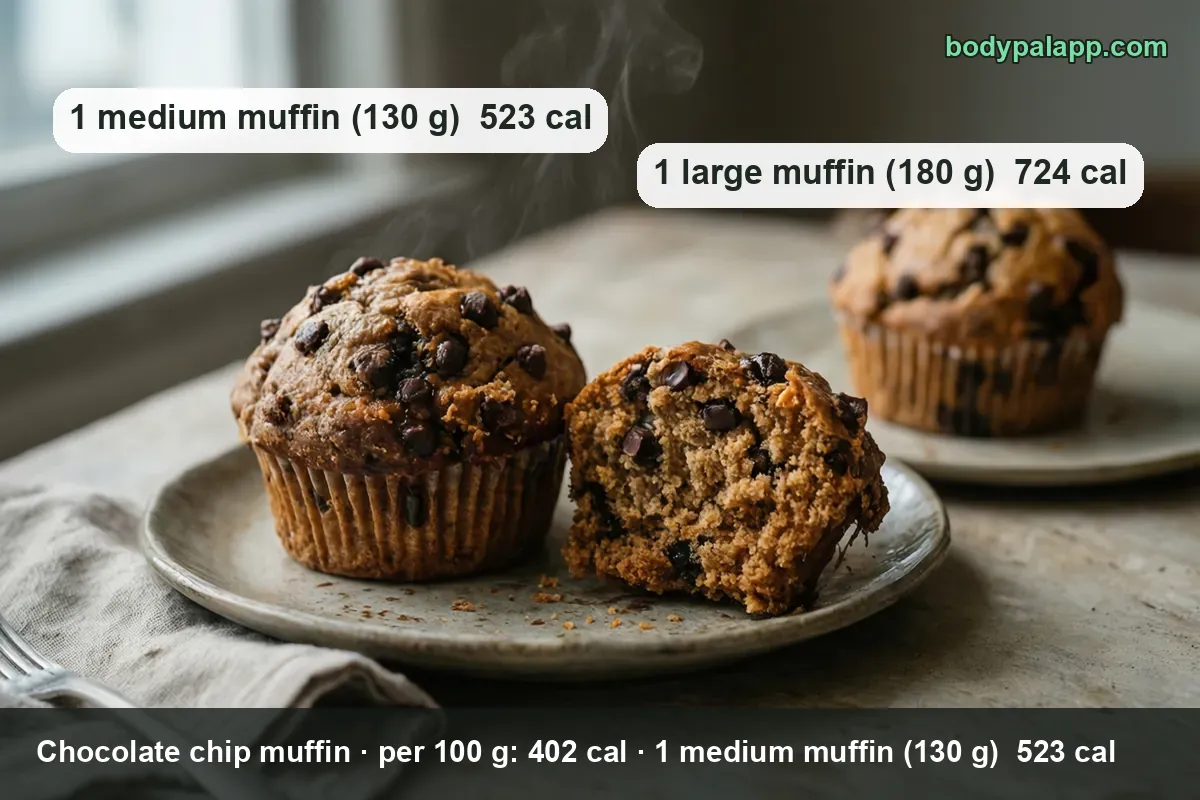
A medium chocolate chip muffin of 130 g is 523 calories, which is 402 per 100 g. A bite-size one off a party tray is 40. The large domed thing in a bakery clamshell, 180 g of it, is 724. Same USDA recipe, same chips, an eighteenfold spread between the smallest muffin and the biggest.
On this page
- Chocolate chip muffin quick facts
- US servings, from bite-size to bakery
- Why "one muffin" is not a serving size
- The saturated fat outruns the carbs
- The sugar, and the fiber that is not there
- Mini, double chocolate, muffin top and whole grain
- How does a chocolate chip muffin compare?
- Most popular chocolate chip muffin brands
- FAQ
Chocolate chip muffin quick facts
Every figure on this page traces back to one record: FNDDS 2707832, "Muffin, chocolate chip", filed by USDA under biscuits, muffins and quick breads. There is no Foundation Foods line and no SR Legacy line for this food, which is normal for a baked mixed item — the survey database is where finished bakery goods live. It describes what a person actually holds: a baked muffin with chips through it, not a box of dry mix and not a banana or pumpkin version.
The serving column is USDA's own medium muffin, 130 g.
| Nutrient | Per 100 g | Per 1 medium muffin (130 g) | % Daily Value |
|---|---|---|---|
| Calories | 402 | 523 | — |
| Total fat | 19.04 g | 24.8 g | 32% |
| Saturated fat | 5.39 g | 7.0 g | 35% |
| Carbohydrate | 55.4 g | 72.0 g | 26% |
| Dietary fiber | 1.8 g | 2.3 g | 8% |
| Total sugars | 32.92 g | 42.8 g | — |
| Protein | 5.77 g | 7.5 g | 15% |
| Sodium | 306 mg | 398 mg | 17% |
% Daily Value is based on a 2,000-calorie diet.
Verified nutrition data
Numbers on this page come from USDA FoodData Central, the U.S. Department of Agriculture’s food composition database, and from manufacturer labels where a branded product is named. Last verified September 2026. How we verify our data →
Two lines a supermarket label would carry are absent above, and for the same reason: this FNDDS edition publishes no added sugars and no trans fat value for the record. Filling those cells from some other product's wrapper would mean putting one food's numbers under another food's name, so they stay out. Total sugars carry no Daily Value on a US label at all, which is why that percentage cell is empty rather than missing.
Two more nutrients sit in the same record without appearing on the label proper. Cholesterol runs 45 mg per 100 g, or 59 mg in a medium muffin, close to a fifth of the 300 mg Daily Value. Potassium is 175 mg per 100 g, 228 mg per muffin, roughly 5% of the day.
US servings, from bite-size to bakery
| Serving | Weight | Calories |
|---|---|---|
| 1 bite-size muffin | 10 g | 40 |
| 1 miniature muffin | 25 g | 101 |
| 1 oz | 28 g | 113 |
| 1 small muffin | 70 g | 281 |
| 1 medium muffin | 130 g | 523 |
| 1 large bakery-style muffin | 180 g | 724 |
Those weights are USDA's household portions for this exact record, not our guesses, and they are the most useful thing on the page. The distance from the top row to the bottom row is 684 calories — the difference between a nibble and a third of a day's food, with no change in ingredients whatsoever.
The mini row is the one worth memorizing. A 25 g miniature muffin is 101 calories, which is why the "100-calorie" muffin package exists at all; the marketing number is not a reformulation, it is a 25 g piece of the same batter. Eat four of them and you are at 404, well past the 281 calories of a 70 g small muffin, having felt like you ate almost nothing.
The ounce row covers the shared muffin and the torn-off top: 113 calories per ounce, whatever shape the piece is.
Why "one muffin" is not a serving size
Package labels agree on the density of a chocolate chip muffin and disagree wildly about the object.
Across US labels in USDA's branded database, "1 muffin" is 71 g and 240 calories at Muffin Town, 71 g and 280 at World Class Bakery, 85 g and 330 at Tastykake, 99 g and 400 at Favorite Day, 113 g and 460 at Otis Spunkmeyer, and 156 g and 630 at both Entenmann's and Sara Lee. Hostess skips the word altogether and declares 2 pieces (57 g) for 240.
Per 100 g those products run 338 to 421, a spread of under a quarter. Per declared serving they run 240 to 630, a spread of 2.6 times. Nothing in the recipe explains that gap. It is entirely the weight of the thing in the wrapper.
The Hostess line is the one that catches people, because its serving is two muffins at 57 g together — a pair of minis. Set that against an Entenmann's or Sara Lee muffin at 156 g and you have two products, both truthfully labeled "chocolate chip muffin", where one serving is worth 2.6 of the other.
The rule that falls out of this: with a package in front of you, log the label; in a bakery or coffee shop, log by weight, and be honest about it. A domed café muffin is closer to USDA's 180 g large than to its 130 g medium, and the two national retail brands above sit at 156 g and about 630 calories — well past the 523 most calorie charts print as "a muffin".
The saturated fat outruns the carbs
People file muffins under sweet carbohydrate. The percentage column says otherwise.
One medium muffin covers 35% of the day's saturated fat and 32% of total fat, against 26% of carbohydrate, using the FDA Daily Values of 20 g, 78 g and 275 g. The single biggest number on the label is the fat row, not the carb row.
Split the 523 calories by where they come from — our own arithmetic, at 9 calories a gram of fat and 4 a gram of carbohydrate and protein — and it holds up: 24.8 g of fat supplies roughly 220 of them, the 72 g of carbohydrate about 290, and 7.5 g of protein the last 30. A muffin is closer to a slice of cake baked in oil than to a bread roll, which is what the 19.04 g of fat per 100 g is telling you.
Saturated fat is the row to watch if you eat one regularly. The Dietary Guidelines for Americans put the limit at under 10% of daily calories, about 20 g on a 2,000-calorie day, and one muffin uses 7.0 g of that before anything else on the plate. The large bakery version uses 9.7 g, close to half the day, in a single item eaten with coffee.
Sodium is the quiet one: 398 mg per muffin, 17% of the 2,300 mg Daily Value. That is more than most people expect from something sweet, and it is ordinary — chemical leavening is sodium, and every muffin is built on it.
The sugar, and the fiber that is not there
A medium chocolate chip muffin holds 42.8 g of total sugars. A 12-ounce can of regular cola holds about 39 g. The muffin wins, and it does it while being eaten at 8 a.m. by someone who chose it over a donut for reasons of virtue.
Against that sugar there is 2.3 g of fiber, 8% of the 28 g Daily Value — one gram of fiber for roughly every 31 g of carbohydrate. That ratio is the signature of refined white flour, and it is the honest answer to "is a muffin a healthy breakfast". MyPlate's grain guidance asks for half of daily grains to be whole; this record contributes to the other half.
One caveat on the sugar figure, and it matters. USDA publishes total sugars for this record but no added sugars value, so the percentage that appears on a packaged label — the one people actually look for — cannot be calculated from this source honestly. Very little of a muffin's sugar arrives from fruit, so the added share is high, but a number would be invention rather than data. A specific brand's label is the only place to get it.
If you want the muffin and want the sugar smaller, size is the lever, not the flavor. A 70 g small muffin carries 23.0 g of sugars against the medium's 42.8. Nothing else about it changes.
Mini, double chocolate, muffin top and whole grain
| Version | Per 100 g | Serving | Calories |
|---|---|---|---|
| Medium chocolate chip muffin | 402 | 1 muffin (130 g) | 523 |
| Large bakery-style muffin | 402 | 1 muffin (180 g) | 724 |
| Miniature muffin | 402 | 1 mini (25 g) | 101 |
| Double chocolate muffin | 395 | 1 muffin (130 g) | 514 |
| Chocolate chip muffin top | 440 | 1 top (50 g) | 220 |
| Whole-grain foodservice muffin | 329 | 1 muffin (57 g) | 188 |
| Dry muffin mix, before baking | — | 1/2 cup mix (61 g) | 247 |
The double chocolate version surprises most readers. USDA's "Muffin, chocolate" record is cocoa batter rather than plain batter with chips, and it comes in slightly lower at 395 calories per 100 g, with less carbohydrate (50.94 g against 55.4 g) and a little more protein (6.54 g against 5.77 g). At the same 130 g the gap is nine calories. Ordering the darker one is a flavor decision, not a calorie one.
The muffin top is the opposite trick. At 440 calories per 100 g it is the densest item in the table, because the top is the buttery, sugary crown of the muffin with none of the plainer base. It still comes out at 220 calories, purely because a top weighs 50 g. Density up, portion down, total well under half.
The whole-grain foodservice muffin — the kind that turns up in school and cafeteria programs — is the genuinely different food here: 329 calories per 100 g, with 12.39 g of fat against the standard 19.04 g, about a third less. In a 57 g piece that is 188 calories.
The last row is a warning, not a serving. The number on a box of dry mix describes powder: half a cup of Betty Crocker chocolate chip muffin mix, 61 g, is 247 calories. The muffin you take out of the oven is heavier than the mix that went in, because oil, egg and milk are added. Never log the box.
How does a chocolate chip muffin compare?
Because USDA does not give these bakery records a shared household weight, the fair comparison is at one weight. Everything below is set at 130 g, the medium muffin.
| Item | Per 100 g | Per 130 g | Protein / Carbs / Fat per 130 g |
|---|---|---|---|
| Chocolate chip muffin (this page) | 402 | 523 | 7.5 / 72.0 / 24.8 g |
| Double chocolate muffin | 395 | 514 | 8.5 / 66.2 / 24.4 g |
| Fruit muffin, blueberry type | 375 | 488 | 5.8 / 68.9 / 20.9 g |
| Muffin, unspecified type | 375 | 488 | 5.8 / 68.9 / 20.9 g |
| Scone | 382 | 497 | 8.7 / 62.5 / 23.9 g |
The two 488 rows are not a copying error. USDA models its generic fruit muffin on its generic muffin, so both carry identical values in this edition — useful to know if you log a blueberry muffin and wonder why it matches the unspecified one exactly.
Our take: at the same weight the whole family sits within 35 calories, so swapping chocolate chips for blueberries buys about 7% and no more. Take the fruit muffin if you want the smallest number and 4 g less fat; the double chocolate one is a better deal than its name suggests; the scone carries the most protein in the table. None of it matters as much as choosing the 70 g muffin over the 180 g one, which is worth 443 calories in a single decision.
Most popular chocolate chip muffin brands in the United States
Ranked by how widely each product appears among foods sold in the United States, from the BodyPal food database of over 3.3 million products. Calories are the figures printed on each Nutrition Facts label, checked against USDA FoodData Central.
| Product | Calories (per 100 g) |
|---|---|
| Otis Spunkmeyer Chocolate Chip Muffin | 407 cal |
| Muffin Town Chocolate Chip Muffin | 338 cal |
| World Class Bakery Chocolate Chip Muffin | 394 cal |
| Entenmann's Chocolate Chip Muffin | 404 cal |
| Sara Lee Chocolate Chip Muffin | 404 cal |
| Hostess Chocolate Chip Muffins | 421 cal |
Brand popularity: BodyPal food database. Nutrition: manufacturer labels / USDA FoodData Central.
Chocolate chip muffin FAQs
How many calories are in a chocolate chip muffin?
523 calories in a medium 130 g muffin, at 402 calories per 100 g. That serving carries 24.8 g of fat, 72.0 g of carbohydrate, 42.8 g of total sugars, 7.5 g of protein and 398 mg of sodium. A small 70 g muffin is 281 calories.
How many calories are in a large chocolate chip muffin?
724 calories for a large bakery-style muffin of 180 g, from the same 402 per 100 g. It brings 34.3 g of fat, 99.7 g of carbohydrate and 59.3 g of sugars. Retail muffins from the big national bakers weigh 156 g and land near 630 calories.
How many calories are in a mini chocolate chip muffin?
101 calories for a 25 g miniature muffin, which is where the "100-calorie" muffin package gets its name. A bite-size 10 g muffin is 40 calories. Four minis come to 404, more than the 281 calories in a 70 g small muffin.
How much sugar is in a chocolate chip muffin?
42.8 g of total sugars in a medium 130 g muffin, from 32.92 g per 100 g. That is more than the roughly 39 g in a 12-ounce can of regular cola. USDA publishes no added sugars figure for this record, so the added share cannot be given honestly from this source.
How much protein is in a chocolate chip muffin?
7.5 g in a medium muffin, 15% of the 50 g Daily Value, from 5.77 g per 100 g. It arrives alongside 523 calories, so the protein-per-calorie ratio is poor next to eggs or yogurt. A scone at the same 130 g carries slightly more, 8.7 g.
Is a chocolate chip muffin a good breakfast?
It is a 523-calorie start with 2.3 g of fiber, 8% of the Daily Value, and 35% of a day's saturated fat. The refined-flour signature is the fiber-to-carbohydrate ratio: one gram of fiber for every 31 g of carbohydrate. It works better as a treat than as the meal that has to hold you until lunch.
How many calories are in a double chocolate chip muffin?
514 calories at 130 g, from 395 per 100 g — nine fewer than the chocolate chip version, not more. Cocoa batter carries less carbohydrate, 50.94 g against 55.4 g per 100 g, and a little more protein at 6.54 g. The darker muffin is not the heavier one.
Why does the package say a different number?
Because "1 muffin" is a weight, not a standard. Hostess declares 2 pieces (57 g) at 240 calories while Entenmann's and Sara Lee declare 1 muffin (156 g) at 630 — a 2.6-fold gap between servings, though all three sit between 404 and 421 calories per 100 g. Log the label when you have the package.
Similar foods
- Cosmic Brownie — 261 cal per medium brownie
- Honey Bunches Of Oats Cereal — 120 cal per 3/4 cup
- Cheesecake — 698 cal per slice
- Butter Croissant — 231 cal per croissant
- Cap'N Crunch Cereal — 107 cal per serving
- Crescent roll — 114 cal per crescent roll
Count it without the math
Point the camera at the muffin and BodyPal works out whether it is the 130 g one or the 180 g one, chips and all.


How long does it take to burn off 523 kcal of chocolate chip muffin?
One medium muffin (130 g) is 523 kcal. Enter your weight and the amount you ate to see how long it takes you to burn that off:
lb
| Activity | Time to burn 523 kcal |
|---|---|
| Walking, brisk | 1 hr 45 min |
| Cycling, moderate | 1 hr 5 min |
| Swimming, moderate | 1 hr 15 min |
| Jogging | 1 hr 2 min |
| Weight training, moderate | 1 hr 56 min |
Times are for a 155 lb adult at a steady pace; change the weight to see yours. The amount is set to the portion in the text (130 g); change it to what you actually ate. BodyPal works this out from your steps automatically.
Want the bigger picture? Calculate your daily calorie needs — your maintenance figure, a target for losing or gaining, and the date you get there.