
How Many Calories in a Slice of Cheesecake?
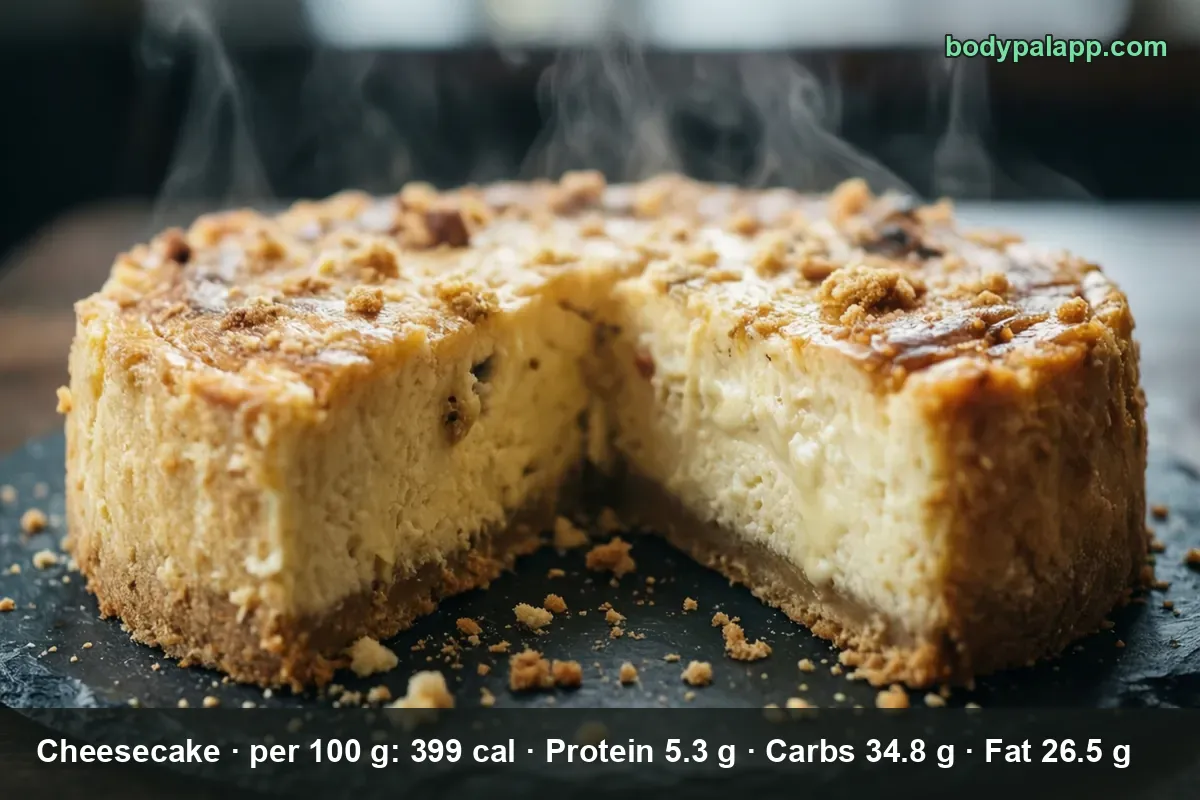
One standard slice of plain baked cheesecake weighs 175 g and carries 698 calories. Per 100 g it runs 399 calories, and roughly 60% of those calories come from fat rather than flour or sugar. The headline numbers below are for plain cheesecake: no fruit, no sauce, no chocolate shell.
On this page
- Cheesecake quick facts
- US servings from one ounce to a full cup
- Cheesecake variants beyond the plain slice
- Saturated fat is the row that decides the day
- How does cheesecake compare?
- Most popular cheesecake brands
- FAQ
Cheesecake quick facts
The number people actually need is the one for the wedge sitting on the plate, so this page is built on the USDA FNDDS record 2707861, "Cheesecake, plain". It comes with a bakery-style household portion, one slice, and it is the only one of these records that reports cholesterol and potassium. Store-bought and no-bake records exist too, and they land noticeably lower, but that is a difference in how the cake was made, not a difference in source. Those rows get their own section further down.
| Nutrient | Per 100 g | Per 1 slice (175 g) | % Daily Value |
|---|---|---|---|
| Calories | 399 | 698 | — |
| Total fat | 26.52 g | 46.4 g | 60% |
| Saturated fat | 14.37 g | 25.1 g | 126% |
| Carbohydrate | 34.82 g | 60.9 g | 22% |
| Dietary fiber | 0.5 g | 0.9 g | 3% |
| Total sugars | 26.64 g | 46.6 g | — |
| Protein | 5.29 g | 9.3 g | 19% |
| Sodium | 277 mg | 485 mg | 21% |
| Cholesterol | 114 mg | 200 mg | 66% |
% Daily Value is based on a 2,000-calorie diet.
Verified nutrition data
Numbers on this page come from USDA FoodData Central, the U.S. Department of Agriculture’s food composition database, and from manufacturer labels where a branded product is named. Last verified September 2026. How we verify our data →
Two rows you would see on a supermarket label are missing here. Added sugars and trans fat are not published in this FNDDS edition, so they are left out rather than guessed at. In practice almost all of the 46.6 g of total sugars in a slice is sugar beaten into the filling, with a small share of lactose riding along from the cream cheese. Potassium is modest at 104 mg per 100 g, or 182 mg in a slice, which is 4% of the Daily Value.
The sodium figure surprises people. A slice carries 485 mg, close to a fifth of a teaspoon of table salt, in something nobody thinks of as salty. That comes from the cream cheese and the crust, not from a shaker.
US servings from one ounce to a full cup
| Serving | Weight | Calories |
|---|---|---|
| 1 oz | 28 g | 113 kcal |
| One small bakery slice, a sixth of a 17 oz cake | 80 g | 319 kcal |
| One slice, USDA piece | 175 g | 698 kcal |
| 1 cup | 180 g | 718 kcal |
| Per 100 g | 100 g | 399 kcal |
Only two of those are USDA household measures: the 175 g slice and the 1 cup entry. The 80 g bakery wedge and the 1 oz square are our own arithmetic from the USDA 100 g figure, scaled for the sizes people actually cut at home.
That 1 cup row is the trap. "A cup" sounds like a restrained amount, the sort of thing you write down when you scooped a broken slice into a bowl. It weighs 180 g and comes to 718 calories, which is more than the standard slice. Cheesecake is dense enough that volume flatters it, so weight is the honest way to log it.
The gap between the two slice sizes is where most of the disagreement online comes from. A generous restaurant wedge at 175 g is 698 calories. A small bakery slice cut as a sixth of a 17-ounce cake is 80 g and 319 calories, less than half. Both are "a slice of cheesecake." If you only remember one number, remember 3.99 calories per gram and weigh the piece.
Cheesecake variants beyond the plain slice
| Version | Per 100 g | Typical piece | Calories |
|---|---|---|---|
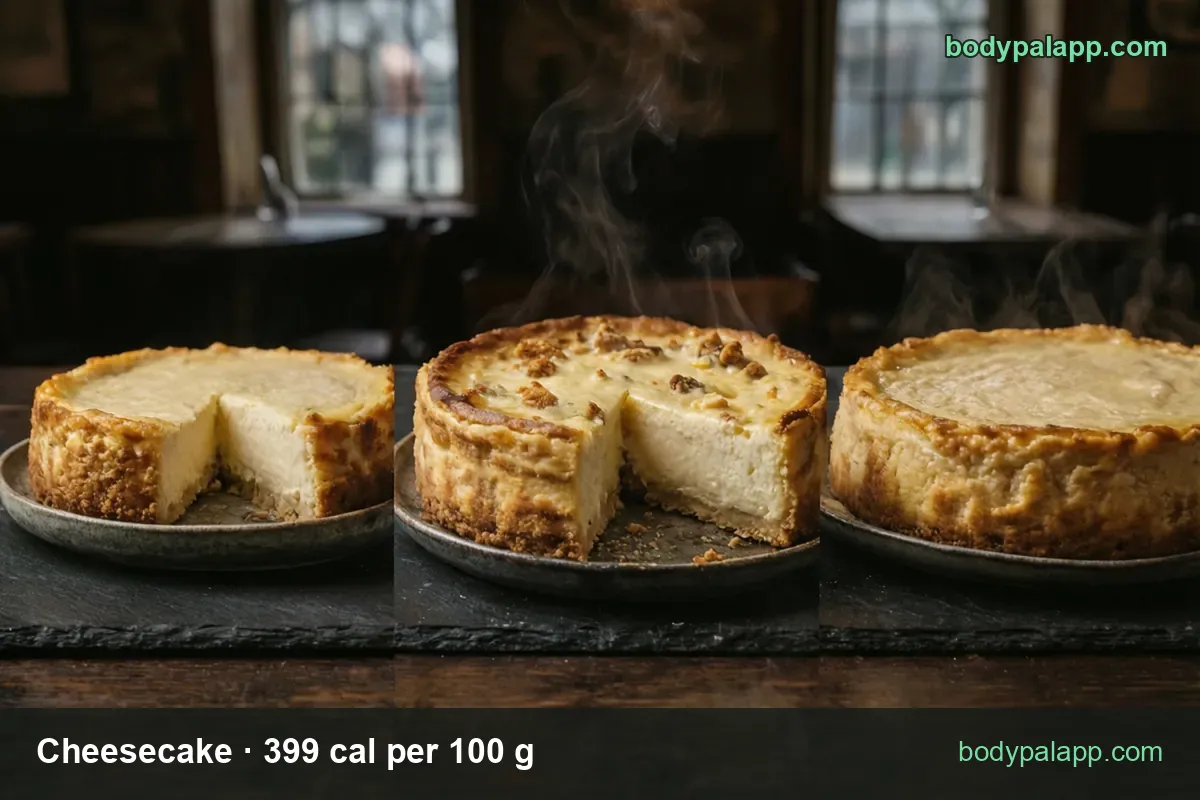
| Plain, baked | 399 kcal | 1 slice, 175 g | 698 kcal |
| Fruit-topped | 387 kcal | 1 slice, 200 g | 774 kcal |
| Chocolate | 394 kcal | 1 slice, 175 g | 690 kcal |
| Store-bought, commercially prepared | 321 kcal | 1 piece, NLEA 125 g | 401 kcal |
| No-bake, prepared from mix | 274 kcal | 1/12 of a 9-inch cake, 99 g | 271 kcal |
Fruit-topped cheesecake reads lighter per 100 g at 387, because the topping is mostly water and sugar diluting the fat: 23.88 g of fat per 100 g against 26.52 g in plain. Then the slice gets bigger. At a typical 200 g the strawberry version is 774 calories, the heaviest single serving on this page.
Chocolate cheesecake barely moves the needle at 394 calories per 100 g. The one genuine change is fiber, which climbs to 1.6 g per 100 g from cocoa, more than three times the 0.5 g in plain. It is still a dessert, not a fiber source.
The commercially prepared record is the one to use for a supermarket cake. At 321 calories per 100 g it is meaningfully lighter than bakery-style, because a factory slice carries less filling relative to crust, but sodium goes the other way: 438 mg per 100 g against 277 mg. No-bake cheesecake from a mix is the lightest option at 274 calories per 100 g, with fat cut roughly in half to 12.7 g, since it is set with milk instead of a full load of cream cheese. It also carries 380 mg of sodium per 100 g. Less fat, more salt.
Retail slices sit between the extremes. USDA Branded lists a Carmine's Bakery New York style slice at 388 calories per 100 g and 330 for an 85 g slice, a Walmart Bakery New York style slice at 365 per 100 g and 380 for 104 g, and a 142 g Carmine's classic slice at 500 calories. The per-slice number tracks the size of the cut far more than the brand on the box.
Saturated fat is the row that decides the day
Calories are not the interesting part of a cheesecake slice. Saturated fat is. A 175 g slice delivers 25.1 g, which is 126% of the FDA Daily Value of 20 g. One dessert, and the day's reference amount is already behind you. The Dietary Guidelines for Americans put the recommendation at less than 10% of daily calories from saturated fat, which is the same neighborhood.
This is where portion size stops being a technicality. Cut the slice to 80 g and saturated fat drops to 11.5 g, about 57% of the Daily Value. Same cake, same recipe, and the day still works. If you are watching saturated fat, the no-bake version at 6.69 g per 100 g is the structurally different choice rather than a smaller version of the same thing.
Protein is a footnote worth mentioning because cream cheese confuses people. A slice has 9.3 g, 19% of the Daily Value, which is real but not a reason to file cheesecake under dairy nutrition. MyPlate counts cream cheese as a food with little of the calcium and protein that make dairy useful. Treat the 9.3 g as a bonus, not a purpose.
How does cheesecake compare?
| Dessert | Per 100 g | US serving | Calories |
|---|---|---|---|
| Cheesecake, plain | 399 kcal | one slice, 175 g | 698 kcal |
| Pie, peanut butter cream | 421 kcal | 1 oz, 28 g | 119 kcal |
| Cake, chocolate, flourless | 410 kcal | 1 oz, 28 g | 116 kcal |
| Snack cake, chocolate | 399 kcal | 1 oz, 28 g | 113 kcal |
The serving column is not apples to apples, because USDA lists these neighbors by the ounce. Ounce for ounce cheesecake is 113 calories, identical to the packaged chocolate snack cake, three behind flourless chocolate cake at 116 and six behind peanut butter cream pie at 119.
Our take: as a material, cheesecake is unremarkable — it sits at the bottom of this group per gram, tied with a snack cake. As a serving it wins the day, because nobody eats 28 g of it. The slice is what makes cheesecake a 698-calorie decision while a chocolate snack cake is a 113-calorie one. If you want the flavor without the arithmetic, order one slice for two people, or buy the commercially prepared cake where a 125 g piece is 401 calories. The one thing worth avoiding is scooping it into a cup, which is 718 calories and does not feel like more than a slice.
Most popular cheesecake brands in the United States
Ranked by how widely each product appears among foods sold in the United States, from the BodyPal food database of over 3.3 million products. Calories are the figures printed on each Nutrition Facts label, checked against USDA FoodData Central.
| Product | Calories (per 100 g) |
|---|---|
| Atlanta Cheesecake Company Red Velvet Cheesecake | 324 cal |
| Carmine's Bakery New York Style Cheesecake | 388 cal |
| The Bakery at Walmart New York Style Cheesecake | 365 cal |
| The Bakery Baked with Pride New York Style Cheesecake | 340 cal |
| Carmine's Bakery Classic New York Cheesecake | 352 cal |
| Carmine's Bakery New York Style Cheesecake (large slice) | 375 cal |
Brand popularity: BodyPal food database. Nutrition: manufacturer labels / USDA FoodData Central.
Cheesecake FAQs
How many calories are in a slice of cheesecake?
A standard 175 g slice of plain baked cheesecake is 698 calories, at 399 calories per 100 g. Bakery slices are often smaller: an 80 g wedge cut as a sixth of a 17-ounce cake works out to 319 calories, our own arithmetic from the USDA 100 g figure rather than a USDA serving.
How many calories in New York style cheesecake?
USDA has no separate generic row for New York style, so the retail labels are the guide: a Carmine's Bakery 85 g slice is 330 calories, a Walmart Bakery 104 g slice is 380, and a 142 g Carmine's classic slice is 500. Per 100 g they run 352 to 388, a little under plain cheesecake at 399.
How much sugar is in cheesecake?
A 175 g slice carries 46.6 g of total sugars, from 26.64 g per 100 g. Most of that is sugar mixed into the filling, with a small share of lactose from the cream cheese. USDA does not publish added sugars for this FNDDS record, so the split between the two is not broken out.
How much saturated fat is in one slice of cheesecake?
One 175 g slice has 25.1 g of saturated fat, 126% of the 20 g Daily Value. That is a full day's reference amount on one plate. A smaller 80 g bakery slice drops it to 11.5 g, about 57% of the Daily Value, which leaves room for the rest of the day.
Does no-bake cheesecake have fewer calories?
Yes: no-bake cheesecake prepared from a mix is 274 calories per 100 g against 399 for baked, and a 99 g piece is 271 calories against 698 for a 175 g baked slice. The trade is sodium: 380 mg per 100 g in the no-bake version against 277 mg in the baked one.
How many calories in strawberry cheesecake?
Fruit-topped cheesecake is 387 calories per 100 g, slightly below plain at 399, but the topping adds weight. A 200 g fruit-topped slice comes to 774 calories, more than the 698 in a 175 g plain slice. Carbohydrate rises to 38.23 g per 100 g while fat falls to 23.88 g.
How many calories in a whole cheesecake?
Six 80 g slices from a 17-ounce bakery cheesecake come to 1,914 calories, our own arithmetic from the USDA figure of 399 calories per 100 g. USDA does not publish a weight for a whole cake, so weigh yours and multiply by 3.99 calories per gram. That works for any diameter.
Is cheesecake healthier than chocolate cake?
By calories they are close: plain cheesecake is 399 per 100 g, flourless chocolate cake 410, and a packaged chocolate snack cake exactly 399. The difference is where the calories sit. Cheesecake carries 26.52 g of fat per 100 g, 14.37 g of it saturated, while the snack cake runs on carbohydrate at 60.31 g.
Similar foods
- Cap'N Crunch Cereal — 107 cal per serving
- Cosmic Brownie — 261 cal per medium brownie
- Honey Bunches Of Oats Cereal — 120 cal per 3/4 cup
- Chocolate chip muffin — 523 cal per medium muffin
- Bread Crumbs — 427 cal per cup
- Chocolate Muffin — 514 cal per medium muffin
Count it without the math
Point the camera at the plate and BodyPal counts the slice for you, crust and all.


How long does it take to burn off cheesecake?
One slice (175 g) is 698 kcal. Enter your weight and the amount you ate to see how long it takes you to burn that off:
lb
| Activity | Time to burn 698 kcal |
|---|---|
| Walking, brisk | 2 hr 20 min |
| Cycling, moderate | 1 hr 27 min |
| Swimming, moderate | 1 hr 40 min |
| Jogging | 1 hr 22 min |
| Weight training, moderate | 2 hr 35 min |
Times are for a 155 lb adult at a steady pace; change the weight to see yours. The amount is set to the portion in the text (175 g); change it to what you actually ate. BodyPal works this out from your steps automatically.
This table assumes you know your daily total. If you do not, the daily calorie calculator works it out from five numbers.