
How Many Calories in a Cinnamon Roll?
A medium cinnamon roll with no frosting is 335 calories for a 90 g roll, or 372 per 100 g. Add the frosting and the same size roll becomes 407 calories. A canned Pillsbury roll baked with its icing is much smaller and lands at 145 calories.
On this page
- Cinnamon roll quick facts
- What the frosting actually adds
- Serving sizes from mini to bakery case
- The sodium trap in canned dough
- When the label shows half a roll
- How a cinnamon roll compares with other pastries
- Most popular cinnamon roll brands
- FAQ
Cinnamon roll quick facts
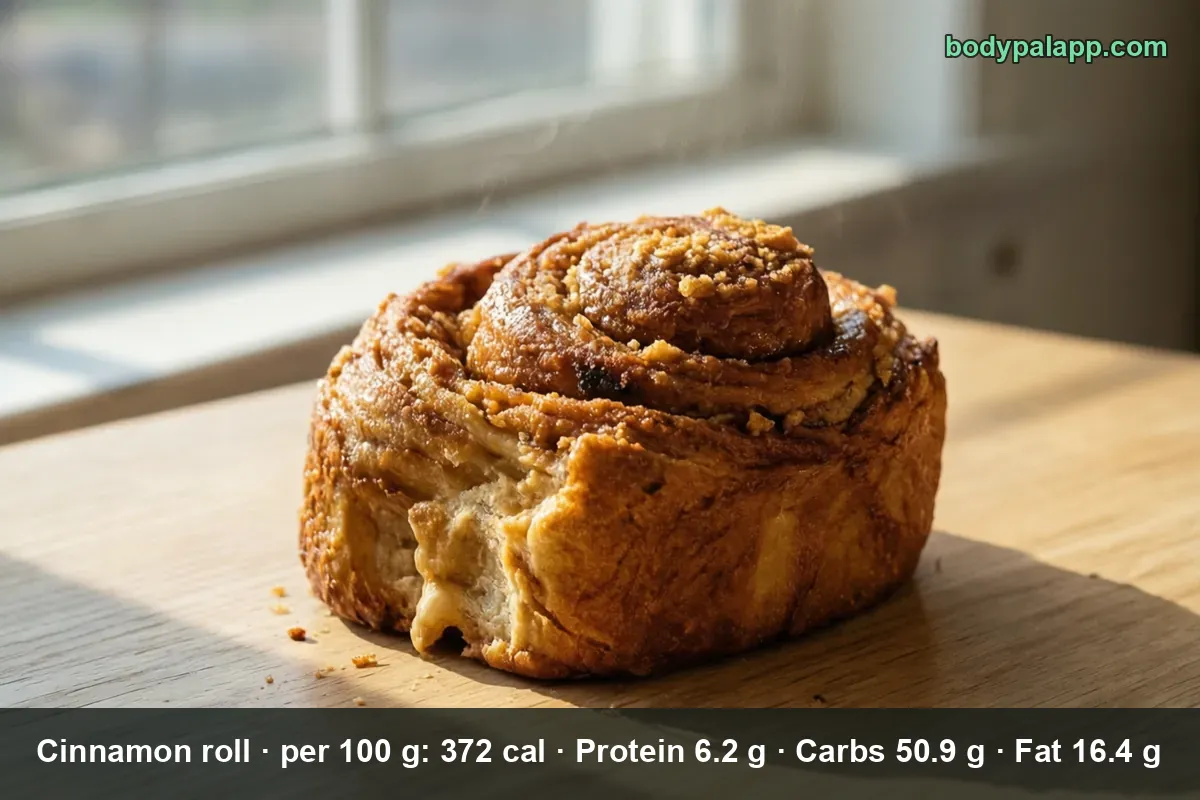
The reference roll here is the one in the photo: baked, spiral on top, no frosting, 90 g on the plate. That is the size USDA files as "1 medium" for Roll, sweet, cinnamon bun, no frosting, and it is also what its database returns when a serving size is not specified.
| Nutrient | Per 100 g | Per 1 medium roll (90 g) | % Daily Value |
|---|---|---|---|
| Calories | 372 | 335 | — |
| Total fat | 16.4 g | 14.8 g | 19% |
| Saturated fat | 3.1 g | 2.8 g | 14% |
| Carbohydrate | 50.9 g | 45.8 g | 17% |
| Dietary fiber | 2.4 g | 2.2 g | 8% |
| Total sugars | 31.7 g | 28.6 g | — |
| Protein | 6.2 g | 5.6 g | 11% |
| Sodium | 304 mg | 274 mg | 12% |
% Daily Value is based on a 2,000-calorie diet. Total sugars have no Daily Value; only added sugars do.
Verified nutrition data
Numbers on this page come from USDA FoodData Central, the U.S. Department of Agriculture’s food composition database, and from manufacturer labels where a branded product is named. Last verified September 2026. How we verify our data →
Two numbers on that table are worth a second look. The 28.6 g of sugars is high even for a pastry, and the reason is a quirk of the source: the generic unfrosted row USDA publishes is built on a commercially prepared cinnamon sweet roll made with raisins, which pushes both sugars and cholesterol (59 mg per roll, 20% DV) above what you might expect from plain dough.
The other is fiber. At 2.2 g per roll it is not nothing — enriched wheat flour and a little dried fruit get you to 8% of the day, which is more than a doughnut manages.
There is no added-sugars figure in this table because USDA does not publish one for the generic roll. That row is left out rather than guessed at; the branded numbers further down are the only added-sugar figures on this page, and they belong to specific products.
What the frosting actually adds
Here is the part almost every calorie chart gets backwards.
Take the same 90 g roll and frost it. Calories go from 335 to 407, using USDA's frosted row. That is 72 calories, which is real but not dramatic.
Now look at saturated fat. The plain roll carries 2.8 g. The frosted roll carries 11.4 g — 57% of a day's Daily Value in one pastry, against 14% for the plain one. A single frosted cinnamon roll uses up more than half your saturated fat allowance before you have eaten anything else.
And sugar? It goes down, from 28.6 g to 23.1 g. Part of that is the raisin quirk mentioned above, since the two USDA rows are built on different base foods, but the direction of travel is still the honest headline: frosting is a fat story, not a sugar story. It is butter, shortening and cream cheese carrying powdered sugar, and the fat is what moves.
The rest of the frosted roll, per 90 g: 23.9 g total fat (31% DV), 43.7 g carbohydrate (16%), 1.1 g fiber (4%), 4.0 g protein (8%), 275 mg sodium (12%).
If you want one practical takeaway from this page, that is it. Scraping half the frosting off is worth more to your saturated fat total than skipping the roll's second half is.
Serving sizes from mini to bakery case
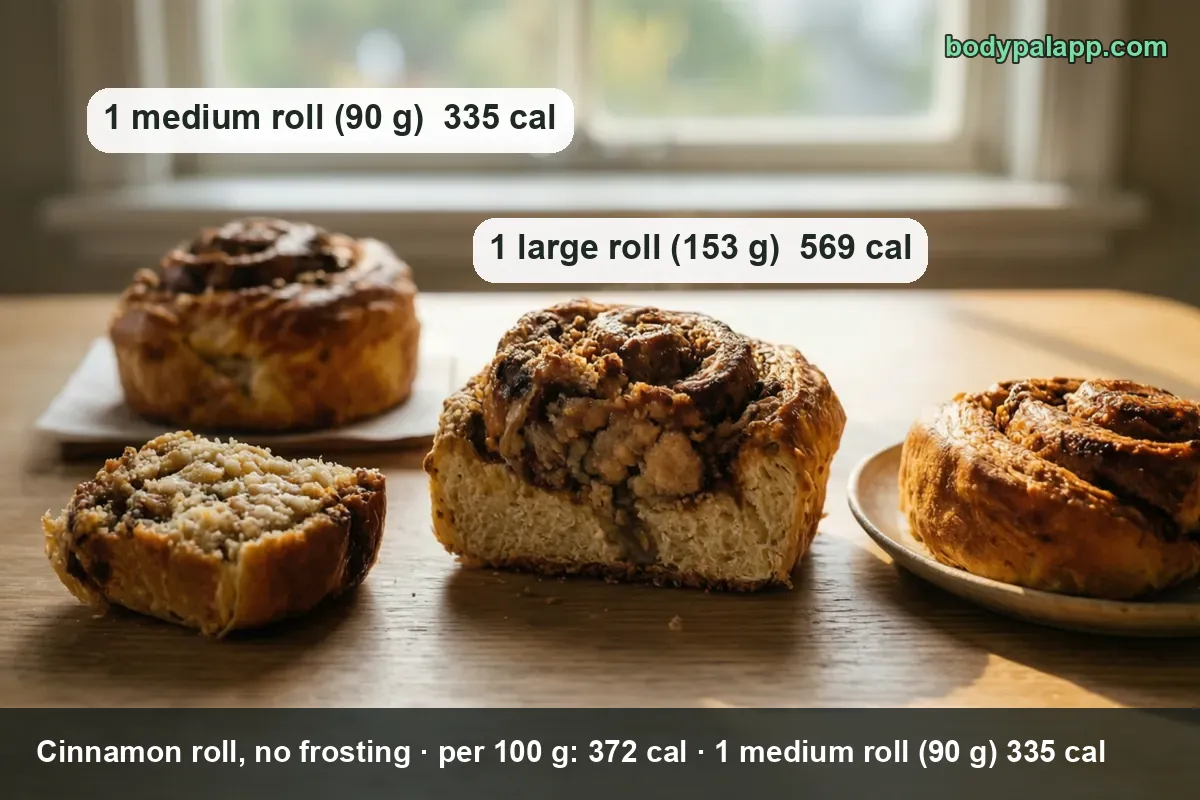
"A cinnamon roll" covers an enormous range of objects. USDA files real gram weights for each of them, and the spread is close to tenfold.
| Serving | Weight | No frosting | Frosted |
|---|---|---|---|
| 1 miniature roll | 30 g | 112 calories | 136 |
| 1 small roll | 54 g | 201 calories | 244 |
| 1 medium roll | 90 g | 335 calories | 407 |
| 1 large roll | 153 g | 569 calories | 692 |
| 1 oz | 28 g | 105 calories | 128 |
A mall-style bakery roll is bigger again. USDA's survey database keeps a 240 g portion on file for the frosted row, and on those numbers a roll that size works out to roughly 1,085 calories — arithmetic from the USDA value, not a figure read off a chain's own menu.
Two things follow. First, the difference between the small roll and the large roll (368 calories) is larger than the entire small roll. Second, a bakery display case rarely tells you which of these you are buying, so weight beats guesswork: 105 calories per ounce unfrosted, 128 frosted, is the fastest mental shortcut on this page.
Mini rolls sold as a fast-food side are denser than the bakery kind at 403 calories per 100 g, but they are small — 101 calories each for a 25 g roll.
The sodium trap in canned dough
Nobody searches for the sodium in a cinnamon roll. They should, because the refrigerated tube is where it hides.
- Bakery-style roll, 90 g: 274 mg sodium (12% DV)
- Frosted roll, 90 g: 275 mg (12% DV)
- Pillsbury refrigerated dough, 1 roll with icing, 44 g: 343 mg (15% DV)
Read that list twice. The canned roll is less than half the size of the bakery one and carries more sodium — 343 mg against 274 mg — for 145 calories against 335. Per 100 g the gap is 780 mg against 304 mg, roughly two and a half times. Baking powder and salt in the dough do the work that time and yeast do in a bakery.
That does not make the canned roll a bad choice. At 145 calories it is comfortably the smallest real cinnamon roll you can eat, with 5.0 g fat, 1.4 g saturated fat, 23.5 g carbohydrate and 9.4 g sugars. It is simply not the "light" option its calorie count suggests if sodium is the number you watch. The FDA sets the Daily Value at 2,300 mg, and two canned rolls take 30% of it.
One more oddity from the same corner of the database: unbaked refrigerated dough runs 333 calories per 100 g and the identical dough after baking runs 362. Nothing was added. Water evaporated, so the same food got about 9% denser per gram. Weigh your dough before it goes in the oven and you will undercount.
When the label shows half a roll
Two of the most-logged packaged cinnamon rolls in America print their Nutrition Facts for half the pastry, and the calorie line on the front is the half.
- Little Debbie Cinnamon Roll: 220 calories per 0.5 pastry (57 g). The whole 114 g roll is 440 calories.
- Entenmann's Cinnamon Buns: 280 calories per 0.5 bun (71 g). The whole 142 g bun is 560 calories.
Almost nobody eats half. If you log the number on the panel, you log half your breakfast.
Added sugars are worth checking on those packages too, because this is where USDA does publish the figure. A Pillsbury Grands! roll with icing (99 g) carries 20.7 g of added sugars, 41% of the 50 g Daily Value. An Immaculate Baking organic roll of the same size carries 24.0 g, 48% DV. A whole Little Debbie carries 30.0 g — 60% DV in one pastry. The standard canned Pillsbury roll, being small, is the gentle one at 9.0 g, or 18%.
The Dietary Guidelines for Americans put the ceiling for added sugars at under 10% of daily calories. On a 2,000-calorie day that is 50 g, which is where those percentages come from, and it explains why a single large frosted roll can be most of the day's allowance.
How a cinnamon roll compares with other pastries
| Item | Per 100 g | Typical serving | Calories | Protein | Fat |
|---|---|---|---|---|---|
| Cinnamon roll, no frosting | 372 | 1 medium roll (90 g) | 335 | 5.6 g | 14.8 g |
| Glazed doughnut | 421 | 1 doughnut (63 g) | 265 | 3.9 g | 14.3 g |
| Butter croissant | 406 | 1 medium (57 g) | 231 | 4.7 g | 12.0 g |
| Blueberry muffin | 375 | 1 medium (113 g) | 424 | 5.1 g | 18.2 g |
| Plain bagel | 264 | 1 medium (105 g) | 277 | 11.1 g | 1.4 g |
Per 100 g the cinnamon roll is unremarkable — lighter than a doughnut and a croissant, about level with a muffin. Per item it sits in the middle, because size decides everything: the doughnut is a small object, the muffin is a large one.
Our take: if the goal is the smallest hit at a bakery counter, the croissant wins at 231 calories and the doughnut is close behind. If the goal is a breakfast that holds until lunch, the bagel is the trade worth making — 277 calories, within 60 of the cinnamon roll, but with double the protein and a tenth of the fat. Nothing on that table is a low-calorie food; the bagel is just the one that gives you something back for the calories.
And if it is the cinnamon roll you want, buy it unfrosted or eat it small. A 54 g roll at 201 calories is a genuine snack. A 153 g frosted one at 692 is a meal that eats like a snack.
Most popular cinnamon roll brands in the United States
Ranked by how widely each product appears among foods sold in the United States, from the BodyPal food database of over 3.3 million products. Calories are the figures printed on each Nutrition Facts label, checked against USDA FoodData Central.
| Product | Calories (per 100 g) |
|---|---|
| Pillsbury Cinnamon Rolls with Original Icing | 330 cal |
| Pillsbury Grands! Cinnamon Rolls with Cinnabon Icing | 323 cal |
| Pillsbury Grands! Flaky Cinnamon Rolls with Cinnabon Icing | 362 cal |
| Immaculate Baking Organic Cinnamon Rolls with Icing | 328 cal |
| Annie’s Organic Cinnamon Rolls with Icing | 333 cal |
| Great Value Original Cinnamon Rolls with Icing | 341 cal |
Brand popularity: BodyPal food database. Nutrition: manufacturer labels / USDA FoodData Central.
Cinnamon roll FAQs
How many calories in a cinnamon roll?
335 calories for a medium 90 g roll with no frosting, at 372 calories per 100 g. A small 54 g roll is 201 calories and a large 153 g bakery roll is 569. Frosted, the same medium roll comes to 407 calories.
How many calories in a cinnamon roll with icing?
407 calories for a medium 90 g frosted roll, at 452 calories per 100 g. That is 72 calories more than the same roll plain. The bigger change is saturated fat, which climbs from 2.8 g to 11.4 g, or 57% of the Daily Value.
How many calories in a Pillsbury cinnamon roll?
145 calories for one 44 g roll baked with its icing, at 330 calories per 100 g. It carries 5.0 g of fat, 23.5 g of carbohydrate, 9.4 g of sugars and 343 mg of sodium — 15% of the Daily Value, more than a bakery roll twice its size.
How many calories in a Pillsbury Grands cinnamon roll?
320 calories for one 99 g Grands! roll with icing, at 323 calories per 100 g. Added sugars are the number to watch on that label: 20.7 g in a single roll, which is 41% of the 50 g Daily Value.
How much sugar is in a cinnamon roll?
28.6 g of total sugars in a medium 90 g roll without frosting. Total sugars carry no Daily Value, but added sugars do, and packaged rolls declare them: a 99 g Immaculate Baking roll holds 24.0 g of added sugars, 48% of the daily 50 g.
Is a cinnamon roll healthy?
A frosted 90 g roll carries 11.4 g of saturated fat, 57% of the Daily Value, next to 407 calories. Unfrosted, the same roll drops to 2.8 g, or 14%. Skipping the frosting changes the nutrition panel far more than eating a smaller frosted roll does.
How much protein is in a cinnamon roll?
5.6 g in a medium 90 g roll, which is 11% of the Daily Value. A plain bagel of roughly the same calories carries 11.1 g with 1.4 g of fat, so the roll is the weaker breakfast when protein is what you are counting.
How many calories in a large bakery cinnamon roll?
569 calories for a 153 g roll without frosting, and 692 calories frosted. USDA also keeps a 240 g portion on file for the frosted row, which works out at about 1,085 calories on its numbers — the size sold at mall bakery counters.
Similar foods
- Cheerios Cereal — 104 cal per cup
- Sausage Biscuit — 409 cal per regular sausage biscuit
- Biscotti — 119 cal per cookie
- Corn Chex Cereal — 145 cal per cup
- Kolache — 263 cal per pastry
- Weetabix — 130 cal per 2 biscuits
Count it without the math
Point the camera at the pastry and BodyPal works out the calories, the sugars and the sodium from the photo.


How long does it take to burn off a cinnamon roll?
A medium 90 g roll, no frosting is 335 kcal. Enter your weight and the amount you ate to see how long it takes you to burn that off:
lb
| Activity | Time to burn 335 kcal |
|---|---|
| Walking, brisk | 1 hr 7 min |
| Cycling, moderate | 42 min |
| Swimming, moderate | 48 min |
| Jogging | 39 min |
| Weight training, moderate | 1 hr 14 min |
Times are for a 155 lb adult at a steady pace; change the weight to see yours. The amount is set to the portion in the text (90 g); change it to what you actually ate. BodyPal works this out from your steps automatically.
This table assumes you know your daily total. If you do not, the daily calorie calculator works it out from five numbers.