Jelly donut calories come to 289 for one 85 g donut and 340 per 100 g. The detail to notice is where they come from: fat supplies 48% of the calories and carbs 45%, while protein stays at 7%. You're eating a fried pastry first. The jelly comes a distant second.
289kcal
1 donut · 85 g, yeast-leavened, jelly filled
7%protein
5 gProtein
33 gCarbs
15.9 gFat
How to burn off 289 kcal
—Walking, brisk
—Jogging
—Cycling, moderate
—Swimming
Skip the math. BodyPal counts these calories from your steps and workouts automatically.
Nutrition facts
Yeast-leavened, jelly filled · per 85 g
Calories
289 kcal
Protein
5 g
Carbohydrate
33 g
Fat
15.9 g
Saturated fat
4.1 g
Cholesterol
22 mg
Sodium
387 mg
Potassium
67 mg
Iron
1.5 mg
Source: USDA FoodData Central
🛡️
Verified nutrition data
Numbers on this page come from USDA FoodData Central, the U.S. Department of Agriculture’s food composition database, and from manufacturer labels where a branded product is named. Last verified September 2026. How we verify our data →
Jelly donut: calories, protein and sodium by serving
Percent of daily value uses the FDA reference of 2,000 kcal a day.
Serving
kcal
Protein
Carbs
Fat
Sodium
% DV kcal
1 donut (85 g)
289
5 g
33.2 g
15.9 g
387 mg
14%
100 g
340
5.9 g
39 g
18.7 g
455 mg
17%
3 × 1 donut (85 g)
867
15 g
1,160 mg
5 × 1 donut (85 g)
1,445
25.1 g
1,934 mg
One donut is 289 calories, and a box climbs fast
A single 85 g jelly donut carries 289 calories, about 14% of the daily value for energy. That is a manageable treat on its own. The trouble is that donuts rarely travel alone, and the filling makes each one heavier than a plain ring of dough.
Two donuts weigh 170 g and reach 578 calories. Three come to 255 g and 867 calories, and five, the kind of number that disappears at an office meeting, total 425 g and 1,445 calories. Protein barely keeps pace: five donuts deliver only 25.1 g of it, so the energy rises much faster than the staying power.
If you plan to have one, decide on one before the box opens. Halving a donut is also a fair option, since the calories split evenly with the weight. Logging it right away keeps the second one from slipping in unnoticed; BodyPal can log a jelly donut from a photo.
Fat, not jelly, supplies most of the calories
The jelly suggests a fruit snack, but the calorie split says otherwise. Fat accounts for 48% of the calories, carbs for 45% and protein for just 7%. Per 100 g that means 18.7 g of fat, 39 g of carbs and 5.9 g of protein.
One donut holds 15.9 g of fat and 33.2 g of carbs, and 17.9 g of those carbs are sugars. Saturated fat runs 4.8 g per 100 g. Fiber is nearly absent at 0.8 g per donut, which is why a jelly donut digests quickly and rarely holds you over until lunch.
The frying is the big driver here. The dough soaks up oil, and the sweet filling adds sugar on top. Neither part brings much protein or fiber to slow things down, so it works best as a planned dessert rather than a breakfast you expect to carry you through the morning.
Sodium is the row nobody expects in a sweet pastry
A jelly donut tastes sweet, yet one donut carries 387 mg of sodium, 17% of the 2300 mg daily value. Per 100 g it reaches 455 mg, or 20%. Leavening and salt in the dough account for most of it, and the sweet filling hides it well.
Like the calories, sodium scales with every extra donut. Two donuts bring 774 mg, three bring 1,160 mg and five reach 1,934 mg. At five, a box of pastries has used up most of the daily value before any savory food enters the picture.
Cholesterol, by contrast, is modest at 26 mg per 100 g against a daily value of 300 mg. Potassium is low at 79 mg per 100 g. If you watch sodium, count a jelly donut the way you would count a salty snack, not as a free sweet.
Pair it with protein if it has to be breakfast
With 5 g of protein, one donut covers about 10% of the daily value. That gap is the reason a donut breakfast often leaves you hungry an hour later. Adding a protein source such as eggs, Greek yogurt or a glass of milk gives the meal something that lasts.
Treat the donut as the sweet part of the meal and let the rest of the plate do the work. Fruit adds fiber the donut lacks, and coffee or tea without extra sugar keeps the sugar total from stacking up. Later meals can lean on vegetables and lean protein to balance the fat and sodium.
If you buy specialty versions, such as Katz Gluten Free Jelly Donut, check the package label, since recipes and sizes differ. The figures on this page describe a standard yeast-leavened donut with jelly filling.
How does jelly donut compare?
Here is how a jelly donut stacks up against plain, sugar and Boston cream donuts, per 100 g and per usual serving.
Verdict: For the fewest calories per gram, the jelly donut wins at 340 per 100 g, against 426 for plain and sugar donuts and 361 for Boston cream. If you want the smallest single treat, a 192-calorie sugar donut beats a 289-calorie jelly donut simply because it weighs less.
Most popular jelly donut brands in the United States
Ranked by popularity in the BodyPal database
# Productkcal / 100 g
1Katz Gluten Free Jelly Donut2.1 oz · 60 g283 kcal
The gluten-free packaged donut is made to a different recipe, so its per-100 g number reads lower than the yeast-leavened bakery doughnut above. Source: manufacturer labels / USDA FoodData Central.
Jelly donut FAQs
How many calories are in one jelly donut?
A standard jelly donut weighs about 85 g and has 289 calories. Per 100 g, a yeast-leavened jelly doughnut is 340 calories.
Is a jelly donut good for weight loss?
One 85 g jelly donut is 289 calories, mostly from 33.2 g carbs and 15.9 g fat, with only 5.0 g protein and 0.8 g fiber, so it is calorie-dense for its size.
Jelly donut vs plain donut: which has fewer calories?
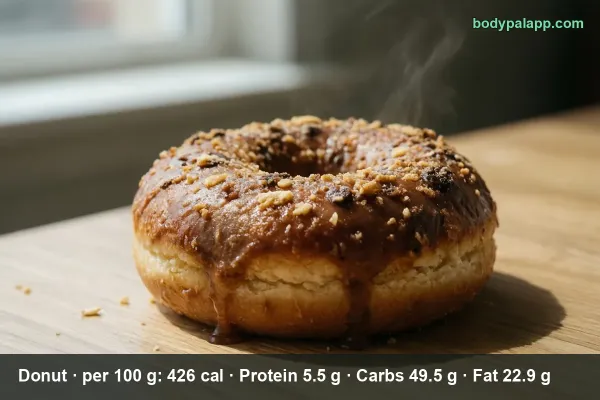
Per 100 g a jelly donut is 340 calories and a plain donut is 426. One 85 g jelly donut works out to 289 calories.
How much sugar is in a jelly donut?
An 85 g jelly donut has 17.9 g sugar within 33.2 g total carbs. Per 100 g that is 21.1 g sugar.
How many calories are in two jelly donuts?
Two jelly donuts total 578 calories for 170 g. They also bring 774 mg of sodium and 10 g of protein, so the calories climb much faster than the protein.
How much fat is in a jelly donut?
One jelly donut has 15.9 g of fat, and fat supplies 48% of its calories. Saturated fat comes to 4.8 g per 100 g, so most of the energy traces back to frying.
How much protein does a jelly donut have?
A jelly donut has 5 g of protein, about 10% of the daily value. Protein makes up only 7% of its calories, so it will not keep you full for long.
How much sodium is in a jelly donut?
One jelly donut contains 387 mg of sodium, 17% of the daily value. Per 100 g that rises to 455 mg, which is a lot for a sweet pastry.