
How many calories are in a donut?
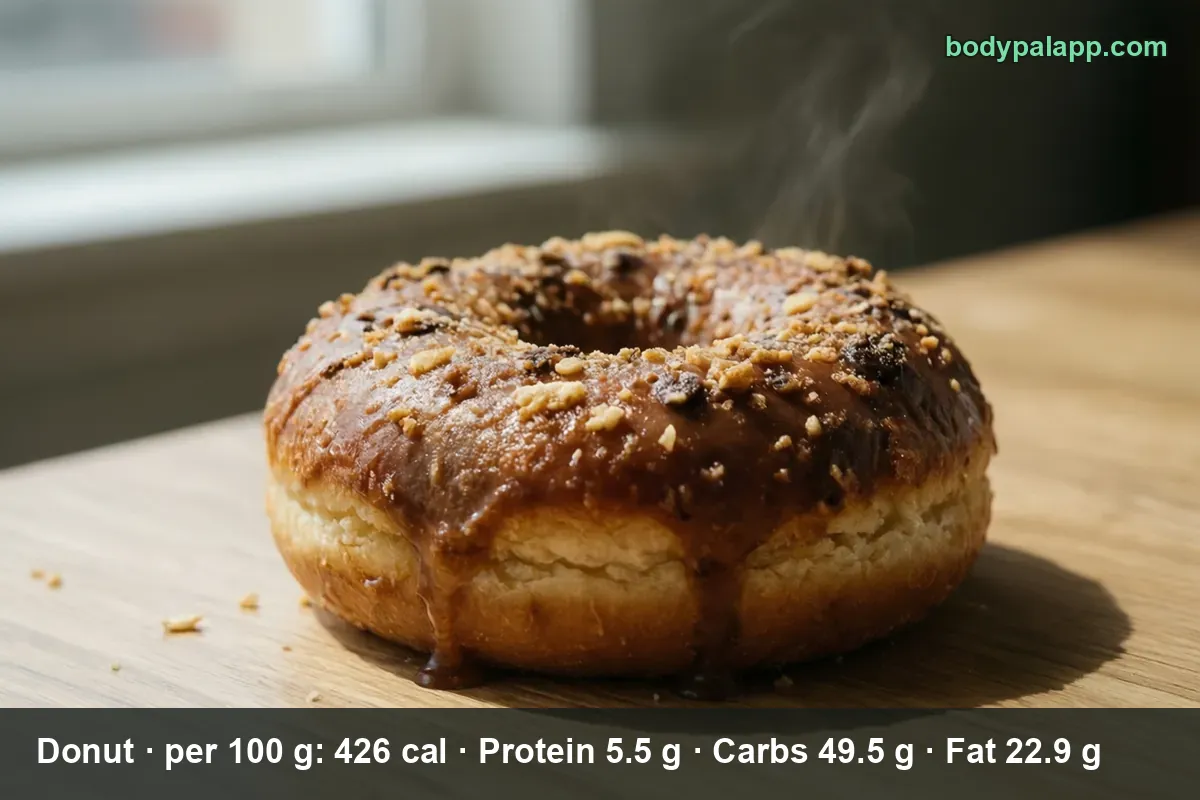
One donut from the counter weighs about 75 g and carries 320 calories. Per 100 g, fried and glazed dough runs 426 calories, which makes it one of the densest things in the pastry case. Two on the way to work is 639. The type matters less than most people expect.
On this page
- Donut quick facts
- US servings, from a donut hole to two donuts
- Glazed, cake, chocolate, jelly and Boston cream
- Saturated fat is the row that surprises people
- How does a donut compare?
- Most popular donut brands
- FAQ
Donut quick facts
The number above comes from the USDA record FNDDS 2708062, "Doughnut, NFS". NFS means "not further specified", and that is exactly the situation most people are in: a donut from a box on the counter, glazed or not, nobody quite sure whether the dough was raised with yeast or baking powder. Named styles get their own rows further down, and they land within about 70 calories of each other per 100 g.
| Nutrient | Per 100 g | Per 1 doughnut (75 g) | % Daily Value |
|---|---|---|---|
| Calories | 426 | 320 | — |
| Total fat | 22.86 g | 17.1 g | 22% |
| Saturated fat | 9.85 g | 7.4 g | 37% |
| Carbohydrate | 49.52 g | 37.1 g | 14% |
| Dietary fiber | 1.8 g | 1.4 g | 5% |
| Total sugars | 23.51 g | 17.6 g | — |
| Protein | 5.52 g | 4.1 g | 8% |
| Sodium | 378 mg | 284 mg | 12% |
| Cholesterol | 20 mg | 15 mg | 5% |
| Potassium | 113 mg | 85 mg | 2% |
% Daily Value is based on a 2,000-calorie diet.
Verified nutrition data
Numbers on this page come from USDA FoodData Central, the U.S. Department of Agriculture’s food composition database, and from manufacturer labels where a branded product is named. Last verified September 2026. How we verify our data →
Two rows you would see on a wrapper are missing here on purpose. This FNDDS edition does not publish added sugars or trans fat for prepared foods, so there is nothing honest to put in those cells. Total sugars are published, and at 17.6 g a single donut is mostly the glaze and the dough talking, not fruit. Sodium at 284 mg is roughly an eighth of a teaspoon of table salt, which is more than a donut tastes like it holds.
US servings, from a donut hole to two donuts
| Serving | Weight | Calories |
|---|---|---|
| 1 mini donut hole | 15 g | 64 kcal |
| 1 oz | 28 g | 119 kcal |
| 1 cup, pieces | 60 g | 256 kcal |
| One donut, counter size | 75 g | 320 kcal |
| Two donuts | 150 g | 639 kcal |
| Per 100 g | 100 g | 426 kcal |
The 75 g donut, the 15 g donut hole and the 1 cup of pieces are USDA household measures for this record. The ounce and the two-donut line are our own arithmetic from the USDA 100 g figure, not USDA servings.
That cup line is the trap. A cup of donut pieces weighs only 60 g and comes to 256 calories, which is less than one whole donut at 75 g and 320 calories. Fried dough is full of air, so volume measures undercount it badly. If you are logging a donut, log the piece, not the cup. Five donut holes, at 15 g each, come to the same 320 calories as one full-size donut, which is the more useful piece of arithmetic when the box on the table is holes.
Glazed, cake, chocolate, jelly and Boston cream
| Version | Per 100 g | Typical piece | Calories |
|---|---|---|---|
| Glazed, yeast-leavened | 421 kcal | 1 doughnut (60 g) | 253 kcal |
| Cake, plain (old-fashioned) | 434 kcal | 1 doughnut (60 g) | 260 kcal |
| Cake with icing | 431 kcal | 1 doughnut (75 g) | 323 kcal |
| Chocolate | 417 kcal | 1 doughnut (75 g) | 313 kcal |
| Jelly | 390 kcal | 1 oz (28 g) | 109 kcal |
| Custard-filled (Boston cream) | 363 kcal | 1 oz (28 g) | 102 kcal |
The spread between the lightest and heaviest donut per 100 g is smaller than the marketing suggests. Custard-filled is the lightest USDA row here at 363 calories per 100 g; plain cake is the heaviest at 434. Everything else sits in a narrow band in between. What actually decides your number is the size of the thing in your hand.
Yeast-leavened glazed is the classic light, airy ring, 253 calories for a 60 g piece. It is also the closest USDA stand-in for a chain's original glazed, since USDA publishes no record for restaurant donuts. If the shop gives you its own label numbers, use those instead.
Plain cake dough is raised with baking powder rather than yeast, and it drinks more frying fat: 24.93 g per 100 g against 22.7 g for the yeast ring. Add icing and the sugars climb to 27.14 g per 100 g. Chocolate donuts are the fiber outlier, at 3.7 g per 100 g, double the 1.8 g in the generic row, because cocoa solids carry their own.
Filled donuts behave the way you would hope. Jam is water and sugar, so the jelly row drops to 18.16 g of fat per 100 g and custard to 18.92 g, against 22.86 g for the generic donut. USDA does not publish a piece weight for either filled row, so a per-donut figure has to be scaled: at the generic 75 g, that is about 293 calories for jelly and 272 for custard-filled, our own arithmetic from the 100 g values rather than a USDA serving. And if you want the single sugariest thing in the case, it is the glazed french cruller at 412 calories and 35.11 g of sugars per 100 g.
Packaged supermarket donuts run in the same territory. Mel-O-Cream original glazed holes list 210 calories for four holes, 50 g, and Little Debbie mini glazed list 250 for four donuts, 60 g. Frosted mini donuts are the outlier on the shelf at 500 calories per 100 g, so three of them, 48 g, come to 240.
Saturated fat is the row that surprises people
Most people check the calories on a donut and stop. The row that deserves the look is saturated fat. One 75 g donut delivers 7.4 g, which is 37% of the FDA Daily Value of 20 g, while total fat at 17.1 g is only 22% of its own Daily Value. One breakfast pastry takes better than a third of the day's saturated fat allowance, and the Dietary Guidelines put saturated fat squarely among the things to hold down.
Sodium is the quiet second story, and it depends on the dough. Plain cake donuts carry 477 mg of sodium per 100 g against 316 mg for the yeast-leavened glazed. On a 60 g piece that is 286 mg, 12% of the Daily Value, versus 190 mg and 8%. Jelly donuts are the mildest at 259 mg per 100 g. If you are watching sodium, the yeast ring or the filled donut is the better pick, and the difference is bigger than the calorie gap between them.
None of that makes a donut a problem food. It makes it a 320-calorie item with very little protein, 4.1 g, and very little fiber, 1.4 g, which is another way of saying it will not hold you until lunch. Pairing it with something built on protein is the practical move, and MyPlate is the plain-English version of that idea.
How does a donut compare?
| Pastry | Per 100 g | US serving | Calories |
|---|---|---|---|
| Donut | 426 kcal | one donut, 75 g | 320 kcal |
| Churros | 419 kcal | 1 oz, 28 g | 117 kcal |
| Beignet | 417 kcal | 1 oz, 28 g | 117 kcal |
| Croissant | 406 kcal | 1 oz, 28 g | 114 kcal |
Our take: on a per-gram basis these four are the same food. The donut is the densest of them at 426 calories per 100 g, but the croissant at 406 is only 20 behind, and nobody switches pastries for 20 calories per 100 g. The real difference is portion discipline. A donut arrives as a fixed 75 g object, so its number is fixed too, while churros and beignets arrive by the plate and a croissant can weigh anything from 40 g to well over 100. If you want the number you can predict, take the donut. If you want the smaller number, take a smaller piece of anything on this list. And on protein the croissant wins outright, 8.2 g per 100 g against 5.52 g, which is the one nutritional argument in the group.
Most popular donut brands in the United States
Ranked by how widely each product appears among foods sold in the United States, from the BodyPal food database of over 3.3 million products. Calories are the figures printed on each Nutrition Facts label, checked against USDA FoodData Central.
| Product | Calories (per 100 g) |
|---|---|
| Mel-O-Cream Original Glazed Donut Holes | 420 cal |
| Mel-O-Cream Chocolate Glazed Donut Holes | 420 cal |
| Little Debbie Mini Glazed Donuts | 417 cal |
| Maple Donuts Glazed Chocolate Cake Donut Holes | 375 cal |
| Hostess Frosted Mini Donuts | 500 cal |
| Hostess Mini Donuts, Frosted Strawberry | 500 cal |
Brand popularity: BodyPal food database. Nutrition: manufacturer labels / USDA FoodData Central.
Donut FAQs
How many calories are in one donut?
One donut is 320 calories at the USDA generic weight of 75 g, or 426 calories per 100 g. That single pastry carries 17.1 g of fat, 7.4 g of it saturated, and 17.6 g of sugars. A second donut takes the pair to 639 calories.
How many calories are in a glazed donut?
A yeast-leavened glazed donut is 253 calories for a 60 g piece, or 421 calories per 100 g. Airy yeast dough sits slightly below the generic donut row and well below cake dough on sodium: 316 mg per 100 g against 477 mg for plain cake donuts.
How many calories are in a Krispy Kreme original glazed doughnut?
USDA does not publish a record for any chain donut, so the closest match is its yeast-leavened glazed row at 421 calories per 100 g, or 253 calories for a 60 g piece. Chains publish their own label numbers; use those when you have them, and this row when you don't.
How many calories are in a chocolate donut?
A chocolate donut is 313 calories at 75 g, or 417 calories per 100 g. It carries the most fiber of any donut row here, 3.7 g per 100 g, double the 1.8 g in the generic donut, because cocoa solids bring their own. Sugars sit higher too, at 26.05 g.
How many calories are in a cake or old-fashioned donut?
A plain cake donut, the old-fashioned style, is 260 calories for a 60 g piece and 434 calories per 100 g, the highest of the eight USDA donut records on this page. Chemically leavened dough soaks up more frying fat, 24.93 g per 100 g, and carries 477 mg of sodium.
How many calories are in a jelly donut?
A jelly donut is 390 calories per 100 g, or 109 calories per ounce. USDA does not publish a piece weight for the filled rows, so scaling to the generic 75 g donut is our own arithmetic: about 293 calories. Jam is water and sugar, so fat drops to 18.16 g.
How many calories are in a Boston cream donut?
A custard-filled donut, the base for Boston cream, is 363 calories per 100 g and 102 calories per ounce. That is the lightest donut row on this page, because custard displaces fried dough. Scaled to the generic 75 g donut it works out to 272 calories, our arithmetic rather than a USDA serving.
How many calories are in a donut hole?
One mini donut hole is 64 calories at 15 g, the USDA household measure for the generic donut row. Five of them is 320 calories, the same as one whole donut. Packaged holes land close: Mel-O-Cream original glazed lists 210 calories for four holes, 50 g.
Similar foods
- Chocolate Donut — 320 cal per donut
- Chocolate Croissant — 240 cal per croissant
- Glazed Donut — 253 cal per glazed donut, medium
- Honey Bun — 358 cal per 3 oz bun
- Granola Cereal — 462 cal per cup
- Cake donut — 308 cal per large donut
Count it without the math
Point the camera at the box and BodyPal counts the donut for you, glaze and all.


How long does it take to burn off a donut?
One doughnut (75 g) is 320 kcal. Enter your weight and the amount you ate to see how long it takes you to burn that off:
lb
| Activity | Time to burn 320 kcal |
|---|---|
| Walking, brisk | 1 hr 4 min |
| Cycling, moderate | 40 min |
| Swimming, moderate | 46 min |
| Jogging | 38 min |
| Weight training, moderate | 1 hr 11 min |
Times are for a 155 lb adult at a steady pace; change the weight to see yours. The amount is set to the portion in the text (75 g); change it to what you actually ate. BodyPal works this out from your steps automatically.
Want the bigger picture? Calculate your daily calorie needs — your maintenance figure, a target for losing or gaining, and the date you get there.