
How many calories in a cake donut?
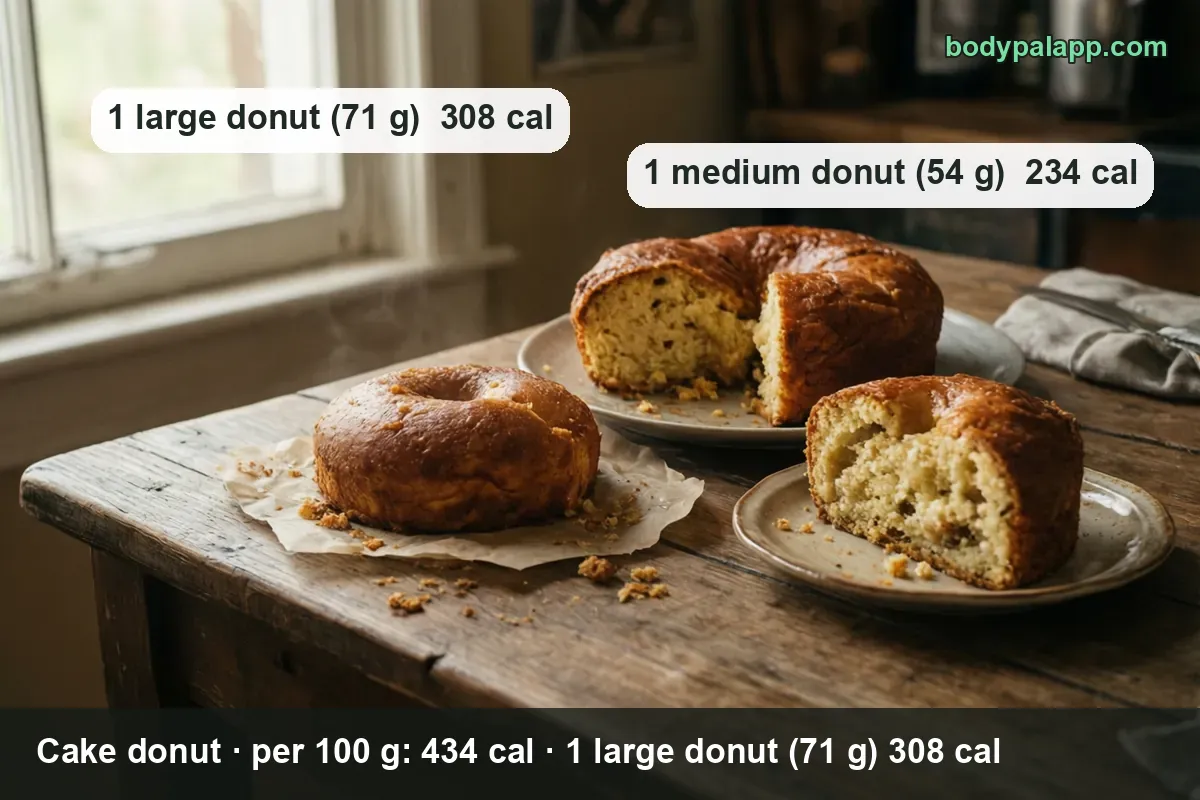
A medium cake donut, 3-1/4 inches across and 54 g on the scale, is 234 calories. Per 100 g the plain ring runs 434. A large 4-inch donut is 308, and one donut hole is 61. Every figure on this page describes a plain or old-fashioned cake donut; glazed and chocolate-frosted rings carry their own numbers further down.
On this page
- Cake donut quick facts
- US servings, from a donut hole to a 4-inch ring
- Four donut holes cost more than one donut
- Glaze and frosting, and why they lower the density
- Saturated fat is the row to watch
- The sodium nobody expects in a sweet ring
- Cake or yeast? Size settles it
- How does a cake donut compare?
- Most popular cake donut brands
- FAQ
Cake donut quick facts
The record underneath everything here is SR Legacy 174990, "Doughnuts, cake-type, plain (includes unsugared, old-fashioned)". USDA spells it doughnut; the counter you buy it at spells it donut. Same ring.
That record matters because it is the undressed one. USDA keeps three separate cake-type lines — plain, sugared or glazed, and chocolate-frosted — and the one a search for "calories in cake donut" lands on is the first, the old-fashioned ring with nothing on it but the crust the fryer gave it.
The serving column is a medium donut of 3-1/4 inches, 54 g, which is USDA's own household measure and the size most cake donuts are cut to.
| Nutrient | Per 100 g | Per 1 medium donut (54 g) | % Daily Value |
|---|---|---|---|
| Calories | 434 | 234 | — |
| Total fat | 24.9 g | 13.5 g | 17% |
| Saturated fat | 11.1 g | 6.0 g | 30% |
| Carbohydrate | 47.1 g | 25.4 g | 9% |
| Dietary fiber | 1.7 g | 0.9 g | 3% |
| Total sugars | 18.2 g | 9.8 g | — |
| Protein | 5.3 g | 2.9 g | 6% |
| Sodium | 477 mg | 258 mg | 11% |
% Daily Value is based on a 2,000-calorie diet.
Verified nutrition data
Numbers on this page come from USDA FoodData Central, the U.S. Department of Agriculture’s food composition database, and from manufacturer labels where a branded product is named. Last verified September 2026. How we verify our data →
Two rows a packaged label would print are absent, and for one reason: the SR Legacy edition holds no added sugars figure and no trans fat figure for any cake-type doughnut line. Copying either from a store label would mean stapling one food's numbers to another food's record, so they stay off the table. Total sugars carry no Daily Value on a US label at all, which is why that cell is blank.
Two more numbers sit outside the core label but come from the same record. Cholesterol is 10 mg per 100 g, so about 5 mg in a medium donut, a rounding error against the 300 mg Daily Value. Potassium is 134 mg per 100 g, or 72 mg in a donut, under 2% of the day.
US servings, from a donut hole to a 4-inch ring
| Serving | Weight | Calories |
|---|---|---|
| 1 mini donut, 1-1/2 in (donut hole) | 14 g | 61 |
| 1 oz | 28 g | 123 |
| 1 donut, USDA generic | 40 g | 174 |
| 1 donut stick | 52 g | 226 |
| 1 long twist, 4-1/2 in | 52 g | 226 |
| 1 medium donut, 3-1/4 in | 54 g | 234 |
| 1 large donut, 4 in | 71 g | 308 |
Seven household measures, all of them from USDA's portion file for this one record, and the spread between the smallest whole donut and the largest is 134 calories. That is the trap in this food. Nothing about the recipe changes across those rows. Only the diameter does.
The gap that catches people is the one between USDA's generic "1 donut" at 40 g and the ring an American bakery case actually hands over. Log the generic and you book 174 calories. Eat a medium and you ate 234; eat a large and you ate 308. A person who taps "1 donut" out of habit is short by a quarter to nearly a half of the item, every single time, and the error always leans the same way.
There is no raw-against-cooked question here, unlike ground beef or rice. A donut only exists after the fryer. What replaces it is the size question, and it is worth about as much: measure the ring against your palm before you log it. Three inches and change is a medium. Four inches and it is a 308.
Four donut holes cost more than one donut
Donut holes read as a smaller decision than a donut. On the scale they are not.
One hole is 14 g and 61 calories. Four of them come to 243 — that is more than the 234 in a whole medium donut, in a form you can eat in a minute standing at a counter. Six holes reach 365, which is beyond the 308 of the largest ring in the table.
Store labels tell the same story in their own units. A retail bag of glazed sour cream cake donut holes declares 260 calories for four pieces; a plain-cake bag declares 220 for four. Different recipes, same conclusion.
Holes disappear quickly because nothing about them signals a portion. A donut is one object and you decide once. A tub of holes is a pile you decide about six times, each decision worth 61 calories.
Glaze and frosting, and why they lower the density
| Version | Per 100 g | Serving | Calories |
|---|---|---|---|
| Plain / old-fashioned (this page) | 434 | 1 medium, 3-1/4 in (54 g) | 234 |
| Sugared or glazed | 426 | 1 medium, 3 in (45 g) | 192 |
| Chocolate-coated or frosted | 452 | 1 medium, 3 in (43 g) | 194 |
| Chocolate-frosted, large | 452 | 1 large, 3-1/2 in (67 g) | 303 |
| Chocolate-frosted donette | 452 | 1 donette, 2 in (18 g) | 81 |
Here is the result almost nobody expects. Sugar coating lowers the calories per 100 g rather than raising them: the glazed cake donut line is 426 against the plain ring's 434.
The arithmetic behind that is straightforward once you see it. Glaze adds carbohydrate, 50.8 g per 100 g against 47.1 g. It also dilutes the fat, 22.9 g against 24.9 g. Fat carries 9 calories per gram and sugar carries 4, so trading two grams of one for four grams of the other very nearly cancels out, and what tips it is the fat.
Frosting behaves differently because chocolate coating brings its own fat with it. That line runs 452 per 100 g, the densest of the three, with 25.3 g of fat and 51.3 g of carbohydrate.
None of that decides what lands in your log, though. Serving size does. The glazed medium is a 3-inch ring at 45 g and the plain medium is a 3-1/4-inch ring at 54 g, so the glazed donut comes in at 192 calories against 234 — 42 fewer, despite being the sweeter object. A frosted donette of 18 g is 81 calories and a frosted large of 67 g is 303, from the same record, a spread of nearly four to one.
The lesson is worth stating flatly, because the internet gets it backwards constantly: on a cake donut, coating is a rounding adjustment and diameter is the number.
Saturated fat is the row to watch
Calories are why people search for donuts. Saturated fat is the row that should make them pause.
One medium cake donut is 234 calories, which is under 12% of a 2,000-calorie day. The same donut carries 6.0 g of saturated fat, which is 30% of the 20 g FDA Daily Value. The ratio between those two percentages is about 2.5 to 1. For most baked goods it sits nearer 1.5 to 1.
That gap is the honest information gain of this page. A cake donut is not remarkable on calories for a pastry. It is remarkable on saturated fat, because the batter is enriched and then fried in more fat, and the Dietary Guidelines for Americans put the ceiling for saturated fat at under 10% of daily calories. On a 2,000-calorie day that is roughly 22 g. One medium plain cake donut spends more than a quarter of it.
The glazed version, oddly, is the gentler pick on this exact row: 5.93 g of saturated fat per 100 g against 11.1 g for the plain ring. Chocolate-frosted is the harshest at 13.5 g per 100 g. If saturated fat is the number you track, the ranking runs glazed, then plain, then frosted — the reverse of how sweet they taste.
The sodium nobody expects in a sweet ring
A medium cake donut holds 258 mg of sodium, 11% of the 2,300 mg Daily Value, from 477 mg per 100 g.
Two donuts and a coffee, then, and you have spent 22% of the day's sodium before anything salty has reached your plate. Fried dough is salted dough, and sugar covers the taste of salt well enough that most people would guess a fifth of that figure.
It is also the row that separates cake donuts from the rest of the case. Yeast-raised glazed runs 316 mg per 100 g and a french cruller 345 mg; the plain cake ring is 477 mg, half again as much as the yeast ring and 38% above the cruller. Chemical leavening is part of the reason — baking powder is a sodium compound, and cake donuts use it where yeast donuts use time.
Fiber does nothing to offset any of this: 0.9 g in a medium donut, 3% of the 28 g Daily Value. MyPlate counts whole grains toward the day's grain servings, and a cake donut is refined flour throughout, so it contributes to the grain group the way a slice of white bread does and no more.
Cake or yeast? Size settles it
Per 100 g the two families are almost the same food: cake at 434, yeast-leavened glazed at 421, a difference of 3%. Anyone comparing densities would call it a tie and move on.
Per donut they are not close. The standard yeast glazed ring is 64 g and the standard cake ring is 54 g, so the yeast donut lands at 269 calories against 234 — 15% more, from the same 3% density gap plus ten grams of dough.
Yeast donuts are lighter to hold and larger to buy. Cake donuts are denser to hold and smaller to buy. Those two facts pull in opposite directions and the size wins, which is why the per-100-g comparison that dominates calorie charts gives the wrong answer to the only question anyone asks: which one costs me less at the counter?
Our take: on calories the plain cake donut wins by 35. On saturated fat the two tie at 6.0 g a piece, because the yeast ring's lower density is cancelled by its larger size. The frosted cake donut is the one to leave in the box at 13.5 g per 100 g. Neither is worth logging as anything but dessert: 2.9 g of protein and 0.9 g of fiber in a cake donut, 3.9 g and 1.3 g in a yeast one.
How does a cake donut compare?
| Item | Per 100 g | Serving | Calories | Protein / Carbs / Fat |
|---|---|---|---|---|
| Cake donut, plain (this page) | 434 | 1 medium, 3-1/4 in (54 g) | 234 | 2.9 / 25.4 / 13.5 g |
| Cake donut, sugared or glazed | 426 | 1 medium, 3 in (45 g) | 192 | 2.3 / 22.9 / 10.3 g |
| Cake donut, chocolate-frosted | 452 | 1 medium, 3 in (43 g) | 194 | 2.1 / 22.1 / 10.9 g |
| Yeast donut, glazed | 421 | 1 medium, 3-3/4 in (64 g) | 269 | 3.9 / 30.7 / 14.5 g |
| French cruller, glazed | 412 | 1 cruller, 3 in (41 g) | 169 | 1.3 / 24.4 / 7.5 g |
All five are USDA survey records from the same doughnut family, so the comparison is fair. Per 100 g they cover 412 to 452, a spread of under 10%. Per piece they cover 169 to 269, a spread of nearly 60%. The density column is close to useless here and the weight column decides everything.
Our take: the french cruller is the smallest number on the counter at 169 calories, and it earns that by being a 41 g object with the least fat in the table, 7.5 g. The glazed cake donut is the pick if you want a normal-looking donut for under 200. The yeast glazed ring is the largest number here at 269 and it also brings the most protein, 3.9 g, which is not a reason to choose it. If you are watching saturated fat rather than calories, the cruller wins again at 4.67 g per 100 g against 11.1 g for the plain cake ring — less than half.
Most popular cake donut brands in the United States
Ranked by how widely each product appears among foods sold in the United States, from the BodyPal food database of over 3.3 million products. Calories are the figures printed on each Nutrition Facts label, checked against USDA FoodData Central.
| Product | Calories (per 100 g) |
|---|---|
| Maple Donuts Glazed Chocolate Cake Donut Holes | 375 cal |
| Bakery Fresh Goodness Chocolate Enrobed Cake Donuts | 464 cal |
| Kroger Glazed Sour Cream Cake Donut Holes | 464 cal |
| Meijer Plain Cake Donut Holes | 393 cal |
| Maple Donuts Assorted Cake Donut Holes | 406 cal |
| Meijer Assorted Cake Donut Holes | 411 cal |
Brand popularity: BodyPal food database. Nutrition: manufacturer labels / USDA FoodData Central.
Cake donut FAQs
How many calories are in a cake donut?
234 calories in a medium plain cake donut of 54 g, which is 434 calories per 100 g. That serving carries 13.5 g of fat, 25.4 g of carbohydrate, 9.8 g of sugars, 2.9 g of protein and 258 mg of sodium. A large 4-inch cake donut is 308 calories.
How many calories are in a glazed cake donut?
192 calories in a medium glazed or sugared cake donut of 45 g, at 426 calories per 100 g. That is fewer than the 234 in a plain cake donut, because the glazed ring USDA measures is a 3-inch piece against the plain one's 3-1/4 inches. Per 100 g the glaze actually lowers the figure slightly, from 434 to 426.
How many calories are in cake donut holes?
61 calories per hole, from a 14 g mini donut at 434 calories per 100 g. Four holes come to 243 calories, which is more than a whole medium donut at 234, and six reach 365. Retail bags land in the same place: four glazed sour cream holes declare 260 calories on the label.
How many carbs are in a cake donut?
25.4 g of carbohydrate in a medium 54 g cake donut, 9% of the 275 g Daily Value, from 47.1 g per 100 g. Of that, 9.8 g is total sugars and only 0.9 g is fiber. A glazed cake donut runs higher per 100 g at 50.8 g and a chocolate-frosted one higher still at 51.3 g.
Is a cake donut healthier than a yeast donut?
On calories per piece, yes: 234 for a medium cake donut against 269 for a medium yeast glazed one. Per 100 g they are near-identical at 434 and 421. The cake donut loses on sodium, 477 mg per 100 g against 316 mg, and on saturated fat, 11.1 g against 9.45 g. Neither is a light food.
How much saturated fat is in a cake donut?
6.0 g in a medium 54 g donut, which is 30% of the 20 g Daily Value, from 11.1 g per 100 g. The donut is only 12% of a 2,000-calorie day, so saturated fat runs about 2.5 times ahead of calories here. Glazed is gentler at 5.93 g per 100 g and chocolate-frosted harsher at 13.5 g.
How much sodium is in a cake donut?
258 mg in a medium 54 g donut, 11% of the 2,300 mg Daily Value, from 477 mg per 100 g. That is the highest sodium figure in the doughnut case: yeast glazed is 316 mg per 100 g and a french cruller 345 mg. Chemical leavening is part of the reason cake donuts sit so much higher.
What is an old-fashioned donut and how many calories does it have?
234 calories for a medium one, because an old-fashioned donut is the same food as a plain cake donut. USDA files both under one record, "Doughnuts, cake-type, plain (includes unsugared, old-fashioned)", at 434 calories per 100 g. The craggy edges and the crisp crust come from the batter and the fryer, not from a different recipe.
Similar foods
- Old Fashioned Donut — 234 cal per medium donut
- Chocolate Donut — 320 cal per donut
- Donut — 320 cal per doughnut
- Chocolate Croissant — 240 cal per croissant
- Glazed Donut — 253 cal per glazed donut, medium
- Honey Bun — 358 cal per 3 oz bun
Count it without the math
Point the camera at the box and BodyPal tells the medium from the large, and counts the holes you took with it.


How long does it take to burn off a cake donut?
A medium donut (54 g) is 234 kcal. Enter your weight and the amount you ate to see how long it takes you to burn that off:
lb
| Activity | Time to burn 234 kcal |
|---|---|
| Walking, brisk | 47 min |
| Cycling, moderate | 29 min |
| Swimming, moderate | 33 min |
| Jogging | 28 min |
| Weight training, moderate | 52 min |
Times are for a 155 lb adult at a steady pace; change the weight to see yours. The amount is set to the portion in the text (54 g); change it to what you actually ate. BodyPal works this out from your steps automatically.
This table assumes you know your daily total. If you do not, the daily calorie calculator works it out from five numbers.