
How many calories are in pork roll?
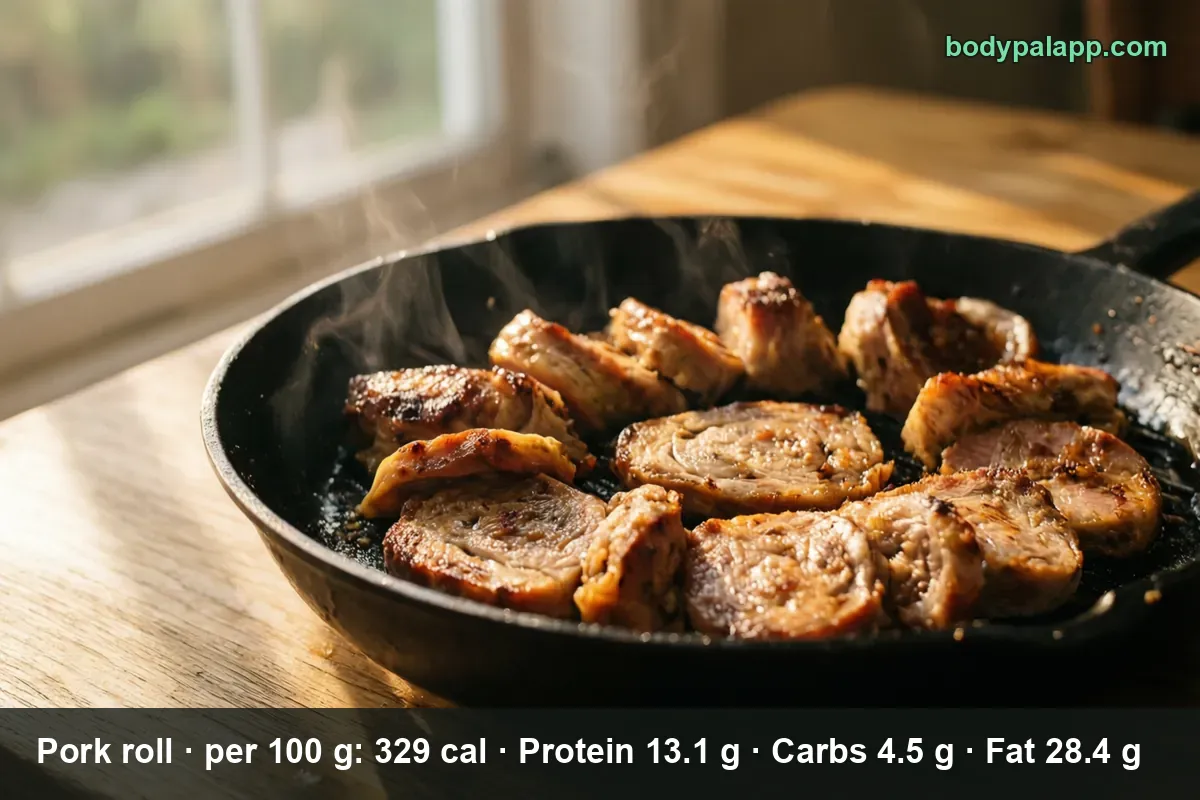
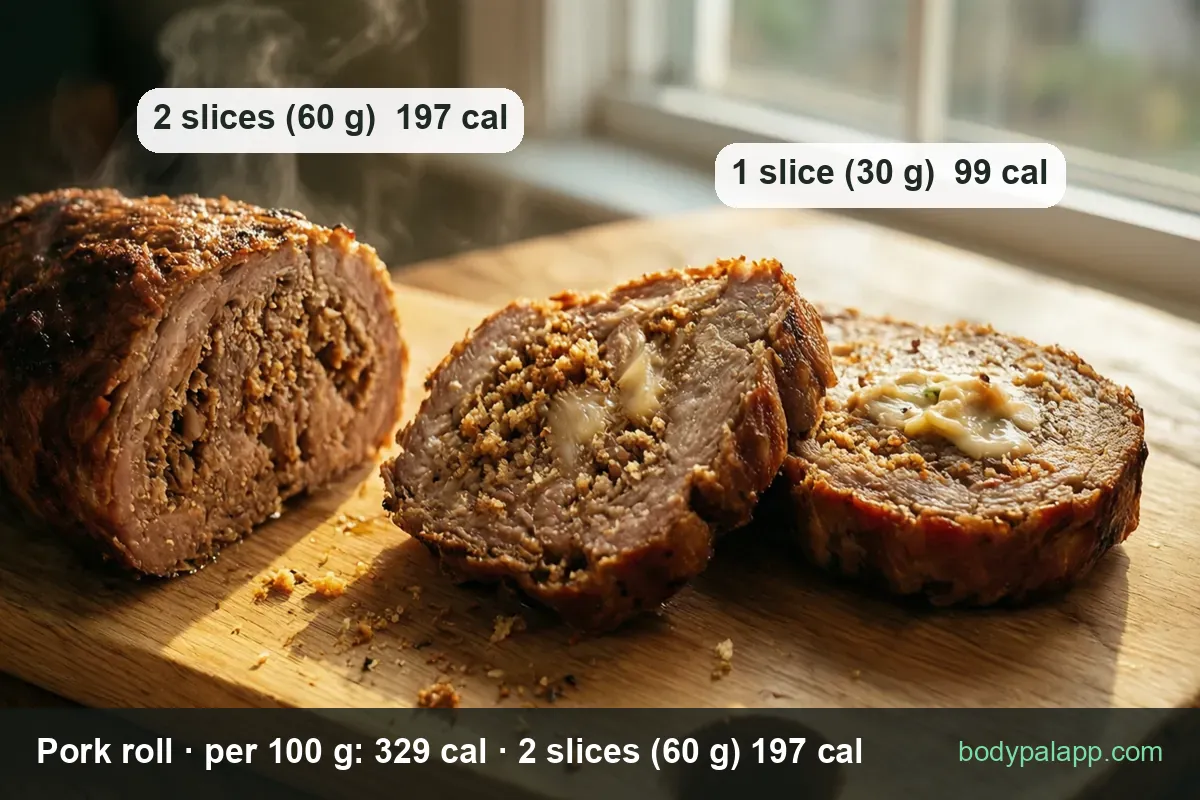
Two slices of pork roll weigh 60 g and carry 197 calories. Per 100 g the cured meat runs 329 calories, heavier per gram than the Spam and mortadella it shares the deli case with. One thin griddle slice is 99. Fat does most of that work: 28.39 g per 100 g, more than double the protein.
On this page
- Pork roll quick facts
- US servings, from one ounce to three griddle slices
- Shoulder rolls, egg rolls and the brand labels
- Sodium is the row to watch
- How does pork roll compare?
- Most popular pork roll brands
- FAQ
Pork roll quick facts
FoodData Central carries the New Jersey deli staple as one line in FNDDS, Pork, roll, fdc_id 2705883, filed under cold cuts and cured meats. That is the record on this page, because it describes the thing people actually buy: a cloth-wrapped log cut into disks for the skillet. Four other USDA entries also answer to the word roll — a cured pork shoulder blade roll, roasted and unheated, plus two egg roll records — and none of them is what anyone means at a Jersey diner counter.
The serving below is two slices, 60 g, the quantity USDA pairs with the record. Its 329 calories per 100 g sits close to the top of what the store brands print on their own labels, which run from 293 for Hatfield up to 333 for Case's Tangy. Nothing here is an outlier; pork roll is simply a fatty cured meat, and the numbers say so plainly.
| Nutrient | Per 100 g | Per 2 slices (60 g) | % Daily Value |
|---|---|---|---|
| Calories | 329 | 197 | — |
| Total fat | 28.39 g | 17.0 g | 22% |
| Saturated fat | 10.35 g | 6.2 g | 31% |
| Carbohydrate | 4.49 g | 2.7 g | 1% |
| Dietary fiber | 0 g | 0 g | 0% |
| Total sugars | 0 g | 0 g | — |
| Protein | 13.07 g | 7.8 g | 16% |
| Sodium | 1377 mg | 826 mg | 36% |
| Cholesterol | 69 mg | 41 mg | 14% |
| Potassium | 399 mg | 239 mg | 5% |
% Daily Value is based on a 2,000-calorie diet.
Verified nutrition data
Numbers on this page come from USDA FoodData Central, the U.S. Department of Agriculture’s food composition database, and from manufacturer labels where a branded product is named. Last verified September 2026. How we verify our data →
Two rows you would expect on a package are missing here: USDA does not publish added sugars or trans fat for this record, so they are left off rather than guessed at. One oddity is worth flagging, though. The record lists 4.49 g of carbohydrate per 100 g with 0 g of total sugars — that carbohydrate is cure and binder, not sweetness, which is why the meat tastes salty and tangy rather than sweet the way a honey-cured ham does.
US servings, from one ounce to three griddle slices
| Serving | Weight | Calories |
|---|---|---|
| 1 oz | 28 g | 93 kcal |
| One slice, thin griddle cut | 30 g | 99 kcal |
| One thick hand-cut slice | 43 g | 141 kcal |
| Two slices, the diner plate | 60 g | 197 kcal |
| Three slices, off a 6 oz package | 64 g | 211 kcal |
| Per 100 g | 100 g | 329 kcal |
Only two of those come straight from USDA: one slice at 30 g and two slices at 60 g, the household measures attached to the record. The ounce, the 43 g thick cut and the 64 g three-slice stack are our own arithmetic from the USDA 100 g figure, not USDA servings.
Here is the trap that costs people the most: a slice is not an ounce. An ounce of pork roll is 93 calories, but a slice cut by hand off the log for a sandwich easily hits 43 g and 141 calories — 52% more meat for the same word. Thin griddle slices off a pre-sliced package land closer to 30 g. If you log "one slice" without looking at the knife, you can be off by more than 40 calories per slice, which is most of an extra slice's worth by the time you have plated three.
Shoulder rolls, egg rolls and the brand labels
| Version | Per 100 g | Typical portion | Calories |
|---|---|---|---|
| Pork roll, sliced (the record above) | 329 kcal | 2 slices, 60 g | 197 kcal |
| Cured shoulder blade roll, roasted | 287 kcal | 3 oz, 85 g | 244 kcal |
| Cured shoulder blade roll, unheated | 269 kcal | 1 oz, 28.4 g | 76 kcal |
| Taylor pork roll, brand label | 312 kcal | 3 slices, 64 g | 200 kcal |
| Egg roll with beef and/or pork | 272 kcal | 1 egg roll, 64 g | 174 kcal |
| Pork egg rolls, refrigerated, heated | 227 kcal | 1 roll, 85 g | 193 kcal |
The roasted shoulder blade roll is the interesting comparison. It comes in at 287 calories per 100 g, 42 below the sliced pork roll, and with 973 mg of sodium against 1,377 mg. That gap is about preparation and cut, not about a different data source — whole-muscle shoulder roasted in the oven simply drips fat and dilutes salt in a way a finely ground, tightly cured log does not.
Brand labels sit a notch under the generic record, as label numbers usually do. Taylor lists 200 calories for three slices; our arithmetic on the USDA figure gives 211 for the same 64 g. ShopRite's hickory smoked roll prints 170 for a 2 oz serving, and Taylor's thick-cut 6 oz version prints 130 for one 43 g slice against 141 from the USDA math. All of it lands inside an 8% band, so pick whichever number is on the package in front of you and move on.
Two USDA rows that show up in a search for "pork roll" are a different food entirely. Egg rolls — the wrapper-and-cabbage kind — run 227 to 272 calories per 100 g, with 27 to 28 g of carbohydrate per 100 g and a fraction of the fat. If your number came from one of those, you were logging takeout, not breakfast meat.
Sodium is the row to watch
Calories are not the headline on this food. Sodium is. Two slices carry 826 mg, which is 36% of the FDA Daily Value of 2,300 mg. That is roughly a third of a teaspoon of table salt sitting inside 60 g of meat. Eat three servings across a day — 180 g of pork roll, less than half a pound — and you have passed the whole day's limit on this one item, before the bread, the cheese or anything you cook it with.
Saturated fat runs a close second. Two slices deliver 6.2 g, 31% of the 20 g DV, and the Dietary Guidelines for Americans advise keeping saturated fat under 10% of daily calories. On a 2,000-calorie day that is about 22 g, so one plate of pork roll has spent more than a quarter of it.
What you get back is thinner than the meat's reputation suggests. Protein is 7.8 g per serving, 16% of the DV — respectable, but the same 197 calories from a leaner cut in the MyPlate protein group would return roughly double that. Pork roll earns its place through flavor, not through protein per calorie. If you are watching sodium, one slice with eggs does the same job on the plate for 99 calories and 413 mg.
How does pork roll compare?
| Deli meat | Per 100 g | US serving | Calories |
|---|---|---|---|
| Pork roll | 329 kcal | 1 oz, 28.4 g | 93 kcal |
| Liverwurst | 327 kcal | 1 oz, 28.4 g | 93 kcal |
| Spam | 315 kcal | 1 oz, 28.4 g | 89 kcal |
| Mortadella | 311 kcal | 1 oz, 28.4 g | 88 kcal |
Our take: pork roll is the heaviest of the four per 100 g, but the spread is 18 calories across the whole group, and at the ounce it ties liverwurst at 93. Swapping pork roll for Spam to save calories is not a real decision — it buys you four calories an ounce. The decision that actually moves your day is how thick the slice is and how many go in the pan, and after that, the sodium column rather than the calorie column.
Most popular pork roll brands in the United States
Ranked by how widely each product appears among foods sold in the United States, from the BodyPal food database of over 3.3 million products. Calories are the figures printed on each Nutrition Facts label, checked against USDA FoodData Central.
| Product | Calories (per 100 g) |
|---|---|
| ShopRite Hickory Smoked Pork Roll | 304 cal |
| ShopRite Tangy Hickory Smoked Pork Roll | 310 cal |
| Taylor Pork Roll | 312 cal |
| Case's Tangy Pork Roll | 333 cal |
| Hatfield Pork Roll Sausage | 293 cal |
| Taylor Pork Roll 6 oz Thick Slice | 302 cal |
Brand popularity: BodyPal food database. Nutrition: manufacturer labels / USDA FoodData Central.
Pork roll FAQs
How many calories are in pork roll?
197 calories in two slices, the 60 g serving USDA lists for its Pork, roll record. Per 100 g the meat runs 329 calories, and a single thin griddle slice of 30 g is 99. Fat supplies most of it, at 28.39 g per 100 g.
How many calories in a slice of pork roll?
99 calories for the 30 g slice USDA counts as one slice, any size. Thickness moves that number more than anything else: a thick hand-cut slab of 43 g works out to 141 calories, our own arithmetic from the USDA 329 per 100 g figure, while an ounce is 93.
How much sodium is in pork roll?
826 mg in two slices, which is 36% of the 2,300 mg Daily Value, scaled from 1,377 mg per 100 g. That is roughly a third of a teaspoon of table salt inside 60 g of meat. Three servings in a day, only 180 g, would clear the entire limit.
Is pork roll the same as Taylor ham?
Same product, two names: the Taylor label lists 200 calories for three slices at 64 g, and which word you use depends on which end of New Jersey you are standing in. The generic USDA record works out to 211 for that same weight, a gap of about 5% that comes from label rounding.
Does frying pork roll add calories?
Not by itself — a 30 g slice stays 99 calories in a dry pan. USDA does not publish a fried pork roll record, so there is no separate number for the skillet. What changes the total is fat you put in it, since butter or oil goes on top of that 99.
How many calories in a pork roll, egg and cheese sandwich?
The pork roll part is 197 calories for two slices, or 99 if you use one. The USDA record covers the meat only, so this page does not put a number on the finished sandwich; the kaiser roll, the egg and the cheese each carry their own count on top of the meat.
Pork roll vs Spam: which has fewer calories?
Spam, but barely: 315 calories per 100 g against 329 for pork roll. At the ounce that is 89 against 93, a four-calorie gap nobody will notice. Spam also edges it slightly on protein, 13.4 g against 13.07 g per 100 g. Choose by slice thickness, not by can versus log.
Is pork roll healthy?
Two slices deliver 36% of the Daily Value for sodium and 31% for saturated fat while returning 7.8 g of protein, 16% of the DV. That ratio is the honest picture: it is a cured meat, better treated as a flavor anchor next to eggs than as the protein center of the plate.
Similar foods
- Banana Bread — 196 cal per slice
- Banana Nut Bread — 196 cal per slice
- Toaster Strudel — 180 cal per pastry with icing
- Biscuit — 165 cal per biscuit
- Raisin Bran — 191 cal per cup
- Key Lime Pie — 483 cal per slice
Count it without the math
Point the camera at the plate and BodyPal counts the slices for you, thick cut or thin.


How long does it take to burn off pork roll?
Two slices (60 g) is 197 kcal. Enter your weight and the amount you ate to see how long it takes you to burn that off:
lb
| Activity | Time to burn 197 kcal |
|---|---|
| Walking, brisk | 39 min |
| Cycling, moderate | 25 min |
| Swimming, moderate | 28 min |
| Jogging | 23 min |
| Weight training, moderate | 44 min |
Times are for a 155 lb adult at a steady pace; change the weight to see yours. The amount is set to the portion in the text (60 g); change it to what you actually ate. BodyPal works this out from your steps automatically.
Burning it off is one side of it. The other is knowing your number: work out how many calories you need a day, with macros and a goal date.