
How many calories are in banana nut bread?
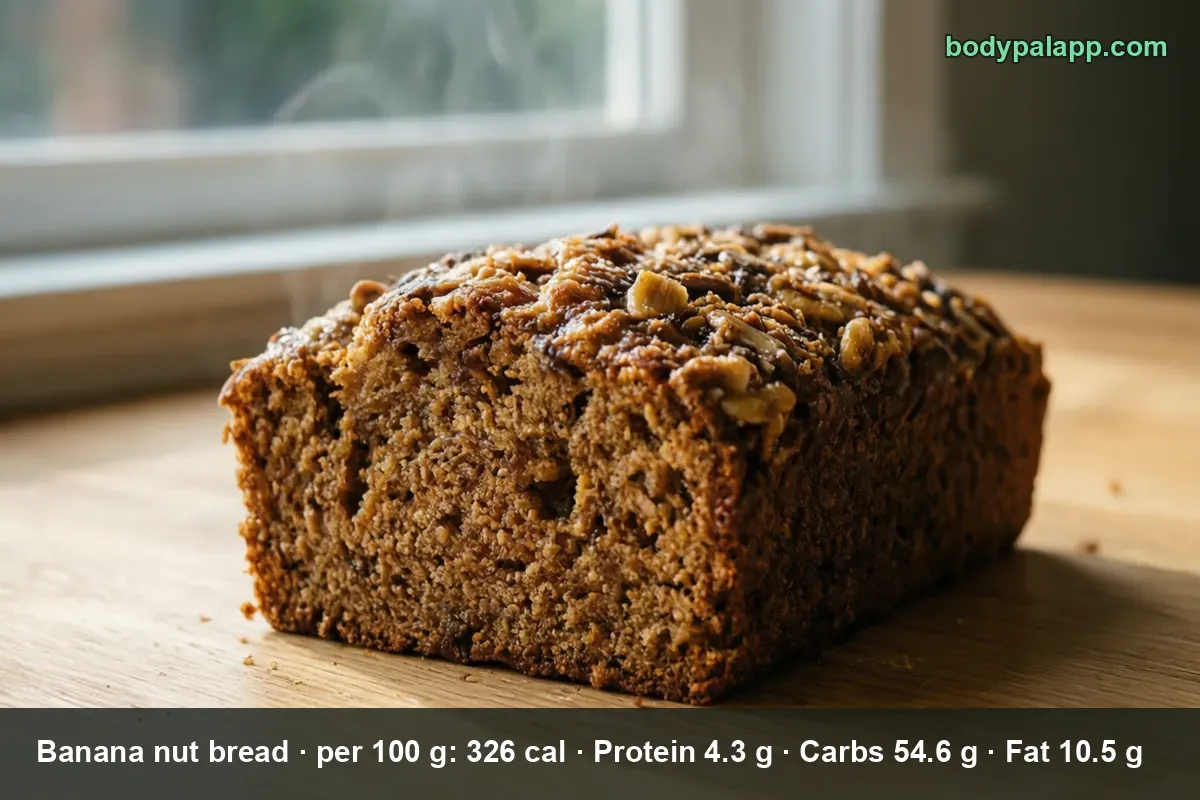
One slice of banana nut bread, 60 g cut from a homemade loaf, is 196 calories. Per 100 g the loaf runs 326 calories, which puts it closer to pound cake than to sandwich bread. Two slices with coffee is 391 calories before anything you spread on them.
On this page
- Banana nut bread quick facts
- US servings, from one ounce to two slices
- Homemade, store-bought and bakery slices
- The slice is cake math, not bread math
- How does banana nut bread compare?
- Most popular banana nut bread brands
- Banana nut bread FAQs
Banana nut bread quick facts
The number people actually need is the one for a loaf baked at home or bought sliced from a bakery case, so this page is built on USDA SR Legacy 174906, "Bread, banana, prepared from recipe, made with margarine". It is the only USDA record for the bread itself. Everything else in the database that says "banana bread" is a flavor name on something else: instant oatmeal, granola, energy bars.
The USDA household slice is 60 g. That is a modest cut, roughly a finger's width off a standard loaf, and it is the figure the table below is built on.
| Nutrient | Per 100 g | Per one slice (60 g) | % Daily Value |
|---|---|---|---|
| Calories | 326 | 196 | — |
| Total fat | 10.5 g | 6.3 g | 8% |
| Saturated fat | 2.24 g | 1.3 g | 7% |
| Carbohydrate | 54.6 g | 32.8 g | 12% |
| Dietary fiber | 1.1 g | 0.7 g | 2% |
| Protein | 4.3 g | 2.6 g | 5% |
| Sodium | 302 mg | 181 mg | 8% |
% Daily Value is based on a 2,000-calorie diet.
Verified nutrition data
Numbers on this page come from USDA FoodData Central, the U.S. Department of Agriculture’s food composition database, and from manufacturer labels where a branded product is named. Last verified September 2026. How we verify our data →
Three rows are missing on purpose. USDA does not publish total sugars, added sugars or trans fat for this record, so there is nothing honest to print in those cells; branded loaves, which do carry labels, sit between 21 and 32 g of sugar per 100 g. Cholesterol and potassium are published: 43 mg and 134 mg per 100 g, which is 26 mg of cholesterol (9% DV) and 80 mg of potassium (2% DV) in a slice. The cholesterol comes from the eggs, and it is the one line where this loaf beats most commercial cakes for surprise value.
US servings, from one ounce to two slices
| Serving | Weight | Calories |
|---|---|---|
| 1 oz | 28.35 g | 92 kcal |
| One slice, USDA household size | 60 g | 196 kcal |
| One mini loaf, single-serve | 57 g | 186 kcal |
| Two slices | 120 g | 391 kcal |
| Per 100 g | 100 g | 326 kcal |
Only the 60 g slice is a USDA household measure. The ounce, the mini loaf and the two-slice line are our own arithmetic from the USDA 100 g figure, not USDA servings.
The mini loaf line is worth a second look. A single-serve banana bread loaf sold in a cellophane sleeve weighs about 57 g, which lands at 186 calories, less than one regular slice. It looks like a whole loaf and eats like less than a slice, and it is one of the few cases in this category where the packaging works in your favor.
The other direction is where people get caught. Cut generously and you are not at 60 g. A thick end cut off a fresh loaf can hit 100 g on its own, and that is the full 326 calories, one slice.
Homemade, store-bought and bakery slices
| Version | Per 100 g | Typical piece | Calories |
|---|---|---|---|
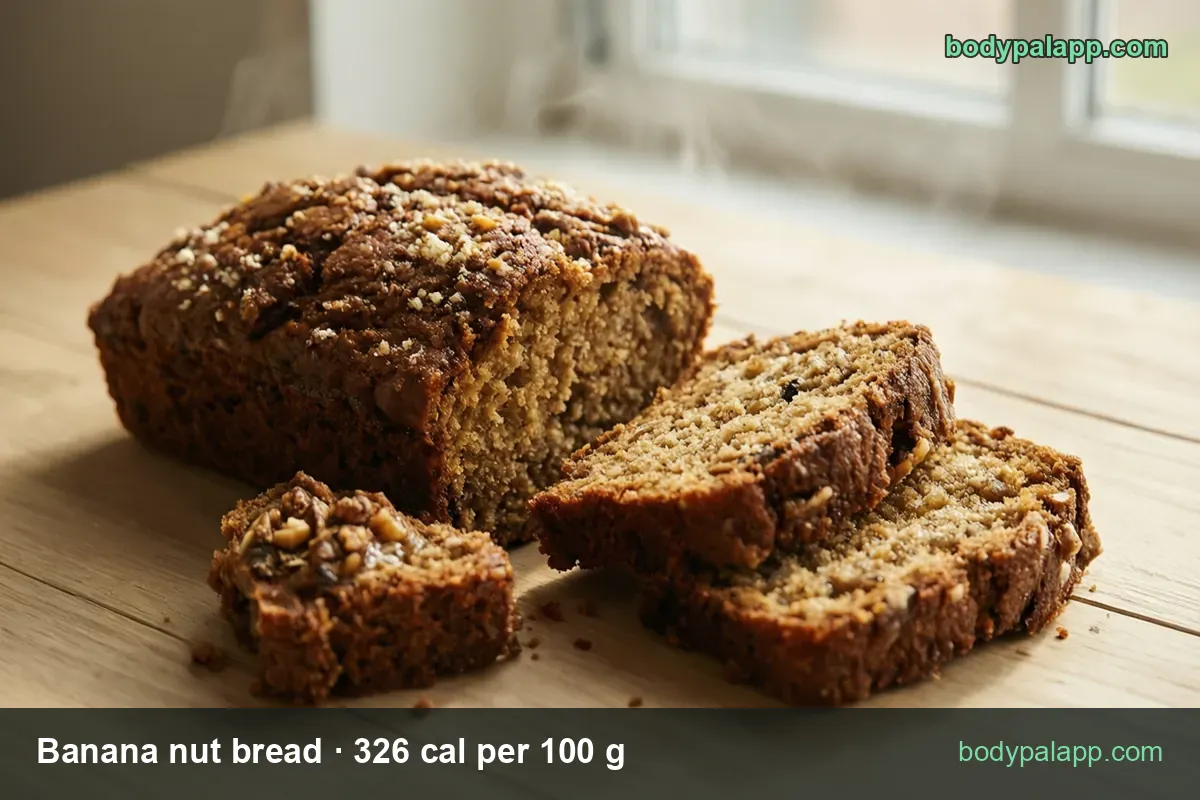
| Homemade loaf, recipe with margarine | 326 kcal | one slice, 60 g | 196 kcal |
| Store-bought sliced banana nut bread | 320 kcal | one slice, 50 g | 160 kcal |
| Bakery loaf, cut at one-fifth | 359 kcal | 78 g | 280 kcal |
| Banana bread instant oatmeal, dry | 368 kcal | one packet, 41 g | 151 kcal |
| Banana bread fruit and nut bar | 451 kcal | one bar, 45 g | 203 kcal |
| Banana nut bread energy bar | 353 kcal | one bar, 68 g | 240 kcal |
The spread across the first three rows is the real story of this food, and it has nothing to do with the recipe. A slice is not a unit. Simple Joys Bakery's sliced banana nut bread calls a slice 50 g and prints 160 calories. L&M Bakery calls it 40 g and prints 150. Target's Favorite Day loaf does not sell slices at all: it lists one-fifth of the loaf, 78 g, at 280 calories. Same shelf, same food, and the calories on the label move by 1.9x because the bakery decided where to put the knife.
Per 100 g the brands run from 311 (Kentucky Proud) up to 421 (Baked by Susan). The homemade record sits at 326, which means only two of the six popular US loaves in the USDA branded data are lighter by weight than a loaf you bake yourself. Baking it at home is not a calorie strategy. It is a control strategy, because you choose the slice.
The oatmeal and bar rows are here because they crowd the search results, not because they are bread. Dry banana bread oatmeal is 368 calories per 100 g, but a packet is only 41 g, so it lands at 151 before milk. A banana bread fruit and nut bar is the densest thing in the table at 451 per 100 g, dates and nuts doing the work.
The slice is cake math, not bread math
Line the slice up against a slice of sandwich bread in your head and the numbers stop matching. A 60 g slice carries 6.3 g of fat, 8% of the FDA Daily Value, and gives back 0.7 g of fiber, which is 2%. That ratio, nine times more fat than fiber by weight, is a cake ratio. MyPlate asks for half your grains to be whole grains; this loaf is white flour with fruit in it, and the banana does not change the grain column.
Saturated fat is milder than you would expect at 1.3 g per slice, 7% DV, because the USDA recipe uses margarine rather than butter. Swap in butter at home and that row climbs, though USDA does not publish a butter version to quote.
Sodium is the quiet one: 181 mg in a slice, 8% DV, or less than a tenth of a teaspoon of table salt from the baking soda and salt in the batter. Two slices is 362 mg, 16% DV. Commercial loaves can go much further; Walmart's The Bakery banana bread lists 536 mg per 100 g against the homemade 302, close to double the salt for the same weight of cake.
Sugar is the row nobody can quote for a homemade loaf. USDA leaves it blank for record 174906, and the Dietary Guidelines cap added sugars at under 10% of daily calories, 200 calories on a 2,000-calorie day. Branded labels list total sugars rather than added sugars: at 21 to 32 g per 100 g, a 60 g slice lands somewhere between 13 and 19 g of total sugars. Treat that as a label estimate, not a USDA figure.
Protein is the weakest column of all: 2.6 g a slice. This is a food that costs like a meal and satisfies like a snack, which is exactly why it disappears fast at 4 p.m.
How does banana nut bread compare?
| Food | Per 100 g | US serving | Calories |
|---|---|---|---|
| Banana nut bread, homemade | 326 kcal | one slice, 60 g | 196 kcal |
| Quaker banana bread instant oatmeal, dry | 368 kcal | one packet, 41 g | 151 kcal |
| Quaker Weight Control banana bread oatmeal, dry | 361 kcal | one packet, 45 g | 162 kcal |
| Larabar banana bread fruit and nut bar | 451 kcal | one bar, 45 g | 203 kcal |
Our take: the bread is the lightest of the four per 100 g and still the second-heaviest thing you can actually eat here, because a slice weighs more than a packet or a bar. If you want the flavor for the fewest calories, the plain oatmeal packet at 151 wins. If you want the flavor and something that holds you, the Weight Control packet is the pick at 162 calories with 16.5 g of protein per 100 g, roughly four times the protein density of the loaf. The bar at 203 costs more calories than a slice and is easier to eat standing up. And if what you want is banana nut bread, eat the slice at 196, cut it at 60 g, and stop guessing at the thickness.
Most popular banana nut bread brands in the United States
Ranked by how widely each product appears among foods sold in the United States, from the BodyPal food database of over 3.3 million products. Calories are the figures printed on each Nutrition Facts label, checked against USDA FoodData Central.
| Product | Calories (per 100 g) |
|---|---|
| L&M Bakery Banana Bread | 375 cal |
| Favorite Day (Target) Banana Bread | 359 cal |
| The Bakery (Walmart) Banana Bread | 339 cal |
| Simple Joys Bakery Banana Nut Sliced Banana Bread | 320 cal |
| Kentucky Proud Banana Nut Bread | 311 cal |
| Baked by Susan Banana Bread | 421 cal |
Brand popularity: BodyPal food database. Nutrition: manufacturer labels / USDA FoodData Central.
Banana nut bread FAQs
How many calories are in a slice of banana nut bread?
One 60 g slice of homemade banana nut bread carries 196 calories, from the USDA recipe record at 326 calories per 100 g. Store slices vary a lot: a 40 g L&M slice is 150 calories, and a Target bakery portion cut at one-fifth of the loaf is 78 g and 280 calories.
How many calories in homemade banana bread?
Homemade banana bread runs 326 calories per 100 g, so a 60 g slice is 196 calories. The USDA recipe uses margarine, eggs and sugar, which is why the loaf carries 10.5 g of fat and 43 mg of cholesterol per 100 g. Baking it yourself does not automatically make it lighter.
How many carbs are in banana nut bread?
A 60 g slice has 32.8 g of carbohydrate, 12% of the Daily Value, and 100 g holds 54.6 g. Only 0.7 g of the slice is fiber, so almost all of it is starch and sugar. Two slices come to 65.6 g of carbs, about a quarter of the 275 g daily value.
How much sugar is in banana nut bread?
USDA does not publish sugars for the homemade recipe record 174906, so there is no official figure to give. Brand labels fill the gap: Simple Joys Bakery lists 21 g per 100 g and Walmart's The Bakery loaf 32.14 g, which works out to roughly 18 g in its 2 oz (56 g) label serving.
How much protein is in banana nut bread?
Protein is the weak row: 2.6 g in a 60 g slice, 5% of the Daily Value, and 4.3 g per 100 g. Two slices bring 5.2 g. For banana bread flavor with real protein, a Quaker Weight Control oatmeal packet has 16.5 g per 100 g, about 7.4 g in a 45 g packet.
Banana bread vs banana nut bread, what is the calorie difference?
The one USDA record here, 326 calories per 100 g, covers the recipe loaf; there is no separate entry for a nut-free version, so there is no documented gap to quote. Branded loaves run from 311 to 421 calories per 100 g with or without walnuts on the label, so the bake matters more than the nuts.
Is banana nut bread healthy?
One slice is 196 calories with 6.3 g of fat, 1.3 g of saturated fat and only 0.7 g of fiber, which is 2% of the Daily Value. It behaves like cake rather than like bread, and the banana does not move the grain column. As an occasional treat with 181 mg of sodium a slice, it is unremarkable.
How many calories in 1 oz of banana nut bread?
One ounce (28.35 g) is 92 calories, our own arithmetic from the USDA 326 per 100 g figure rather than a USDA serving. That is roughly half a slice. A 2 oz cut, the serving size Walmart prints on its loaf, works out to about 185 calories at the homemade loaf's density.
Similar foods
- Banana Bread — 196 cal per slice
- Biscuit — 165 cal per biscuit
- Raisin Bran — 191 cal per cup
- Pork Roll — 197 cal for 2 slices
- Key Lime Pie — 483 cal per slice
- Hawaiian Roll — 96 cal per roll
Count it without the math
Point the camera at the plate and BodyPal counts the slice for you, walnuts and all.


How long does it take to burn off 196 kcal of banana nut bread?
One slice (60 g) is 196 kcal. Enter your weight and the amount you ate to see how long it takes you to burn that off:
lb
| Activity | Time to burn 196 kcal |
|---|---|
| Walking, brisk | 39 min |
| Cycling, moderate | 24 min |
| Swimming, moderate | 28 min |
| Jogging | 23 min |
| Weight training, moderate | 44 min |
Times are for a 155 lb adult at a steady pace; change the weight to see yours. The amount is set to the portion in the text (60 g); change it to what you actually ate. BodyPal works this out from your steps automatically.
This table assumes you know your daily total. If you do not, the daily calorie calculator works it out from five numbers.