
How many calories are in Pringles?
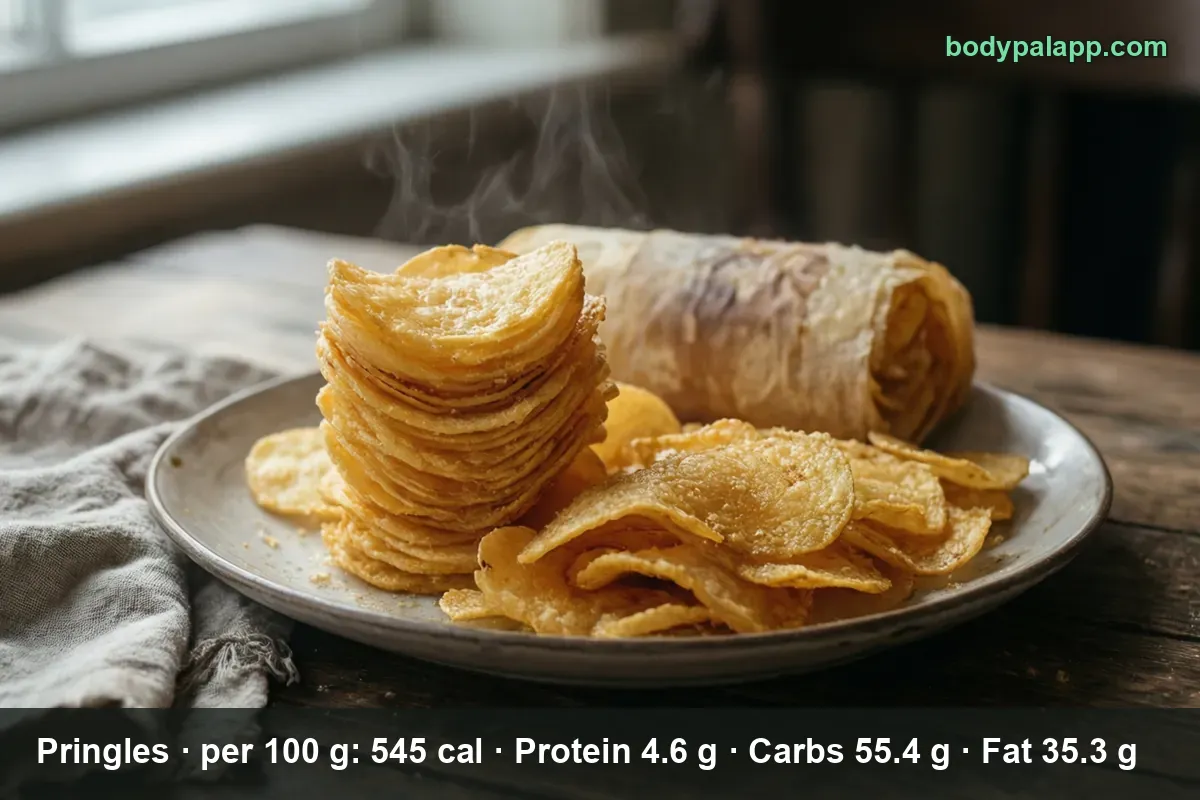
A 1 oz serving of Pringles — 28 g, roughly 16 crisps — is 153 calories. Per 100 g the crisps run 545 calories, because dried potato dough fried in oil is close to a third fat by weight. Empty the 7 oz can and you are at 1,079.
On this page
- Pringles quick facts
- US servings from one crisp to the whole can
- Flavors and the reduced-fat question
- Sodium is the row that moves fastest
- How do Pringles compare to other chips?
- Most popular pringles brands
- FAQ
Pringles quick facts
Pringles are not sliced potato. They are stamped from a dough of dried potato, starch and flour, which is why the right USDA entry is SR Legacy 168853, "Snack, potato chips, made from dried potatoes, plain" rather than any of the fried-slice records. Plain corresponds to Original, and the 1 oz serving USDA uses is the same one printed on the can.
That record is generic, covering every formed potato crisp on the US market, not a Kellogg's lab result. It lands within a few calories of the label on a 36-count multipack, which is the useful check: the flavors move the number by a calorie or two an ounce, never by twenty.
| Nutrient | Per 100 g | Per 1 oz (28 g) | % Daily Value |
|---|---|---|---|
| Calories | 545 | 153 | — |
| Total fat | 35.28 g | 9.9 g | 13% |
| Saturated fat | 8.64 g | 2.4 g | 12% |
| Carbohydrate | 55.38 g | 15.5 g | 6% |
| Dietary fiber | 2.9 g | 0.8 g | 3% |
| Total sugars | 0.76 g | 0.2 g | — |
| Protein | 4.62 g | 1.3 g | 3% |
| Sodium | 529 mg | 148 mg | 6% |
% Daily Value is based on a 2,000-calorie diet.
Verified nutrition data
Numbers on this page come from USDA FoodData Central, the U.S. Department of Agriculture’s food composition database, and from manufacturer labels where a branded product is named. Last verified September 2026. How we verify our data →
Added sugars are not in the table because the SR Legacy edition does not publish them for this record. Total sugars are under 1 g per 100 g, so whatever is added is negligible either way. Cholesterol is 0 mg, since there is no animal fat in the dough, and potassium is 637 mg per 100 g, which works out to 178 mg per ounce, or 4% of the Daily Value.
The row that surprises people is total fat. At 35.28 g per 100 g, a crisp is closer in composition to a piece of shortbread than to a boiled potato, and 9.9 g of that lands in a single ounce.
US servings from one crisp to the whole can
| Serving | Weight | Calories |
|---|---|---|
| One crisp | 1.7 g | 9 kcal |
| 16 crisps | 26 g | 142 kcal |
| 1 oz, about 16 crisps, label serving | 28 g | 153 kcal |
| Grab-and-go can, 1.3 oz | 37 g | 202 kcal |
| Half a large can, 3.5 oz | 99 g | 540 kcal |
| Full can, 7 oz | 198 g | 1079 kcal |
| Per 100 g | 100 g | 545 kcal |
The 1 oz serving and the 16-crisp row both come straight from USDA household measures for record 168853. The three can rows and the single crisp are our own arithmetic from the USDA 100 g figure, not USDA servings: 7 oz of crisps is 198 g, and 198 × 5.45 gives 1,079 calories.
Notice the gap between the two USDA measures. Sixteen crisps weigh 26 g and carry 142 calories, while the printed 1 oz serving is 28 g and 153. That is because 16 is an approximation on the label, not a count anyone verified for your can. A crisp averages about 1.7 g and somewhere between 9 and 10 calories, so miscounting by three crisps costs you roughly 30.
The practical trap is the tube itself. A 7 oz can never looks like seven servings while you are eating it, and half of one is already 540 calories, which is a full lunch for most people who track. The 1.3 oz single-serve cans at 202 calories, and the 0.67 oz Snack Stacks cups at 100, exist precisely because the big tube has no natural stopping point.
Flavors and the reduced-fat question
USDA carries six records for formed potato crisps. Three of them are lighter than Original per 100 g, but only one is lighter by a margin worth changing your order for.
| Version | Per 100 g | 1 oz (28.35 g) | Calories |
|---|---|---|---|
| Original (plain) | 545 kcal | one ounce | 154 kcal |
| Sour Cream & Onion | 547 kcal | one ounce | 155 kcal |
| Cheddar Cheese | 551 kcal | one ounce | 156 kcal |
| Reduced Fat | 502 kcal | one ounce | 142 kcal |
| Multigrain | 505 kcal | one ounce | 143 kcal |
| Fat-free, made with olestra | 253 kcal | one ounce | 72 kcal |
This table uses the exact ounce, 28.35 g, which is why Original reads 154 here and 153 in the quick-facts table above, where the rounded 28 g label serving applies. The difference is arithmetic, not disagreement.
Sour Cream and Onion and Cheddar Cheese both come in slightly above Original. The seasoning displaces starch with fat and dairy powder: cheese flavor is 37 g fat and 7 g protein per 100 g against 35.28 g and 4.62 g for plain. You get one or two extra calories an ounce and a noticeably saltier crisp, which is the real trade.
Reduced Fat is the one people expect to be a win. It is 502 calories per 100 g against 545 — about 12 calories saved per ounce. Fat falls hard, from 35.28 g to 26.14 g per 100 g, but carbohydrate climbs from 55.38 g to 64.76 g, which is where most of the saving goes back. Multigrain does the same trick with a grain blend, landing at 505.
The olestra version is the genuine outlier at 253 calories per 100 g, under half of Original, with 7.3 g of fiber against 2.9 g. It is also a period piece: fat-free crisps made with olestra are not on US shelves anymore, so treat that row as a historical benchmark rather than a shopping option. Sodium in it stays at 429 mg per 100 g, which tells you the salt was never the part being removed.
Retail can sizes track the flavors closely. The 36-count and 15-count multipacks list 200 calories per 37 g can, the 12-count variety pack 150 per 28 g, and Original Snack Stacks 100 calories in a 19 g cup — the smallest portion Kellogg sells, and the only one that ends by itself.
Sodium is the row that moves fastest
One ounce carries 148 mg of sodium, 6% of the FDA Daily Value of 2,300 mg. On its own that is unremarkable — less than a slice of deli bread in some cases.
The whole can is a different conversation. At 198 g, a 7 oz tube delivers 1,047 mg, or 46% of the day's limit in one sitting, which is roughly half a teaspoon of table salt. The CDC notes that most Americans already run well past 2,300 mg without help from the snack aisle, so if you are watching blood pressure, the can size matters more than the flavor.
Flavor does shift it, though. Cheddar Cheese is the saltiest crisp record at 600 mg per 100 g, Sour Cream and Onion 541, plain 529, and Reduced Fat the lightest of the current line at 450. Per ounce that is a spread of about 43 mg — small next to the difference between one serving and one can.
Saturated fat is the quieter number: 2.4 g per ounce, 12% of the Daily Value, from 8.64 g per 100 g. Half a can puts you at 8.6 g, which is 43% of the day. Fiber, meanwhile, contributes almost nothing at 0.8 g per serving, so crisps do not count toward the vegetable side of MyPlate despite being made from potatoes.
How do Pringles compare to other chips?
| Snack | Per 100 g | US serving | Calories |
|---|---|---|---|
| Pringles (formed potato crisps) | 545 kcal | 1 oz, 28 g | 153 kcal |
| Potato chips, plain, unsalted | 536 kcal | 1 oz, 28.35 g | 152 kcal |
| Corn chips, extruded, plain | 539 kcal | 1 oz, 28.35 g | 153 kcal |
| Pork rinds, plain | 544 kcal | 1 oz, 28.35 g | 154 kcal |
Our take: on calories, this is a four-way tie. Every mainstream salty snack lands within 3 calories of the others per ounce, because they are all starch or protein fried in oil to about the same fat percentage, and choosing between them on calorie count is wasted effort. Where they separate is composition and stopping point. Pork rinds carry 61.3 g of protein per 100 g and zero carbohydrate, so they hold you far longer per calorie; unsalted potato chips remove the sodium problem entirely. Pringles win on neither, and their tube makes portioning harder than a bag you can weigh. If you are eating for satiety, the pork rinds are the honest answer; if you simply want the crisp, buy the 19 g Snack Stacks cup and skip the arithmetic.
Most popular pringles brands in the United States
Ranked by how widely each product appears among foods sold in the United States, from the BodyPal food database of over 3.3 million products. Calories are the figures printed on each Nutrition Facts label, checked against USDA FoodData Central.
| Product | Calories (per 100 g) |
|---|---|
| Pringles Potato Crisps 36 ct | 541 cal |
| Pringles Potato Crisps 15 ct | 541 cal |
| Pringles Potato Crisps Variety Pack 12 ct | 536 cal |
| Pringles Lightly Salted Sour Creme & Onion | 536 cal |
| Pringles Potato Crisps Variety Pack 18 ct | 526 cal |
| Pringles Original Snack Stacks | 526 cal |
Brand popularity: BodyPal food database. Nutrition: manufacturer labels / USDA FoodData Central.
Pringles FAQs
How many calories are in a can of Pringles?
A full 7 oz can holds 198 g of crisps and 1,079 calories, our own arithmetic from the USDA figure of 545 per 100 g. The 1.3 oz grab-and-go can is 202 calories. Sodium in the big can reaches 1,047 mg, which is 46% of the day's limit.
How many calories are in one Pringle?
Between 9 and 10 calories per crisp. USDA lists 16 crisps at 26 g and 142 calories, which works out to 8.9 each, while the 1 oz label serving of 153 calories across about 16 crisps gives 9.6. Both figures are our arithmetic, and crisp weight varies slightly by flavor.
How many Pringles are in a 1 oz serving?
About 16 crisps make the 1 oz (28 g) label serving, and that serving is 153 calories. USDA's own 16-crisp measure weighs slightly less at 26 g, for 142 calories. Counting beats pouring by eye, since a handful taken from a 7 oz tube rarely stops at sixteen.
How many calories are in Pringles Sour Cream and Onion?
Sour Cream and Onion runs 547 calories per 100 g, so a 1 oz (28.35 g) serving is 155 calories, one more than Original at the same weight. The seasoning trades starch for fat: 37 g fat against 35.28 g, and 51.3 g carbohydrate against 55.38 g per 100 g.
Are reduced fat Pringles actually lower in calories?
Barely: reduced fat crisps are 502 calories per 100 g against 545, so one ounce saves about 12 calories, 142 instead of 154. Fat drops from 35.28 g to 26.14 g per 100 g, but carbohydrate climbs from 55.38 g to 64.76 g, which is where most of the saving returns.
How much sodium is in a serving of Pringles?
A 1 oz (28 g) serving carries 148 mg of sodium, 6% of the 2,300 mg Daily Value. That stays modest until the tube empties: 198 g delivers 1,047 mg, or 46%. Cheddar Cheese is the saltiest crisp record at 600 mg per 100 g, reduced fat the lightest of the current line at 450 mg.
Are Pringles healthier than regular potato chips?
Not meaningfully: formed crisps are 545 calories per 100 g and plain fried potato chips 536, a gap of 9 that disappears in a serving: 153 against 152 per ounce. Fried chips carry more protein, 7 g against 4.62 g per 100 g, and unsalted versions remove the sodium question.
How much protein is in Pringles?
Very little: 1.3 g in a 1 oz serving, 3% of the Daily Value, from 4.62 g per 100 g. Cheddar Cheese flavor is the highest crisp record at 7 g per 100 g, thanks to the milk powder in the seasoning. Pork rinds, at 61.3 g per 100 g, are another category entirely.
Similar foods
- Pork Rinds — 152 cal per oz
- Beef Stick — 110 cal per stick
- Dark Chocolate — 44 cal per piece
- Corn Chips — 151 cal per oz
- Nutella — 199 cal per 2 tbsp
- Skinny Pop Popcorn — 150 cal for 3 3/4 cups
Count it without the math
Point the camera at the plate and BodyPal counts the crisps for you, tube and all.


How long does it take to burn off Pringles?
A 1 oz (28 g) serving is 153 kcal. Enter your weight and the amount you ate to see how long it takes you to burn that off:
lb
| Activity | Time to burn 153 kcal |
|---|---|
| Walking, brisk | 31 min |
| Cycling, moderate | 19 min |
| Swimming, moderate | 22 min |
| Jogging | 18 min |
| Weight training, moderate | 34 min |
Times are for a 155 lb adult at a steady pace; change the weight to see yours. The amount is set to the portion in the text (28 g); change it to what you actually ate. BodyPal works this out from your steps automatically.
One food is easy to picture; a whole day is harder. See how many calories you need a day and what a deficit actually looks like.