
How Many Calories in Clam Chowder?
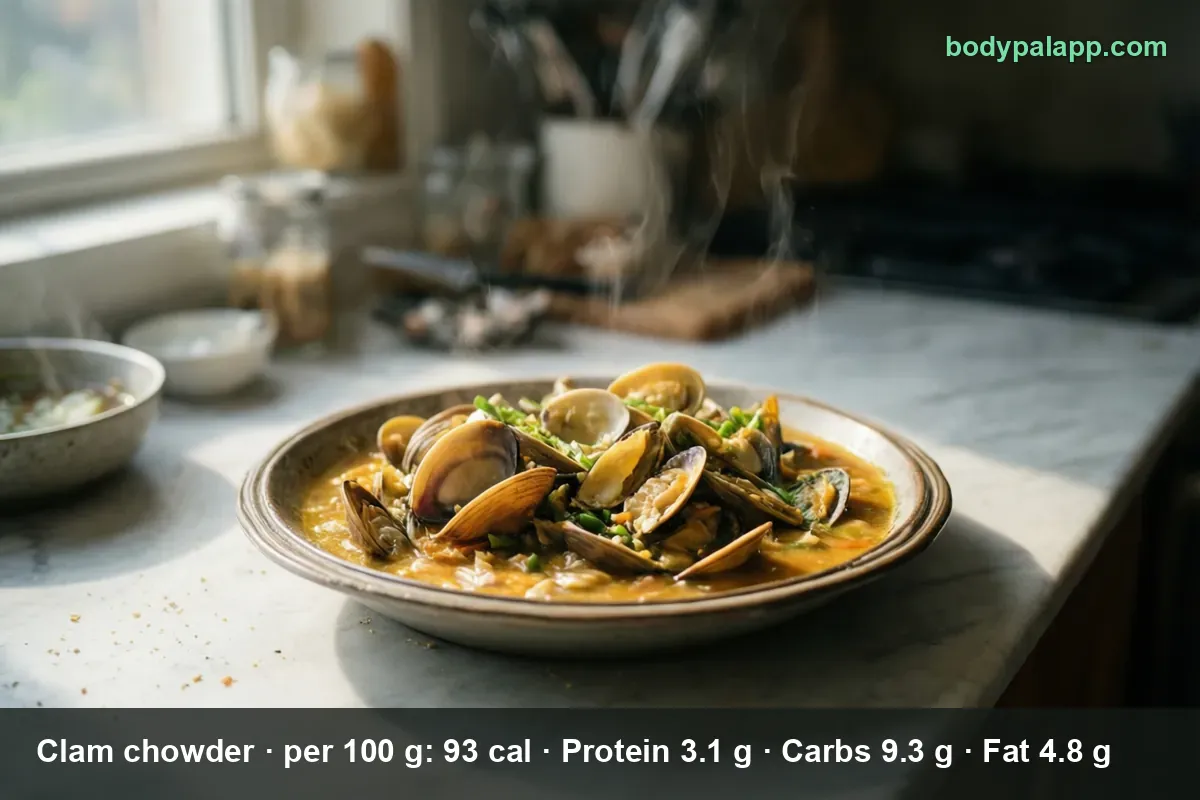
One cup of creamy New England clam chowder, 255 g of it, is 237 calories — 93 calories per 100 g. Ask for the tomato-based Manhattan style instead and the same size cup lands at 86 calories. Two soups, one name on the menu, and a gap of more than 2.5 times.
On this page
- Clam chowder quick facts
- New England or Manhattan sets the number
- Cup, deli container, can
- Canned, condensed and what water does
- The saturated fat, not the calories
- Clam chowder against the rest of the soup aisle
- Most popular clam chowder brands
- FAQ
Clam chowder quick facts
The reference below is the soup as it is actually eaten: ready-to-eat New England chowder, cream-based, straight from the ladle. USDA lists it as Soup, New England clam chowder (FDC 2707139), and a cup of it weighs 255 g.
| Nutrient | Per 100 g | Per 1 cup (255 g) | % Daily Value |
|---|---|---|---|
| Calories | 93 kcal | 237 kcal | — |
| Total fat | 4.8 g | 12.2 g | 16% |
| Saturated fat | 2.51 g | 6.4 g | 32% |
| Carbohydrate | 9.25 g | 23.6 g | 9% |
| Dietary fiber | 1 g | 2.6 g | 9% |
| Total sugars | 0.95 g | 2.4 g | — |
| Protein | 3.12 g | 8.0 g | 16% |
| Sodium | 247 mg | 630 mg | 27% |
% Daily Value is based on a 2,000-calorie diet.
Verified nutrition data
Numbers on this page come from USDA FoodData Central, the U.S. Department of Agriculture’s food composition database, and from manufacturer labels where a branded product is named. Last verified September 2026. How we verify our data →
Read that table across and one row refuses to sit still. Calories are modest for a hot lunch. Saturated fat is not: 32% of the day in a single cup, nearly three times the share the calories take. Total sugars carry no percentage because the FDA sets a Daily Value for added sugars only, and the 2.4 g here comes from the milk and the vegetables, not a sweetener.
New England or Manhattan sets the number
Most calorie charts hand you one figure for "clam chowder." That figure is close to useless, because the two American styles are barely the same dish. New England is cream and butter thickened into something that coats a spoon. Manhattan is a clear tomato broth (FDC 2707138) with no dairy in it at all.
| Style | Per 100 g | 1 cup | Protein per cup | Fat per 100 g |
|---|---|---|---|---|
| New England (cream) | 93 kcal | 255 g → 237 kcal | 8.0 g | 4.8 g |
| Manhattan (tomato) | 35 kcal | 245 g → 86 kcal | 6.1 g | 0.51 g |
The fat column explains the whole gap. Manhattan holds 0.51 g of fat per 100 g against 4.8 g for New England, and its saturated fat is 0.07 g per 100 g, which rounds to nothing on a label.
There is a second detail worth having. A cup of New England weighs 255 g in the USDA portion data; a cup of Manhattan weighs 245 g. Same cup, ten extra grams, because the cream version is denser. It is a small thing, and it tells you the thickness you can see in the bowl is real, not an illusion of the spoon.
Protein is where Manhattan quietly wins. It delivers 6.1 g per cup for 86 calories, against 8.0 g for 237. Per calorie, the tomato version carries roughly twice the protein.
Cup, deli container, can
"A cup" is the unit people say. It is rarely the unit they eat.
| Serving | Weight | Calories |
|---|---|---|
| 1 oz | 28 g | 26 kcal |
| 100 g | 100 g | 93 kcal |
| 1 cup | 255 g | 237 kcal |
| 1 individual deli container | 440 g | 409 kcal |
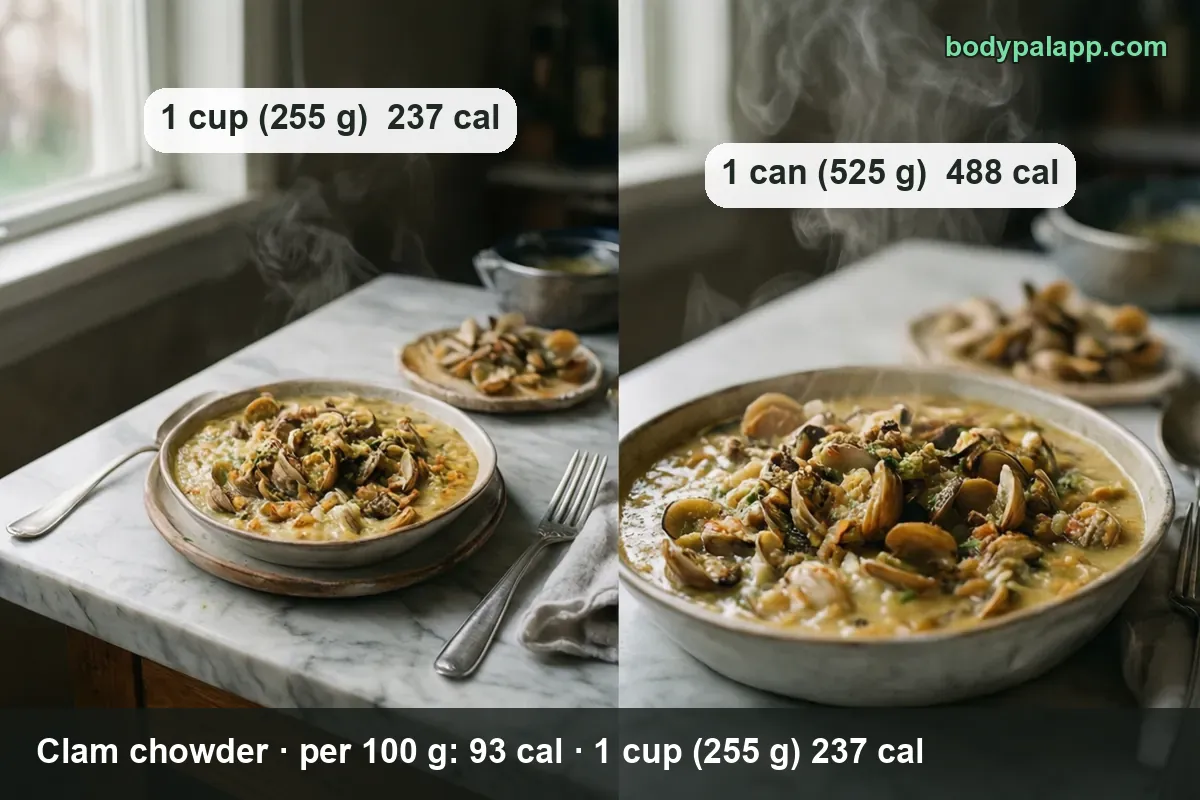
| 1 can | 525 g | 488 kcal |
The deli container is the row that catches people out. At 440 g it is not a cup and a bit — it is nearly two cups, and the number climbs to 409 calories with 11.0 g of saturated fat, or 55% of the day. Nothing about the packaging announces that. It looks like a portion for one, and it is, but it is a 400-calorie portion for one.
Sodium scales the same way, and it gets loud fast:
- 1 cup (255 g): 630 mg, 27% of the Daily Value
- Deli container (440 g): 1,087 mg, 47%
- Whole can (525 g): 1,297 mg, 56%
CDC puts the ceiling at 2,300 mg a day for adults, the same figure the FDA uses for the label. A can of chowder eaten in one sitting is a little over half of it — roughly what you would get from half a teaspoon of table salt, except you never see it go in.
Canned, condensed and what water does
This is where calorie counts go wrong more often than anywhere else on the shelf, and the culprit is a single instruction on the label: add one can of water.
| Version | Calories per 100 g | Sodium per 100 g |
|---|---|---|
| Ready-to-eat New England (reference) | 93 kcal | 247 mg |
| Canned, ready-to-serve | 79 kcal | 343 mg |
| Canned, reduced sodium, ready-to-serve | 70 kcal | 194 mg |
| Canned, condensed, straight from the can | 72 kcal | 516 mg |
| Condensed, prepared with equal water | 35 kcal | 254 mg |
| Condensed, prepared with equal 2% milk | 61 kcal | 273 mg |
| Campbell's Chunky New England | 81 kcal | 353 mg |
Condensed chowder is 72 calories per 100 g in the can and 35 per 100 g in the bowl. Both numbers are correct; they describe different things. If you log the can figure against the volume you actually ate, you have doubled your own soup. A 10.7 oz can of condensed is 218 calories for the whole thing, and half a cup of it — 126 g of concentrate — is 91.
Ready-to-serve canned chowder (FDC 174062) needs no arithmetic: 79 calories per 100 g, so a 254 g cup is 201 calories and the full 521 g can is 412. The chunkier retail versions run a touch higher, around 81 per 100 g, which puts a 251 g cup at 203 and a 519 g can at 420.
Two lines in that table are worth pulling out.
Reduced sodium cuts the salt, not the meal. The reduced-sodium can carries 194 mg per 100 g against 343 mg for the standard one, a drop of about 43%. Calories move from 79 to 70. If sodium is the number you watch, that swap is one of the better ones on the shelf. If calories are the number you watch, it barely registers.
Making it with milk changes the sugar row. Condensed chowder prepared with 2% milk shows 2.81 g of total sugars per 100 g, while the same chowder prepared with water sits at 0.19 g. That is lactose from the milk, not anything added — the same reason it also carries 3.24 g of protein per 100 g against 1.55 g for the water version.
The saturated fat, not the calories
At 237 calories a cup, New England chowder is a light-to-middling lunch item on its own. The interesting number is the one underneath.
- Saturated fat, 1 cup: 6.4 g — 32% of the Daily Value
- Saturated fat, deli container: 11.0 g — 55%
- Saturated fat, whole can: 13.2 g — 66%
The Dietary Guidelines for Americans advise keeping saturated fat under 10% of daily calories, which on a 2,000-calorie day is the 20 g the FDA uses as the Daily Value. A cup of chowder spends a third of that allowance while spending only about a tenth of the calorie budget. That ratio is the honest reason chowder feels richer than its calorie count suggests.
Cholesterol and potassium follow the cream. A cup gives 40.8 mg of cholesterol, 14% of the Daily Value, and 471.8 mg of potassium, about 10%. The protein, 8.0 g, is real but modest — enough to make chowder a component of lunch rather than the whole of it. MyPlate counts a cream soup like this against the dairy and protein groups at once, which is a fair description of what is in the bowl.
If chowder is a weekly habit rather than a once-a-winter thing, the useful move is not shrinking the portion. It is knowing which of the two styles is in front of you.
Clam chowder against the rest of the soup aisle
| Soup | Per 100 g | 1 cup | Protein per cup | Fat per cup |
|---|---|---|---|---|
| New England clam chowder | 93 kcal | 237 kcal | 8.0 g | 12.2 g |
| Manhattan clam chowder | 35 kcal | 86 kcal | 6.1 g | 1.2 g |
| Tomato soup, canned | 34 kcal | 83 kcal | 1.5 g | 0.8 g |
| Chicken soup, canned | 33 kcal | 81 kcal | 4.9 g | 1.8 g |
| Vegetable soup, canned | 38 kcal | 93 kcal | 2.7 g | 1.0 g |
New England chowder is not slightly heavier than the rest of the aisle. It is more than two and a half times heavier than every other soup on that list, and a single cup of it carries more fat than the other four cups put together.
Our take: if you want soup that fills a corner without touching the day's budget, Manhattan clam chowder is the pick — 86 calories with 6.1 g of protein, four times the protein of tomato soup and more than twice that of vegetable soup for much the same calories, and it still tastes of clams. If you want the cream, have the cream, but treat a cup of New England as a course rather than a starter and put something lean beside it. The one version to be careful with is the 440 g deli container eaten as a snack; at 409 calories and 55% of a day's saturated fat, it is the whole lunch whether you meant it to be or not.
Most popular clam chowder brands in the United States
Ranked by how widely each product appears among foods sold in the United States, from the BodyPal food database of over 3.3 million products. Calories are the figures printed on each Nutrition Facts label, checked against USDA FoodData Central.
| Product | Calories (per 100 g) |
|---|---|
| Campbell's Chunky New England Clam Chowder 18.8 oz | 73 cal |
| Campbell's Chunky New England Clam Chowder 16.3 oz | 73 cal |
| Campbell's Homestyle New England Clam Chowder 16.3 oz | 69 cal |
| Campbell's Homestyle New England Clam Chowder 18.8 oz | 65 cal |
| Campbell's Condensed New England Clam Chowder 10.5 oz | 63 cal |
| Campbell's Slow Kettle Style New England Clam Chowder | 81 cal |
Brand popularity: BodyPal food database. Nutrition: manufacturer labels / USDA FoodData Central.
Clam chowder FAQs
How many calories in clam chowder?
237 calories in a 1 cup (255 g) serving of New England clam chowder, at 93 calories per 100 g. Manhattan clam chowder, the tomato-based style, is 35 per 100 g, so the same size cup is 86 calories. The style matters more than the portion size.
How many calories in a bowl of clam chowder?
Around 409 calories for a 440 g deli container of New England chowder, which is what most soup counters hand over as a bowl. A whole 525 g can is 488 calories. A standard 1 cup measure is only 255 g and 237 calories, so a "bowl" is often close to double.
New England or Manhattan clam chowder: which has fewer calories?
Manhattan, by a wide margin: 86 calories per cup against 237 for New England. The difference is dairy. Manhattan has 0.51 g of fat per 100 g and 0.07 g of saturated fat, while the cream-based version has 4.8 g and 2.51 g. Manhattan also carries more protein per calorie.
How much sodium is in clam chowder?
630 mg in a 1 cup (255 g) serving, or 27% of the 2,300 mg Daily Value. A whole 525 g can of that chowder works out to about 1,297 mg. Canned ready-to-serve chowder is saltier per gram at 343 mg per 100 g, and the reduced-sodium canned version drops to 194 mg per 100 g.
Is clam chowder healthy?
New England chowder is moderate in calories at 237 a cup but high in saturated fat: 6.4 g, or 32% of the Daily Value, in that same cup. It also gives 8.0 g of protein and 471.8 mg of potassium. Manhattan style delivers similar protein for 86 calories and almost no saturated fat.
How many calories in canned clam chowder?
79 calories per 100 g for ready-to-serve New England chowder, which is 201 calories in a 254 g cup and 412 in a 521 g can. The chunkier retail style runs about 81 per 100 g, so a 251 g cup is 203 calories. Reduced-sodium cans are 70 per 100 g.
Does condensed clam chowder have more calories?
Per 100 g of what is in the can, yes: condensed New England chowder is 72 calories per 100 g. Once you add the equal volume of water the label asks for, it becomes 35 per 100 g. A whole 10.7 oz can of concentrate is 218 calories no matter how much water you stir in.
How much protein is in clam chowder?
8.0 g in a 1 cup (255 g) serving of New England chowder, which is 16% of the Daily Value. Manhattan style gives 6.1 g per cup for a third of the calories. Condensed chowder made up with 2% milk lands at 3.24 g per 100 g, against 1.55 g when it is made with water.
Similar foods
- Potato Soup — 230 cal per cup
- Chicken Corn Soup — 238 cal per cup
- Goulash Soup — 211 cal per cup
- Chicken Tortilla Soup — 250 cal per cup
- Taco Soup — 250 cal per cup
- Chicken And Sausage Gumbo — 203 cal per cup
Count it without the math
Point your camera at the bowl and BodyPal logs the calories, the saturated fat and the sodium together, cup or can.


How long does it take to burn off clam chowder?
A cup of New England clam chowder (255 g) is 237 kcal. Enter your weight and the amount you ate to see how long it takes you to burn that off:
lb
| Activity | Time to burn 237 kcal |
|---|---|
| Walking, brisk | 47 min |
| Cycling, moderate | 30 min |
| Swimming, moderate | 34 min |
| Jogging | 28 min |
| Weight training, moderate | 53 min |
Times are for a 155 lb adult at a steady pace; change the weight to see yours. The amount is set to the portion in the text (255 g); change it to what you actually ate. BodyPal works this out from your steps automatically.
Want the bigger picture? Calculate your daily calorie needs — your maintenance figure, a target for losing or gaining, and the date you get there.