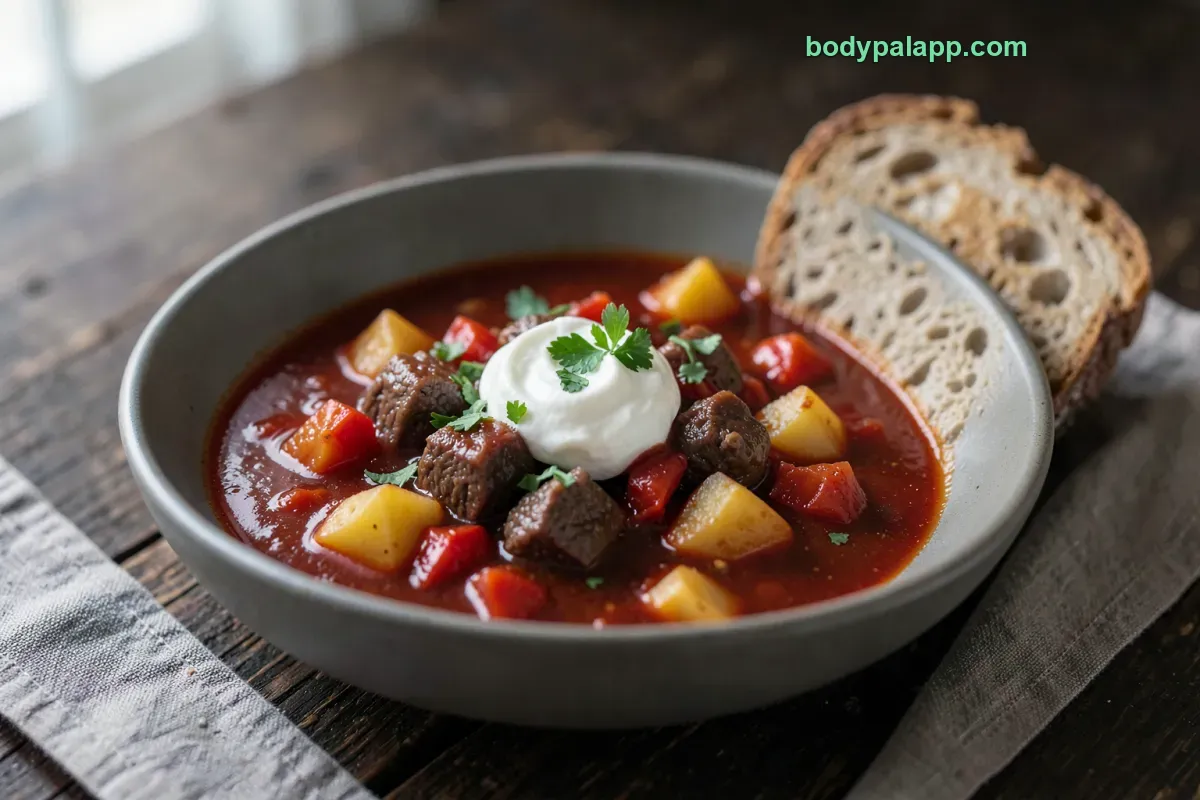
Goulash soup calories come to 211 for 1 cup (245 g) and 86 per 100 g, based on a packaged label. The number to notice is not the calories but the sodium: that same cup carries 899 mg, or 39% of the daily value, while its calories cover only 11%.
211kcal
1 cup · 245 g, packaged, per label
22%protein
12 gProtein
17 gCarbs
11 gFat
How to burn off 211 kcal
—Walking, brisk
—Jogging
—Cycling, moderate
—Swimming
Skip the math. BodyPal counts these calories from your steps and workouts automatically.
Nutrition facts
Packaged, per label · per 245 g
Calories
211 kcal
Protein
12 g
Carbohydrate
17 g
Fat
11 g
Saturated fat
4.5 g
Cholesterol
34 mg
Sodium
899 mg
Source: USDA FoodData Central
🛡️
Verified nutrition data
Numbers on this page come from USDA FoodData Central, the U.S. Department of Agriculture’s food composition database, and from manufacturer labels where a branded product is named. Last verified September 2026. How we verify our data →
Goulash soup: calories, protein and sodium by serving
Percent of daily value uses the FDA reference of 2,000 kcal a day.
Serving
kcal
Protein
Carbs
Fat
Sodium
% DV kcal
1 cup (245 g)
211
12 g
17 g
11 g
899 mg
11%
100 g
86
4.9 g
6.9 g
4.5 g
367 mg
4%
3 × 1 cup (245 g)
632
36 g
2,697 mg
5 × 1 cup (245 g)
1,054
60 g
4,496 mg
One cup is 211 calories, a big bowl is double
The label serving is 1 cup (245 g), and it lands at 211 calories with 12 g of protein. That is a light lunch on paper. The catch is that few people stop at one cup, and soup bowls at home often hold two.
Two cups (490 g) come to 421 calories and 24 g of protein. Three cups (735 g) reach 632 calories, which is meal territory. If you finish a whole pot of 5 cups (1,225 g) over a day, you have eaten 1,054 calories and 60 g of protein from soup alone.
Calories scale in a straight line here, so the easiest control is the ladle. Measure one serving into your usual bowl once, note how full it looks, and you will know whether your normal portion is one cup or closer to two.
Fat supplies nearly half the calories
Per 100 g, goulash soup has 4.5 g of fat, 6.9 g of carbs and 4.9 g of protein. Those grams look small, but fat carries more calories per gram, so it ends up as 46% of the energy. Carbs bring 32% and protein 22%.
The fat comes with 1.8 g of saturated fat per 100 g. A cup holds 11 g of total fat, which is a real share of a day for a bowl of soup. Most of it likely comes from the beef and any oil used in the base.
Protein is the bright spot. At 12 g per cup, one serving covers 24% of the daily value, and two cups get you to 24 g. That is respectable for a canned soup and more than many vegetable or cream soups offer. Fiber is modest at 2 g per cup, and sugars sit at 5 g.
Sodium is the row to watch
Each 100 g carries 367 mg of sodium, 16% of the daily value. Scale that to the label cup and you get 899 mg, or 39% of the daily value in a single serving. Compare that with the 11% of daily calories the same cup provides, and the imbalance is clear.
The numbers climb fast with bigger bowls. Two cups bring 1,798 mg of sodium. Three cups reach 2,697 mg, which is already past the full daily value of 2300 mg used on this page. A day built around this soup can blow through the sodium budget before dinner.
If you watch sodium, treat one cup as the portion and keep the rest of the meal low in salt. Fresh vegetables, plain grains and unsalted sides balance the day better than bread with butter or salty crackers.
Turn one cup into a fuller meal
One cup at 211 calories and 12 g of protein works as a starter or a light lunch, but on its own it may not keep you full for long. Bulking it up with low-sodium foods is the smarter move than ladling a second cup.
A side salad, steamed green vegetables or a piece of fruit adds volume and fiber without adding salt. A small portion of plain rice or a boiled potato makes it more filling if you need more carbs. Skip extra cheese or sour cream on top if you are keeping fat in check, since fat already supplies 46% of the calories.
If you are tracking intake, BodyPal can log goulash soup from a photo of your bowl, which helps when your portion is not a neat 1 cup.
How does goulash soup compare?
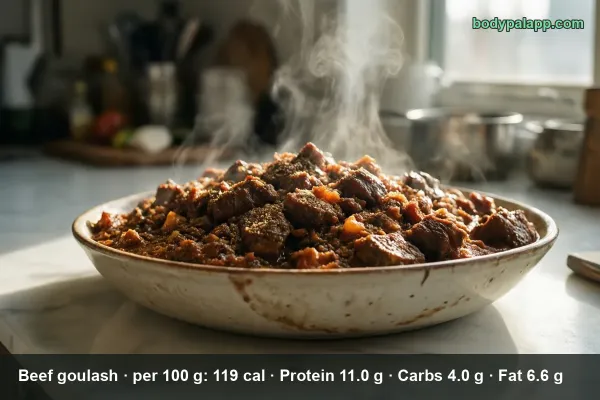
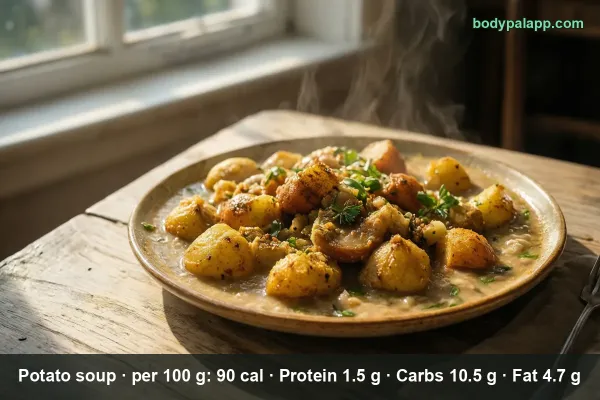
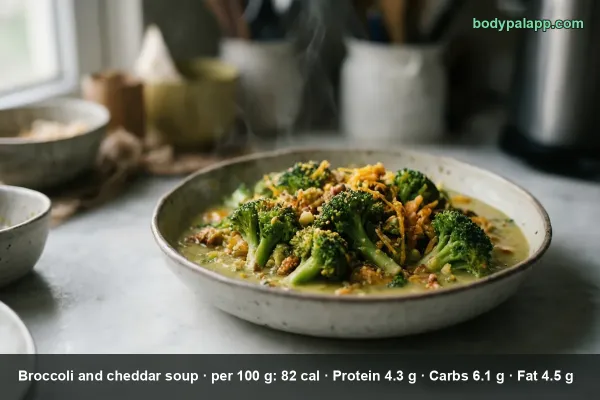
Here is how goulash soup stacks up against beef goulash, potato soup and broccoli and cheddar soup, per 100 g and per usual serving.
Verdict: For the fewest calories pick broccoli and cheddar soup at 82 per 100 g or goulash soup at 86, since beef goulash runs about 1.4 times higher at 119. For staying full pick beef goulash, with 11 g of protein per 100 g, but expect 573 mg of sodium versus 367 mg here.
Most popular goulash soup brands in the United States
Ranked by popularity in the BodyPal database
# Productkcal / 100 g
1Hy-Vee Du Jour Beef Goulash Soup1 cup · 245 g86 kcal
About 211 calories in one cup (245 g), which is 86 calories per 100 g.
Is goulash soup good for weight loss?
It is a lighter option at 86 calories per 100 g with 4.9 g protein, compared with 119 calories per 100 g for beef goulash. One cup carries about 899 mg sodium.
Goulash soup vs beef goulash: which has fewer calories?
Goulash soup has 86 calories per 100 g and beef goulash has 119, so the soup is lower per gram.
How much protein is in goulash soup?
About 12.0 g protein per cup (245 g), or 4.9 g per 100 g, with 11.0 g fat per cup.
Is goulash soup healthy?
Goulash soup is moderate in calories at 211 per cup and gives 12 g of protein, 24% of the daily value. The drawback is sodium: 899 mg per cup, or 39% of the daily value. Keep portions to one cup if you watch salt.
How many calories are in a bowl of goulash soup?
A bowl of two cups (490 g) of goulash soup has 421 calories and 24 g of protein. A single 1 cup bowl has 211 calories, and a large three-cup bowl reaches 632.
What are the nutrition facts for goulash soup per 100 g?
Per 100 g, goulash soup has 86 calories, 4.9 g protein, 6.9 g carbs, 4.5 g fat, 1.8 g saturated fat, 0.8 g fiber, 2 g sugars, 367 mg sodium and 14 mg cholesterol.
How many calories are in 100 g of beef goulash?
Beef goulash has 119 calories per 100 g, about 1.4 times the 86 calories in goulash soup. It also brings more protein at 11 g and more sodium at 573 mg per 100 g.