
How many calories are in beef goulash?
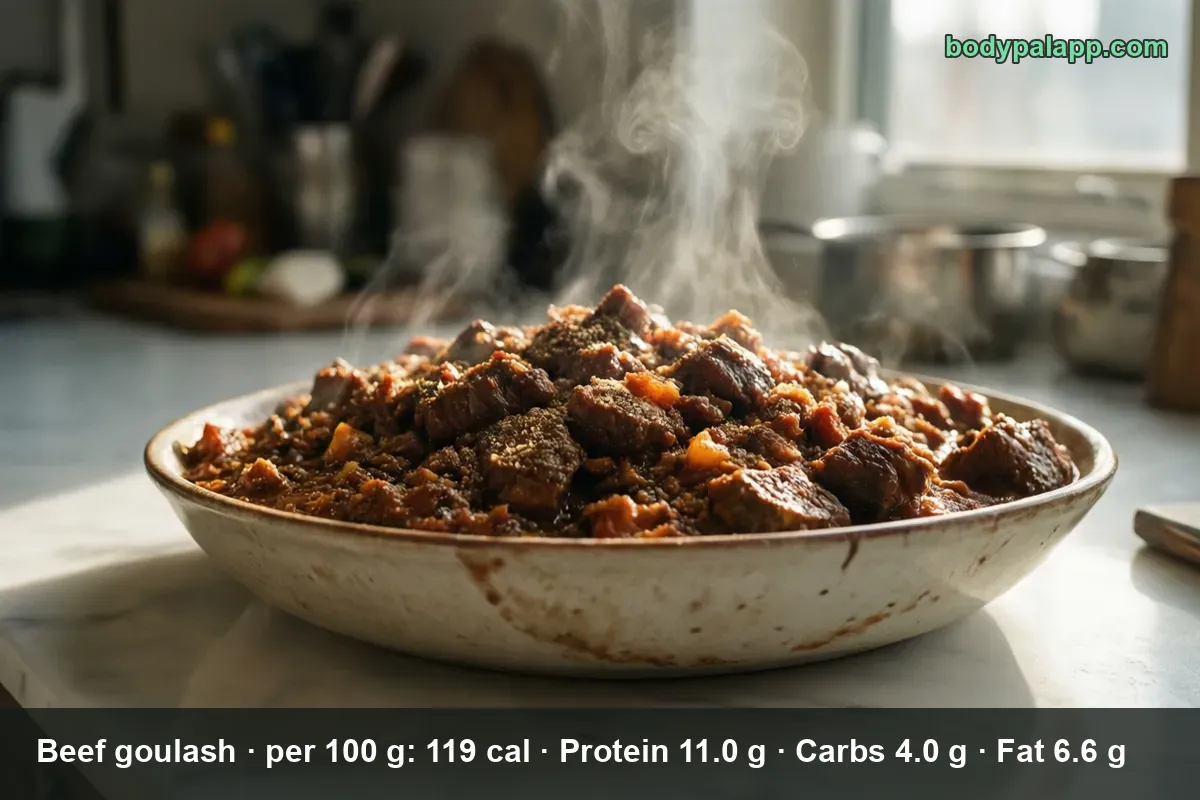
A 1-cup serving of beef goulash, 227 g of meat and sauce, holds 270 calories. Per 100 g the same goulash runs 119 calories, which is light for a beef dish because most of the weight is paprika-red sauce rather than meat. The cup also carries 25.0 g of protein.
On this page
- Beef goulash quick facts
- US servings, from one ounce to a full bowl
- Jarred, deli and soup versions
- Hungarian goulash vs American goulash
- Sodium is the row to watch, not calories
- How does beef goulash compare?
- Most popular beef goulash brands
- FAQ
Beef goulash quick facts
Goulash has a gap in the USDA database. There is no Foundation, Legacy or FNDDS entry for it, so every real number comes from a packaged label filed by GTIN. The one used on this page is Podravka Beef Goulash, 10.5 oz (fdc_id 2580403) — beef and onion in sauce, no pasta and no side dish. That matches what people picture when they type the phrase, and it has the highest protein of the goulash records at 11.01 g per 100 g.
The label serving is a cup, 227 g. Everything in the middle column below is that cup.
| Nutrient | Per 100 g | Per 1 cup (227 g) | % Daily Value |
|---|---|---|---|
| Calories | 119 | 270 | — |
| Total fat | 6.61 g | 15.0 g | 19% |
| Saturated fat | 3.08 g | 7.0 g | 35% |
| Carbohydrate | 3.96 g | 9.0 g | 3% |
| Dietary fiber | 1.3 g | 3.0 g | 11% |
| Total sugars | 1.54 g | 3.5 g | — |
| Protein | 11.01 g | 25.0 g | 50% |
| Sodium | 573 mg | 1301 mg | 57% |
| Cholesterol | 33 mg | 75 mg | 25% |
% Daily Value is based on a 2,000-calorie diet.
Verified nutrition data
Numbers on this page come from USDA FoodData Central, the U.S. Department of Agriculture’s food composition database, and from manufacturer labels where a branded product is named. Last verified September 2026. How we verify our data →
Two rows you will not find here. Added sugars are not declared on this label, and neither is potassium, so both are left out instead of being borrowed from a different product. The label does list 0.22 g of trans fat per 100 g, which is not part of the standard Quick Facts block but is worth knowing if you eat goulash often.
US servings, from one ounce to a full bowl
| Serving | Weight | Calories |
|---|---|---|
| 1 oz | 28 g | 33 kcal |
| 1/2 cup | 113.5 g | 135 kcal |
| 1 cup, the label serving | 227 g | 270 kcal |
| 1 can, 10.5 oz | 298 g | 355 kcal |
| 1 bowl, 1 1/2 cups | 340 g | 405 kcal |
| Per 100 g | 100 g | 119 kcal |
Only the 1-cup line is a USDA household measure. The half cup, the ounce, the full 10.5 oz can and the 340 g bowl are our own arithmetic from the USDA 100 g figure, not USDA servings.
That bowl line is where the counting usually goes wrong. Nobody ladles goulash with a measuring cup. A soup bowl at home takes a cup and a half without looking full, and 340 g is 405 calories — 50 percent more than the label serving, off the same jar, for the same food. If you log "one serving of goulash" and eat a bowl, you are 135 calories short every time.
The 10.5 oz jar is the other trap. It reads like a single-serve container and holds 298 g, so finishing it is 355 calories rather than the 270 printed next to the serving size.
Jarred, deli and soup versions
Goulash reaches American kitchens in four fairly different forms, and the spread per 100 g is wider than the name suggests.
| Version | Per 100 g | Typical serving | Calories |
|---|---|---|---|
| Beef goulash, jarred (Podravka) | 119 kcal | 1 cup, 227 g | 270 kcal |
| Beef goulash, deli tub (The Best Taste) | 110 kcal | 300 g tub | 330 kcal |
| Goulash entree, deli case (Lunds & Byerlys) | 129 kcal | 1 entree, 340 g | 439 kcal |
| American goulash with pasta (Kilyn's Kitchen) | 173 kcal | 1 cup, 272 g | 471 kcal |
| Beef goulash soup (Hy-Vee) | 94 kcal | 1 cup, 245 g | 230 kcal |
| Beef goulash soup, Du Jour (Hy-Vee) | 86 kcal | 1 cup, 245 g | 211 kcal |
The jarred and deli tub versions sit close together, 119 and 110 calories per 100 g, and both are essentially beef in sauce. The deli entree is denser at 129 because it comes plated with macaroni, and it is sold in a 340 g box, so the serving is 439 calories before anything is added to it.
The two soups are the lightest records in the set: 94 and 86 calories per 100 g. Broth is doing that, not a leaner recipe. Protein falls with it, to 5.31 g per 100 g in the Hy-Vee soup against 11.01 g in the jar, so the soup is thinner in every sense.
Hungarian goulash vs American goulash
These are two dishes with one name, and the numbers separate them cleanly. Hungarian-style goulash is beef, onion and paprika in a sauce: 119 calories and 3.96 g of carbohydrate per 100 g. American goulash is ground beef with elbow macaroni and tomato, and the closest USDA record shows 173 calories with 29.78 g of carbohydrate per 100 g.
That is 45 percent more calories per gram, and the gap comes almost entirely from starch rather than from the beef. A 272 g cup of the pasta version is 471 calories against 270 for the same volume of the meat-and-sauce kind. Carbohydrate in that cup works out to about 81 g by our own arithmetic from the 100 g figure.
Neither is the "wrong" goulash. But if you searched for goulash calories after a Hungarian recipe and logged an American goulash entry, you overstated lunch by roughly 200 calories.
Sodium is the row to watch, not calories
At 270 calories a cup, goulash is a modest lunch. Sodium is where it stops being modest: 1,301 mg in that cup, 57 percent of the 2,300 mg Daily Value the FDA sets. That is a bit over half a teaspoon of table salt in a single serving. Eat the 340 g bowl instead and sodium lands near 1,950 mg by our own arithmetic from the 573 mg per 100 g figure — most of a day's allowance in one dish. The Dietary Guidelines for Americans put excess sodium among the country's most common intake problems, and packaged entrees like this one are exactly where it hides.
Saturated fat is the second row worth a look: 7.0 g a cup, 35 percent of the Daily Value. The upside is real, though. Protein is 25.0 g a cup, 50 percent DV, which is a lot for a 270-calorie serving, and MyPlate builds its protein-food targets in ounce-equivalents that an adult typically fills at around five to six a day.
If you are watching sodium, the honest move is a smaller ladle plus a plain side, not a different brand — even the deli entree, at 256 mg per 100 g, still works out to about 870 mg in its 340 g box by our own arithmetic.
How does beef goulash compare?
| Dish | Per 100 g | US serving | Calories |
|---|---|---|---|
| Beef goulash, jarred | 119 kcal | 1 cup, 227 g | 270 kcal |
| Goulash entree, deli case | 129 kcal | 1 entree, 340 g | 439 kcal |
| American goulash with pasta | 173 kcal | 1 cup, 272 g | 471 kcal |
| Beef goulash soup | 94 kcal | 1 cup, 245 g | 230 kcal |
Our take: for a filling lunch, the jarred meat-and-sauce goulash is the best value in this table — 270 calories for 25.0 g of protein beats everything else here per calorie. For weight loss, the soup is the only entry lighter per 100 g, at 94, and a cup of it is 230 calories, but you get half the protein and will be hungry sooner. The two pasta-carrying versions, at 439 and 471 calories a serving, are dinners, not light lunches. Whichever you pick, portion it into a cup and leave the bowl for a day when goulash is the whole meal.
Most popular beef goulash brands in the United States
Ranked by how widely each product appears among foods sold in the United States, from the BodyPal food database of over 3.3 million products. Calories are the figures printed on each Nutrition Facts label, checked against USDA FoodData Central.
| Product | Calories (per 100 g) |
|---|---|
| The Best Taste Beef Goulash | 110 cal |
| Podravka Beef Goulash | 119 cal |
| Lunds & Byerlys Goulash | 129 cal |
| Kilyn's Kitchen Premium Cabin Goulash | 173 cal |
| Hy-Vee Beef Goulash Soup | 94 cal |
| Hy-Vee Du Jour Beef Goulash Soup | 86 cal |
Brand popularity: BodyPal food database. Nutrition: manufacturer labels / USDA FoodData Central.
Beef goulash FAQs
How many calories in 1 cup of beef goulash?
A 1-cup serving of 227 g holds 270 calories, based on the Podravka label in USDA FoodData Central. That cup also carries 25.0 g of protein and 15.0 g of fat. Per 100 g the same goulash runs 119 calories, which is light for a beef dish because the sauce is mostly water.
How many calories are in a bowl of beef goulash?
A 340 g bowl, about a cup and a half, works out to 405 calories. That is our own arithmetic from the USDA 100 g figure of 119 calories, not a labeled serving. The bowl adds 50 percent over the 270-calorie cup and pushes sodium close to 1,950 mg, which is the number most people miss.
Is beef goulash high in protein?
Yes — one cup delivers 25.0 g of protein, 50 percent of the Daily Value, and per 100 g it is 11.01 g, the highest of the goulash records in the USDA database. For comparison, a MyPlate protein-food target for an adult sits at roughly five to six ounce-equivalents across a whole day.
How much sodium is in beef goulash?
One cup carries 1,301 mg of sodium, 57 percent of the 2,300 mg Daily Value, or a bit over half a teaspoon of table salt. Per 100 g it is 573 mg. Soup versions run lower at 355 mg per 100 g, and the deli entree lower still at 256 mg, though its box is larger.
Is beef goulash low carb?
The meat-and-sauce version is: 3.96 g of carbohydrate per 100 g and 9.0 g in a cup, which is 3 percent of the Daily Value. American goulash is a different dish, with 29.78 g per 100 g on its USDA record, or roughly 81 g in a 272 g cup by our own arithmetic. Pasta does that.
What is the difference between Hungarian goulash and American goulash?
Hungarian goulash is beef, onion and paprika in sauce: 119 calories and 3.96 g of carbohydrate per 100 g. American goulash is ground beef with macaroni and tomato, and its USDA record shows 173 calories and 29.78 g of carbohydrate per 100 g. Same name, 45 percent more calories per gram.
How many calories in beef goulash soup?
A 1-cup serving of Hy-Vee beef goulash soup, 245 g, is 230 calories at 94 calories per 100 g. A second recipe of the same soup lists 86 per 100 g, or 211 a cup. Broth dilutes everything: protein falls to 5.31 g per 100 g, about half what the jarred goulash carries.
Is beef goulash good for weight loss?
At 119 calories per 100 g with 11.01 g of protein, the meat-and-sauce version is one of the more filling ways to spend 270 calories at lunch. The pasta version is 173 per 100 g and 471 a cup. If you are watching sodium, portion the cup rather than the 405-calorie bowl.
Similar foods
- Chili Con Carne — 301 cal per cup
- Shakshuka — 289 cal per bowl
- Shrimp Teriyaki — 241 cal per cup
- Tomato Pasta — 300 cal per cup
- Chicken Saag — 331 cal per meal
- Curry Rice — 232 cal per cup
Count it without the math
Point the camera at the plate and BodyPal counts the goulash for you, sauce and all.


How long does it take to burn off beef goulash?
A 1-cup (227 g) serving is 270 kcal. Enter your weight and the amount you ate to see how long it takes you to burn that off:
lb
| Activity | Time to burn 270 kcal |
|---|---|
| Walking, brisk | 54 min |
| Cycling, moderate | 34 min |
| Swimming, moderate | 39 min |
| Jogging | 32 min |
| Weight training, moderate | 1 hr |
Times are for a 155 lb adult at a steady pace; change the weight to see yours. The amount is set to the portion in the text (227 g); change it to what you actually ate. BodyPal works this out from your steps automatically.
Burning it off is one side of it. The other is knowing your number: work out how many calories you need a day, with macros and a goal date.