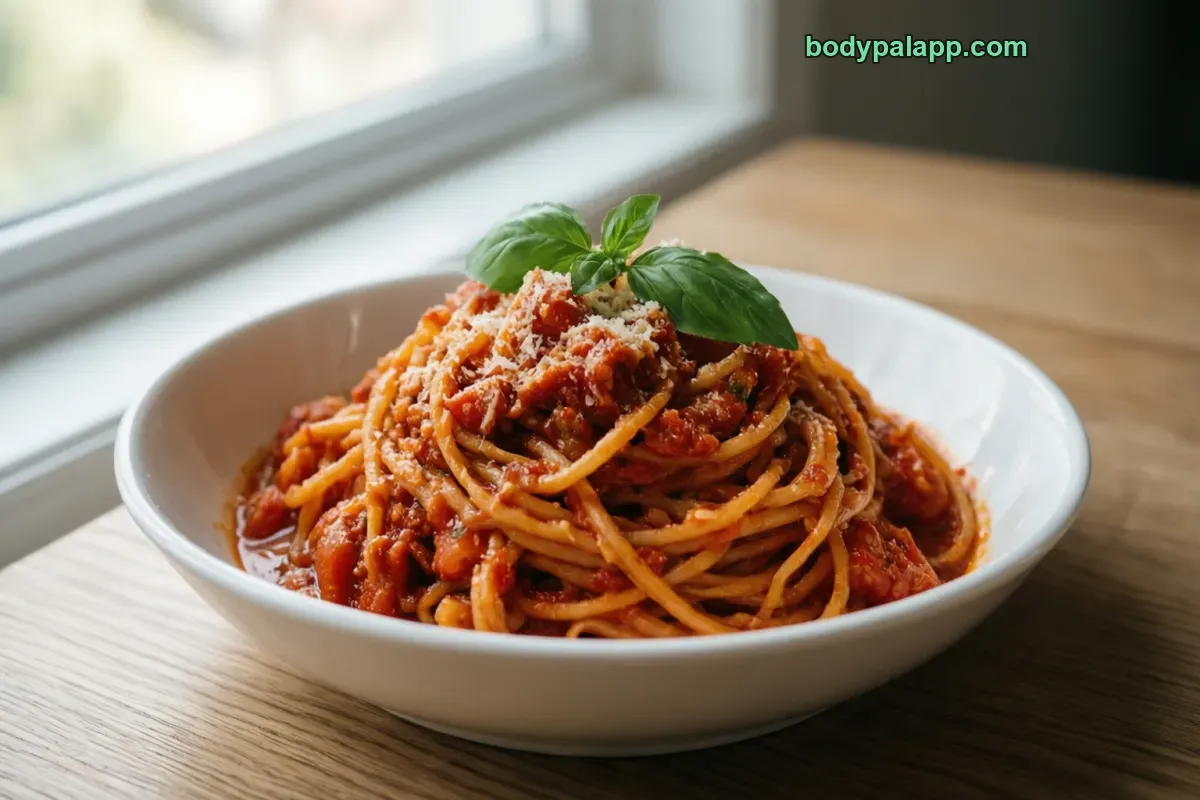
Tomato pasta calories come to 300 for a 1 cup (250 g) serving and 120 per 100 g of ready-to-heat pasta in tomato sauce. The number to notice is sodium, not calories: that one cup carries 845 mg, 37% of the daily value, while its calories fill only 15%.
300kcal
1 cup · 250 g, with tomato sauce, ready-to-heat
12%protein
9 gProtein
49 gCarbs
7.5 gFat
How to burn off 300 kcal
—Walking, brisk
—Jogging
—Cycling, moderate
—Swimming
Skip the math. BodyPal counts these calories from your steps and workouts automatically.
Nutrition facts
With tomato sauce, ready-to-heat · per 250 g
Calories
300 kcal
Protein
9 g
Carbohydrate
49 g
Fat
7.5 g
Saturated fat
1 g
Cholesterol
3 mg
Sodium
845 mg
Potassium
433 mg
Iron
2.5 mg
Source: USDA FoodData Central
🛡️
Verified nutrition data
Numbers on this page come from USDA FoodData Central, the U.S. Department of Agriculture’s food composition database, and from manufacturer labels where a branded product is named. Last verified September 2026. How we verify our data →
Tomato pasta: calories, protein and sodium by serving
Percent of daily value uses the FDA reference of 2,000 kcal a day.
Serving
kcal
Protein
Carbs
Fat
Sodium
% DV kcal
1 cup (250 g)
300
9 g
48.6 g
7.5 g
845 mg
15%
With meat (250 g)
348
14.4 g
46.9 g
10.9 g
838 mg
17%
1 can (425 g)
510
15.3 g
82.6 g
12.7 g
1,437 mg
26%
100 g
120
3.6 g
19.4 g
3 g
338 mg
6%
3 × 1 cup (250 g)
900
27.1 g
2,535 mg
5 × 1 cup (250 g)
1,500
45.1 g
4,225 mg
One cup is 300 calories, a whole can is 510
The USDA row behind this page is pasta with tomato-based sauce, ready-to-heat, and the default serving is 1 cup (250 g) at 300 calories. That is 15% of the daily value for calories, a moderate figure for a main dish. Finish the whole 1 can (425 g) and the total climbs to 510 calories, or 26% of the daily value.
Pasta is easy to overserve, and the total moves in straight steps. Two cups, 500 g, come to 600 calories. Three cups, 750 g, reach 900. A family pot of five cups, 1,250 g, holds 1,500 calories, which is why the serving spoon matters more than the brand of sauce.
If you log by weight, the math stays simple: every 100 g adds 120 calories. A kitchen scale beats eyeballing a bowl, because noodles pile up and look smaller than they are. If you skip the scale, BodyPal can log a bowl of tomato pasta from a photo.
Carbs supply about two thirds of the calories
Carbohydrate supplies 65% of the calories in tomato pasta, fat 23% and protein 12%. Per 100 g that works out to 19.4 g of carbs, 3 g of fat and 3.6 g of protein. This is a starch-forward dish, exactly what you would expect from noodles in sauce.
Protein is the weak spot. One cup gives 9 g, 18% of the daily value, which is light for a plate meant to be a meal. The version with meat raises that to 14.4 g per 250 g, or 29% of the daily value, for 348 calories instead of 300. That trade is worth it if you want the bowl to hold you longer.
Fat stays modest at 7.5 g per cup, and saturated fat is only 0.4 g per 100 g. Sugars come to 7.2 g per cup, a small slice of the 48.6 g of total carbs. Fiber lands at 4.5 g a cup, reasonable but not high.
Sodium is the row to watch
At 338 mg per 100 g, ready-to-heat tomato pasta is a salty food. One cup carries 845 mg, 37% of the daily value, more than double its share of calories. The full 1 can (425 g) reaches 1,437 mg, or 62% of the daily value, in a single sitting.
Bigger portions push it further. Two cups contain 1,690 mg and three cups 2,535 mg, which is past the full daily value on its own. Choosing the meat version does not help here: it still has 838 mg per 250 g.
Plain pasta, by comparison, lists 131 mg per 100 g and wheat pasta just 4 mg, so the ready-made sauce is where the salt sits. If you watch sodium, keep the other meals of the day lower in salt, or cook plain pasta and season your own sauce so you control the shaker.
Build the plate around protein and vegetables
Tomato pasta works best as one part of a plate, not the whole plate. Because protein is only 12% of its calories, a lean protein on the side or the meat version makes the meal more balanced. Vegetables add volume and fiber without adding much to the total.
A practical move: keep the pasta to 1 cup and fill the rest of the bowl with salad or steamed vegetables. You get a plate that looks generous for about 300 calories from the pasta itself. If dinner is pasta from a can, let breakfast and lunch carry the lower-sodium, higher-protein foods.
Potassium is 173 mg per 100 g, a modest amount, so this is not a dish to lean on for that row either. Treat it as a quick, convenient base and build the nutrition around it.
How does tomato pasta compare?
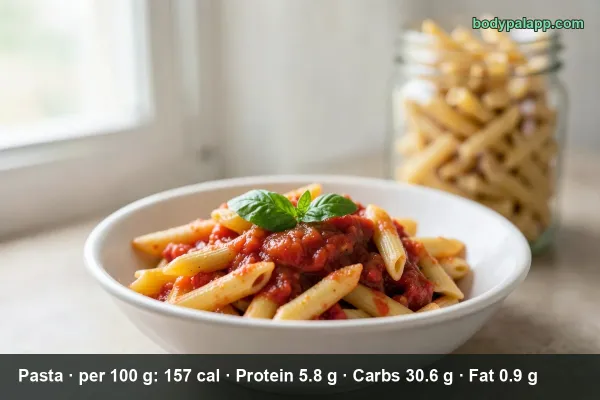
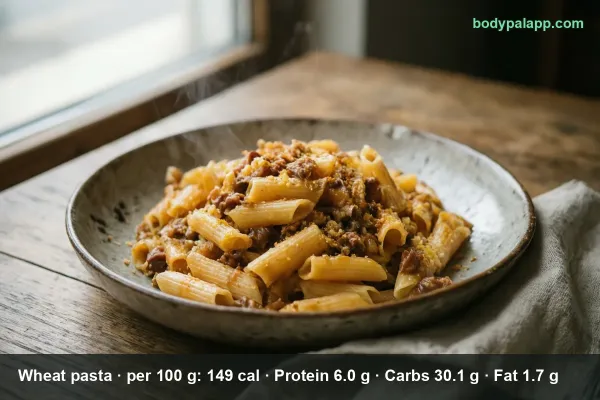
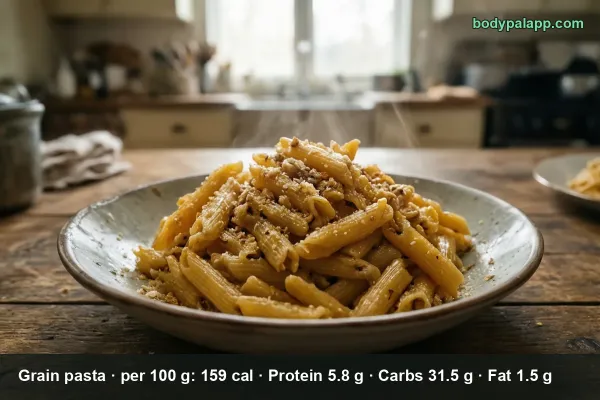
Here is how ready-to-heat tomato pasta stacks up against plain pasta, wheat pasta and grain pasta, per 100 g and per usual serving.
Verdict: Per 100 g, tomato pasta is the lightest option at 120 calories, against 157 for pasta and 159 for grain pasta, so it is the pick if calories alone decide. For sodium and protein, plain wheat pasta wins with 4 mg of sodium and 6 g of protein per 100 g, so cook it yourself if salt is your concern.
Tomato pasta FAQs
How many calories are in a cup of tomato pasta?
About 300 calories in 1 cup (250 g) of pasta with tomato sauce, which works out to 120 calories per 100 g.
Is tomato pasta good for weight loss?
A cup is 300 calories with 7.5 g of fat and 48.6 g of carbs. The same cup made with meat is 348 calories.
Tomato pasta or plain pasta: which has fewer calories?
Per 100 g tomato pasta is 120 calories and plain cooked pasta is 157. A 250 g cup of tomato pasta is 300 calories, against 195 for a 124 g cup of plain spaghetti.
How much protein is in tomato pasta?
3.6 g per 100 g, so about 9 g in a 250 g cup. The version with meat has 5.7 g per 100 g, or about 14 g per cup.
How many calories are in a can of tomato pasta?
A 1 can (425 g) serving of tomato pasta has 510 calories, 26% of the daily value. It also carries 1,437 mg of sodium, 62% of the daily value, along with 15.3 g of protein.
Does tomato pasta with meat have more calories?
Yes. A 250 g serving with meat has 348 calories, compared with 300 for the plain version. The meat lifts protein from 9 g to 14.4 g, and fat rises from 7.5 g to 10.9 g.
How much sodium is in tomato pasta?
One cup (250 g) of tomato pasta has 845 mg of sodium, 37% of the daily value. Per 100 g it is 338 mg, far more than the 131 mg listed for plain pasta.
How many carbs are in a cup of tomato pasta?
A cup (250 g) of tomato pasta has 48.6 g of carbohydrates, including 4.5 g of fiber and 7.2 g of sugars. Carbs supply 65% of its calories.