
How Many Calories in a Cup of Pasta?
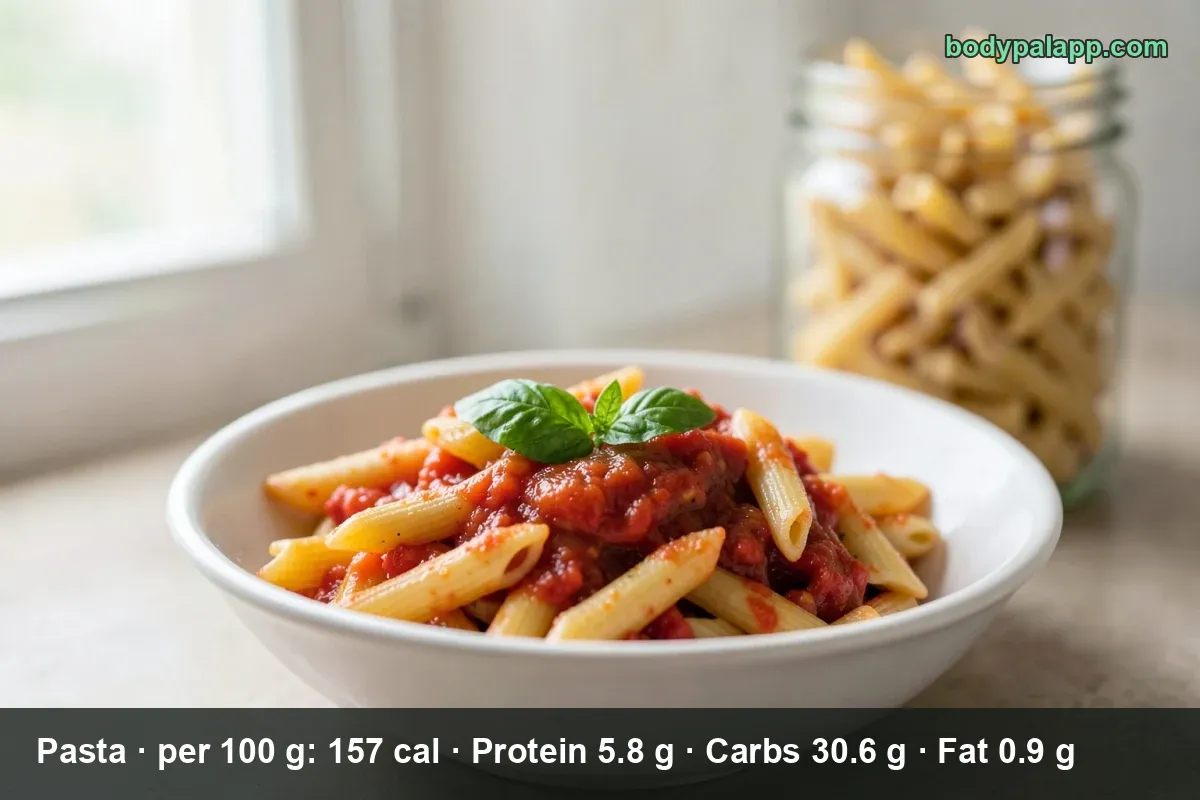
A 1-cup serving of cooked penne weighs 107 g and carries 168 calories. Per 100 g, cooked enriched pasta runs 157 calories. The number moves with the shape and with how hard you pack the cup: that same cup filled with pressed spaghetti weighs 151 g and reaches 237 calories.
On this page
- Pasta quick facts
- US servings, from one ounce to a packed cup
- Whole-wheat, gluten-free, dry and sauced
- Carbs, fiber and the sodium in the water
- How does pasta compare?
- Most popular pasta brands
- FAQ
Pasta quick facts
The row used here is SR Legacy 169751, "Pasta, cooked, enriched, with added salt". That is the American default: dry semolina pasta out of a box, boiled in salted water, drained, no sauce yet. USDA also carries a survey average for cooked pasta (FNDDS 2708357) at the same 157 calories, but its sodium is 232 mg per 100 g, which reflects how heavily other people salt their water rather than how much energy is on your plate.
Everything below is measured on cooked, drained pasta. If you weigh yours dry instead, jump to the dry row further down — the two numbers are more than twice as far apart as most people expect.
| Nutrient | Per 100 g | Per 1 cup penne (107 g) | % Daily Value |
|---|---|---|---|
| Calories | 157 | 168 | — |
| Total fat | 0.93 g | 1.0 g | 1% |
| Saturated fat | 0.18 g | 0.2 g | 1% |
| Carbohydrate | 30.59 g | 32.7 g | 12% |
| Dietary fiber | 1.8 g | 1.9 g | 7% |
| Total sugars | 0.56 g | 0.6 g | — |
| Protein | 5.8 g | 6.2 g | 12% |
| Sodium | 131 mg | 140 mg | 6% |
% Daily Value is based on a 2,000-calorie diet.
Verified nutrition data
Numbers on this page come from USDA FoodData Central, the U.S. Department of Agriculture’s food composition database, and from manufacturer labels where a branded product is named. Last verified September 2026. How we verify our data →
There is no added-sugars row because SR Legacy does not publish that field, and boiled pasta with nothing on it has no added sugar to publish. Trans fat is 0 g. Cholesterol is 0 mg, since there is no egg in standard dry semolina pasta. Potassium is 44 mg per 100 g, so 47 mg in the cup — 1% of the Daily Value, small enough to ignore.
US servings, from one ounce to a packed cup
| Serving | Weight | Calories |
|---|---|---|
| 1 oz | 28 g | 44 kcal |
| 1 cup penne | 107 g | 168 kcal |
| 1 cup elbows, not packed | 120 g | 188 kcal |
| 1 cup spaghetti, not packed | 124 g | 195 kcal |
| 1 cup spaghetti, packed | 151 g | 237 kcal |
| Per 100 g | 100 g | 157 kcal |
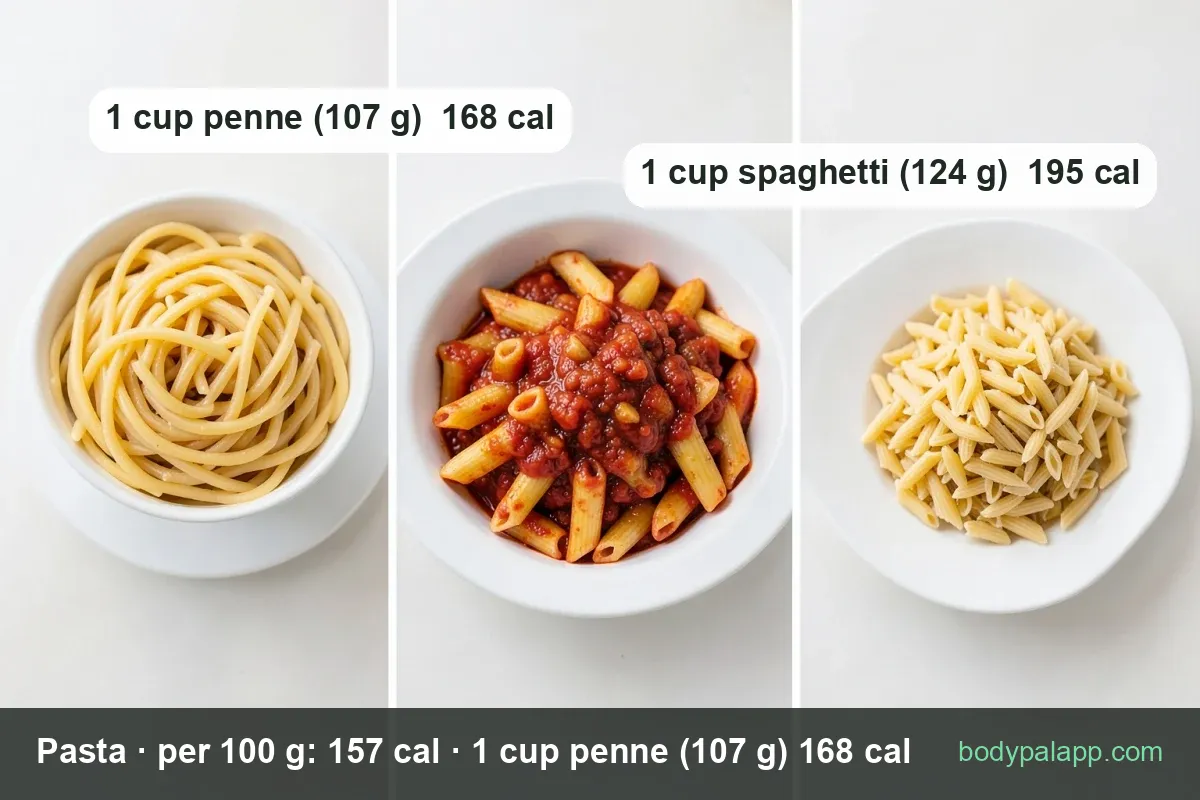
Four of those cups are USDA household measures attached to the record itself, which is why they disagree with each other. Penne leaves air gaps and comes in lightest at 107 g. Loose spaghetti settles at 124 g. Press the same spaghetti down into the cup and you get 151 g — a 69-calorie spread across one measuring cup, which is more than the difference between white and whole-wheat pasta at the same weight. The 1 oz line is our own arithmetic from the USDA 100 g figure, not a USDA serving.
The practical fix is boring and it works: log pasta by weight, not by cup. A cheap kitchen scale removes the entire 69-calorie question in one step.
Whole-wheat, gluten-free, dry and sauced
| Version | Per 100 g | Typical serving | Calories |
|---|---|---|---|
| Whole-wheat, cooked | 149 kcal | 1 cup penne (97 g) | 145 kcal |
| Gluten-free, brown rice flour, cooked | 138 kcal | 1 cup penne, not packed (131 g) | 181 kcal |
| Dry, uncooked, enriched | 371 kcal | 2 oz dry (57 g) | 211 kcal |
| Cooked in unsalted water | 158 kcal | 1 cup spaghetti (124 g) | 196 kcal |
| With tomato-based sauce | 120 kcal | 1 cup (250 g) | 300 kcal |
| With cream sauce | 167 kcal | 1 cup (250 g) | 418 kcal |
Dry versus cooked is the one that trips people up. Dry pasta is 371 calories per 100 g; cooked pasta is 157. Nothing is lost in the pot — the pasta simply takes on water and more than doubles in weight, so the same energy spreads across a bigger number on the scale. Two ounces of dry pasta, 57 g, is 211 calories and lands on the plate as roughly one cup.
Whole-wheat saves you very little energy, about 5% per 100 g, and buys you a lot of fiber. Gluten-free brown-rice pasta reads lower at 138 calories per 100 g, but it packs denser into a cup, so a real bowl of it is 181 calories against 168 for wheat penne — the per-100-g number flatters it and the plate does not.
Sauce is the real variable. A cup of pasta with tomato sauce, 250 g, is 300 calories. The same cup with cream sauce is 418. That 118-calorie gap is about 70% of the 168 calories in the plain cup of penne underneath it.
Boxed brands line up with the USDA dry row rather than fighting it. Barilla prints a 2 oz dry serving at 56 g and 200 calories, and De Cecco and Garofalo use the same 56 g at 200 and 210 calories, which is the same food as the USDA 211 at 57 g once you account for the label rounding down to 56 g and to the nearest ten calories. Barilla Ready Pasta, sold already cooked, is the exception: 174 calories per 100 g and 211 for its 121 g cup, because it is packed with a little oil.
Carbs, fiber and the sodium in the water
A cup of pasta is 32.7 g of carbohydrate, 12% of the FDA Daily Value of 275 g. It is also 6.2 g of protein — 12% of the 50 g DV, and more than most people expect from a food they file under "starch." Fat is the row that barely exists: 1.0 g in the cup, 1% DV, and 0.2 g of that saturated.
Fiber is where the choice matters. Enriched white pasta gives 1.9 g per cup, 7% of the 28 g DV. Whole-wheat pasta carries 3.9 g per 100 g against 1.8 g — more than double — and the Dietary Guidelines for Americans ask that at least half your grains be whole grains, which one box swap covers. MyPlate counts a half-cup of cooked pasta as one ounce-equivalent of grains.
Salt is the last surprise. Pasta cooked in salted water is 131 mg of sodium per 100 g; cooked in plain water it is 1 mg. The calories are identical at 157 and 158, so the salt costs you nothing in energy and 140 mg in the cup, 6% of the 2,300 mg Daily Value. If you're watching sodium, that is a cheap place to save — and if you're not, salting the water is free.
How does pasta compare?
| Pasta | Per 100 g | US serving | Calories |
|---|---|---|---|
| Enriched, cooked (this page) | 157 kcal | 1 cup penne, 107 g | 168 kcal |
| Whole-wheat, cooked | 149 kcal | 1 cup penne, 97 g | 145 kcal |
| Gluten-free, brown rice, cooked | 138 kcal | 1 cup penne, 131 g | 181 kcal |
| Dry, enriched | 371 kcal | 2 oz dry, 57 g | 211 kcal |
Our take: for weight loss, whole-wheat penne is the pick — 145 calories a cup, the lowest bowl in the table, with 3.8 g of fiber to keep you full. For fiber per calorie, the same row wins twice: 3.9 g per 100 g at 149 calories. Gluten-free brown-rice pasta looks like the light option per 100 g and is not: it settles heavier in the cup and drops protein from 5.8 g to 3.46 g per 100 g, roughly 40% less, so buy it for the gluten, not for the calories. And whichever box you open, the sauce ladle moves your total further than the pasta does.
Most popular pasta brands in the United States
Ranked by how widely each product appears among foods sold in the United States, from the BodyPal food database of over 3.3 million products. Calories are the figures printed on each Nutrition Facts label, checked against USDA FoodData Central.
| Product | Calories (per 100 g) |
|---|---|
| Barilla Ready Pasta | 174 cal |
| Barilla Ziti | 357 cal |
| Barilla Linguine | 357 cal |
| Barilla Fettuccine | 357 cal |
| De Cecco Tricolore | 357 cal |
| Garofalo Macaroni | 375 cal |
Brand popularity: BodyPal food database. Nutrition: manufacturer labels / USDA FoodData Central.
Pasta FAQs
How many calories are in 1 cup of cooked pasta?
168 calories for a cup of cooked penne, which weighs 107 g. A cup of loose spaghetti is 124 g and 195 calories, elbows 120 g and 188 calories, and spaghetti pressed into the cup 151 g and 237 calories. The shape and the packing decide the number, not the brand.
How many calories in 2 oz of dry pasta?
211 calories in 2 oz of dry enriched pasta, which is 57 g on a kitchen scale. Dry pasta is 371 calories per 100 g because there is no water in it yet. Boiled, those 2 oz swell to roughly a cup on the plate at the same 211 calories.
Does pasta lose calories when cooked?
No, 100 g of dry pasta is 371 calories and 100 g of cooked pasta is 157, but that gap is water, not lost energy. Boiling more than doubles the weight while the calories stay put. Weigh pasta dry for the steadier number, or weigh it cooked and use the 157 figure.
Is whole wheat pasta lower in calories than white pasta?
Slightly: 149 calories per 100 g against 157 for enriched white pasta, about 5% less. The real difference is fiber, 3.9 g per 100 g versus 1.8 g, more than double. A cup of whole-wheat penne at 97 g is 145 calories and 3.8 g of fiber.
How many calories in gluten free pasta?
138 calories per 100 g for cooked brown-rice pasta, lower than the 157 of enriched wheat pasta. A cup of it, not packed, weighs 131 g, so the bowl lands at 181 calories. Protein is the trade: 3.46 g per 100 g against 5.8 g, roughly 40% less.
How much protein is in a cup of pasta?
6.2 g of protein in a cup of cooked penne, 107 g, which is 12% of the FDA Daily Value of 50 g. Per 100 g that is 5.8 g. Dry pasta looks richer at 13.04 g per 100 g only because the water has not gone into it yet.
Does salting the pasta water add calories?
No, USDA lists cooked enriched pasta at 157 calories per 100 g with added salt and 158 without, the same number inside rounding. What changes is sodium: 131 mg per 100 g against 1 mg. A cup of salted penne carries 140 mg, 6% of the 2,300 mg Daily Value.
Is pasta good for weight loss?
A cup of plain cooked pasta is 168 calories, which is modest; the sauce usually moves the total. A cup of pasta with tomato sauce, 250 g, is 300 calories, and the same cup with cream sauce is 418. If you're watching calories, measure the sauce more carefully than the pasta.
Similar foods
- Penne pasta — 169 cal per cup
- Baba ganoush — 110 cal for 1/4 cup
- Rice — 205 cal per cup, cooked
- Quinoa — 222 cal per cup cooked
- Prosciutto — 55 cal for 3 thin slices
- Wild Rice — 166 cal per cup, cooked
Count it without the math
Point the camera at the bowl and BodyPal counts the pasta for you, sauce and all.


How long does it take to burn off pasta?
A 1-cup serving of penne (107 g) is 168 kcal. Enter your weight and the amount you ate to see how long it takes you to burn that off:
lb
| Activity | Time to burn 168 kcal |
|---|---|
| Walking, brisk | 34 min |
| Cycling, moderate | 21 min |
| Swimming, moderate | 24 min |
| Jogging | 20 min |
| Weight training, moderate | 37 min |
Times are for a 155 lb adult at a steady pace; change the weight to see yours. The amount is set to the portion in the text (107 g); change it to what you actually ate. BodyPal works this out from your steps automatically.
This table assumes you know your daily total. If you do not, the daily calorie calculator works it out from five numbers.