
How Many Calories Are in Prosciutto?
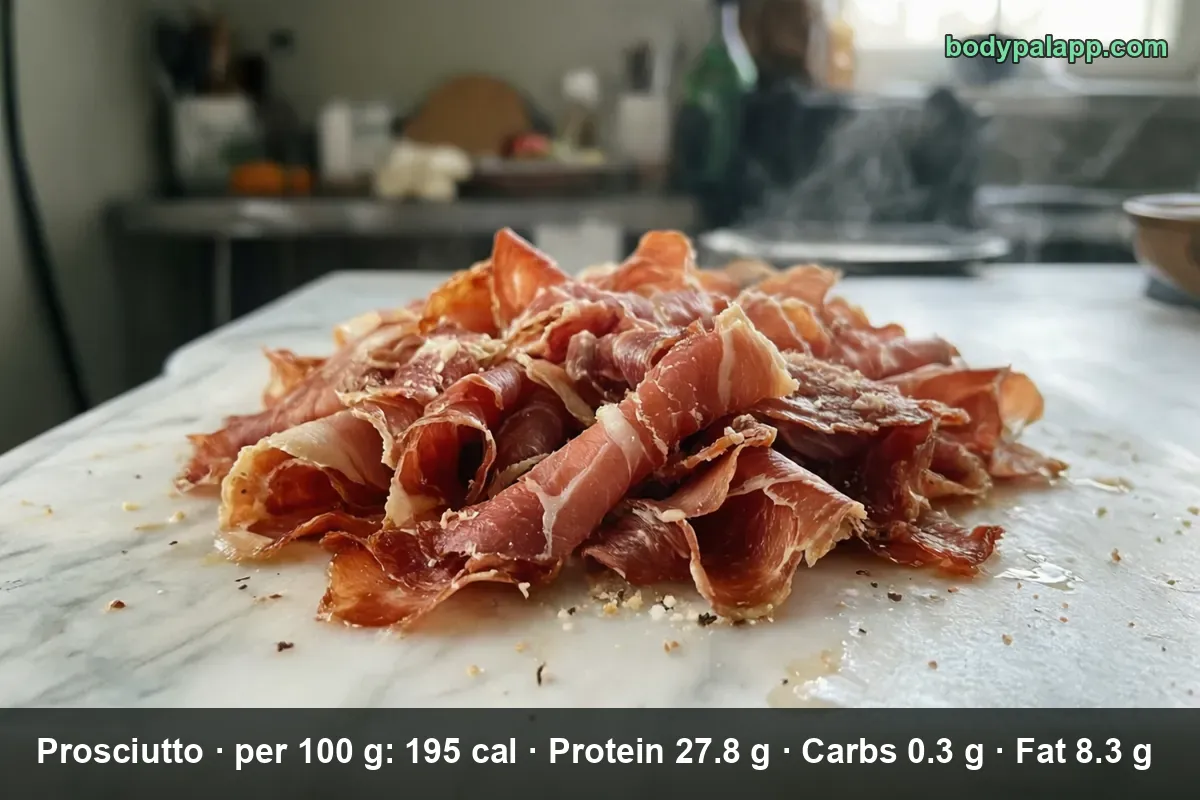
An ounce of prosciutto, which is about three thin folded slices, is 55 calories, and 100 g is 195. One slice on its own is 18. The calories here are small enough that most people never bother to log them. The sodium is not: that same ounce carries 755 mg, a third of the Daily Value.
On this page
- Prosciutto quick facts
- US serving sizes
- The sodium is the real number
- What the label on the package says
- Prosciutto di Parma, cubetti and snack packs
- Protein per calorie, where prosciutto wins
- Is prosciutto healthy?
- How does prosciutto compare?
- Most popular prosciutto brands
- FAQ
Prosciutto quick facts
The reference record is USDA's survey entry for the food itself, FNDDS 2705879, "Ham, prosciutto": dry-cured ham sliced thin at the deli counter, nothing wrapped around it and nothing on the side. The serving column is 1 oz, the amount nearly every American package declares.
| Nutrient | Per 100 g | Per 1 oz (28 g) | % Daily Value |
|---|---|---|---|
| Calories | 195 | 55 | — |
| Total fat | 8.3 g | 2.3 g | 3% |
| Saturated fat | 2.8 g | 0.8 g | 4% |
| Carbohydrate | 0.3 g | 0.1 g | 0% |
| Dietary fiber | 0 g | 0 g | 0% |
| Total sugars | 0 g | 0 g | — |
| Protein | 27.8 g | 7.8 g | 16% |
| Sodium | 2695 mg | 755 mg | 33% |
| Cholesterol | 70 mg | 20 mg | 7% |
| Potassium | 510 mg | 143 mg | 3% |
% Daily Value is based on a 2,000-calorie diet.
Verified nutrition data
Numbers on this page come from USDA FoodData Central, the U.S. Department of Agriculture’s food composition database, and from manufacturer labels where a branded product is named. Last verified September 2026. How we verify our data →
Two numbers sit at opposite ends of that table. An ounce of prosciutto uses 3% of a day's fat and 33% of a day's sodium, which makes it one of the few foods where the salt line outruns the fat line by a factor of eleven.
There is no added-sugars row and no trans-fat row on this page because USDA publishes neither for this record. Cured ham has no sugar in its formulation, and the survey database carries no trans-fat figure for entry 2705879. Those rows are absent rather than blank, and mixing in a value from a different USDA source to fill them would describe a different food.
One more row that will not appear anywhere here: cooked. Prosciutto is salted and air-dried for months rather than cooked, so the raw-versus-cooked split that governs every other pork page does not exist. What is on the scale is what goes on the plate.
US serving sizes
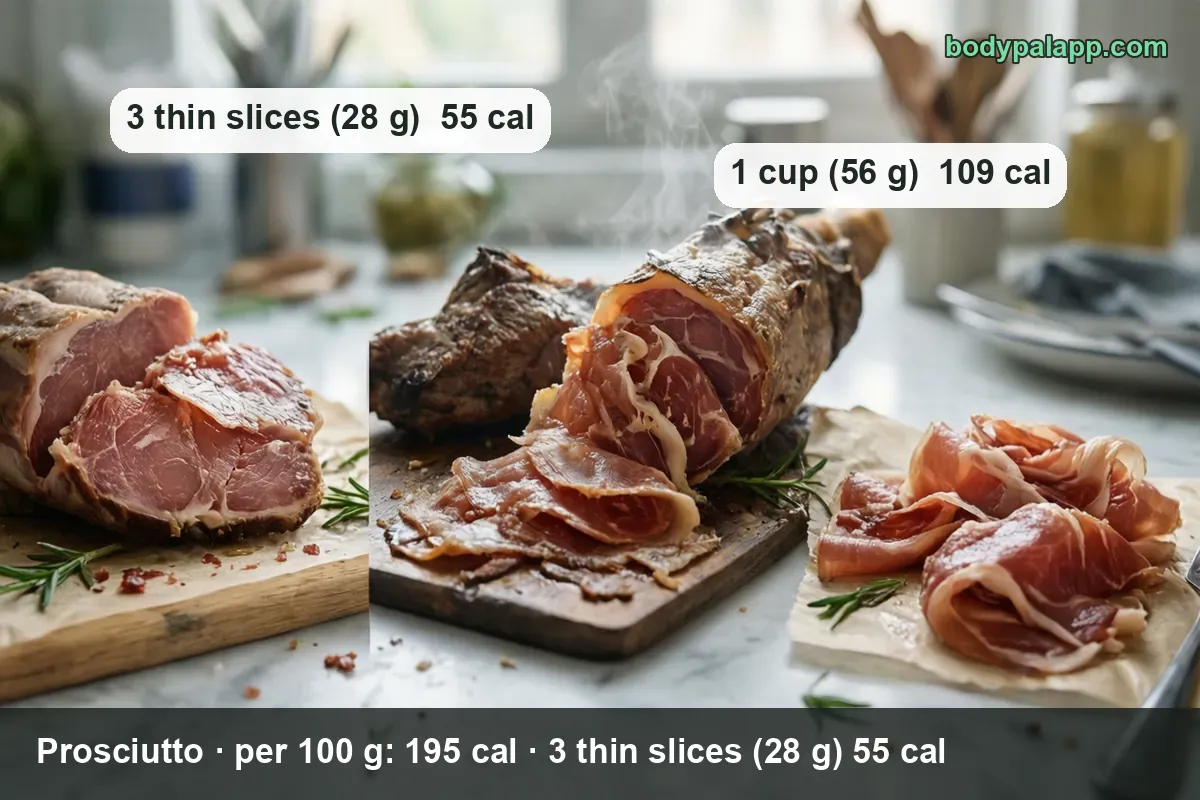
The thin slice, the ounce and the cup below are USDA portions for the same record, built on 195 calories per 100 g. The package serving and the 2 oz charcuterie portion are our own scaling of that same figure to amounts people actually serve.
| Portion | Weight | Calories | Protein | Sodium |
|---|---|---|---|---|
| 1 thin slice | 9.2 g | 18 | 2.6 g | 248 mg (11% DV) |
| 3 thin slices, about 1 oz | 28 g | 55 | 7.8 g | 755 mg (33% DV) |
| 2 slices, the package serving | 28 g | 55 | 7.8 g | 755 mg (33% DV) |
| 1 cup, folded slices | 56 g | 109 | 15.6 g | 1,509 mg (66% DV) |
| 2 oz charcuterie serving | 56 g | 109 | 15.6 g | 1,509 mg (66% DV) |
| 100 g | 100 g | 195 | 27.8 g | 2,695 mg (117% DV) |
The slice is the unit that matters, and it is tiny. At 9.2 g, a thin slice of prosciutto is barely a third of an ounce and costs 18 calories. Draping two of them over a melon wedge or a roasted asparagus spear adds 36. That is genuinely close to free, and it is why prosciutto keeps showing up in recipes written for people counting calories.
Notice that two rows share a weight. Three thin USDA slices come to about an ounce and most packages call 2 slices a serving, and both land at 28 g, because slice thickness at the deli counter is not a standard. Count grams if the number has to be exact; count slices if it only has to be close.
The last two rows are the same 56 g wearing different names. A cup of loosely folded slices and a 2 oz charcuterie portion are the identical pile of meat, and both are 109 calories.
The sodium is the real number
Calories are why people search for prosciutto. Sodium is why they should.
- One thin slice, 9.2 g: 248 mg, or 11% DV
- One ounce, 28 g: 755 mg, or 33% DV
- One cup of folded slices, 56 g: 1,509 mg, or 66% DV
- 100 g: 2,695 mg, or 117% DV
The Dietary Guidelines for Americans put the ceiling at 2,300 mg of sodium a day, which is roughly a teaspoon of table salt. An ounce of prosciutto spends a third of that on 55 calories.
Run the cup row again slowly, because it is the one that catches people. A cup of folded prosciutto on a charcuterie board is 109 calories and two thirds of a day's sodium. The calorie count says snack. The sodium says main event. Nobody eats a cup of prosciutto and thinks they have eaten much, which is exactly the problem.
CDC puts most American sodium in packaged and restaurant foods rather than in the salt shaker, and dry-cured meat is that principle at its purest: salt is not seasoning here, it is the preservation method. Take the salt out and there is no prosciutto, only raw pork.
This inverts the usual advice about deli meat. The standard warning is that cured meats are calorie traps, and prosciutto is not one: 55 calories an ounce is less than any cured meat on this page except canned ham. It is a sodium trap instead, and it wears the low calorie count as camouflage.
What the label on the package says
USDA's generic record and the packages in an American refrigerator case do not agree, and the gap runs in a direction worth knowing.
| Source | Calories per 100 g | Sodium per 100 g |
|---|---|---|
| USDA generic record, FNDDS 2705879 | 195 | 2,695 mg |
| American package labels, range | 179 to 250 | 1,393 to 2,200 mg |
| Median of those labels | 214 | — |
The generic record is below every label but one on calories and above all of them on sodium. A typical American package runs about 10% above 195 calories per 100 g and well below 2,695 mg of sodium. Nothing is wrong with either number. USDA's survey record averages prosciutto as eaten across the country, including whatever comes off a whole leg at a deli counter, while a package label describes one producer's product measured in one plant.
Which one to use depends on what is in your hand. If a package is in front of you, its label beats every average ever computed, and the sodium line is the one to read. If prosciutto was sliced to order and handed over in paper, 195 calories per 100 g and 55 per ounce is the best available figure.
The practical version: the calorie difference between the highest and lowest package on the shelf, 250 against 179 per 100 g, is 20 calories on a 1 oz serving. The sodium difference across the same shelf is over 200 mg per ounce. Read labels for salt, not for calories.
Prosciutto di Parma, cubetti and snack packs
Three forms of prosciutto sit in the same store, and they are not interchangeable.
| Form | Per 100 g | Serving | Calories | Protein | Fat | Sodium per serving |
|---|---|---|---|---|---|---|
| Prosciutto di Parma, PDO | 200 | 2 slices (30 g) | 60 | 8.0 g | 3.5 g | 660 mg (29% DV) |
| Cubetti, diced prosciutto | 250 | 2 oz (56 g) | 140 | 15.0 g | 9.0 g | 1,130 mg (49% DV) |
| Prosciutto and provolone snack pack | 214 | 2 oz (56 g) | 120 | 15.0 g | 7.0 g | 1,030 mg (45% DV) |
Prosciutto di Parma is the protected-designation ham, aged at least a year in one province of Italy, and its label reads 200 calories per 100 g with 11.7 g of fat, against 8.3 g in the generic USDA record. It is the fattier meat and the less salty one: 2,200 mg of sodium per 100 g is about 18% below the generic figure. Paying for the PDO stamp buys you a milder cure, not a lighter slice.
Cubetti, the diced prosciutto sold for carbonara and pasta sauces, is the calorie outlier at 250 per 100 g. Dice comes off the fattier part of the leg, so 16.1 g of fat per 100 g against 8.3 g in sliced prosciutto is the whole explanation. Two ounces stirred into a pan is 140 calories, which is still modest, but it is the heaviest prosciutto in the case by a wide margin.
The snack pack with provolone is the only prosciutto product on this page that contains carbohydrate at all: 1.8 g per 100 g, and every gram of it is cheese. Two ounces is 120 calories and 1,030 mg of sodium, 45% of the day, which is a large share of a day's salt for something sold as a car-seat snack.
Protein per calorie, where prosciutto wins
Rank the deli case by how much protein arrives per 100 calories and prosciutto sits at the top, well clear of the field.
| Deli meat | Calories per 100 g | Protein per 100 g | Protein per 100 calories |
|---|---|---|---|
| Prosciutto | 195 | 27.8 g | 14.3 g |
| Dried beef, chipped | 225 | 28.1 g | 12.5 g |
| Ham, canned | 167 | 20.9 g | 12.5 g |
| Bologna, reduced fat | 204 | 11.8 g | 5.8 g |
| Salami | 378 | 21.1 g | 5.6 g |
Prosciutto delivers two and a half times the protein per calorie of salami and nearly the same margin over reduced-fat bologna. A cup of it carries 15.6 g of protein, 31% of the Daily Value, for 109 calories, and MyPlate counts cured ham inside the protein foods group alongside fresh cuts.
Curing is what produces that ratio. Months of air-drying remove water, so what is left per gram is concentrated meat rather than fat or filler. The same drying is what concentrates the salt, which is why the protein table and the sodium table are two readings of a single process.
Is prosciutto healthy?
By the calorie count, prosciutto is one of the leanest things at the deli counter: 55 calories per ounce, 2.3 g of fat, 0.8 g of saturated fat (4% DV) and 7.8 g of protein. Compared against the FDA Daily Values, the fat, saturated fat, carbohydrate and cholesterol lines are all in single digits for a 1 oz serving.
The sodium line is 33%, and it is the number that decides the answer. One ounce is easy to fit into any day. A cup of it, at 66% DV, leaves 791 mg of sodium for everything else eaten that day.
So the useful frame is portion size, not permission. Two slices over cantaloupe cost 36 calories and 496 mg of sodium. A charcuterie board where prosciutto is the main event is a different food, and it should be counted as one.
Cholesterol is worth a glance too: 70 mg per 100 g, 20 mg per ounce, 7% DV. It is the third-highest percentage in the quick facts table, after sodium and protein, and nowhere near the salt.
How does prosciutto compare?
Every row at the same 1 oz serving (28 g), each from its own USDA record.
| Deli meat | Per 100 g | Per 1 oz | Protein | Fat |
|---|---|---|---|---|
| Prosciutto | 195 | 55 | 7.8 g | 2.3 g |
| Ham, canned | 167 | 47 | 5.9 g | 2.4 g |
| Bologna, reduced fat | 204 | 57 | 3.3 g | 4.1 g |
| Beef, dried and chipped | 225 | 63 | 7.9 g | 3.2 g |
| Salami | 378 | 106 | 5.9 g | 8.9 g |
Salami is the only genuine outlier: 106 calories per ounce, nearly twice prosciutto, with 8.9 g of fat against 2.3 g. Everything else on that list lands within 16 calories of everything else, which means the choice between them is not really a calorie decision at all.
Our take: for protein at the lowest calorie cost, prosciutto is the best row in the case, and it is not close. For the lightest slice on a sandwich, canned ham wins on calories at 47 per ounce, though it gives up nearly 2 g of protein to do it. And if salt is the number you watch, none of these are an escape route from prosciutto, because curing is what all of them have in common. The one thing to avoid on calorie grounds is salami, where the same ounce costs twice as much and returns less protein.
Most popular prosciutto brands in the United States
Ranked by how widely each product appears among foods sold in the United States, from the BodyPal food database of over 3.3 million products. Calories are the figures printed on each Nutrition Facts label, checked against USDA FoodData Central.
| Product | Calories (per 100 g) |
|---|---|
| Parma Prosciutto di Parma | 200 cal |
| Citterio All Natural Prosciutto di Parma | 214 cal |
| Citterio Prosciutto | 214 cal |
| Citterio Cubetti Prosciutto | 250 cal |
| Fratelli Beretta Prosciutto | 214 cal |
| Fratelli Beretta Sliced Prosciutto | 214 cal |
Brand popularity: BodyPal food database. Nutrition: manufacturer labels / USDA FoodData Central.
Prosciutto FAQs
How many calories are in prosciutto?
55 calories in a 1 oz serving (28 g), which is about three thin slices, at 195 calories per 100 g. A single thin slice weighs 9.2 g and is 18 calories. A full cup of folded slices, 56 g, comes to 109. Package labels run from 179 to 250 calories per 100 g.
How many calories are in 1 slice of prosciutto?
18 calories for one thin slice, which USDA weighs at 9.2 g. That slice carries 2.6 g of protein and 248 mg of sodium, 11% of the Daily Value. Slice thickness varies at the deli counter, so a hand-cut slice off a whole leg can run heavier than the USDA weight.
How many calories are in 2 slices of prosciutto?
36 calories for two thin slices at 9.2 g each. If the package declares 2 slices as its serving, those slices are thicker and total 28 g, which is 55 calories. Check the gram weight on the label rather than the slice count, because the package serving weighs half again as much.
What are the nutrition facts for prosciutto?
Per 100 g: 195 calories, 27.8 g of protein, 8.3 g of fat, 2.8 g of saturated fat, 0.3 g of carbohydrate, no fiber or sugar, and 2,695 mg of sodium. Per 1 oz serving that is 55 calories, 7.8 g of protein and 755 mg of sodium, plus 20 mg of cholesterol.
How much sodium is in prosciutto?
755 mg in a 1 oz serving, which is 33% of the Daily Value, and 2,695 mg per 100 g. One thin slice is 248 mg and a cup of folded slices is 1,509 mg, or 66% of the day. American package labels run lower, between 1,393 and 2,200 mg per 100 g.
Is prosciutto healthy?
A 1 oz serving is 55 calories with 7.8 g of protein, 2.3 g of fat and only 0.8 g of saturated fat, 4% of the Daily Value. Sodium is the limiting number at 755 mg, 33% of the day. At one or two slices it fits easily; a cup at 66% DV leaves little sodium for the rest of the day.
Prosciutto or salami, which has fewer calories?
Prosciutto, at 55 calories an ounce against 106 for salami, roughly half. Per 100 g it is 195 against 378. Prosciutto also carries more protein in that ounce, 7.8 g against 5.9 g, with 2.3 g of fat where salami has 8.9 g.
How much protein is in prosciutto?
7.8 g in a 1 oz serving, 16% of the Daily Value, and 27.8 g per 100 g. That works out to 14.3 g of protein per 100 calories, the highest ratio at the deli counter, ahead of chipped dried beef and canned ham at 12.5 g and salami at 5.6 g.
Similar foods
- Baba ganoush — 110 cal for 1/4 cup
- Taco Beef — 369 cal per cup
- Sausage Gravy — 432 cal per cup
- Homemade Hummus — 435 cal per cup
- Biscuits And Gravy — 493 cal per biscuit with gravy
- Cocoa Powder — 12 cal per tbsp
Count it without the math
Point the camera at the plate and BodyPal logs the slices, the protein and the sodium in one shot.


How long does it take to burn off prosciutto?
1 oz, about three thin folded slices is 55 kcal. Enter your weight and the amount you ate to see how long it takes you to burn that off:
lb
| Activity | Time to burn 55 kcal |
|---|---|
| Walking, brisk | 11 min |
| Cycling, moderate | 7 min |
| Swimming, moderate | 8 min |
| Jogging | 6 min |
| Weight training, moderate | 12 min |
Times are for a 155 lb adult at a steady pace; change the weight to see yours. The amount is set to the portion in the text (1 oz); change it to what you actually ate. BodyPal works this out from your steps automatically.
Burning it off is one side of it. The other is knowing your number: work out how many calories you need a day, with macros and a goal date.