
How many calories are in cocoa powder?
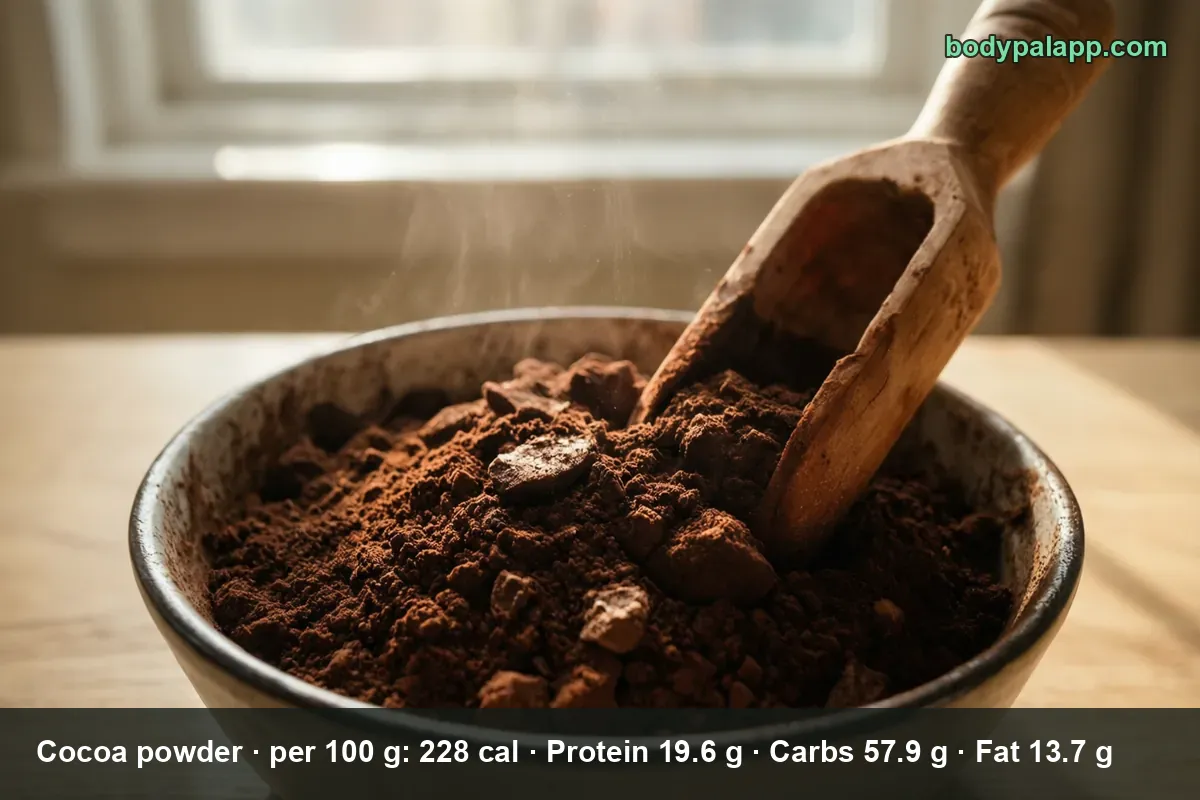
One level tablespoon of unsweetened cocoa powder weighs 5.4 g and carries 12 calories. Per 100 g the same powder runs 228 calories, which sounds heavy until you remember nobody eats it by the cup: a tablespoon in coffee, two in a smoothie, and 37 g of fiber per 100 g doing quiet work in the background.
On this page
- Cocoa powder quick facts
- US servings, from one tablespoon to a full cup
- Natural, Dutch-process, breakfast cocoa and mixes
- Why the box says 10 calories and USDA says 12
- Fiber is the row nobody expects
- How does cocoa powder compare?
- Most popular cocoa powder brands
- FAQ
Cocoa powder quick facts
The record that matches the can in your pantry is SR Legacy 169593, "Cocoa, dry powder, unsweetened". It is plain natural cocoa, nothing added, and it is the only unsweetened cocoa entry that comes with real household measures for both a tablespoon and a cup. The FNDDS twin, record 2705587, carries identical values, so there is nothing to reconcile between them.
Everything below is scaled from that one record. The tablespoon column is the USDA household serving of 5.4 g, which is a touch lighter than the 6 g some brand labels print.
| Nutrient | Per 100 g | Per 1 tbsp (5.4 g) | % Daily Value |
|---|---|---|---|
| Calories | 228 | 12 | — |
| Total fat | 13.7 g | 0.7 g | 1% |
| Saturated fat | 8.07 g | 0.4 g | 2% |
| Carbohydrate | 57.9 g | 3.1 g | 1% |
| Dietary fiber | 37 g | 2.0 g | 7% |
| Total sugars | 1.75 g | 0.1 g | — |
| Protein | 19.6 g | 1.1 g | 2% |
| Sodium | 21 mg | 1 mg | 0% |
% Daily Value is based on a 2,000-calorie diet.
Verified nutrition data
Numbers on this page come from USDA FoodData Central, the U.S. Department of Agriculture’s food composition database, and from manufacturer labels where a branded product is named. Last verified September 2026. How we verify our data →
Two rows you will not find here: added sugars and trans fat. The SR Legacy edition of this record does not publish either one, and unsweetened cocoa has no added sugar by definition anyway. Cholesterol is 0 mg, since cocoa is a plant food. Potassium is the sleeper number at 1,524 mg per 100 g, though a single tablespoon only delivers 82 mg, about 2% of the Daily Value.
US servings, from one tablespoon to a full cup
Cocoa powder is unusually fluffy, and that is what trips people up. A cup of it weighs 86 g, not the 120 g or so you would get from a cup of flour, so cup-based recipes are lighter than they look.
| Serving | Weight | Calories |
|---|---|---|
| 1 tbsp | 5.4 g | 12 kcal |
| 2 tbsp, a mug of cocoa or a smoothie scoop | 10.8 g | 25 kcal |
| 1 oz | 28.35 g | 65 kcal |
| 1/2 cup | 43 g | 98 kcal |
| 1 cup | 86 g | 196 kcal |
| Per 100 g | 100 g | 228 kcal |
The tablespoon and the cup are USDA household measures attached to record 169593. The two-tablespoon, one-ounce and half-cup lines are our own arithmetic from the USDA 100 g figure, not USDA servings, so treat them as clean math rather than measured portions.
For logging purposes, the tablespoon is the only line that matters most days. Where the cup line earns its place is baking: a devil's food cake that takes a full cup of cocoa is starting from 196 calories of powder before any sugar, butter or flour joins in.
Natural, Dutch-process, breakfast cocoa and mixes
| Version | Per 100 g | Typical serving | Calories |
|---|---|---|---|
| Unsweetened (natural) cocoa powder | 228 kcal | 1 tbsp (5.4 g) | 12 kcal |
| Dutch-process (alkalized) cocoa powder | 220 kcal | 1 tbsp (5.4 g) | 12 kcal |
| High-fat or breakfast cocoa | 479 kcal | 1 tbsp (5 g) | 24 kcal |
| Hershey's European Style cocoa | 410 kcal | 1 tbsp (5 g) | 21 kcal |
| Cocoa mix, no sugar added, powder | 377 kcal | 1 envelope (15 g) | 57 kcal |
| Cocoa mix, prepared with water | 55 kcal | 6 fl oz (206 g) | 113 kcal |
Dutch-process cocoa is the one bakers argue about, and calorie-wise the argument is pointless: 220 against 228 per 100 g, and at a tablespoon both land on 12. Alkalizing does cost fiber, dropping it from 37 g to 29.8 g per 100 g. Pick it for the darker color and mellower flavor, not for the label.
Breakfast cocoa is the real outlier at 479 calories per 100 g, more than double plain cocoa, because the cocoa butter was never pressed out. Its fat runs 23.71 g per 100 g against 13.7 g. A tablespoon is 24 calories instead of 12, which still barely registers, but a cup of it in a recipe is a different food.
The Hershey's European Style line is a brand label record rather than a lab analysis, which is why its saturated fat reads as zero; use it as a rough guide only. Its 21-calorie tablespoon is our own scaling of the 410 per 100 g, not a USDA serving. And the two cocoa mixes belong in a separate mental category. A no-sugar-added envelope is 57 calories for 15 g, and its sodium is 876 mg per 100 g against 21 mg for plain cocoa, because the mix is mostly dry milk solids. The sweetened kind is 65.55 g of sugars per 100 g. That is candy powder with cocoa in it.
Why the box says 10 calories and USDA says 12
Pick up three cans of unsweetened cocoa and you will get three different numbers per 100 g, none of them 228. The 365 Whole Foods Market can lists 10 calories per 6 g tablespoon, which works out to 167 per 100 g. Ghirardelli lists 15 per 6 g, or 250. Scharffen Berger lists 15 per 5 g, or 300. Raw cacao brands go higher still, up to 525.
The spread is rounding, not chemistry. FDA labeling lets a small serving round to the nearest 5 calories, so a 12-calorie tablespoon can legally print as 10 or 15 depending on the declared gram weight. Scale that rounding by a factor of 17 or 20 to reach 100 g and the error balloons. The USDA lab number of 228 is the honest middle, and it is what to log when the can and the app disagree.
Fiber is the row nobody expects
Cocoa powder is 37 g of fiber per 100 g. That is more than a third of the powder by weight, and it is invisible at a tablespoon: 2.0 g, or 7% of the 28 g Daily Value the FDA uses on the Nutrition Facts panel. Two tablespoons in oatmeal push that to 4.0 g for 25 calories, which is one of the better fiber-per-calorie trades in a kitchen.
At a full cup the arithmetic turns strange. That 86 g holds 31.8 g of fiber, 114% of the Daily Value, along with 16.9 g of protein and 6.9 g of saturated fat, which is 35% of the 20 g limit. Nobody eats a cup on its own, but it explains why a heavily cocoa-loaded brownie recipe behaves differently from one built on melted chocolate.
Sugar is the other half of the story. Unsweetened cocoa carries 1.75 g of total sugars per 100 g and no added sugar at all, while the Dietary Guidelines for Americans cap added sugars at under 10% of daily calories. If you are watching added sugar, the bitter powder plus a sweetener you control is the better pick over a pre-mixed cocoa.
How does cocoa powder compare?
| Powder | Per 100 g | US serving | Calories |
|---|---|---|---|
| Cocoa powder, unsweetened | 228 kcal | 1 tbsp, 5.4 g | 12 kcal |
| Dutch-process cocoa | 220 kcal | 1 tbsp, 5.4 g | 12 kcal |
| Breakfast cocoa, high-fat | 479 kcal | 1 tbsp, 5 g | 24 kcal |
| Cocoa mix, no sugar added | 377 kcal | 1 envelope, 15 g | 57 kcal |
Our take: for anyone counting, plain unsweetened cocoa is close to a free ingredient. Twelve calories a tablespoon buys chocolate flavor, 2.0 g of fiber and 82 mg of potassium, and natural versus Dutch-process makes no difference worth logging. Breakfast cocoa is the one to notice at 479 per 100 g, since the fat stayed in. And the moment you switch to an envelope mix you are logging 57 calories and 876 mg of sodium per 100 g of powder, which is a beverage decision rather than a cocoa decision.
Most popular cocoa powder brands in the United States
Ranked by how widely each product appears among foods sold in the United States, from the BodyPal food database of over 3.3 million products. Calories are the figures printed on each Nutrition Facts label, checked against USDA FoodData Central.
| Product | Calories (per 100 g) |
|---|---|
| Ghirardelli 100% Unsweetened Premium Baking Cocoa | 250 cal |
| 365 Whole Foods Market Unsweetened Organic Cocoa Powder | 167 cal |
| Good & Gather Unsweetened Cocoa Powder | 200 cal |
| Scharffen Berger Natural Cocoa Powder | 300 cal |
| TCHO Natural Cocoa Powder | 500 cal |
| Big Tree Farms Raw Cocoa Powder | 525 cal |
Brand popularity: BodyPal food database. Nutrition: manufacturer labels / USDA FoodData Central.
Cocoa powder FAQs
How many calories are in 1 tablespoon of cocoa powder?
One level tablespoon of unsweetened cocoa powder is 12 calories at 5.4 g, the household weight USDA lists for record 169593. Two tablespoons, the usual scoop for a mug of hot cocoa or a smoothie, come to 25 calories by our own arithmetic from the 228-per-100-g figure.
How many calories are in a cup of cocoa powder?
A cup of cocoa powder is 86 g and 196 calories. That cup also carries 31.8 g of fiber, which is 114% of the 28 g Daily Value, plus 16.9 g of protein. Baking recipes calling for a full cup are adding real nutrition, not only color and flavor.
Is cocoa powder high in fiber?
Yes. Cocoa powder holds 37 g of fiber per 100 g, and even a 5.4 g tablespoon brings 2.0 g, or 7% of the 28 g Daily Value. Two tablespoons stirred into oatmeal add 4.0 g of fiber for 25 calories, a rare trade for something used as a flavoring.
How much protein is in cocoa powder?
Cocoa powder is 19.6 g of protein per 100 g, but a tablespoon holds only 1.1 g, about 2% of the 50 g Daily Value. The powder is protein-dense by weight and irrelevant by serving. A full cup at 86 g would give 16.9 g, and nobody drinks that.
Dutch-process vs natural cocoa powder: is there a calorie difference?
Barely. Natural unsweetened cocoa is 228 calories per 100 g and Dutch-process is 220, and at one tablespoon both round to 12 calories. The real difference is fiber: 37 g per 100 g natural against 29.8 g alkalized. Choose on flavor and recipe chemistry rather than on calories.
Does cocoa powder have sugar?
Unsweetened cocoa powder has 1.75 g of total sugars per 100 g, which is 0.1 g in a tablespoon. Sweetened cocoa mix is a different product entirely at 65.55 g of sugars per 100 g. If sugar sits in the first three ingredients, you bought a mix, not cocoa.
Is cacao powder the same as cocoa powder?
USDA publishes no separate laboratory record for raw cacao powder, so there is no clean comparison to make. Branded raw cacao labels run high, with one listing 525 calories per 100 g against 228 for USDA unsweetened cocoa. Treat cacao label numbers as manufacturer rounding, not measured values.
How many calories does cocoa powder add to coffee or oatmeal?
One tablespoon adds 12 calories to coffee or oatmeal, and two adds 25 by our own arithmetic from the USDA 100 g figure. The mix is what moves the total: a no-sugar-added cocoa envelope is 57 calories for 15 g, more than four tablespoons of plain cocoa.
Similar foods
- Pizza Dough — 130 cal per 2 oz
- Hummus — 78 cal per 2 tbsp
- Hummus — 78 cal per 2 tbsp
- Biscuits And Gravy — 493 cal per biscuit with gravy
- Pancake Syrup — 47 cal per tbsp
- Hummus Dip — 36 cal per tablespoon
Count it without the math
Point the camera at the mug or the mixing bowl and BodyPal counts the cocoa for you, tablespoon by tablespoon.


One food is easy to picture; a whole day is harder. See how many calories you need a day and what a deficit actually looks like.