
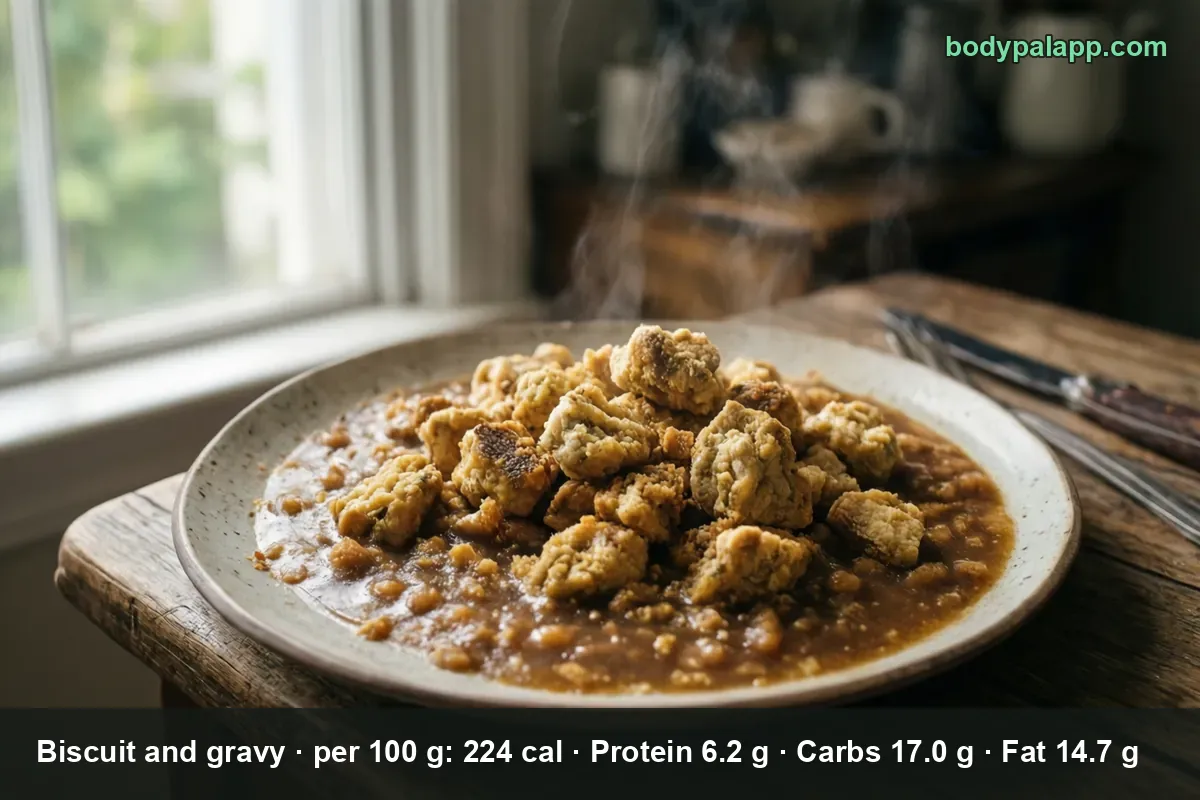
How many calories are in biscuits and gravy?
One diner-style biscuit smothered in sausage gravy weighs 220 g and carries 493 calories. Per 100 g the plate runs 224 calories, which sounds mild until you look at the serving size. That one plate is 32.3 g of fat and 992 mg of sodium, a breakfast that spends 43% of a day's sodium before the coffee.
On this page
- Biscuit and gravy quick facts
- US servings, from one ounce to two biscuits
- Frozen bowls, bites and gravy on its own
- Saturated fat and sodium are the two rows to watch
- How does biscuit and gravy compare?
- Most popular biscuit and gravy brands
- FAQ
Biscuit and gravy quick facts
The number people want is for the finished plate, not for the biscuit dough or the gravy in the jar. USDA publishes exactly one composite entry for that dish: FNDDS 2708744, "Biscuit with gravy", and it comes with its own household measure of one biscuit with gravy at 220 g. That is the row used everywhere on this page.
It is worth knowing what a 220 g serving looks like before you trust the number. It is one split biscuit with enough gravy to cover it, not the flooded platter a diner puts in front of you. Homemade versions swing with the ladle, and USDA has no separate record for "extra gravy" — the honest way to handle a heavier plate is to scale the 100 g figure, which is what the servings table below does.
| Nutrient | Per 100 g | Per 1 biscuit with gravy (220 g) | % Daily Value |
|---|---|---|---|
| Calories | 224 | 493 | — |
| Total fat | 14.68 g | 32.3 g | 41% |
| Saturated fat | 6.31 g | 13.9 g | 69% |
| Carbohydrate | 16.98 g | 37.4 g | 14% |
| Dietary fiber | 0.8 g | 1.8 g | 6% |
| Total sugars | 3.88 g | 8.5 g | — |
| Protein | 6.2 g | 13.6 g | 27% |
| Sodium | 451 mg | 992 mg | 43% |
| Cholesterol | 16 mg | 35 mg | 12% |
| Potassium | 152 mg | 334 mg | 7% |
% Daily Value is based on a 2,000-calorie diet.
Verified nutrition data
Numbers on this page come from USDA FoodData Central, the U.S. Department of Agriculture’s food composition database, and from manufacturer labels where a branded product is named. Last verified September 2026. How we verify our data →
Two rows you will not find here: added sugars and trans fat. The FNDDS edition behind this record does not publish either value for composite cooked dishes, so printing a figure would mean inventing one. Total sugars has no Daily Value of its own under the FDA label rules, which is why that cell is blank rather than zero.
US servings, from one ounce to two biscuits
| Serving | Weight | Calories |
|---|---|---|
| 1 oz | 28 g | 64 kcal |
| Half a serving | 110 g | 246 kcal |
| One biscuit with gravy | 220 g | 493 kcal |
| Two biscuits with gravy | 440 g | 986 kcal |
| Per 100 g | 100 g | 224 kcal |
Only the 220 g line is a USDA household measure. The ounce, the half plate and the two-biscuit plate are our own arithmetic from the USDA 100 g figure, not USDA servings — useful because that is how the dish actually shows up. Nobody eats a measured 220 g; they eat one biscuit or they eat two.
The two-biscuit line is the one to internalize. A short stack in a Southern breakfast house is closer to 440 g than to 220 g, and at 986 calories it is half a day's energy in ten minutes. If you are logging by eye, the safer habit is to count biscuits, not grams: one covered biscuit is roughly 490, each extra one adds roughly the same again.
Watch out for the cup, too. Gravy gets measured in cups and biscuits in pieces, so a recipe that says "half a cup of gravy per biscuit" is describing about 114 g of gravy on top of the bread, not the whole 220 g plate. Those are different quantities, and mixing them is the most common way people undercount this breakfast.
Frozen bowls, bites and gravy on its own
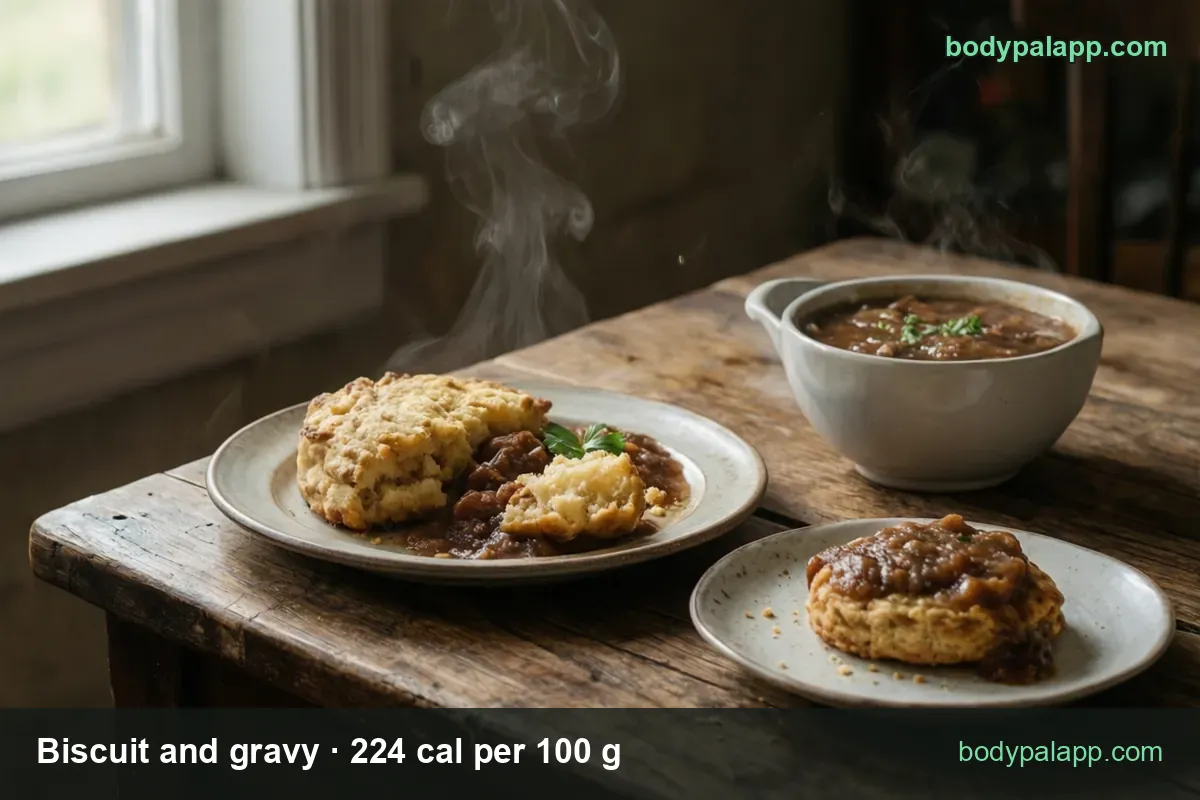
Store-bought versions are not lighter in the way the per-gram number suggests. A Jimmy Dean breakfast bowl is 180 calories per 100 g, well under the 224 of the diner plate, because the bowl carries more gravy and less biscuit per gram. The bowl also weighs 255 g, so the finished total lands at 459 — within 34 calories of the homemade plate.
| Version | Per 100 g | Typical serving | Calories |
|---|---|---|---|
| Diner biscuit with gravy (USDA composite) | 224 kcal | one biscuit with gravy, 220 g | 493 kcal |
| Frozen breakfast bowl, Jimmy Dean | 180 kcal | one bowl, 255 g | 459 kcal |
| Frozen breakfast bowl, Morning Delight | 207 kcal | one bowl, 198 g | 410 kcal |
| Packaged single-serve biscuit and gravy | 225 kcal | one pack, 227 g | 510 kcal |
| Biscuit and sausage gravy bites | 239 kcal | 6 pieces, 92 g | 220 kcal |
| Freeze-dried camping mix, dry | 452 kcal | 1 cup dry, 62 g | 280 kcal |
| Sausage gravy alone, jarred | 123 kcal | quarter cup, 57 g | 70 kcal |
The bites are the genuinely smaller option, and not because they are lighter food. At 239 calories per 100 g they are the densest of the ready-to-eat versions, denser than the diner plate. Six of them just weigh very little: 92 g, so 220 calories. Portion size is doing all the work.
The freeze-dried line needs a warning label. Camping biscuits and gravy show 452 calories per 100 g, twice the diner figure, but that is dry powder before you add water. One cup of the dry mix, 62 g, makes a serving worth 280 calories, and comparing 452 to 224 is comparing flour to a finished plate. This is the same raw-versus-cooked trap that catches people with dry rice and oatmeal.
Gravy on its own is the useful reference point for home cooks. Jarred sausage gravy runs 123 calories per 100 g, so a quarter-cup ladle of 57 g is about 70 calories and two ladles are about 140. That means a plain biscuit under a light pour is a very different breakfast from the same biscuit under four ladles, even though both get logged as "biscuits and gravy".
Saturated fat and sodium are the two rows to watch
The calorie count is not the surprise here — 493 is an ordinary big breakfast. The saturated fat is. One serving carries 13.9 g, which is 69% of the 20 g Daily Value, and the Dietary Guidelines for Americans put the target at under 10% of daily calories. On a 2,000-calorie day that is about 22 g, so a single plate uses roughly two-thirds of the allowance before lunch exists.
Sodium is the second bill, and it is the one nobody sees. The plate holds 992 mg, 43% of the 2,300 mg Daily Value, which works out to about two-fifths of a teaspoon of table salt. What makes it stubborn is that the gravy is saltier per gram than the finished dish: jarred sausage gravy is 491 mg per 100 g against 451 mg for the plate as a whole. Add gravy and the sodium rises faster than the calories do.
Protein is the third number, and it is where this breakfast underperforms for its size. 13.6 g on 493 calories is 27% of the Daily Value from a quarter of a day's energy. Run the macros and fat supplies about 59% of the calories, carbohydrate about 30% and protein about 11%. If satiety per calorie is what you care about, MyPlate guidance about pairing a protein food with the grain applies directly: an egg on the side changes the arithmetic more than skipping half the biscuit does.
None of this makes it a food to avoid. It makes it a food to place: one plate fits a 2,000-calorie day comfortably if the rest of the day is light on saturated fat and salt, and it fits badly on a day that already includes bacon, cheese and a deli sandwich.
How does biscuit and gravy compare?
Serving sizes across breakfast dishes are wildly different, so this table compares them ounce for ounce and per 100 g, where the food itself is what differs rather than the plate.
| Breakfast | Per 100 g | US serving | Calories |
|---|---|---|---|
| Biscuit with gravy | 224 kcal | 1 oz, 28 g | 64 kcal |
| Egg sandwich on English muffin, with ham | 222 kcal | 1 oz, 28 g | 63 kcal |
| Egg sandwich on wheat bread | 226 kcal | 1 oz, 28 g | 64 kcal |
| Egg sandwich on white bread | 228 kcal | 1 oz, 28 g | 65 kcal |
Our take: gram for gram these four are the same breakfast — 6 calories separate the lightest from the heaviest per 100 g — and yet they are not the same meal at all. The egg sandwich on an English muffin with ham carries 12.17 g of protein per 100 g against 6.2 g here, nearly double, and the white-bread egg sandwich holds 2.9 g of saturated fat per 100 g, under half of this dish's 6.31 g. For weight loss the egg sandwiches win on protein per calorie, not on calories. For pure staying power on a cold morning, the gravy plate delivers, and the honest lever is the serving: one biscuit at 493, not two at 986.
Most popular biscuit and gravy brands in the United States
Ranked by how widely each product appears among foods sold in the United States, from the BodyPal food database of over 3.3 million products. Calories are the figures printed on each Nutrition Facts label, checked against USDA FoodData Central.
| Product | Calories (per 100 g) |
|---|---|
| Jimmy Dean Biscuit & Sausage Gravy Breakfast Bowl | 180 cal |
| Morning Delight Biscuit & Sausage Gravy Breakfast Bowl | 207 cal |
| Amigos Biscuit & Gravy | 225 cal |
| Morning Delight Biscuit & Sausage Gravy Bites | 239 cal |
| Mountain House Biscuits & Gravy (freeze-dried, dry) | 452 cal |
Brand popularity: BodyPal food database. Nutrition: manufacturer labels / USDA FoodData Central.
Biscuit and gravy FAQs
How many calories are in biscuits and gravy?
A 220 g serving, one biscuit under a ladle of gravy, is 493 calories, and the dish runs 224 calories per 100 g. That single USDA serving covers a quarter of a 2,000-calorie day. Half the plate, 110 g, comes to 246 calories. Two biscuits with gravy, scaled from the same USDA figure, come to 986 calories.
How much sodium is in biscuits and gravy?
992 mg in one 220 g serving, which is 43% of the 2,300 mg Daily Value the FDA publishes. Per 100 g the plate holds 451 mg. Jarred sausage gravy on its own is denser still at 491 mg per 100 g, so the size of the ladle moves the sodium more than the biscuit does.
Are biscuits and gravy high in saturated fat?
Yes: 13.9 g in a 220 g serving, 69% of the 20 g Daily Value, from one breakfast. Per 100 g it is 6.31 g. The Dietary Guidelines put saturated fat under 10% of daily calories, about 22 g on a 2,000-calorie day, so one plate uses most of that in a sitting.
How many carbs are in biscuits and gravy?
37.4 g of carbohydrate in a 220 g serving, 14% of the 275 g Daily Value, with 1.8 g of it fiber and 8.5 g total sugars. Per 100 g the figure is 16.98 g. For a flour-based breakfast that is low, because the calories here come mostly from fat rather than starch.
How much protein is in biscuits and gravy?
13.6 g in a 220 g serving, 27% of the 50 g Daily Value, or 6.2 g per 100 g. That is modest for 493 calories. A USDA egg sandwich on an English muffin with ham carries 12.17 g per 100 g, nearly double the protein for almost identical energy per gram.
How many calories in a frozen biscuits and gravy bowl?
A Jimmy Dean Biscuit and Sausage Gravy Breakfast Bowl is 459 calories for the 255 g bowl, at 180 calories per 100 g. A Morning Delight bowl is 410 calories for 198 g. Both are lighter per gram than the 224 of the diner plate, but the bowls are bigger, so the totals land close.
How many calories in sausage gravy by itself?
Jarred sausage gravy is 123 calories per 100 g, so a quarter-cup ladle of 57 g is about 70 calories and two ladles about 140. It is the cheapest part of the plate per gram, but also the saltiest, at 491 mg of sodium per 100 g.
How many calories in two biscuits with gravy?
986 calories for 440 g, which is our own scaling of the USDA 100 g figure rather than a USDA serving. That plate carries 27.8 g of saturated fat and 1,984 mg of sodium, which is 86% of the Daily Value for sodium and 139% of it for saturated fat.
Similar foods
- Cocoa Powder — 12 cal per tbsp
- Pizza Dough — 130 cal per 2 oz
- Hummus — 78 cal per 2 tbsp
- Hummus — 78 cal per 2 tbsp
- Pancake Syrup — 47 cal per tbsp
- Hummus Dip — 36 cal per tablespoon
Count it without the math
Point the camera at the plate and BodyPal counts the biscuit and the gravy for you, ladle and all.


How long does it take to burn off 493 kcal of biscuits and gravy?
One biscuit with gravy (220 g) is 493 kcal. Enter your weight and the amount you ate to see how long it takes you to burn that off:
lb
| Activity | Time to burn 493 kcal |
|---|---|
| Walking, brisk | 1 hr 39 min |
| Cycling, moderate | 1 hr 2 min |
| Swimming, moderate | 1 hr 10 min |
| Jogging | 58 min |
| Weight training, moderate | 1 hr 50 min |
Times are for a 155 lb adult at a steady pace; change the weight to see yours. The amount is set to the portion in the text (220 g); change it to what you actually ate. BodyPal works this out from your steps automatically.
Want the bigger picture? Calculate your daily calorie needs — your maintenance figure, a target for losing or gaining, and the date you get there.