
How Many Calories in Baba Ganoush?
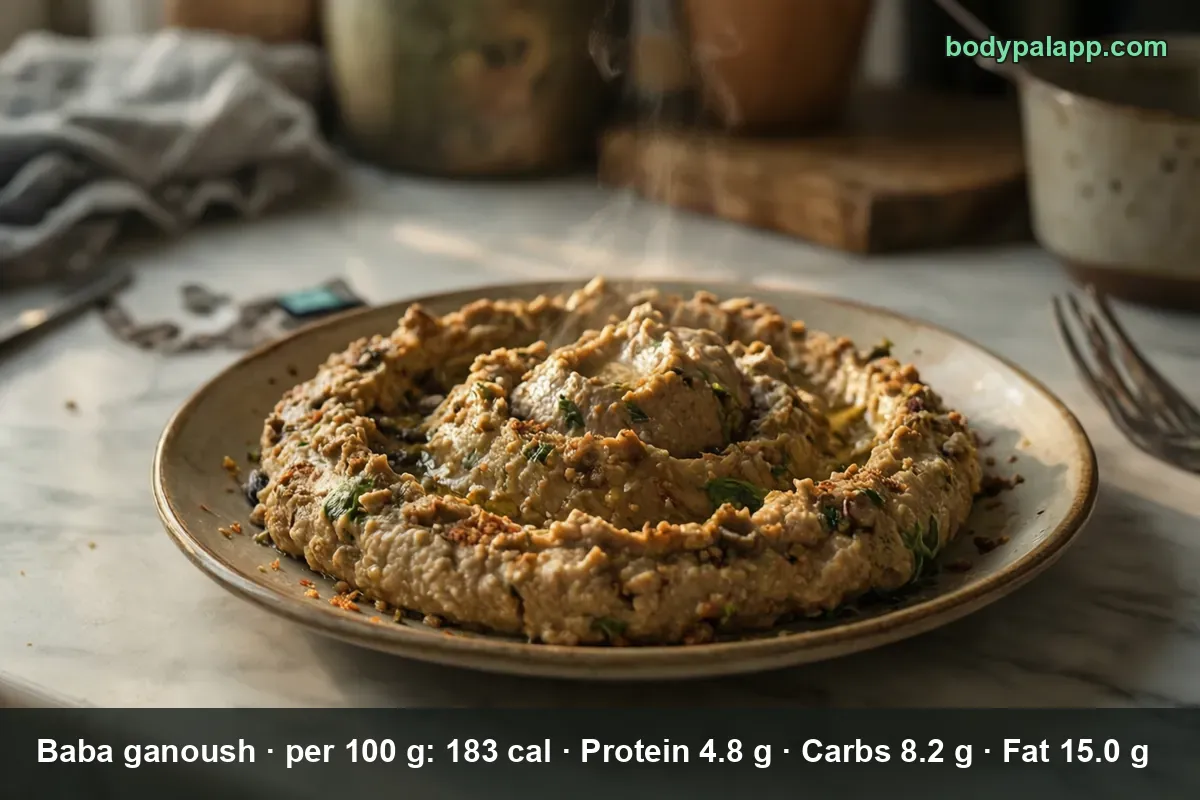
A quarter cup of baba ganoush — the shallow pool of it that comes with a mezze plate — is 110 calories, built from 183 calories per 100 g. Two tablespoons, the serving size printed on the tub, is 55. One tablespoon, which is roughly what stays on a pita chip, is 27.
On this page
- Baba ganoush quick facts
- The eggplant is not where the calories are
- Servings, from one scoop to half a cup
- What a store-bought tub does to the number
- The sodium is in the jar, not the recipe
- Fiber, cholesterol and the rest of the panel
- How does baba ganoush compare?
- Most popular baba ganoush brands
- FAQ
Baba ganoush quick facts
There is no USDA record called baba ganoush. The dish is filed under its plainer American name, FNDDS 2710049, "Eggplant dip", in the survey category for dips and sauces — smoked eggplant blended with tahini, oil, lemon and garlic. That record is what leads this page, because it describes the finished bowl rather than the vegetable that went into it.
| Nutrient | Per 100 g | Per 1/4 cup (60 g) | % Daily Value |
|---|---|---|---|
| Calories | 183 kcal | 110 kcal | — |
| Total fat | 14.98 g | 8.99 g | 12% |
| Saturated fat | 2.19 g | 1.31 g | 7% |
| Carbohydrate | 8.15 g | 4.89 g | 2% |
| Dietary fiber | 3.9 g | 2.34 g | 8% |
| Total sugars | 2.81 g | 1.69 g | — |
| Protein | 4.8 g | 2.88 g | 6% |
| Sodium | 209 mg | 125 mg | 5% |
% Daily Value is based on a 2,000-calorie diet.
Verified nutrition data
Numbers on this page come from USDA FoodData Central, the U.S. Department of Agriculture’s food composition database, and from manufacturer labels where a branded product is named. Last verified September 2026. How we verify our data →
Two rows that belong on a US label are missing here, and the gap is deliberate. This edition of FNDDS publishes no value for added sugars or trans fat in this category, so there is nothing measured to print. A zero in either row would be a guess dressed up as a reading, and baba ganoush has no added sugar in it anyway — the 2.81 g of total sugars per 100 g is the eggplant's own.
What the record does carry beyond the panel is 0 mg of cholesterol and 264 mg of potassium per 100 g. The first of those is the honest headline of the dish: this is a bowl of fat with no animal in it.
The eggplant is not where the calories are
Here is the single most useful fact about this dip, and it is the one the name hides.
Per 100 g, baba ganoush carries 14.98 g of fat. At 9 calories a gram, that fat alone accounts for about 135 of the 183 calories — roughly 74% of the energy in the bowl. The eggplant contributes the volume, the color and most of the weight. The tahini and the olive oil contribute the calories.
That ratio explains why two jars of the same dip can be so far apart, and it explains why baba ganoush lands at 183 per 100 g while a roasted vegetable has no business being anywhere near that number. Eggplant on its own runs under 30 calories per 100 g. Everything above that line was poured in.
It also means the dish scales by the spoon of tahini, not by the size of the eggplant. A cook who is generous with the oil is not making a slightly richer dip; they are making a different food at the same volume. Nothing about how it looks in the bowl tells you which one you have in front of you.
Raw against cooked, the split that matters for most food on this site, does not apply. The eggplant is charred or roasted before it is mashed, so baba ganoush exists in one state only. There is no raw version of this number and no shrink to correct for.
Servings, from one scoop to half a cup
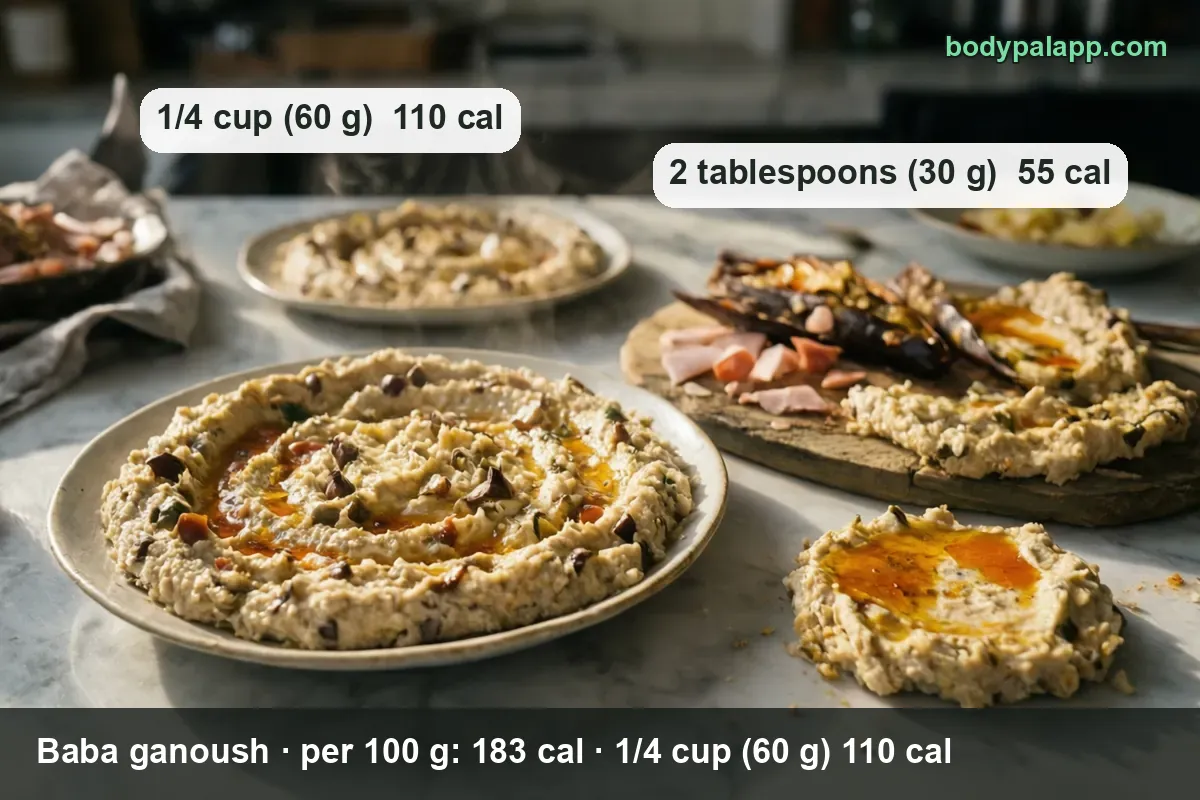
The tablespoon and the single-serve container weights come from USDA's own portion list for this record. The rest are our own scaling at the same 183 calories per 100 g — multiples of that tablespoon, plus the 1 oz row taken at 28 g:
| Portion | Weight | Calories |
|---|---|---|
| 1 tablespoon | 15 g | 27 |
| 1 oz | 28 g | 51 |
| 2 tablespoons | 30 g | 55 |
| 1/4 cup | 60 g | 110 |
| 1 single-serve container | 70 g | 128 |
| 1/2 cup | 120 g | 220 |
| 100 g | 100 g | 183 |
The distance between the top row and the bottom two is the whole problem with dip.
A tablespoon is 27 calories. That is a genuinely small number, small enough that nobody would bother logging it, and it is the number most people have in their head when they say they had some baba ganoush. But a tablespoon is one scoop — a single pass with one chip. A quarter cup is four of those, and half a cup is eight. Nothing about the second scoop feels different from the first, which is why the running total goes unnoticed.
This is also why the serving size on the label is 2 tablespoons. At 30 g it is 55 calories, 4.49 g of fat, 2.45 g of carbs and 1.44 g of protein — a portion that flatters the panel and almost nobody eats. The single-serve container sold for lunchboxes is more honest at 70 g and 128 calories, and it has the advantage of ending.
If you want a number to log without weighing anything, use the quarter cup. It is the amount that fits in a small ramekin, it is the amount that comes alongside a pita, and at 110 calories it is a real snack rather than a rounding error.
What a store-bought tub does to the number
Take the lid off two supermarket tubs and the labels disagree violently. MAMNOON Smoked Eggplant Dip declares 89 calories per 100 g — 25 calories in its 28 g serving. NARA All Natural Baba Ganoush declares 194 calories per 100 g, or 60 calories in a 31 g serving.
That is a spread of better than two to one for a product with the same three words on the front, and it is not a disagreement between databases. Both figures are manufacturer labels; the USDA survey record sits at 183, close to the NARA end. The difference is the recipe. More tahini and more oil against more eggplant, exactly the ratio from the section above, playing out on a shelf.
The practical rule: a tub is not a generic food. If the container in your refrigerator has a panel on it, log the panel. The 183 figure is the right default for a restaurant bowl, a mezze plate or a batch you made at home, where nobody printed the ratio.
The sodium is in the jar, not the recipe
Salt is where the gap between homemade and store-bought turns into a real number, and it runs the same direction for both tubs.
The USDA record carries 209 mg of sodium per 100 g, which works out at 125 mg in a quarter cup — 5% of the FDA Daily Value of 2,300 mg. For a savory dip, that is modest. Salt is doing flavor work here, not preservation work.
The labels tell a different story. NARA's panel puts sodium at 774 mg per 100 g and MAMNOON's at 571 mg — between 2.7 and 3.7 times the survey figure. Scale NARA's label to the same quarter cup ourselves and you are at roughly 464 mg, about 20% of the day, from a scoop of dip.
That inversion is worth holding onto, because it points the wrong way from the calories. MAMNOON is the lighter of the two tubs on energy at 89 per 100 g and still carries nearly three times the sodium of the reference recipe. Less fat in a jar usually means more salt doing the job the fat used to do, and the two numbers have to be read together. The Dietary Guidelines for Americans put the adult sodium limit at 2,300 mg a day, and a dip is not where most people plan to spend a fifth of it.
Fiber, cholesterol and the rest of the panel
The rest of the record is better than the fat line suggests, and one row is genuinely unusual.
Fiber is 3.9 g per 100 g — 2.34 g in a quarter cup, or 8% of the Daily Value. For a dip that is a lot. Most of what gets scooped out of a tub is dairy or emulsified oil, neither of which brings any fiber at all; here the eggplant is a whole vegetable that survived into the bowl, and the sesame in the tahini adds to it. Eight percent of the day's fiber for 110 calories is the strongest thing on this panel.
Saturated fat stays low for the fat total: 2.19 g per 100 g, so 1.31 g in a serving, 7% DV. That is the plant fat showing. Fourteen grams of dairy fat would put that row several times higher.
Potassium comes in at 264 mg per 100 g, about 158 mg in a quarter cup, or 3% DV. Cholesterol is zero, as it is in anything without an animal in it.
Where the dish does not help is the vegetable count people expect from it. Eggplant belongs to the MyPlate vegetable group, but a quarter cup of baba ganoush is not a quarter cup of vegetables — three quarters of its energy is added fat. Our read: treat it as a fat with a vegetable in it, which is how the number behaves, and let the carrot sticks going into it do the produce work.
How does baba ganoush compare?
Every row is a dip from the same USDA survey category, measured at the same quarter cup so the comparison is fair:
| Item | Per 100 g | Per 1/4 cup (60 g) | Protein | Carbs | Fat |
|---|---|---|---|---|---|
| Baba ganoush (eggplant dip) | 183 | 110 | 2.88 g | 4.89 g | 8.99 g |
| Vegetable dip, yogurt based | 191 | 115 | 4.90 g | 2.26 g | 9.62 g |
| Ranch dip, yogurt based | 195 | 117 | 5.09 g | 2.48 g | 9.65 g |
| Onion dip, light | 166 | 100 | 1.20 g | 7.12 g | 7.42 g |
| Black bean sauce | 168 | 101 | 3.77 g | 10.42 g | 5.07 g |
The first surprise is how little separates them. The whole category sits between 166 and 195 calories per 100 g, so baba ganoush is neither the indulgence nor the escape route — it is the middle of a narrow field, and swapping one dip for another moves a quarter-cup serving by 17 calories at most.
Our take: if calories are the only thing you are counting, this table says the choice barely matters, and you should spend your attention on the number of scoops instead. If you want the serving to do something for you, baba ganoush is the pick — its fat is plant fat, it carries no cholesterol, and it brings fiber the yogurt dips do not. Those yogurt dips beat it on protein by about 2 g a serving, which is a fair trade if protein is what you are short of; the black bean sauce carries the least fat on the list, and the most carbs.
Most popular baba ganoush brands in the United States
Ranked by how widely each product appears among foods sold in the United States, from the BodyPal food database of over 3.3 million products. Calories are the figures printed on each Nutrition Facts label, checked against USDA FoodData Central.
| Product | Calories (per 100 g) |
|---|---|
| NARA All Natural Baba Ganoush Hummus | 194 cal |
| MAMNOON Baba Ganoush Smoked Eggplant Dip | 89 cal |
Brand popularity: BodyPal food database. Nutrition: manufacturer labels / USDA FoodData Central.
Baba ganoush FAQs
How many calories are in baba ganoush?
110 calories in a 1/4-cup (60 g) serving, from 183 calories per 100 g. Two tablespoons, the serving size on most labels, is 55 calories. That quarter cup also carries 8.99 g of fat, 2.88 g of protein and 2.34 g of fiber.
How many calories are in 2 tablespoons of baba ganoush?
55 calories for 30 g, which is the standard label serving. It comes with 4.49 g of fat, 2.45 g of carbs, 1.44 g of protein and 63 mg of sodium. One tablespoon on its own — about one loaded chip — is 27 calories.
How many calories are in half a cup of baba ganoush?
220 calories for 120 g, which is eight tablespoons. A single-serve container of 70 g is 128 calories and a 1 oz portion is 51. Half a cup is the amount that quietly accumulates when a bowl sits on the table during a conversation.
What are the nutrition facts for baba ganoush?
A 1/4-cup (60 g) serving is 110 calories, 8.99 g of total fat, 1.31 g of saturated fat, 4.89 g of carbohydrate, 2.34 g of fiber, 1.69 g of total sugars, 2.88 g of protein and 125 mg of sodium. Cholesterol is 0 mg and potassium is about 158 mg.
Is baba ganoush healthy?
A 110-calorie quarter cup gives 2.34 g of fiber (8% DV), no cholesterol and only 1.31 g of saturated fat (7% DV), which is a good panel with one clear cost: about 74% of those calories come from tahini and olive oil rather than eggplant. It behaves like a plant fat, not like a vegetable side.
How much protein is in baba ganoush?
2.88 g in a 1/4-cup serving, or 4.8 g per 100 g — 6% of the Daily Value. That is less than the yogurt-based dips in the same USDA category, which reach 4.90 to 5.09 g for the same quarter cup. The protein here comes from the sesame in the tahini.
Does store-bought baba ganoush have more calories?
It depends entirely on the tub: two US labels declare 89 and 194 calories per 100 g against 183 for the USDA record. The spread comes from how much tahini and oil went in against how much eggplant. If your container has a panel, log the panel rather than the generic figure.
How much sodium is in baba ganoush?
125 mg in a 1/4-cup serving, which is 5% of the 2,300 mg Daily Value, from 209 mg per 100 g. Supermarket tubs run far higher: two US labels list 571 mg and 774 mg per 100 g, so the same quarter cup from a jar can reach about 464 mg, or 20% of the day.
Similar foods
- Taco Beef — 369 cal per cup
- Sausage Gravy — 432 cal per cup
- Homemade Hummus — 435 cal per cup
- Prosciutto — 55 cal for 3 thin slices
- Avocado Spread — 80 cal per 2 tbsp
- Balsamic Dressing — 47 cal per 2 Tbsp
Count it without the math
Point the camera at the bowl and BodyPal counts the scoops, the tahini and the oil in one shot.


How long does it take to burn off baba ganoush?
A 1/4-cup (60 g) serving is 110 kcal. Enter your weight and the amount you ate to see how long it takes you to burn that off:
lb
| Activity | Time to burn 110 kcal |
|---|---|
| Walking, brisk | 22 min |
| Cycling, moderate | 14 min |
| Swimming, moderate | 16 min |
| Jogging | 13 min |
| Weight training, moderate | 24 min |
Times are for a 155 lb adult at a steady pace; change the weight to see yours. The amount is set to the portion in the text (60 g); change it to what you actually ate. BodyPal works this out from your steps automatically.
One food is easy to picture; a whole day is harder. See how many calories you need a day and what a deficit actually looks like.