Balsamic dressing calories come to 47 for a 2 Tbsp (30 g) serving and 158 per 100 g, based on a packaged vinaigrette label. The number to notice is how fast the pour adds up: dressing is easy to double without seeing it, and sodium climbs right alongside the calories.
47kcal
1 2 tablespoons · 30 g, packaged, per label
0%protein
0 gProtein
4 gCarbs
3.5 gFat
How to burn off 47 kcal
—Walking, brisk
—Jogging
—Cycling, moderate
—Swimming
Skip the math. BodyPal counts these calories from your steps and workouts automatically.
Nutrition facts
Packaged, per label · per 30 g
Calories
47 kcal
Protein
0 g
Carbohydrate
4 g
Fat
3.5 g
Saturated fat
0 g
Cholesterol
0 mg
Sodium
160 mg
Source: USDA FoodData Central
🛡️
Verified nutrition data
Numbers on this page come from USDA FoodData Central, the U.S. Department of Agriculture’s food composition database, and from manufacturer labels where a branded product is named. Last verified September 2026. How we verify our data →
Balsamic dressing: calories, protein and sodium by serving
Percent of daily value uses the FDA reference of 2,000 kcal a day.
Serving
kcal
Protein
Carbs
Fat
Sodium
% DV kcal
2 Tbsp (30 g)
47
0 g
4 g
3.5 g
160 mg
2%
100 g
158
0 g
13.3 g
11.7 g
533 mg
8%
3 × 2 Tbsp (30 g)
142
0 g
480 mg
5 × 2 Tbsp (30 g)
237
0 g
800 mg
The pour decides the total, not the bottle
A measured 2 Tbsp (30 g) serving of balsamic dressing is 47 calories, about 2% of a standard daily calorie value. That is a small number on paper. The problem is that few people measure dressing, and a salad bowl hides a heavy hand well.
Two servings, or 60 g, bring you to 95 calories. Three servings at 90 g reach 142 calories, and a generous restaurant-style soak of five servings, 150 g, lands at 237 calories. At that point the dressing can outweigh the greens underneath it in energy, even though it looks like a light drizzle.
If you track your intake, measure the dressing once with a spoon to learn what your usual pour really is. After that, eyeballing gets more honest. Tossing the salad in a bowl before serving also spreads a smaller amount further than pouring it over the top, so one serving coats more leaves.
Two thirds of the calories come from oil
Fat supplies 66% of the calories in balsamic dressing and carbohydrates supply the other 34%. Protein is 0. Per 100 g that works out to 11.7 g of fat and 13.3 g of carbs, with no fiber at all, and saturated fat on this label reads 0.
The carbs are mostly sugar. There are 10 g of sugars per 100 g, or 3 g in a 2 Tbsp serving, which is where the sweet, slightly syrupy taste comes from. Honey and fig versions on shelves lean into that sweetness, so the label on your bottle is worth a glance.
Compared with creamy dressings, the oil content here is modest: 3.5 g of fat per serving. That is the main reason balsamic sits at the lighter end of the dressing aisle. It still adds no protein or fiber, so it brings flavor rather than staying power to the plate.
Sodium is the row to watch
Calories stay low per serving, but sodium is less forgiving. One 2 Tbsp serving carries 160 mg of sodium, which is 7% of the daily value. Per 100 g the figure is 533 mg, or 23% of the daily value, compared with just 8% of daily calories in the same amount.
Scale the pour and the gap shows. Two servings hold 320 mg, three hold 480 mg, and five servings reach 800 mg of sodium. A big salad with cheese, olives or cured meat on top stacks more salt on that base.
If you watch sodium, the dressing is an easy place to trim because flavor survives a lighter hand. Adding a squeeze of lemon or a splash of plain vinegar stretches a smaller amount of dressing without stacking more salt.
A light dressing that still needs a plan
Balsamic dressing works best as a finishing touch for foods that bring their own substance. Pair it with leafy greens plus a protein such as chicken, beans or eggs, since the dressing itself contributes 0 g of protein. That combination makes the salad a meal instead of a side.
It also suits roasted vegetables, tomatoes and grain bowls, where a single measured serving goes a long way. Because the sugar is concentrated, a little tastes sweeter than you expect, so start small and add only if needed.
Logging it is simple: snap a photo of your salad and BodyPal can log the balsamic dressing along with everything else on the plate, so the pour does not slip off your tally.
How does balsamic dressing compare?
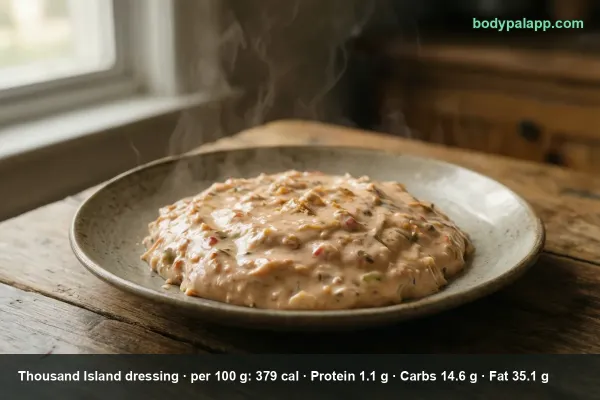
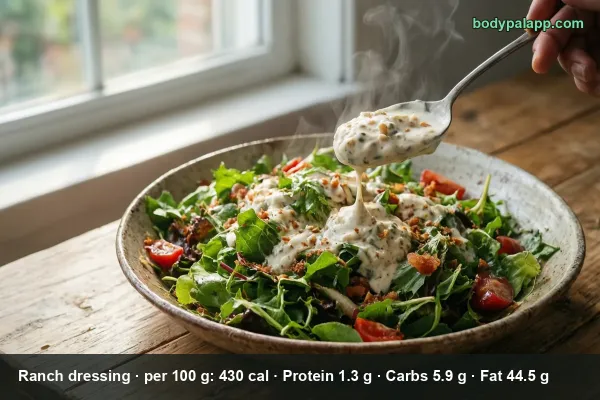
Here is how balsamic dressing stacks up against generic salad dressing, thousand island and ranch, per 100 g and per usual serving.
Verdict: For the fewest calories, balsamic wins clearly at 158 per 100 g, while ranch reaches 430, about 2.7 times as much, and thousand island hits 379. If sodium matters most, balsamic is still the pick at 533 mg per 100 g versus 1,133 mg for generic salad dressing.
Most popular balsamic dressing brands in the United States
About 47 calories in 2 tablespoons (30 g), or 158 calories per 100 g.
Is balsamic dressing good for weight loss?
It has 158 calories per 100 g, compared with 430 for ranch dressing and 542 for caesar dressing.
Balsamic dressing vs salad dressing: which has fewer calories?
Balsamic dressing has 158 calories per 100 g, while generic salad dressing has 355.
How much fat and sugar is in balsamic dressing?
Two tablespoons (30 g) have 3.5 g of fat and 3 g of sugar. Per 100 g that is 11.7 g of fat and 10 g of sugar.
Is balsamic dressing high in calories?
No, balsamic dressing is fairly low at 47 calories per 2 Tbsp and 158 per 100 g. Ranch has 430 per 100 g. The catch is portion size, since five servings reach 237 calories.
How many calories are in 2 tbsp of balsamic vinaigrette?
Two tablespoons (30 g) of balsamic vinaigrette contain 47 calories, with 3.5 g of fat, 4 g of carbs and 3 g of sugars. That serving also carries 160 mg of sodium.
How much sodium is in balsamic dressing?
Balsamic dressing has 160 mg of sodium per 2 Tbsp serving, which is 7% of the daily value. Per 100 g it reaches 533 mg, or 23% of the daily value.
Does balsamic dressing have any protein or fiber?
No. Balsamic dressing has 0 g of protein and 0 g of fiber per 100 g. Its calories split 66% fat and 34% carbs, so pair it with a protein to make the salad filling.
How many calories are in a large pour of balsamic dressing?
Three 2 Tbsp servings (90 g) of balsamic dressing add up to 142 calories, and five servings (150 g) reach 237 calories. Sodium climbs to 800 mg at five servings.