Salad dressing calories come to 107 for 2 tbsp (30 g) of bottled Russian-style dressing and 355 per 100 g. Fat supplies 64% of those calories. Sodium is the surprise: one 2 tbsp serving carries 340 mg, or 15% of the daily value, before the salad itself adds anything.
Skip the math. BodyPal counts these calories from your steps and workouts automatically.
Nutrition facts
Russian-style, bottled · per 30 g
Calories
107 kcal
Protein
0.2 g
Carbohydrate
9.6 g
Fat
7.9 g
Saturated fat
0.7 g
Cholesterol
0 mg
Sodium
340 mg
Potassium
52 mg
Iron
0.2 mg
Source: USDA FoodData Central
🛡️
Verified nutrition data
Numbers on this page come from USDA FoodData Central, the U.S. Department of Agriculture’s food composition database, and from manufacturer labels where a branded product is named. Last verified September 2026. How we verify our data →
Salad dressing: calories, protein and sodium by serving
Percent of daily value uses the FDA reference of 2,000 kcal a day.
Serving
kcal
Protein
Carbs
Fat
Sodium
% DV kcal
2 tbsp (30 g)
107
0.2 g
9.6 g
7.9 g
340 mg
5%
1 tbsp (15 g)
53
0.1 g
4.8 g
3.9 g
170 mg
3%
Cup (245 g)
870
1.7 g
78.2 g
64.1 g
2,776 mg
43%
100 g
355
0.7 g
31.9 g
26.2 g
1,133 mg
18%
3 × 2 tbsp (30 g)
320
0.6 g
1,020 mg
5 × 2 tbsp (30 g)
533
1 g
1,700 mg
Two tablespoons is 107 calories, a heavy hand is 533
The label serving is 2 tbsp (30 g), and that is a modest 107 calories, about 5% of a 2,000-calorie day. A single tablespoon halves it to 53. The trouble is that few people measure. Dressing gets poured, and a pour is rarely two level tablespoons.
Double the serving to 60 g and you are at 213 calories. Three servings, or 90 g, reach 320, which is more than many plain side salads contain before the dressing goes on. Five servings (150 g) climb to 533 calories, and that is the kind of amount a large restaurant salad can arrive with.
A full cup (245 g) holds 870 calories, 43% of the daily value for energy. Nobody eats a cup at one sitting, but it shows how dense this bottle is. If you track intake, measure the dressing once with a spoon so you know what your usual pour actually looks like. After that, eyeballing gets much more honest.
Fat brings 64% of the calories, sugar fills much of the rest
Per 100 g, Russian-style dressing has 26.2 g of fat, 31.9 g of carbohydrate and just 0.7 g of protein. Split by calories, that is 64% fat, 35% carbs and 1% protein. In a 2 tbsp serving you get 7.9 g of fat, 9.6 g of carbs and 0.2 g of protein.
The carbohydrate side is mostly sugar. There are 17.7 g of sugars per 100 g, which works out to 5.3 g per 2 tbsp. That sweetness is part of what sets Russian dressing apart from oil-heavy styles like ranch or caesar, which lean harder on fat and carry far fewer carbs.
Saturated fat is fairly low at 2.4 g per 100 g, and cholesterol is 0. Fiber is a token 0.7 g per 100 g. Put plainly, this dressing adds flavor and energy but almost nothing that keeps you full. The filling part of the meal has to come from the bowl underneath it.
Sodium is the row to watch
At 1,133 mg per 100 g, Russian-style dressing is saltier than most people expect from something they pour on vegetables. One 2 tbsp serving delivers 340 mg, or 15% of the daily value. A single tablespoon is 170 mg, about 7%.
The numbers climb fast with a generous hand. Three servings bring 1,020 mg, and five servings hit 1,700 mg. A cup holds 2,776 mg, which is 121% of the daily value, more than a full day's worth in one container's worth of pouring. Even the 100 g reference amount covers 49% of the daily sodium value.
If you watch sodium, the dressing can quietly become the saltiest thing on the plate, especially when the salad also includes cheese, deli meat, croutons or olives. Measuring the dressing matters more here than it does for the calories, because the sodium share per serving (15%) is triple the calorie share (5%).
Use it as seasoning, not as a sauce
Because the dressing brings 0.2 g of protein per serving, the protein in a salad has to come from what you add: eggs, chicken, beans, tuna or tofu. Pairing a measured spoonful with a protein-rich bowl turns a 107-calorie topping into part of a balanced meal rather than the main source of energy.
A few habits keep the total in check without giving up the flavor. Serve it on the side and dip your fork, toss the greens thoroughly so a smaller amount coats more leaves, or mix one tablespoon with a splash of vinegar or lemon to stretch it. Each of these keeps you closer to 53 or 107 calories than to 320.
If you prefer creamier styles such as thousand island or blue cheese from brands like Wish-Bone, the same measuring rule applies. Logging the dressing separately from the salad is the simplest way to see its real share of the day, and BodyPal can log it from a photo of your plate.
How does salad dressing compare?
Here is how Russian-style salad dressing stacks up against thousand island, ranch and caesar dressing, per 100 g and per usual serving.
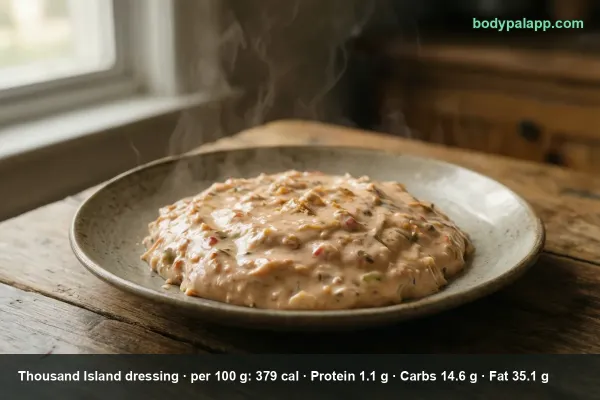
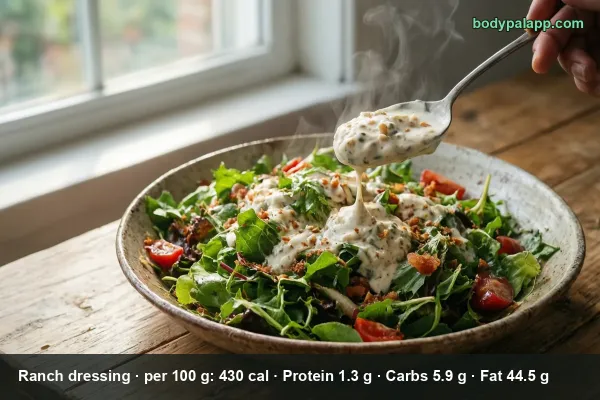
Verdict: For the fewest calories per spoonful, Russian-style dressing at 355 per 100 g beats thousand island at 379, ranch at 430 and caesar at 542, which carries about 1.5 times the calories. If sodium is your main concern, ranch is the better pick at 810 mg per 100 g against 1,133 mg here, while caesar is the saltiest at 1,209 mg.
Most popular salad dressing brands in the United States
Ranked by popularity in the BodyPal database
# Productkcal / 100 g
1Wish-Bone Thousand Island Salad Dressing2 Tbsp · 31 g400 kcal
Brand values below are for thousand island and blue cheese dressings, which run higher in fat than the plain style used for the number above. Source: manufacturer labels / USDA FoodData Central.
Salad dressing FAQs
How many calories are in salad dressing?
A 2 tablespoon (30 g) serving of salad dressing is about 107 calories. Per 100 g the amount is 355 calories.
Is salad dressing good for weight loss?
At 355 calories per 100 g, salad dressing is calorie-dense for its size: a 2 tablespoon serving is 107 calories, with 7.9 g of that from fat.
Salad dressing vs thousand island dressing: are the calories different?
Yes. Salad dressing is 355 calories per 100 g, and thousand island dressing is 379, a difference of about 24 calories per 100 g.
How much fat is in salad dressing?
A 2 tablespoon (30 g) serving of salad dressing has 7.9 g fat, including 0.7 g saturated, and 340 mg sodium. Per 100 g that is 26.2 g fat.
How many calories are in 1 tablespoon of salad dressing?
One tablespoon (15 g) of Russian-style salad dressing has 53 calories. It also carries 3.9 g of fat, 2.7 g of sugars and 170 mg of sodium, about 7% of the daily sodium value.
How much sodium is in salad dressing?
A 2 tbsp serving has 340 mg of sodium, 15% of the daily value. Per 100 g it is 1,133 mg, and a full cup holds 2,776 mg, which is 121% of the daily value.
How much sugar is in salad dressing?
Russian-style dressing has 5.3 g of sugars per 2 tbsp and 17.7 g per 100 g. Sugar makes up most of its 31.9 g of carbohydrate per 100 g, which is why it tastes sweet.
How many calories are in a cup of salad dressing?
A cup (245 g) of Russian-style salad dressing has 870 calories, 43% of the daily value. It also contains 64.1 g of fat, 43.3 g of sugars and 2,776 mg of sodium.
Does salad dressing have cholesterol?
Bottled Russian-style dressing has 0 mg of cholesterol. Its fat is mostly unsaturated, with saturated fat at 2.4 g per 100 g, so the rows to watch are sodium and sugar instead.