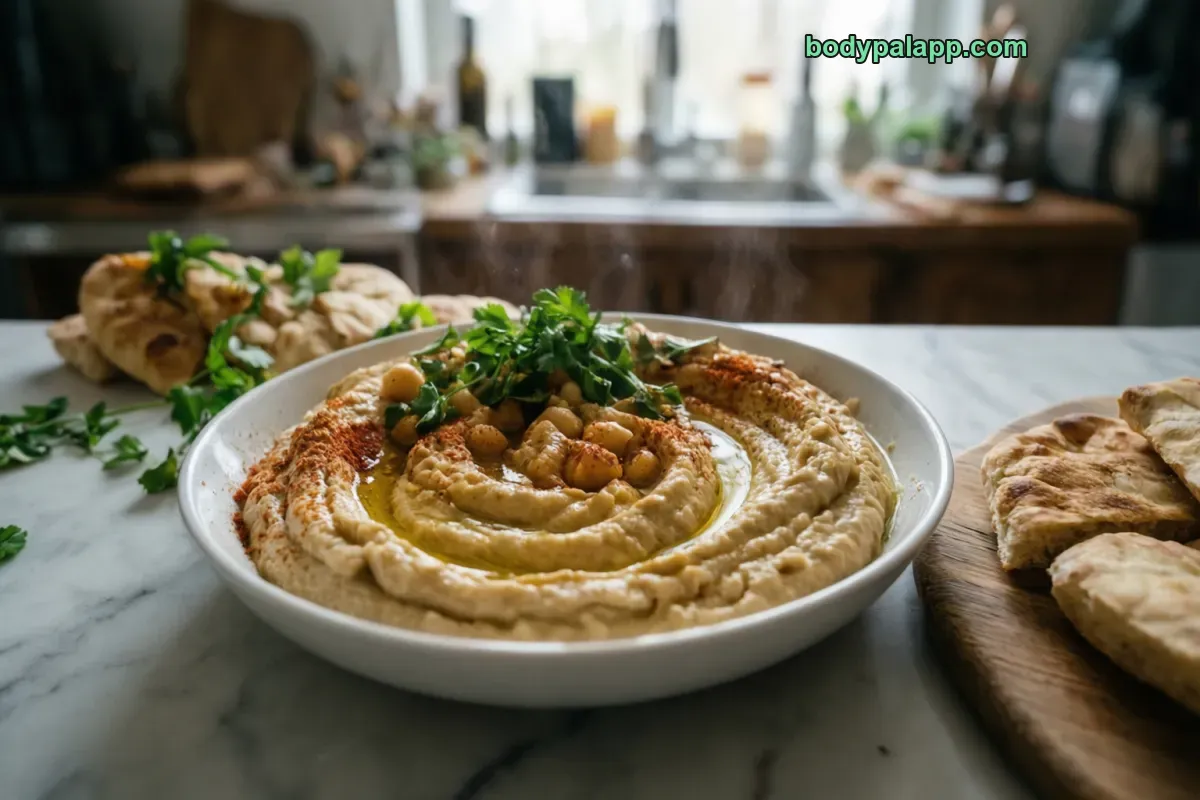
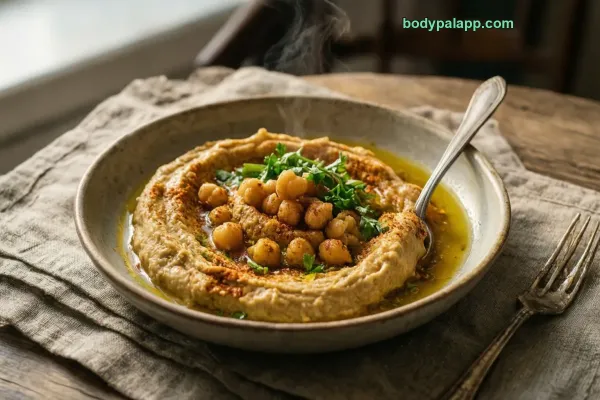
Homemade hummus calories come to 435 for 1 cup (246 g) and 177 per 100 g. Notice how evenly the energy splits: carbs supply 45% of calories and fat 44%, while protein brings only 11%. The portion matters more than the recipe. A tablespoon is a 27-calorie dab, and a cup is a meal.
435kcal
1 cup · 246 g, home prepared
11%protein
12 gProtein
49 gCarbs
21 gFat
How to burn off 435 kcal
—Walking, brisk
—Jogging
—Cycling, moderate
—Swimming
Skip the math. BodyPal counts these calories from your steps and workouts automatically.
Nutrition facts
Home prepared · per 246 g
Calories
435 kcal
Protein
12 g
Carbohydrate
49 g
Fat
21 g
Saturated fat
2.8 g
Cholesterol
0 mg
Sodium
595 mg
Potassium
426 mg
Iron
3.8 mg
Source: USDA FoodData Central
🛡️
Verified nutrition data
Numbers on this page come from USDA FoodData Central, the U.S. Department of Agriculture’s food composition database, and from manufacturer labels where a branded product is named. Last verified September 2026. How we verify our data →
Homemade hummus: calories, protein and sodium by serving
Percent of daily value uses the FDA reference of 2,000 kcal a day.
Serving
kcal
Protein
Carbs
Fat
Sodium
% DV kcal
1 cup (246 g)
435
12 g
49.5 g
21.1 g
595 mg
22%
1 tablespoon (15 g)
27
0.7 g
3 g
1.3 g
36 mg
1%
100 g
177
4.9 g
20.1 g
8.6 g
242 mg
9%
Store-bought cup (246 g)
583
19.1 g
36.9 g
43.8 g
1,048 mg
29%
3 × 1 cup (246 g)
1,306
35.9 g
1,786 mg
5 × 1 cup (246 g)
2,177
59.8 g
2,977 mg
A tablespoon is 27 calories, a cup is 435
Hummus is easy to undercount because nobody measures a dip. One level tablespoon (15 g) carries 27 calories, 1.3 g of fat and 36 mg of sodium. That is small enough to ignore on a single cracker. The trouble starts when the spoon becomes a scoop.
A full cup (246 g) lands at 435 calories, which is 22% of the daily value for energy, plus 12 g of protein and 595 mg of sodium. Double it and you reach 871 calories and 1,191 mg of sodium. Three cups, a realistic amount for a shared party bowl, total 1,306 calories. A big batch of five cups comes to 2,177 calories and 2,977 mg of sodium, so split that across many servings before you log it.
The practical move is to portion first and dip second. Spoon your share onto a plate instead of eating from the batch container. If you track by weight, 100 g is a fair middle serving at 177 calories and 9% of the daily value for energy.
Carbs and fat share the calories almost equally
Per 100 g, homemade hummus has 20.1 g of carbs, 8.6 g of fat and 4.9 g of protein. Fat is the smaller weight but the denser fuel, so it ends up supplying 44% of calories against 45% from carbs. Protein trails at 11%. This is a chickpea dip, not a protein food.
The carbs are the slow kind. You get 4 g of fiber per 100 g and only 0.3 g of sugars, so almost none of the carbohydrate is sweet. A cup holds 9.8 g of fiber, a solid share of the 28 g daily value. That fiber, plus the fat, is why a modest serving feels more filling than its size suggests.
The fat profile is mild. Saturated fat sits at 1.1 g per 100 g, and cholesterol is 0. Most of the fat in a home recipe comes from tahini and olive oil, which is why the amount you pour in shapes the final number. If you want hummus as a real protein source, the cup's 12 g covers 24% of the daily value, but you would need a lot of hummus to rely on it.
Sodium is the row to watch, and store-bought doubles down
Homemade hummus has 242 mg of sodium per 100 g, or 11% of the daily value. A cup brings 595 mg, which is 26% of the daily value in one dish. Salt is the one ingredient you fully control at home, so this is the easiest number on the label to move.
The USDA store-bought row shows how much the recipe shifts things. A store-bought cup (246 g) comes to 583 calories, 43.8 g of fat and 1,048 mg of sodium, which is 46% of the daily value. The homemade cup has 21.1 g of fat. Store-bought does carry more protein, 19.1 g, and more fiber, 13.5 g, so it is richer in everything, not simply worse.
If you watch sodium, homemade is the clear pick at the same cup size. If you buy tubs, the serving size printed on the label matters more than the brand.
Hummus works best as a spread, not a main
Treat hummus as a calorie-dense condiment that happens to bring fiber. A couple of tablespoons on a wrap or a grain bowl adds flavor for little energy. A cup eaten with pita chips is closer to a full meal once you count the dippers.
Pair it with foods that fill the gap in its profile. Raw vegetables add crunch and volume for very few calories, which keeps a snack plate light. Eggs, chicken or fish cover the protein hummus lacks at 11% of calories. The potassium, 173 mg per 100 g, is a minor bonus.
Logging is where most people slip, because dips get eaten in bites. BodyPal can log a plate of hummus and vegetables from a photo, which beats guessing after the fact.
How does homemade hummus compare?
Here is homemade hummus next to Sabra-style hummus, biscuit and gravy, and pancake syrup, compared per 100 g and per usual serving.
Verdict: Homemade hummus is the lightest of the four at 177 calories per 100 g, while the others sit around 1.3 times higher, from 224 for biscuit and gravy to 234 for pancake syrup. For a dip, pick homemade over the store hummus at 229 calories and 17.1 g of fat per 100 g; for staying full, both hummus options beat syrup, which has 0 g of protein.
Homemade hummus FAQs
How many calories are in homemade hummus?
A cup of homemade hummus has 435 calories and one tablespoon has 27. Per 100 g it comes to 177 calories.
Is homemade hummus good for weight loss?
At 177 calories per 100 g it is lighter than store-bought hummus at 237 per 100 g. One tablespoon adds 27 calories and 0.6 g of fiber.
Homemade hummus vs store-bought hummus: which has fewer calories?
Homemade hummus has 177 calories per 100 g and store-bought has 237, a difference of 60 calories per 100 g. The homemade version also has less fat, 8.6 g versus 17.8 g.
How much protein is in homemade hummus?
100 g has 4.9 g of protein, so a full cup provides about 12 g. The same 100 g also has 20.1 g of carbs and 4 g of fiber.
How many calories are in a tablespoon of homemade hummus?
One tablespoon (15 g) of homemade hummus has 27 calories. It also carries 1.3 g of fat, 3 g of carbs, 0.7 g of protein and 36 mg of sodium, so a single spoonful barely registers.
How much sodium is in homemade hummus?
A cup of homemade hummus has 595 mg of sodium, 26% of the daily value. Per 100 g it is 242 mg, and a tablespoon has 36 mg. Because you add the salt yourself, this number is easy to lower.
How much fiber does homemade hummus have?
Homemade hummus has 4 g of fiber per 100 g and 9.8 g per cup (246 g). A tablespoon adds 0.6 g. Sugars stay very low at 0.3 g per 100 g.
Is homemade hummus high in fat?
Homemade hummus has 8.6 g of fat per 100 g, and fat supplies 44% of its calories. Saturated fat is only 1.1 g per 100 g and cholesterol is 0, so most of the fat comes from tahini and oil.
How many calories are in 2 cups of homemade hummus?
Two cups (492 g) of homemade hummus come to 871 calories, with 23.9 g of protein and 1,191 mg of sodium. That is a shared-bowl amount, not a single serving.