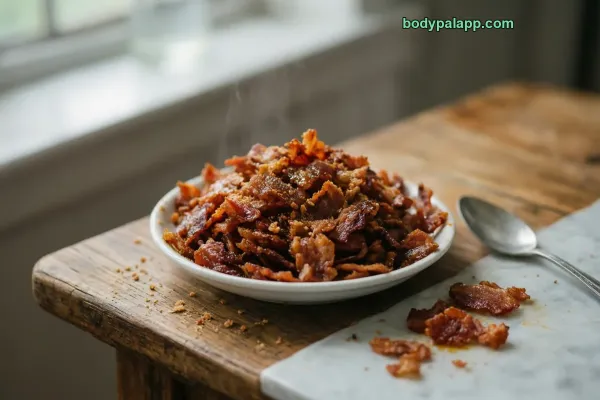
Bacon grease calories come to 39 for 1 tsp (4.3 g) and 897 per 100 g. Every one of those calories is fat: there is no protein, no carbs and no sugar. The real swing is the pour. A splash straight from the jar is rarely a level teaspoon, and each extra spoon adds about 39 more.
39kcal
1 teaspoon · 4 g, rendered pork fat
0%protein
0 gProtein
0 gCarbs
4.3 gFat
How to burn off 39 kcal
—Walking, brisk
—Jogging
—Cycling, moderate
—Swimming
Skip the math. BodyPal counts these calories from your steps and workouts automatically.
Nutrition facts
Rendered pork fat · per 4 g
Calories
39 kcal
Protein
0 g
Carbohydrate
0 g
Fat
4.3 g
Saturated fat
1.7 g
Cholesterol
4 mg
Sodium
6 mg
Potassium
0 mg
Iron
0 mg
Source: USDA FoodData Central
🛡️
Verified nutrition data
Numbers on this page come from USDA FoodData Central, the U.S. Department of Agriculture’s food composition database, and from manufacturer labels where a branded product is named. Last verified September 2026. How we verify our data →
Bacon grease: calories, protein and sodium by serving
Percent of daily value uses the FDA reference of 2,000 kcal a day.
Serving
kcal
Protein
Carbs
Fat
Sodium
% DV kcal
1 tsp (4.3 g)
39
0 g
0 g
4.3 g
6 mg
2%
1 oz (28 g)
251
0 g
0 g
27.9 g
42 mg
13%
100 g
897
0 g
0 g
99.5 g
150 mg
45%
3 × 1 tsp (4.3 g)
116
0 g
19 mg
5 × 1 tsp (4.3 g)
193
0 g
32 mg
A teaspoon is 39 calories, a pan coating is several times that
The label serving of 1 tsp (4.3 g) is small and easy to live with at 39 calories, just 2% of the daily value. Trouble starts when the spoon stays in the drawer. Most people coat a skillet, fry eggs in it or toss potatoes through it, and those uses rarely stop at one teaspoon.
Here is how fast the total climbs. Two teaspoons (9 g) bring 77 calories, three (13 g) bring 116, and five teaspoons, about 22 g, land at 193. One ounce (28 g), roughly what pools in the pan after a full package of bacon, carries 251 calories, or 13% of the daily value for energy.
So the number on the jar is honest, but the portion is up to you. If you track intake, measure the grease into the pan rather than eyeballing it. A level spoon is the difference between a 39-calorie seasoning and a 193-calorie side dish you never meant to eat.
Fat supplies 100% of the calories
Bacon grease is rendered pork fat, and the macro split shows it plainly: 100% of its calories come from fat, with 0% from protein and 0% from carbs. Per 100 g it holds 99.5 g of fat and nothing else worth counting. Sugar is 0 and fiber is 0.
That makes it one of the most calorie-dense foods in a kitchen, at 897 per 100 g. A single teaspoon delivers 4.3 g of fat, and an ounce delivers 27.9 g. Against the 78 g daily value for total fat, an ounce takes a big bite out of the day's budget on its own.
What it does not do is fill you up the way protein or fiber can. It adds flavor and richness, not volume. That is the right way to think about it: a seasoning fat that makes vegetables, eggs or beans taste better, not a food that carries a meal by itself.
Saturated fat is the row to watch, not sodium
Of the 99.5 g of fat in 100 g of bacon grease, 39 g is saturated. The daily value for saturated fat is 20 g, so a large pour adds up quickly. If you are keeping an eye on saturated fat, this is the number on the label that matters most.
Cholesterol is present too, at 95 mg per 100 g, against a daily value of 300 mg. At the teaspoon level that is a small amount, but it grows with every spoon in the same way the calories do.
Sodium is lower than most people expect. The salt in bacon mostly stays in the meat: the grease has 150 mg per 100 g, which is 7% of the daily value. A teaspoon carries only 6 mg, and an ounce carries 42 mg, or 2%. Bacon bits are a very different story at 1,770 mg per 100 g.
Use it in place of another fat, not on top of one
Calorie for calorie, bacon grease behaves like any cooking fat. The smart move is substitution: if a recipe calls for a teaspoon of oil or butter, swapping in a teaspoon of bacon grease barely changes the total. Using both is where the extra calories sneak in.
It earns its place where a little goes a long way. A teaspoon wiped across a skillet for eggs, a spoon stirred into a pot of greens or beans, or a thin coat on roasted vegetables gives a smoky flavor that is hard to get any other way. Pair it with high-volume foods so the 39 calories season a whole plate.
If you buy a jarred product such as Bacon Up Bacon Grease, the same rule applies: measure it, do not pour it. When you cook with it often, BodyPal can log the dish from a photo, which helps you see how much of a meal's total came from the pan.
How does bacon grease compare?
This table compares bacon grease with bacon fat, bacon bits and vegetable oil per 100 g and per usual serving.
Verdict: On calories, bacon grease and vegetable oil are a wash at 897 and 900 per 100 g, so pick by flavor and keep the spoon level. If you want bacon taste for fewer calories, bacon bits come in at 476 per 100 g, but their sodium jumps to 1,770 mg.
Most popular bacon grease brands in the United States
Ranked by popularity in the BodyPal database
# Productkcal / 100 g
1Bacon Up Bacon Grease1 tbsp · 13 g1000 kcal
Label numbers read a little higher than the USDA row: Bacon Up lists 1,000 calories per 100 g against 897 for rendered bacon fat. Source: manufacturer labels / USDA FoodData Central.
Bacon grease FAQs
How many calories are in a teaspoon of bacon grease?
About 39 calories per teaspoon (4.3 g). An ounce is 251 calories and 100 g is 897.
Is bacon grease good for weight loss?
It is one of the densest pantry items at 897 calories per 100 g, all of it fat, so a single teaspoon adds 39 calories to a pan.
Bacon grease vs bacon bits: which has more calories?
Bacon grease has 897 calories per 100 g and bacon bits 476, because the grease is 99.5 g pure fat per 100 g.
How much fat is in bacon grease?
99.5 g of fat per 100 g, of which 39 g is saturated, plus 95 mg cholesterol. A teaspoon holds about 4.3 g of fat.
Does grease have calories?
Yes, a lot. Bacon grease has 897 calories per 100 g and 39 in 1 tsp (4.3 g). It is almost pure fat, 99.5 g per 100 g, which makes it one of the most calorie-dense foods you can cook with.
What are the nutrition facts for bacon grease?
One teaspoon (4.3 g) has 39 calories, 4.3 g of fat, 0 g protein, 0 g carbs and 6 mg sodium. Per 100 g it has 897 calories, 39 g saturated fat and 95 mg cholesterol.
Does bacon fat have the same calories as bacon grease?
Yes. Bacon fat lists 39 calories per 1 tsp (4.3 g) and 897 per 100 g, identical to bacon grease, with the same 99.5 g of fat. They are the same rendered pork fat under two names.
How many calories does an ounce of bacon grease have?
One ounce (28 g) of bacon grease has 251 calories, 13% of the daily value. It carries 27.9 g of fat and 42 mg of sodium, with no protein, carbs or sugar.
Is there cholesterol in bacon grease?
Yes, bacon grease has 95 mg of cholesterol per 100 g, against a daily value of 300 mg. At a 1 tsp serving the amount is small, but it rises with every extra spoon you add.