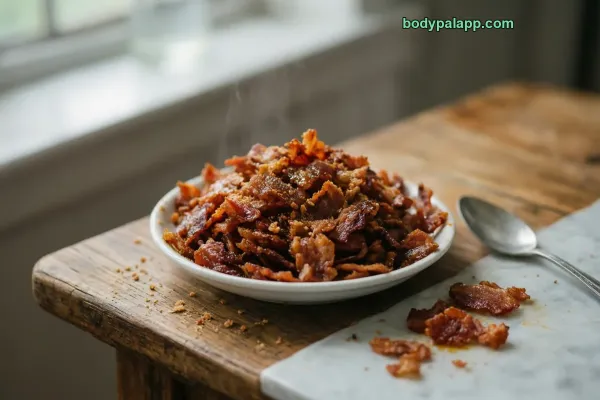
Bacon fat calories come to 39 for one teaspoon (4.3 g) and 897 per 100 g. Every one of those calories is fat: the card lists 0 g protein, 0 g carbs and 0 g sugar. So the one thing that moves your total is how much grease ends up in the pan or on the plate.
39kcal
1 teaspoon · 4 g, rendered from cooked bacon
0%protein
0 gProtein
0 gCarbs
4.3 gFat
How to burn off 39 kcal
—Walking, brisk
—Jogging
—Cycling, moderate
—Swimming
Skip the math. BodyPal counts these calories from your steps and workouts automatically.
Nutrition facts
Rendered from cooked bacon · per 4 g
Calories
39 kcal
Protein
0 g
Carbohydrate
0 g
Fat
4.3 g
Saturated fat
1.7 g
Cholesterol
4 mg
Sodium
6 mg
Potassium
0 mg
Iron
0 mg
Source: USDA FoodData Central
🛡️
Verified nutrition data
Numbers on this page come from USDA FoodData Central, the U.S. Department of Agriculture’s food composition database, and from manufacturer labels where a branded product is named. Last verified September 2026. How we verify our data →
Bacon fat: calories, protein and sodium by serving
Percent of daily value uses the FDA reference of 2,000 kcal a day.
Serving
kcal
Protein
Carbs
Fat
Sodium
% DV kcal
1 tsp (4.3 g)
39
0 g
0 g
4.3 g
6 mg
2%
1 oz (28 g)
251
0 g
0 g
27.9 g
42 mg
13%
100 g
897
0 g
0 g
99.5 g
150 mg
45%
3 × 1 tsp (4.3 g)
116
0 g
19 mg
5 × 1 tsp (4.3 g)
193
0 g
32 mg
A teaspoon is 39 calories, a pour is not
Measured with a spoon, bacon fat is easy to log: 1 tsp (4.3 g) is 39 calories and about 2% of a daily calorie budget. Two teaspoons bring it to 77 calories, three to 116. Most people never measure it, though. They tip the skillet, swirl it around and start cooking.
That unmeasured swirl is where the numbers jump. Five teaspoons, roughly 22 g, come to 193 calories, and 1 oz (28 g) reaches 251 calories, or 13% of the daily value for energy. That is a full snack's worth of calories added to a pan of eggs or potatoes without anyone noticing.
The fix is boring but it works. Pour the grease into a jar after cooking, then spoon back only what you need. If you track your food, log the spoonfuls rather than guessing, because the gap between one teaspoon and an ounce is 39 calories versus 251.
Fat is 100 percent of the calories
Bacon fat is about as pure an energy source as a kitchen holds. Per 100 g it carries 99.5 g of fat and nothing else that counts toward calories, so the calorie split reads 100% fat, 0% protein and 0% carbs. There is no fiber and no sugar either.
That puts it in the same calorie class as cooking oils. Avocado oil, for comparison, lists 884 calories and 100 g of fat per 100 g, almost identical to bacon fat's 897. The difference between them is not the energy. It is the type of fat and the small amount of sodium that comes along from the bacon.
Because there is no protein to slow you down, a spoon of bacon fat adds calories without adding fullness. Treat it as a flavor ingredient, not as a food. A little goes a long way on greens, beans or roasted vegetables, and the smoky taste means you can often use less than you would of a neutral oil.
Saturated fat is the row to watch
Per 100 g, bacon fat holds 39 g of saturated fat. The daily value used on this page is 20 g, so 100 g of bacon fat carries nearly double a full day's saturated fat allowance. Nobody eats 100 g at a sitting, but the ratio shows how quickly this row fills up compared with the calorie row.
Cholesterol is the other number worth a glance: 95 mg per 100 g, against a daily value of 300 mg. At a teaspoon or two that is modest, and it climbs as the portion grows.
Sodium is lower than most people expect. Bacon itself is salty, but the rendered fat lists 150 mg per 100 g, which is 7% of the daily value. One teaspoon has just 6 mg, which rounds to 0% of the daily value, and even 1 oz is only 42 mg. If you watch sodium, the grease is not the problem; the bacon strips are.
Use it as seasoning, not as a base
The smartest way to fit bacon fat into a day of eating is to swap it for another fat rather than add it on top. A teaspoon of bacon fat in place of a teaspoon of oil or butter barely moves your calories, and the dish tastes noticeably richer.
It pairs best with foods that bring the protein and fiber it lacks. Sauteed greens, cabbage, green beans, lentils and eggs all take on a smoky flavor from a small amount. Lean proteins such as chicken breast or white fish can be seared in a thin film of it and still stay light.
Store-bought jars such as Private Selection Rendered Bacon Fat work the same way as the grease you save at home: measure, do not pour. If you cook with it often, BodyPal can log the dish from a photo, but adding the spoonfuls by hand gives the most honest total.
How does bacon fat compare?
Here is how bacon fat compares with bacon bits, avocado oil and mayonnaise, per 100 g and per usual serving.
Verdict: For the fewest calories per spoon, mayonnaise at 31 per teaspoon edges out bacon fat at 39, and bacon bits give you bacon flavor at 476 per 100 g with 32 g of protein. If sodium matters, avocado oil at 0 mg beats bacon fat at 150 mg per 100 g, while bacon bits jump to 1,770 mg.
Most popular bacon fat brands in the United States
Jarred rendered bacon fat is labeled as pure fat at 929 calories per 100 g, a little above the USDA bacon grease row at 897. Source: manufacturer labels / USDA FoodData Central.
Bacon fat FAQs
How many calories are in a teaspoon of bacon fat?
About 39 calories in one teaspoon (4.3 g). Bacon fat is 897 calories per 100 g, of which 99.5 g is fat.
Is bacon fat good for weight loss?
Bacon fat is one of the most calorie-dense foods in a kitchen at 897 calories per 100 g, so the amount counts quickly: 39 calories per teaspoon and 251 calories per ounce.
Is bacon grease the same as rendered bacon fat?
They are the same thing, and the numbers match: bacon grease is 897 calories per 100 g and rendered bacon fat is 898, both 99.5 g fat with no carbs.
How much saturated fat is in bacon fat?
About 39 g of saturated fat per 100 g, which is 1.7 g in a teaspoon. The same teaspoon carries about 4 mg of cholesterol and 0 g of protein.
Does bacon fat have any protein?
No. Bacon fat has 0 g of protein per 100 g and 0 g per teaspoon. All 897 calories per 100 g come from fat, so it adds energy and flavor but nothing that builds or repairs muscle.
How many grams of fat are in a teaspoon of bacon fat?
One teaspoon (4.3 g) of bacon fat contains 4.3 g of fat, which is practically its entire weight. An ounce (28 g) holds 27.9 g of fat and 251 calories.
What percentage of bacon fat is fat?
Bacon fat is 99.5 g of fat per 100 g, and 100% of its calories come from fat. It has 0 g of protein, carbs, fiber and sugar.
How many calories are in an ounce of bacon fat?
An ounce (28 g) of bacon fat has 251 calories, about 13% of the daily value for energy. That is the same as roughly six or seven teaspoons, so a casual pour adds up quickly.
What is the full nutrition of bacon fat per 100 g?
Per 100 g, bacon fat has 897 calories, 99.5 g of fat, 39 g of saturated fat, 95 mg of cholesterol and 150 mg of sodium. Protein, carbs, fiber and sugar are all 0.