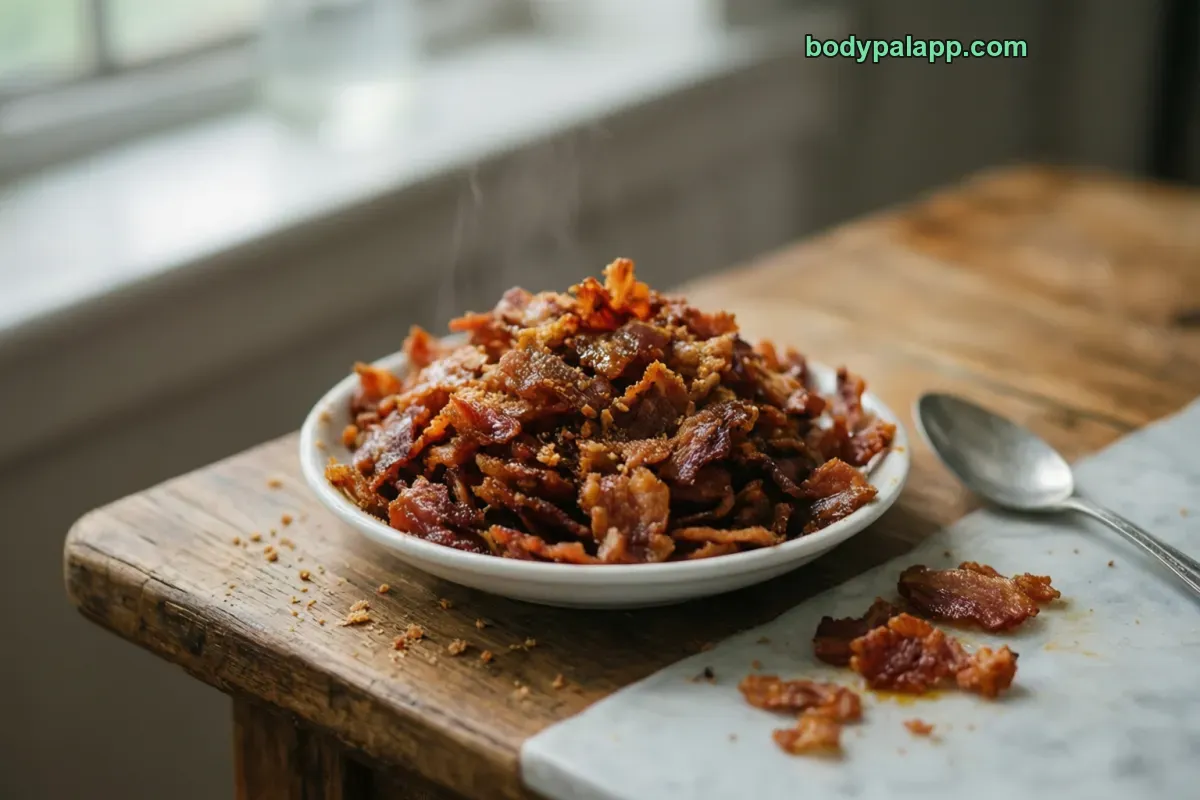
Bacon bits calories come to 33 for one tablespoon (7 g) and 476 per 100 g, for the imitation, soy-based kind USDA lists as meatless. The number to notice is sodium: 124 mg per tablespoon, and the total climbs fast once you shake on more than a spoonful.
33kcal
1 tablespoon · 7 g, imitation, soy based
27%protein
2.2 gProtein
2 gCarbs
1.8 gFat
How to burn off 33 kcal
—Walking, brisk
—Jogging
—Cycling, moderate
—Swimming
Skip the math. BodyPal counts these calories from your steps and workouts automatically.
Nutrition facts
Imitation, soy based · per 7 g
Calories
33 kcal
Protein
2.2 g
Carbohydrate
2 g
Fat
1.8 g
Saturated fat
0.3 g
Cholesterol
0 mg
Sodium
124 mg
Potassium
10 mg
Iron
0.1 mg
Source: USDA FoodData Central
🛡️
Verified nutrition data
Numbers on this page come from USDA FoodData Central, the U.S. Department of Agriculture’s food composition database, and from manufacturer labels where a branded product is named. Last verified September 2026. How we verify our data →
Bacon bits: calories, protein and sodium by serving
Percent of daily value uses the FDA reference of 2,000 kcal a day.
Serving
kcal
Protein
Carbs
Fat
Sodium
% DV kcal
1 tablespoon (7 g)
33
2.2 g
2 g
1.8 g
124 mg
2%
100 g
476
32 g
28.6 g
25.9 g
1,770 mg
24%
1 oz portion (28 g)
133
9 g
8 g
7.3 g
496 mg
7%
3 × 1 tablespoon (7 g)
100
6.7 g
372 mg
5 × 1 tablespoon (7 g)
167
11.2 g
620 mg
One tablespoon is 33 calories, a heavy hand is 167
A level tablespoon weighs just 7 g and carries 33 calories, about 2% of the daily value for calories. That is small enough to treat as a garnish. The trouble is that few people stop at one spoonful, especially on a salad or a loaded baked potato.
Two tablespoons (14 g) come to 67 calories, three reach 100, and five tablespoons (35 g) land at 167. A 1 oz portion of 28 g, the kind of amount that disappears into a big salad bowl, is 133 calories. Same bits, same jar. Only the scoop changed.
If you are counting, measure with a real tablespoon the first few times. Bits are light and loose, so a casual shake is hard to judge by eye. BodyPal can log them from a photo of the finished plate, which helps when the topping is scattered across a whole dish.
Fat supplies about half the calories
Of the calories in these bits, 49% come from fat, 27% from protein and 24% from carbohydrate. Per 100 g that works out to 25.9 g fat, 32 g protein and 28.6 g carbs. So they are not pure fat the way the name suggests, but fat still leads.
Protein is the surprise. A tablespoon gives 2.2 g, and the 1 oz portion gives 9 g, which is 18% of the daily value. That is a real contribution for a topping, though you would need five tablespoons (35 g) to reach 11.2 g, and by then you have also added 167 calories.
Saturated fat is modest at 4.1 g per 100 g, out of 25.9 g total fat. Sugar reads 0. The carbs carry no sweetness at all, and a good share of them is fiber from the soy base, covered further down.
Sodium is the row to watch
Per 100 g these bits hold 1,770 mg of sodium, 77% of the daily value. Calories at the same weight are only 24% of the daily value, so salt runs far ahead of energy. That gap is the real story on this label.
At garnish size it stays manageable: one tablespoon is 124 mg, or 5% of the daily value. Two tablespoons reach 248 mg and three reach 372 mg. Five tablespoons hit 620 mg, and the 1 oz portion carries 496 mg, 22% of the daily value, in a single topping.
Sodium also stacks. Bits usually land on foods that are already seasoned, such as dressed salads, cheesy potatoes or scrambled eggs, so the plate total can sit well above what the bits add alone. If you watch sodium, measure the bits and go lighter on salty dressing or cheese in the same dish.
The soy base brings fiber and zero cholesterol
These numbers are for the imitation, soy-based product USDA lists as meatless bacon bits. That base explains two rows that look odd for anything called bacon: cholesterol is 0 and fiber is 10.2 g per 100 g. Per tablespoon the fiber is 0.7 g, and the 1 oz portion gives 2.9 g against a daily value of 28 g.
Brands on this page split into two camps. Badia, Great Value, ShopRite and Clear Value sell imitation bits, while Hormel and Oscar Mayer sell real bacon versions, including a turkey option. Check the label to know which jar you have, because the figures here describe the meatless kind.
For pairing, bits work best as a flavor accent on foods that bring volume, such as leafy salads, steamed vegetables or a plain baked potato. A tablespoon adds smoky, salty crunch for 33 calories. That is a sensible trade if the rest of the plate stays light on salt.
How does bacon bits compare?
Here is how bacon bits stack up against bacon fat, onion powder and ketchup, per 100 g and per usual serving.
Verdict: For the fewest calories, ketchup at 17 per tablespoon or onion powder at 8 per teaspoon beats the bits, though ketchup still carries 907 mg sodium per 100 g. Skip bacon fat if you only want the smoky flavor: it packs 897 calories per 100 g, about 1.9 times the bits, with 0 g protein.
Most popular bacon bits brands in the United States
8Clear Value Imitation Bacon Bits1 tbsp · 7 g429 kcal
The number above is the soy-based bacon bit at 476 calories per 100 g; products made from real bacon or turkey read lower, from 286 to 429 per 100 g. Source: manufacturer labels / USDA FoodData Central.
Bacon bits FAQs
How many calories are in a tablespoon of bacon bits?
About 33 calories per tablespoon (7 g). Per 100 g the count is 476 calories.
Are bacon bits good for weight loss?
A tablespoon adds 33 calories, 2.2 g protein and 1.8 g fat, so a sprinkle is small. Sodium is the catch at 124 mg per tablespoon, or 1,770 mg per 100 g.
Are real bacon bits different from imitation ones?
Yes. The soy-based bits here are 476 calories per 100 g, while the real-bacon and turkey products in the list run 286 to 429 calories per 100 g.
How much protein is in bacon bits?
32 g of protein per 100 g, which is about 2.2 g in one tablespoon (7 g). Carbs are 28.6 g per 100 g, of which 10.2 g is fiber.
How many calories are in 2 tablespoons of bacon bits?
Two tablespoons (14 g) of imitation bacon bits have 67 calories. They also carry 248 mg sodium and 4.5 g protein. Three tablespoons rise to 100 calories, so a heavy pour adds up quickly.
What are the macros in bacon bits?
Per 100 g, bacon bits have 32 g protein, 28.6 g carbs and 25.9 g fat. By calories that splits into 49% fat, 27% protein and 24% carbs, with 10.2 g fiber and 0 g sugar.
What is the nutritional value of bacon bits?
Per 100 g, bacon bits deliver 476 calories, 1,770 mg sodium, 10.2 g fiber, 145 mg potassium and 0 mg cholesterol. A single tablespoon is far smaller: 33 calories, 124 mg sodium and 0.7 g fiber.
Are bacon bits healthy?
It depends on how much you use: one tablespoon is 33 calories and 124 mg sodium, just 5% of the daily value. At 100 g, sodium reaches 77% of the daily value, so they work best as a light garnish.
How much fat is in bacon bits?
A tablespoon of bacon bits has 1.8 g fat, and 100 g has 25.9 g, of which 4.1 g is saturated. Fat supplies 49% of the calories. These figures are for imitation bits; real bacon versions such as Hormel's can differ.