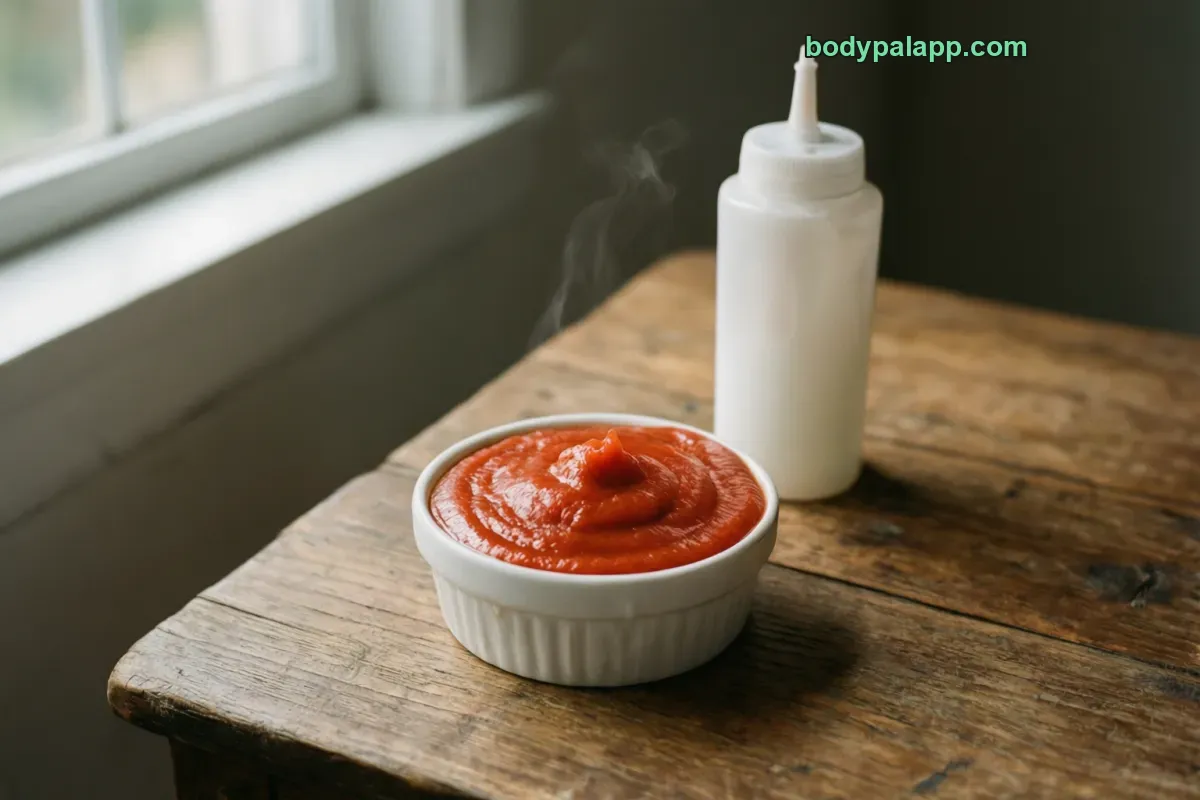
Ketchup calories come to 17 for one tablespoon (17 g) and 101 per 100 g. The calories are not the story. Sodium is: that same tablespoon carries 154 mg, 7% of the daily value, plus 3.6 g of sugar. Ketchup is nearly all sugary carbs and salt, and the size of your squeeze decides both totals.
17kcal
1 tablespoon · 17 g, bottled, ready to use
4%protein
0.2 gProtein
5 gCarbs
0 gFat
How to burn off 17 kcal
—Walking, brisk
—Jogging
—Cycling, moderate
—Swimming
Skip the math. BodyPal counts these calories from your steps and workouts automatically.
Nutrition facts
Bottled, ready to use · per 17 g
Calories
17 kcal
Protein
0.2 g
Carbohydrate
4.7 g
Fat
0 g
Saturated fat
0 g
Cholesterol
0 mg
Sodium
154 mg
Potassium
48 mg
Iron
0.1 mg
Source: USDA FoodData Central
🛡️
Verified nutrition data
Numbers on this page come from USDA FoodData Central, the U.S. Department of Agriculture’s food composition database, and from manufacturer labels where a branded product is named. Last verified September 2026. How we verify our data →
Ketchup: calories, protein and sodium by serving
Percent of daily value uses the FDA reference of 2,000 kcal a day.
Serving
kcal
Protein
Carbs
Fat
Sodium
% DV kcal
1 tablespoon (17 g)
17
0.2 g
4.7 g
0 g
154 mg
1%
1 packet (9 g)
9
0.1 g
2.5 g
0 g
82 mg
0%
1 cup (240 g)
242
2.5 g
65.8 g
0.2 g
2,177 mg
12%
100 g
101
1 g
27.4 g
0.1 g
907 mg
5%
3 × 1 tablespoon (17 g)
52
0.5 g
463 mg
5 × 1 tablespoon (17 g)
86
0.9 g
771 mg
A packet is 9 calories, a cup is 242
Ketchup gets measured in squeezes, not servings, and that is where the math slips. A single packet (9 g) holds 9 calories and 82 mg of sodium, small enough to ignore on its own. A level tablespoon (17 g) is 17 calories, 4.7 g of carbs and 3.6 g of sugar. Few people stop at one.
Two tablespoons come to 34 calories and 308 mg of sodium. Three reach 52 calories and 463 mg. A generous pool for a basket of fries, about 5 tablespoons, lands at 86 calories and 771 mg of sodium. The calories stay modest the whole way. The sodium does not.
A full cup (240 g) is the extreme end: 242 calories, 51 g of sugar and 2,177 mg of sodium, which is 95% of the daily value. Nobody eats that in one sitting, but it shows how fast a bottle passed around a family dinner adds up. If you track, count packets or tablespoons rather than guessing the size of a squeeze.
Carbs supply 96% of the calories
Per 100 g, ketchup has 27.4 g of carbs, 1 g of protein and 0.1 g of fat. That puts 96% of its calories in carbohydrate, 4% in protein and 1% in fat. Strip away the tomato color and this is a sweet sauce first.
Of those 27.4 g of carbs, 21.3 g are sugars. Fiber is a token 0.3 g per 100 g, and a tablespoon offers just 0.1 g. So ketchup adds sweetness and tang to a plate, not fullness. It will not help a meal keep you satisfied, and it does not need to. That is the job of whatever you put it on.
The fat side is a clean sheet. Saturated fat and cholesterol both read 0, which is why ketchup scores so low next to creamy sauces. There is some potassium, 281 mg per 100 g, a trace of the tomatoes it started from. Protein is negligible at 0.2 g a tablespoon.
Sodium is the row to watch
Ketchup carries 907 mg of sodium per 100 g. That is 39% of the daily value in an amount that supplies only 5% of the daily calories. The gap is the whole story: per calorie, ketchup is a salty food, and the burger, fries or eggs it sits on usually bring their own salt.
One tablespoon is 154 mg, 7% of the daily value. Three tablespoons pass 463 mg, and five reach 771 mg. For something you barely register as eating, that is a real share of the day.
If you watch sodium, ketchup is easy to manage. Measure a tablespoon instead of free-pouring, and dip rather than drown. Sugar works the same way. At 3.6 g a tablespoon it is minor, but a cup holds 51 g, so a heavy hand matters more than the label suggests. Versions such as Heinz Simply Tomato Ketchup or Heinz Organic Tomato Ketchup exist if you prefer a different recipe; check their own labels for the numbers.
Ketchup works best as a measured accent
Because a tablespoon is only 17 calories, ketchup rarely decides whether a day of eating fits your goals. What it sits on does. Fries, hash browns, hot dogs and burgers carry far more energy than the sauce, so the useful question is the plate, not the bottle.
Ketchup earns its place next to lean foods. Scrambled eggs, a turkey burger, roasted potatoes or a meatloaf glaze all take a tablespoon or two well, adding flavor for 17 to 34 calories. Used instead of a creamy dip, it is one of the easier trades on a plate, since there is almost no fat to account for.
The simplest habit is to plate your portion instead of eating from a shared bottle or a pile of packets. Logging it is quick too: BodyPal can log ketchup from a photo of your plate, so a squeeze on the side does not slip past the total.
How does ketchup compare?
Here is how ketchup stacks up against cocktail sauce, mayonnaise and alfredo sauce, per 100 g and per usual serving.
Verdict: For the fewest calories, ketchup wins at 101 per 100 g, well under alfredo sauce at 150 and mayonnaise at 680. If sodium is your concern, skip cocktail sauce at 1,262 mg per 100 g; mayonnaise at 635 mg is actually lower in salt than ketchup's 907 mg, but you pay for it in fat.
Label numbers are rounded to whole calories per tablespoon, so they read a little higher per 100 g than the USDA average above. Source: manufacturer labels / USDA FoodData Central.
Ketchup FAQs
How many calories are in a tablespoon of ketchup?
One tablespoon (17 g) has 17 calories. A single-serve packet (9 g) has 9 calories.
How much sugar is in ketchup?
Ketchup has 21.3 g of sugars per 100 g, which is 3.6 g in a tablespoon and 1.9 g in a packet.
Is ketchup high in sodium?
Regular ketchup has 907 mg of sodium per 100 g, or 154 mg per tablespoon. The low-sodium version has 20 mg per 100 g with the same 101 calories.
Is ketchup good for weight loss?
A tablespoon adds only 17 calories and almost no fat, at 0.1 g per 100 g. The calories add up at larger amounts: a cup (240 g) is 242 calories.
How many calories are in a ketchup packet?
A standard packet (9 g) of ketchup has 9 calories, with 2.5 g of carbs, 1.9 g of sugar and 82 mg of sodium, or 4% of the daily value. Two packets roughly equal one tablespoon.
How many calories are in a cup of ketchup?
A cup (240 g) of ketchup has 242 calories, 65.8 g of carbs and 51 g of sugar. It also carries 2,177 mg of sodium, 95% of the daily value, which matters more than the calories if you cook with ketchup in bulk.
How many carbs are in ketchup?
One tablespoon of ketchup has 4.7 g of carbs, of which 3.6 g are sugars and 0.1 g is fiber. Per 100 g the figures are 27.4 g of carbs and 21.3 g of sugars, so carbs supply 96% of its calories.
Does ketchup have any fat or protein?
Barely. A tablespoon of ketchup has 0 g of fat and 0.2 g of protein. Per 100 g it is 0.1 g of fat and 1 g of protein, with no saturated fat or cholesterol, so it is almost pure carbohydrate.
How many calories are in 2 tablespoons of ketchup?
Two tablespoons (34 g) of ketchup have 34 calories, 0.4 g of protein and 308 mg of sodium. Three tablespoons rise to 52 calories and 463 mg of sodium.
Does ketchup contain potassium?
Yes, ketchup has 281 mg of potassium per 100 g, carried over from the tomatoes it is made from. Against its 907 mg of sodium per 100 g, though, it is still far heavier in salt than in potassium.