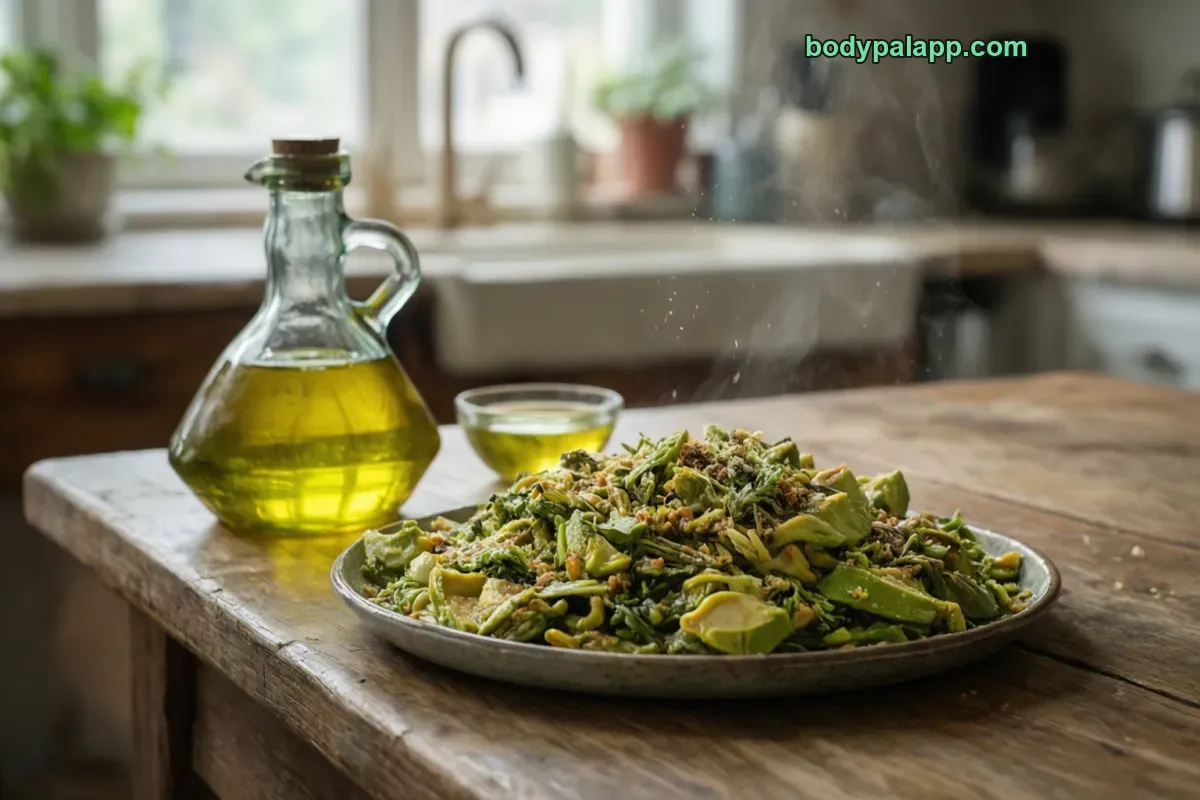
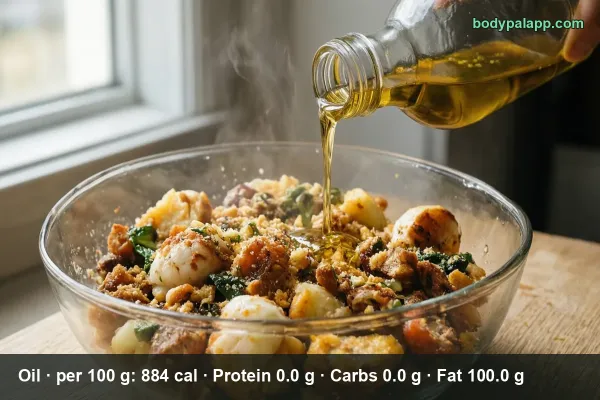
Avocado oil calories come to 124 for 1 tbsp (14 g) and 884 per 100 g. Every one of them is fat: a tablespoon holds 14 g of fat with 0 protein, 0 carbs and 0 sodium. The number that swings your total is not the label but the pour, because oil adds up fast.
124kcal
1 tablespoon · 14 g, pure oil
0%protein
0 gProtein
0 gCarbs
14 gFat
How to burn off 124 kcal
—Walking, brisk
—Jogging
—Cycling, moderate
—Swimming
Skip the math. BodyPal counts these calories from your steps and workouts automatically.
Nutrition facts
Pure oil · per 14 g
Calories
124 kcal
Protein
0 g
Carbohydrate
0 g
Fat
14 g
Saturated fat
1.6 g
Sodium
0 mg
Potassium
0 mg
Iron
0 mg
Source: USDA FoodData Central
🛡️
Verified nutrition data
Numbers on this page come from USDA FoodData Central, the U.S. Department of Agriculture’s food composition database, and from manufacturer labels where a branded product is named. Last verified September 2026. How we verify our data →
Avocado oil: calories, protein and sodium by serving
Percent of daily value uses the FDA reference of 2,000 kcal a day.
Serving
kcal
Protein
Carbs
Fat
Sodium
% DV kcal
1 tbsp (14 g)
124
0 g
0 g
14 g
0 mg
6%
1 tsp (4.5 g)
40
0 g
0 g
4.5 g
0 mg
2%
100 g
884
0 g
0 g
100 g
0 mg
44%
1 cup (218 g)
1,927
0 g
0 g
218 g
0 mg
96%
3 × 1 tbsp (14 g)
371
0 g
0 mg
5 × 1 tbsp (14 g)
619
0 g
0 mg
A tablespoon is 124 calories, and pours run long
The standard measure is 1 tbsp (14 g), which carries 124 calories, about 6% of a 2000-calorie daily reference. A teaspoon (4.5 g) is 40 calories, or 2%. Those numbers look small on paper. The catch is that few people measure oil when it goes into a hot pan.
Totals climb in straight steps. Two tablespoons (28 g) come to 248 calories, three (42 g) to 371, and five (70 g) to 619. A generous drizzle over a salad plus a splash for searing can land in the 2 to 3 tablespoon range without anyone noticing, and that is a small meal's worth of calories hiding in the pan.
At the far end, 1 cup (218 g) holds 1,927 calories, 96% of a 2000-calorie reference day. Nobody eats a cup at once, but it shows the scale: a bottle of oil is one of the densest items in the pantry. If you track intake, a measuring spoon does more for accuracy than any label reading.
Every calorie in avocado oil comes from fat
The calorie split is 100% fat, 0% protein and 0% carbs. Per 100 g the oil has 100 g of fat and nothing else that counts: 0 g protein, 0 g carbs, 0 g fiber. That is what pure oil means. The label reads simply because there is only one macro on it.
This shapes how the calories behave on your plate. A tablespoon adds 124 calories but no volume, no chew and no protein, so it does little to make a meal look or feel bigger. The same calories spent on vegetables or beans would take up far more room on the plate. Oil is easy to add and easy to forget.
None of this makes avocado oil a bad choice. Fat carries flavor, helps food brown and makes dressings cling to leaves. It simply means the oil is a calorie you pour rather than a food you eat, and it deserves its own line in a food log instead of being folded silently into the dish.
Saturated fat is 11.6 g per 100 g
People searching for avocado oil often ask how much saturated fat it has. The answer from the USDA row for pure avocado oil is 11.6 g per 100 g. For context, the daily value used on this page is 20 g for saturated fat and 78 g for total fat.
Put that next to the fat total. Of the 100 g of fat in 100 g of oil, 11.6 g is saturated, so the large majority of the fat is not the saturated kind. Per tablespoon the fat total is 14 g, and only a small slice of that is saturated. Most of the 124 calories in a spoonful come from other fats.
Sodium and potassium both read 0, and so does fiber, so there is no other row on the label to watch. If you track saturated fat against a daily target, log the tablespoon you actually pour rather than the per-100 g figure on the bottle, because the spoon is what reaches your plate.
Measure the oil, not the pan
Avocado oil works for roasting, searing and dressings, and the calorie math is the same in each: 124 per tablespoon, 40 per teaspoon. What changes is how much ends up in the food. A pan sear often leaves some oil behind in the pan, while a dressing goes onto your plate in full.
Brand does not change the picture much. Chosen Foods sells pure, virgin and spray versions, and a spray is the simplest way to coat a pan with less oil. Whichever bottle you use, log what you pour, not what the recipe says.
Pair the oil with foods that bring what it lacks: protein from fish, eggs or beans, and volume from vegetables. A teaspoon tossed with a tray of vegetables is 40 calories; the same vegetables coated in 3 tablespoons carry 371. BodyPal can log the dish from a photo, but a measuring spoon keeps the oil line honest.
How does avocado oil compare?
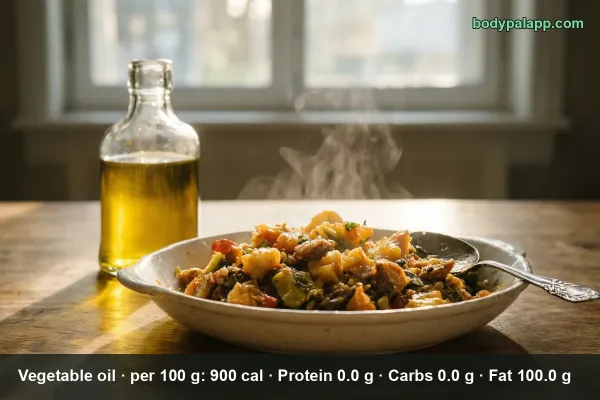
Here is how avocado oil stacks up against generic oil, vegetable oil and bacon fat, per 100 g and per usual serving.
Verdict: On calories there is no real winner: avocado oil has 884 per 100 g, vegetable oil 900 and bacon fat 897, all close to pure fat. If you watch sodium, skip bacon fat, which carries 150 mg per 100 g against 0 for avocado oil.
Most popular avocado oil brands in the United States
Label figures differ with how the serving is measured: bottles listing 15 ml read 867 calories per 100 g, a weighed 14 g serving reads 929, and the spray is labeled per quarter-second spray, which rounds to zero. Source: manufacturer labels / USDA FoodData Central.
Avocado oil FAQs
How many calories are in a tablespoon of avocado oil?
One tablespoon (14 g) is 124 calories. A teaspoon (4.5 g) is 40 calories, and 100 g is 884.
Is avocado oil good for weight loss?
Avocado oil is pure fat at 884 calories per 100 g, with no protein and no carbohydrate. A tablespoon adds 124 calories to a dish and a teaspoon adds 40.
Avocado oil vs vegetable oil: which has fewer calories?
Avocado oil is 884 calories per 100 g and vegetable oil is 900, a difference of about 2 calories per tablespoon (124 against 126).
How much fat is in avocado oil?
It is 100 g of fat per 100 g of oil, 11.6 g of that saturated. One tablespoon holds 14 g of fat, 1.6 g of it saturated.
How many calories are in 1 teaspoon of avocado oil?
One teaspoon (4.5 g) of avocado oil has 40 calories, all from 4.5 g of fat. That is 2% of a 2000-calorie daily reference, which makes the teaspoon a handy unit if you want to keep oil in check.
How many calories are in 2 tablespoons of avocado oil?
Two tablespoons (28 g) of avocado oil have 248 calories, all from fat. That is a common amount for a salad dressing or a stir-fry, so it is worth measuring rather than pouring freely.
How many calories are in 3 tablespoons of avocado oil?
Three tablespoons (42 g) of avocado oil come to 371 calories. Recipes for roasted vegetables or marinades often call for this much, so split the total by the number of servings when you log it.
How much saturated fat is in avocado oil?
Avocado oil has 11.6 g of saturated fat per 100 g, out of 100 g of total fat. The daily value used here for saturated fat is 20 g, so a measured tablespoon keeps the amount small.
How many calories are in 100 g of avocado oil?
A 100 g portion of avocado oil has 884 calories, 44% of a 2000-calorie daily reference. It is 100 g of fat with 0 protein, 0 carbs and 0 sodium, the same macro profile as other pure cooking oils.