
How many calories are in oil?
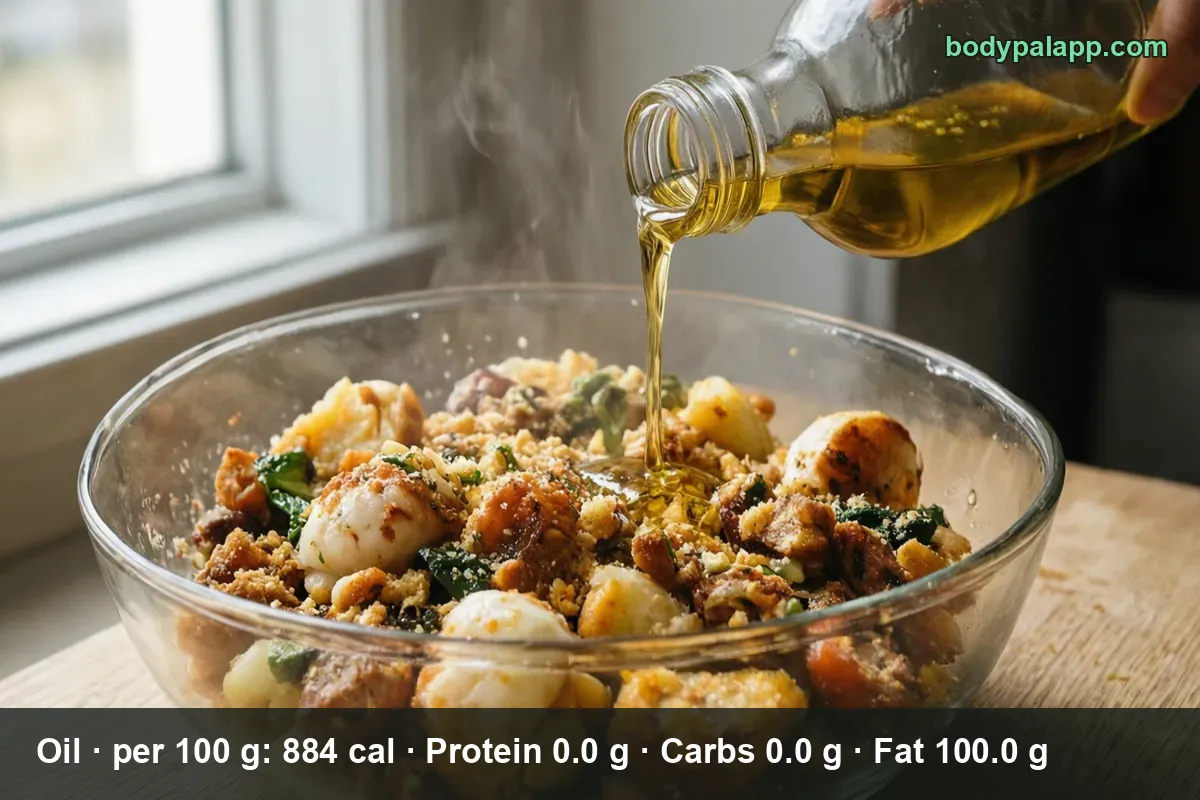
One tablespoon of oil is 124 calories. That is 14 g of canola, and every one of those grams is fat. Per 100 g, oil runs 884 calories — the densest thing in most American kitchens. Switching bottles barely helps: olive, vegetable, sesame and avocado all land on the same 884.
On this page
- Oil quick facts
- US servings, from a teaspoon to a cup
- Olive, vegetable, coconut and the rest
- Saturated fat is the only row that changes
- How does oil compare?
- Most popular oil brands
- FAQ
Oil quick facts
When an American says "oil" in a recipe, the bottle on the counter is neutral cooking oil — canola or a soybean blend sold as vegetable oil. So the numbers here come from USDA SR Legacy 172336, "Oil, canola". It is the one mass-market record with a full nutrient set and its own USDA household measures, including a tablespoon weighed at 14 g rather than estimated.
Every other oil in this article is listed with its own USDA record further down. Nothing is averaged between them.
| Nutrient | Per 100 g | Per 1 tbsp (14 g) | % Daily Value |
|---|---|---|---|
| Calories | 884 | 124 | — |
| Total fat | 100 g | 14.0 g | 18% |
| Saturated fat | 7.37 g | 1.0 g | 5% |
| Carbohydrate | 0 g | 0.0 g | 0% |
| Dietary fiber | 0 g | 0.0 g | 0% |
| Total sugars | 0 g | 0.0 g | — |
| Protein | 0 g | 0.0 g | 0% |
| Sodium | 0 mg | 0 mg | 0% |
% Daily Value is based on a 2,000-calorie diet.
Verified nutrition data
Numbers on this page come from USDA FoodData Central, the U.S. Department of Agriculture’s food composition database, and from manufacturer labels where a branded product is named. Last verified September 2026. How we verify our data →
There is no "Added sugars" row because the SR Legacy edition has no such field, and pure oil has no sugar of any kind to report. Cholesterol and potassium are both 0 mg — plant oils carry neither. The Daily Values used above are the FDA reference amounts on the Nutrition Facts label: 78 g total fat and 20 g saturated fat.
US servings, from a teaspoon to a cup
| Serving | Weight | Calories |
|---|---|---|
| 1 tsp | 4.5 g | 40 kcal |
| 1 tbsp | 14 g | 124 kcal |
| 2 tbsp | 28 g | 248 kcal |
| 1 oz | 28.3 g | 250 kcal |
| 1 cup | 218 g | 1927 kcal |
| Per 100 g | 100 g | 884 kcal |
The teaspoon, the tablespoon and the cup are USDA's own household measures for this record, weights included. The 2 tbsp and 1 oz lines are our own arithmetic from the USDA 100 g figure, not USDA servings — useful because a fluid ounce of oil and an ounce by weight are close enough here that people conflate them.
The cup is the line that catches people. At 218 g it is 1,927 calories, roughly fifteen and a half tablespoons in one pour. A cake batter or a marinade that measures oil by the cup is adding more energy than most people eat at dinner, and it disappears into the mix with no visible bulk. If you log by eye, log oil by the tablespoon or the teaspoon — the cup is a number to measure, never to estimate.
Two teaspoons of oil swirled around a skillet is 80 calories before any food goes in. That is the single most-missed entry in a food diary, and it is why a "light" stir-fry so often costs more than the person who cooked it expects.
Olive, vegetable, coconut and the rest
| Version | Per 100 g | Typical serving | Calories |
|---|---|---|---|
| Canola oil (main record) | 884 kcal | 1 tbsp, 14 g | 124 kcal |
| Olive oil | 884 kcal | 1 tbsp, 13.6 g | 120 kcal |
| Vegetable (soybean) oil | 884 kcal | 1 tbsp, 13.6 g | 120 kcal |
| Avocado oil | 884 kcal | 1 tbsp, 13.6 g | 120 kcal |
| Sesame oil | 884 kcal | 1 tbsp, 13.6 g | 120 kcal |
| Coconut oil | 892 kcal | 1 tbsp, 13.6 g | 121 kcal |
| Corn oil | 900 kcal | 1 tbsp, 13.6 g | 122 kcal |
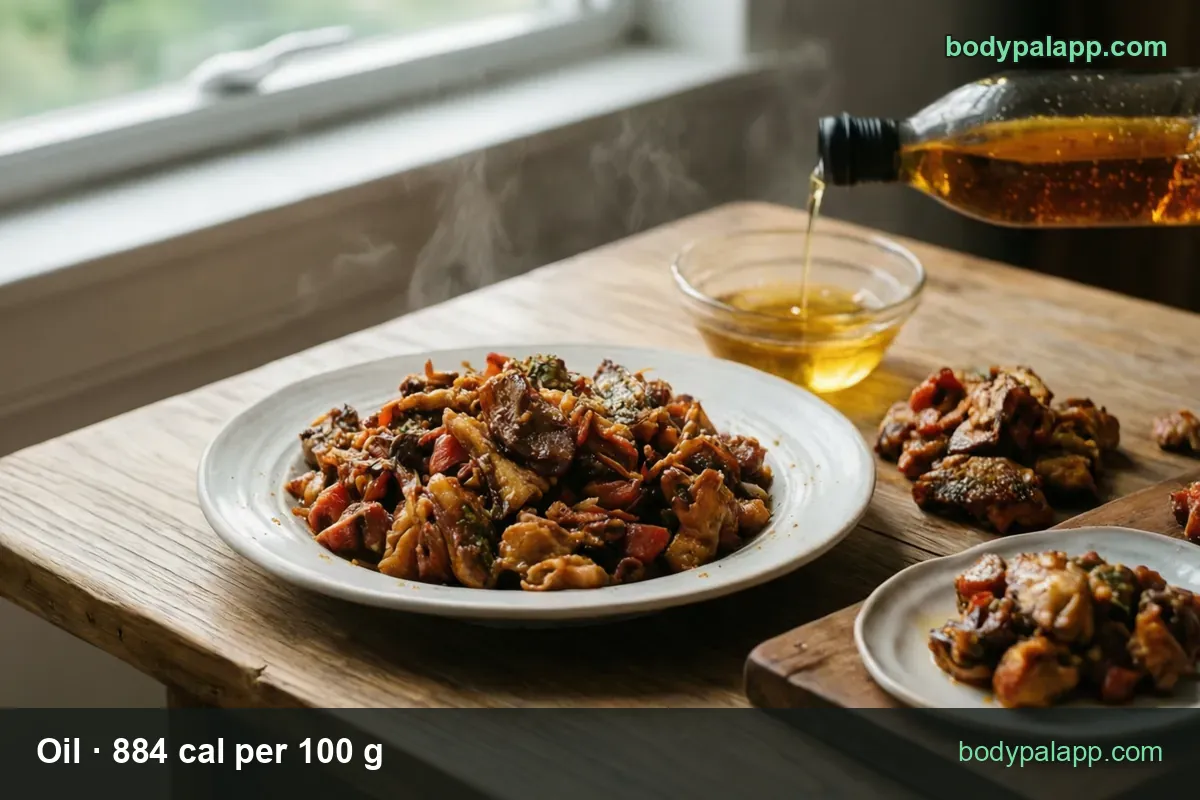
Read that table twice, because it is the whole story: seven bottled oils, and the spread from cheapest to dearest is 16 calories per 100 g. Five of the seven are identical at 884. Corn oil's 900 and coconut's 892 are rounding artifacts of how those SR Legacy editions were compiled, not evidence that corn oil is fattier — all of them are essentially 100 g of fat per 100 g.
The 4-calorie gap between canola's tablespoon and everyone else's is not the oil either. USDA weighs a tablespoon of canola at 14 g and a tablespoon of the others at 13.6 g. Same spoon, different rounding, and it is the only reason 124 and 120 are not the same number.
Bottle labels tell the same story in different units. USDA's Branded records put Chosen Foods 100% Pure Avocado Oil and De Cecco Extra Virgin Olive Oil at 130 calories per 1 Tbsp (15 ml) and Filippo Berio Extra Virgin Olive Oil at 120, all three scaled by us from those records' per-100 g figures — the labels measure a tablespoon by volume at 15 ml, which is a slightly bigger spoonful than USDA's 13.6 g, so the label number runs a touch high. Neither is wrong; they are counting different amounts of the same liquid.
"Vegetable oil" on a US shelf is usually refined soybean oil, which is the USDA record 172370 used above. Sesame oil is the outlier in use rather than in calories: it goes on at the end by the teaspoon, so a realistic serving is 40 calories, not 120.
Saturated fat is the only row that changes
Calories are flat across oils. Saturated fat is not, and that is where the choice actually lives.
One tablespoon of canola is 1.0 g of saturated fat — 5% of the Daily Value, against 18% of the fat DV for the same spoon. Olive oil is 13.81 g per 100 g, so its tablespoon is about 1.9 g, or 9%. Soybean oil lands near 10%, avocado around 8%.
Then there is coconut oil, at 82.47 g of saturated fat per 100 g. One tablespoon carries roughly 11.2 g — 56% of the 20 g Daily Value, more than eleven times the canola spoon, at 121 calories against canola's 124. The Dietary Guidelines for Americans recommend keeping saturated fat under 10% of daily calories, which is about 22 g on a 2,000-calorie day. Two tablespoons of coconut oil clears it.
The cup is worth the same look: 218 g of canola is 16.1 g of saturated fat, 80% of the DV, and 279% of the fat DV. If you're watching saturated fat, the oil you cook with is a bigger lever than most people's cheese habit — and MyPlate's guidance on oils treats them as a separate budget for exactly that reason.
How does oil compare?
| Oil | Per 100 g | US serving | Calories |
|---|---|---|---|
| Canola oil | 884 kcal | 1 tbsp, 14 g | 124 kcal |
| Olive oil | 884 kcal | 1 tbsp, 13.6 g | 120 kcal |
| Coconut oil | 892 kcal | 1 tbsp, 13.6 g | 121 kcal |
| Corn oil | 900 kcal | 1 tbsp, 13.6 g | 122 kcal |
Our take: stop shopping for a lighter oil, because there isn't one. Every bottle in the aisle is within 2% of the next on calories, so the only number you control is how much leaves the bottle — a measured teaspoon instead of a free pour saves 84 calories every time you cook. For everyday heat, canola is the cheapest way to keep saturated fat at 5% of the DV per spoon; olive oil is worth its 9% for what it tastes like on a salad or in a pan of vegetables. Coconut oil is the one to spend deliberately: same calories, 56% of your saturated-fat day in a single tablespoon.
Most popular oil brands in the United States
Ranked by how widely each product appears among foods sold in the United States, from the BodyPal food database of over 3.3 million products. Calories are the figures printed on each Nutrition Facts label, checked against USDA FoodData Central.
| Product | Calories (per 100 g) |
|---|---|
| Chosen Foods 100% Pure Avocado Oil | 867 cal |
| Chosen Foods Virgin Avocado Oil | 929 cal |
| De Cecco Extra Virgin Olive Oil | 867 cal |
| Filippo Berio Extra Virgin Olive Oil | 800 cal |
Brand popularity: BodyPal food database. Nutrition: manufacturer labels / USDA FoodData Central.
Oil FAQs
How many calories are in 1 tablespoon of oil?
A tablespoon of canola oil weighs 14 g and carries 124 calories, all of them from fat. Olive, vegetable, sesame and avocado oil are the same 884 calories per 100 g; USDA measures their tablespoon at 13.6 g, which brings them in at 120. The bottle you pick changes almost nothing.
How many calories are in a teaspoon of oil?
A teaspoon of oil is 40 calories at 4.5 g, which is USDA's own household weight for canola. That is 4.5 g of fat, about 6% of the 78 g Daily Value, and no carbohydrate, protein or sodium at all. Three teaspoons make a tablespoon, so the numbers stack quickly when you free-pour.
How many calories are in a cup of oil?
A cup of oil is 1,927 calories at 218 g, the biggest single number on this page. That is 218 g of fat, 279% of the 78 g Daily Value, and 16.1 g of saturated fat, or 80% of that DV. Recipes calling for a cup are adding more energy than most dinners.
Which cooking oil has the fewest calories?
884 calories per 100 g is the floor, and canola, olive, vegetable (soybean), sesame and avocado oil all sit there. Coconut is 892 and corn 900, differences too small to matter in a recipe. Nothing you pour is a light oil; the only real lever is how much lands in the pan.
Does olive oil have fewer calories than vegetable oil?
No — both are 884 calories per 100 g and 120 per USDA tablespoon of 13.6 g. What changes is the fat type: olive oil carries 13.81 g of saturated fat per 100 g, refined soybean oil 15.25 g. Choose between them on flavor and smoke point, because the calories are identical.
Is coconut oil higher in calories than canola oil?
Coconut oil is 892 calories per 100 g against canola's 884, a difference of eight calories nobody will notice. Saturated fat is the real gap: 82.47 g per 100 g in coconut versus 7.37 g in canola, so one tablespoon is about 56% of the Daily Value instead of 5%.
Do cooking sprays have fewer calories than poured oil?
USDA lists PAM original cooking spray at 792 calories per 100 g, below poured oil's 884, because 20.69 g per 100 g is carrier rather than fat. That record carries no gram weight for a single press, so we can't cost one spray honestly, but a short mist is far less oil than a poured tablespoon.
Does oil have any carbs or protein?
Zero — the canola record lists 0 g carbohydrate, 0 g fiber, 0 g sugar, 0 g protein and 0 mg sodium. Oil is 100 g of fat per 100 g, which is exactly why it reaches 884 calories per 100 g. Cholesterol is 0 mg as well, since plant oils carry none.
Similar foods
- Avocado Oil — 124 cal per tablespoon
- Bacon Fat (Bacon Grease) — 39 cal per teaspoon
- Bacon Grease — 39 cal per teaspoon
- Corn Oil — 122 cal per tablespoon
- Vegetable Oil — 126 cal per tablespoon
- Butter Spray — 2 cal per spray
Count it without the math
Point the camera at the pan and BodyPal counts the oil along with everything else in it.


How long does it take to burn off oil?
One tablespoon (14 g) is 124 kcal. Enter your weight and the amount you ate to see how long it takes you to burn that off:
lb
| Activity | Time to burn 124 kcal |
|---|---|
| Walking, brisk | 25 min |
| Cycling, moderate | 16 min |
| Swimming, moderate | 18 min |
| Jogging | 15 min |
| Weight training, moderate | 28 min |
Times are for a 155 lb adult at a steady pace; change the weight to see yours. The amount is set to the portion in the text (14 g); change it to what you actually ate. BodyPal works this out from your steps automatically.
One food is easy to picture; a whole day is harder. See how many calories you need a day and what a deficit actually looks like.