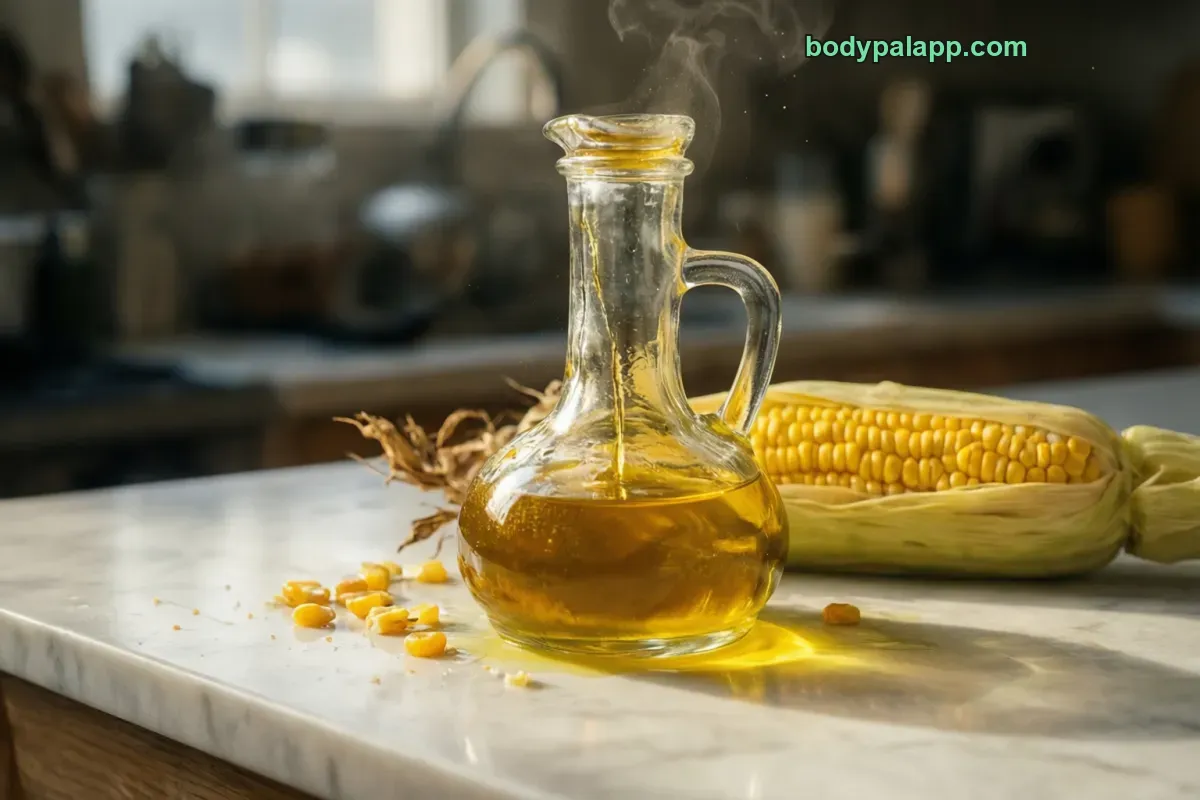
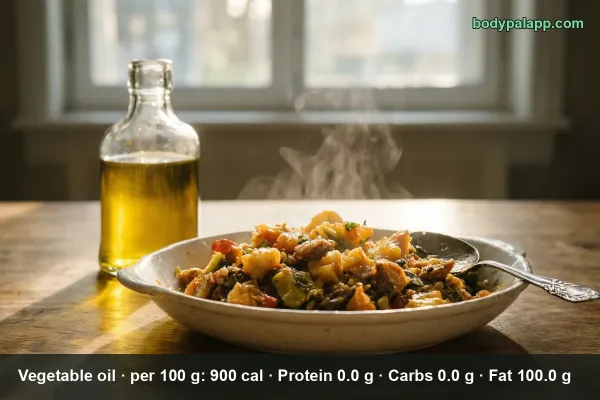
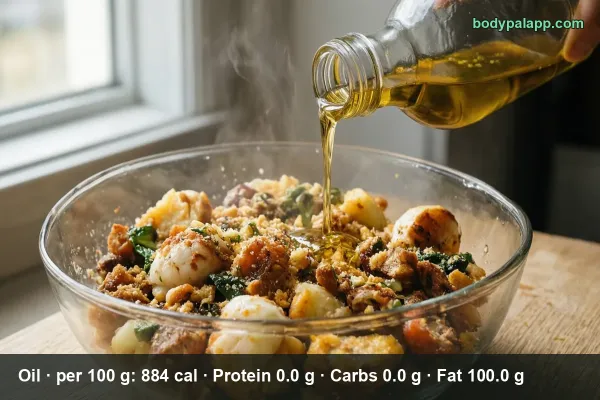
Corn oil calories come to 122 for one tablespoon (13.6 g) and 900 per 100 g. The number to notice is the split: 100% of those calories come from fat, with zero protein, carbs, sugar or sodium. That means the size of your pour decides everything, and a free pour can easily double or triple the total.
122kcal
1 tablespoon · 13 g, all purpose, salad or cooking
0%protein
0 gProtein
0 gCarbs
13.6 gFat
How to burn off 122 kcal
—Walking, brisk
—Jogging
—Cycling, moderate
—Swimming
Skip the math. BodyPal counts these calories from your steps and workouts automatically.
Nutrition facts
All purpose, salad or cooking · per 13 g
Calories
122 kcal
Protein
0 g
Carbohydrate
0 g
Fat
13.6 g
Saturated fat
1.8 g
Cholesterol
0 mg
Sodium
0 mg
Potassium
0 mg
Iron
0 mg
Source: USDA FoodData Central
🛡️
Verified nutrition data
Numbers on this page come from USDA FoodData Central, the U.S. Department of Agriculture’s food composition database, and from manufacturer labels where a branded product is named. Last verified September 2026. How we verify our data →
Corn oil: calories, protein and sodium by serving
Percent of daily value uses the FDA reference of 2,000 kcal a day.
Serving
kcal
Protein
Carbs
Fat
Sodium
% DV kcal
1 tablespoon (13.6 g)
122
0 g
0 g
13.6 g
0 mg
6%
1 teaspoon (4.5 g)
41
0 g
0 g
4.5 g
0 mg
2%
1 cup (218 g)
1,962
0 g
0 g
218 g
0 mg
98%
100 g
900
0 g
0 g
100 g
0 mg
45%
3 × 1 tablespoon (13.6 g)
367
0 g
0 mg
5 × 1 tablespoon (13.6 g)
612
0 g
0 mg
One tablespoon is 122 calories, and pours add up fast
A tablespoon of corn oil weighs 13.6 g and carries 122 calories, about 6% of a daily value. A teaspoon, at 4.5 g, is 41 calories. Those are measured amounts. The catch is that few people measure oil; most pour it straight from the bottle into a hot pan.
Watch how the total moves. Two tablespoons, roughly 27 g, reach 245 calories. Three tablespoons, about 41 g, come to 367. Five tablespoons, around 68 g, land at 612, which is more than many full meals. A loose pour for a stir-fry or a tray of roasted vegetables can fall in that range without anyone noticing.
At the extreme, a full cup (218 g) holds 1,962 calories, or 98% of a daily value. Nobody eats that in one sitting, but it shows how dense a bottle of oil really is. If you track intake, a measuring spoon does more for accuracy than any other habit. Weighing the bottle before and after cooking works too, and it catches the drizzle you add at the end.
Every calorie in corn oil is fat
Corn oil is pure fat. Per 100 g it has 100 g of fat, 0 g of protein, 0 g of carbs and 0 g of sugar. The calorie split reads 100% fat. Fiber and cholesterol are both 0 as well.
That makes the label simple and the math unforgiving. Nothing in the oil adds the kind of fullness that protein or fiber brings, so the calories arrive without adding bulk to the plate. One tablespoon delivers 13.6 g of fat, a real share of the 78 g daily value for fat. Two or three spoonfuls and the oil alone becomes a major fat source for the day.
None of this makes corn oil a bad ingredient. Fat carries flavor, browns food and helps a dressing cling to greens. The point is to treat it as a measured ingredient instead of a background one, and to count it every time it touches the pan. Most logging errors with oil come from forgetting it, not from misreading it.
Saturated fat is the only row worth watching
With sodium, sugar and cholesterol all at 0, the row that deserves a look is saturated fat. Corn oil has 12.9 g per 100 g, measured against a daily value of 20 g. The rest of its fat comes from other fat types, which this page's data does not break down.
At normal portions this is a modest number. A tablespoon is a small slice of 100 g, so the saturated fat in one spoonful stays small. It grows with the pour, exactly like the calories do. If you watch saturated fat, the same habit that controls calories, measuring, controls this row too.
Sodium reads 0 mg in every serving, and potassium is 0 as well. Any salt in a dish cooked with corn oil comes from what you add, not from the oil itself. That makes corn oil easy to fit into a lower-sodium day, as long as the seasoning stays in check.
Let a little oil carry a lot of food
Because corn oil brings only fat, the rest of the plate should supply what it lacks. Pair it with foods that add protein and fiber: beans, lean meat, fish, eggs, whole grains and plenty of vegetables. A teaspoon of oil spread across a big pan of vegetables does far more work than a tablespoon pooled under a small piece of chicken.
Technique matters as much as the bottle. Brushing oil onto food, tossing vegetables in a bowl before roasting, or using a nonstick pan all cut the amount you need. For dressings, whisking oil with vinegar, mustard or citrus stretches it further. Store brands such as Market Pantry sell the same kind of oil as Mazola, so pick by price, not by calories.
If logging every spoonful feels tedious, BodyPal can log a dish from a photo, but add the oil you cooked with, since it rarely shows up on camera. Counting it once at the stove is easier than guessing later.
How does corn oil compare?
Here is corn oil next to vegetable oil, generic oil and avocado oil, compared per 100 g and per usual serving.
Verdict: On calories there is no real winner: corn oil and vegetable oil both list 900 per 100 g, generic oil and avocado oil list 884, and every one is 100 g of fat. Choose by flavor and cooking use, and for weight loss focus on the spoon, since a 1 tbsp (14 g) pour of avocado oil is 124 calories against 122 for a tablespoon of corn oil.
Most popular corn oil brands in the United States
Ranked by popularity in the BodyPal database
# Productkcal / 100 g
1Mazola Corn Oil1 tbsp · 14 g857 kcal
2Giant Eagle Corn Oil1 tbsp · 14 g857 kcal
3Best Choice Corn Oil1 tbsp · 14 g857 kcal
4Foodtown Corn Oil1 tbsp · 14 g857 kcal
5Market Pantry Corn Oil1 tbsp · 14 g857 kcal
6Medeiros Corn Oil1 tbsp · 15 ml800 kcal
Labels build their per 100 g figure from a rounded tablespoon value, so most bottles read 857 calories per 100 g instead of 900. Source: manufacturer labels / USDA FoodData Central.
Corn oil FAQs
How many calories are in a tablespoon of corn oil?
About 122 calories in one tablespoon (13.6 g). A teaspoon is 41 calories and a full cup (218 g) is 1,962.
Is corn oil good for weight loss?
Corn oil is 900 calories per 100 g, the densest kind of food there is, so each tablespoon adds 122 calories to a dish with no protein, carbs or fiber.
Corn oil vs vegetable oil: which has more calories?
They match: both are 900 calories per 100 g and 100 g of fat, so a tablespoon of either is about 122 calories.
How much fat is in corn oil?
Corn oil is 100 percent fat: 100 g of fat per 100 g, of which 12.9 g is saturated. One tablespoon holds 13.6 g of fat and 1.8 g saturated.
How many calories are in a teaspoon of corn oil?
A teaspoon of corn oil (4.5 g) has 41 calories, all from 4.5 g of fat. That is about 2% of a daily calorie value, which makes the teaspoon the easiest way to keep oil in check.
How many calories are in 100 g of corn oil?
100 g of corn oil has 900 calories and 100 g of fat. That covers about 45% of a daily calorie value, with 0 g of protein, carbs, sugar and sodium.
How many calories are in a cup of corn oil?
A cup of corn oil (218 g) has 1,962 calories, or 98% of a daily value. That amount matters mostly for baking and frying, where a recipe's oil gets split across many servings.
Does corn oil have carbs, protein or sodium?
No. Corn oil has 0 g of carbs, 0 g of protein and 0 mg of sodium per 100 g. Its 900 calories per 100 g come entirely from fat.
How much saturated fat is in corn oil?
Corn oil has 12.9 g of saturated fat per 100 g, against a daily value of 20 g. At a single tablespoon the amount is small, but it climbs with every extra spoonful.