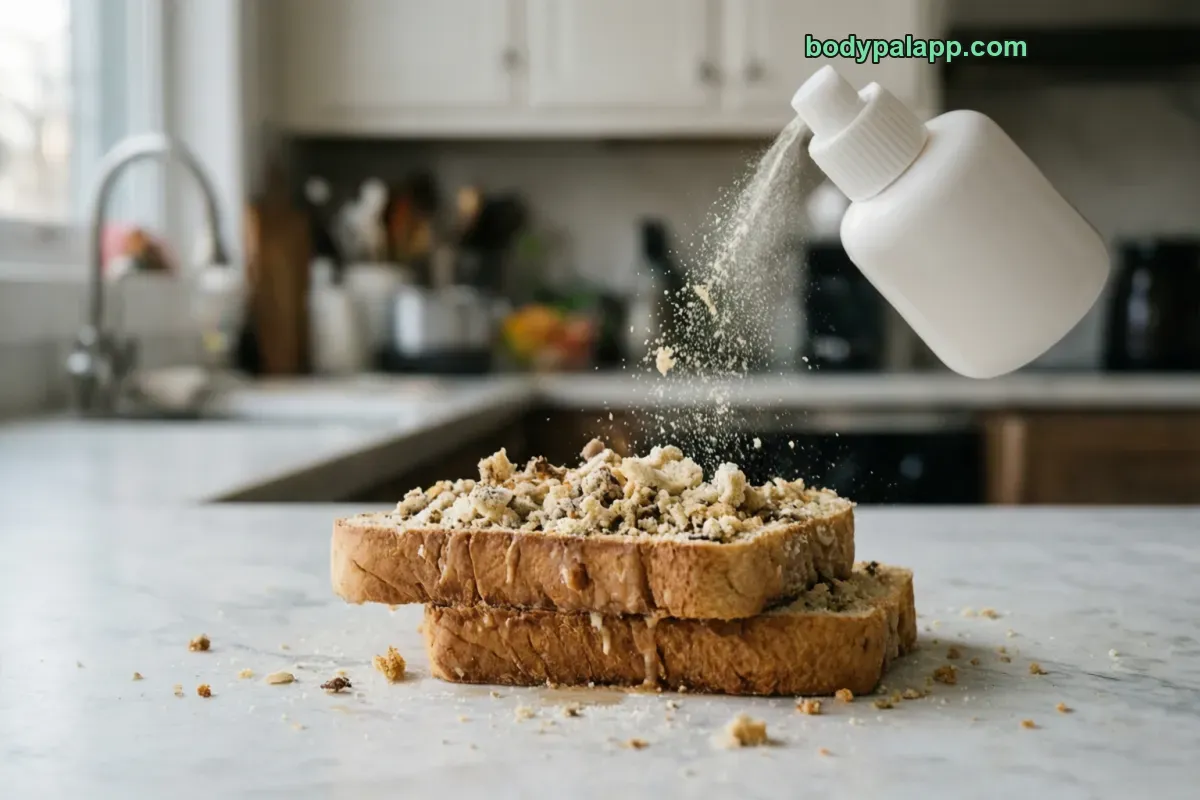
Butter spray calories come to 2 for one spray (0.3 g) and 792 per 100 g. That gap explains the whole product. The spray is nearly pure fat, with 89% of its calories coming from fat, so the total stays tiny only while each spray stays short. Long sprays add up.
2kcal
1 spray · 0 g, butter flavor cooking spray
0%protein
0 gProtein
0 gCarbs
0.2 gFat
How to burn off 2 kcal
—Walking, brisk
—Jogging
—Cycling, moderate
—Swimming
Skip the math. BodyPal counts these calories from your steps and workouts automatically.
Nutrition facts
Butter flavor cooking spray · per 0 g
Calories
2 kcal
Protein
0 g
Carbohydrate
0.1 g
Fat
0.2 g
Saturated fat
0 g
Cholesterol
0 mg
Sodium
0 mg
Potassium
0 mg
Iron
0 mg
Source: USDA FoodData Central
🛡️
Verified nutrition data
Numbers on this page come from USDA FoodData Central, the U.S. Department of Agriculture’s food composition database, and from manufacturer labels where a branded product is named. Last verified September 2026. How we verify our data →
Butter spray: calories, protein and sodium by serving
Percent of daily value uses the FDA reference of 2,000 kcal a day.
Serving
kcal
Protein
Carbs
Fat
Sodium
% DV kcal
1 spray (0.3 g)
2
0 g
0.1 g
0.2 g
0 mg
0%
100 g
792
0.3 g
20.7 g
78.7 g
59 mg
40%
3 × 1 spray (0.3 g)
7
0 g
1 mg
5 × 1 spray (0.3 g)
12
0 g
1 mg
Five sprays still come in at 12 calories
The label serving is one quick spray of 0.3 g, and that delivers 2 calories, 0.2 g of fat and no measurable sodium. Its share of the daily value rounds to 0% for calories, sodium and protein. On paper, that is about as close to nothing as a cooking fat gets.
Real pans rarely get one spray. Two sprays weigh about 1 g and bring 5 calories. Three sprays are 7 calories with 1 mg of sodium. Five sprays, a fair coat for a large skillet or a tray of roasted vegetables, still total only 12 calories and about 2 g of product.
So the count moves slowly as long as you count sprays rather than seconds. A thin mist over eggs or toast barely registers in a day of eating. The number only jumps when the nozzle is held down and the spray turns into a pour, which is where the next sections come in.
Fat is 89% of every calorie
Strip away the tiny serving and butter spray looks like any other oil. Per 100 g it carries 792 calories, 78.7 g of fat, 20.7 g of carbs and just 0.3 g of protein. The calorie split is 89% fat, 10% carbs and 0% protein. That is the profile of a cooking oil with a butter flavor, which matches the USDA row it is based on: an original cooking spray.
Saturated fat is lower than the butter name suggests, at 5 g per 100 g against a daily value of 20 g. Sugars, fiber, cholesterol and potassium all read 0. There is nothing here that adds protein, fiber or micronutrients to a meal; the spray exists to stop food sticking and to add a buttery note.
The useful way to read these numbers is backwards. Because the product is so dense, 100 g would be 40% of a 2,000 calorie daily value. Nobody sprays 100 g, but the figure shows how quickly the total would climb if the can were treated like a free food.
The long spray is the row to watch
The tiny per-spray number depends on a tiny spray. The 0.3 g serving assumes a short burst. Hold the button for several seconds over a big pan and you are dispensing many servings at once, each carrying the same fat-heavy profile of 792 calories per 100 g. The calories are real; the label just slices them thin.
Sodium is not the issue. Even at 100 g the spray has 59 mg of sodium, only 3% of the 2,300 mg daily value, and a single spray shows 0 mg. Sugar is 0 as well. The only number that matters is how much leaves the can.
If you log food closely, count sprays rather than guessing, and log five sprays as 12 calories instead of zero. That keeps the record honest without making the spray a problem. If you would rather skip the counting, BodyPal can log the food from a photo of your plate.
Use it as a coating, not an ingredient
Butter spray earns its place where you need a thin film of fat and little else: eggs in a nonstick pan, a sheet of vegetables before roasting, popcorn, a waffle iron, a muffin tin. In those jobs a few sprays do the work that a spoonful of fat would otherwise do, and the total stays in single or low double digits.
It is a weaker swap where fat is part of the flavor and texture, such as baking or sauces. There you need weight, not mist, and the spray is still roughly 89% fat calories once you use enough of it. Measuring a real fat in those cases gives a clearer count than emptying a can.
Because the spray adds no protein or fiber, it does nothing to make a meal more filling. Pair it with foods that do: eggs, lean meat, beans or vegetables. The spray handles the pan; the rest of the plate handles hunger.
How does butter spray compare?
Here is how butter spray stacks up against other fats and fat-rich pantry foods, per 100 g and per usual serving.
Verdict: Gram for gram, butter spray at 792 calories per 100 g is denser than almond flour at 607, butter cake at 353 or avocado spread at 160, but its 2-calorie serving is far smaller than avocado spread's 80 or butter cake's 215. For greasing a pan pick the spray; for a spread that adds fiber and some protein pick avocado spread, and log it as a real serving.
Butter spray FAQs
How many calories are in butter spray?
One spray is about 2 calories, since a one-third second spray weighs 0.3 g and the oil measures 792 calories per 100 g.
Does butter spray really have 0 calories?
The branded butter sprays list 0 calories per spray on the label, while the oil itself is 792 calories per 100 g, or about 2 calories per 0.3 g spray.
Is butter spray good for weight loss?
Ten sprays come to 24 calories in total, compared with 792 calories in 100 g of the same oil.
How much fat is in butter spray?
100 g has 78.7 g fat, including 5 g saturated fat; a single 0.3 g spray has about 0.2 g fat.
How many calories are in five sprays of butter spray?
Five sprays of butter spray come to 12 calories and about 2 g of product, with 1 mg of sodium. That is still small, but it is not zero, so log it if you track closely.
How many calories are in 100 g of butter spray?
100 g of butter spray has 792 calories, 78.7 g of fat and 20.7 g of carbs. That equals 40% of a 2,000 calorie daily value, which shows how dense the product is.
Does butter spray have sodium?
A single spray shows 0 mg of sodium, and 100 g holds only 59 mg, or 3% of the daily value. Sodium is not a concern with butter spray at any realistic portion.
Is butter spray high in saturated fat?
Butter spray has 5 g of saturated fat per 100 g, against a daily value of 20 g. Per spray the amount is negligible, and the product has 0 mg of cholesterol.
Does butter spray have any protein or sugar?
Butter spray has 0.3 g of protein and 0 g of sugars per 100 g, and 0 g of protein per spray. Its calories are 89% fat and 10% carbs.