
How many calories are in quinoa?
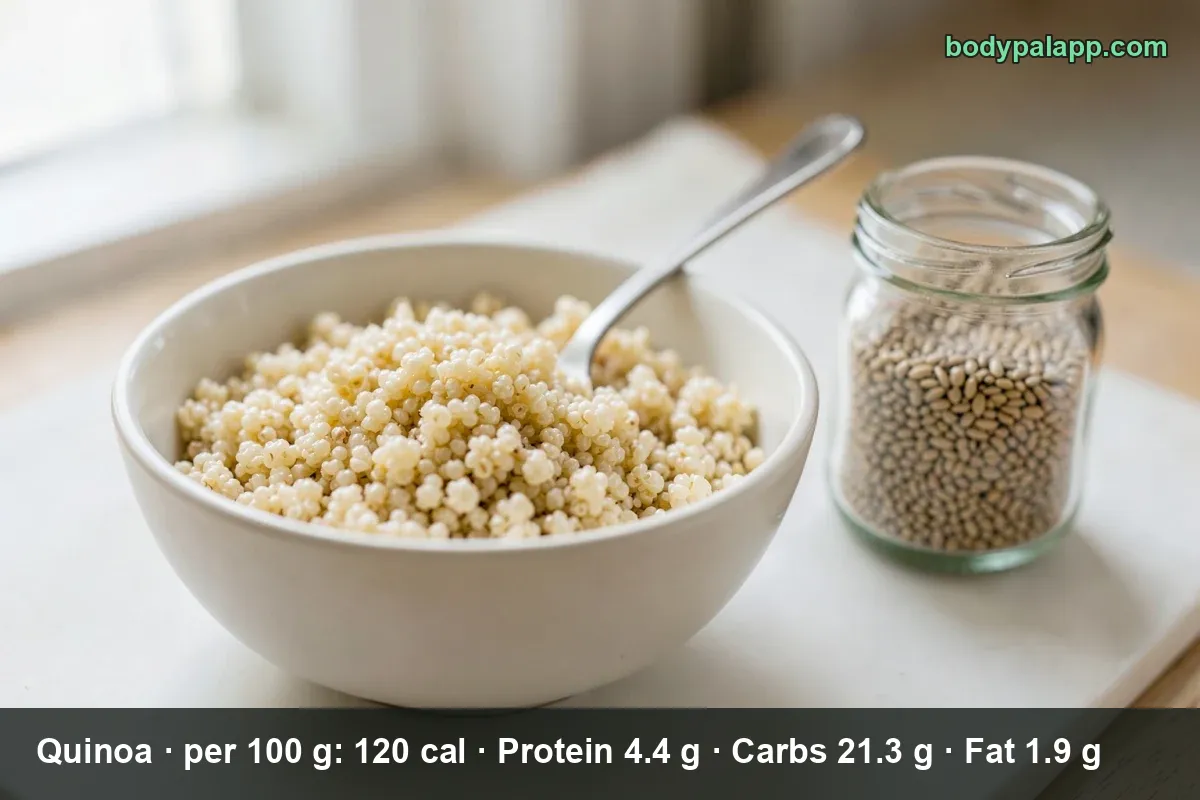
A 1-cup serving of cooked quinoa weighs 185 g and carries 222 calories. Per 100 g, cooked quinoa is 120 calories, lighter than most people expect from a grain bowl. The catch is water: the same quinoa measured dry, before it hits the pot, runs 368 calories per 100 g.
On this page
- Quinoa quick facts
- US servings from one ounce to a full cup
- Dry quinoa flour and quinoa pasta
- Fiber and protein are the rows to watch
- How does quinoa compare?
- Most popular quinoa brands
- Quinoa FAQs
Quinoa quick facts
The number people actually need is for quinoa that has already been cooked in plain water, because that is what lands in the bowl. That record is SR Legacy 168917, "Quinoa, cooked", and it is the only cooked quinoa entry that comes with a real US household measure attached: 1 cup at 185 g.
USDA carries other cooked quinoa records too, but they describe a pot with cooking salt and often fat in it, which pushes sodium from 7 mg per 100 g up to 163–184 mg. Those belong further down the page as variants, not in the headline row.
| Nutrient | Per 100 g | Per 1 cup cooked (185 g) | % Daily Value |
|---|---|---|---|
| Calories | 120 | 222 | — |
| Total fat | 1.92 g | 3.6 g | 5% |
| Saturated fat | 0.23 g | 0.4 g | 2% |
| Carbohydrate | 21.3 g | 39.4 g | 14% |
| Dietary fiber | 2.8 g | 5.2 g | 18% |
| Total sugars | 0.87 g | 1.6 g | — |
| Protein | 4.4 g | 8.1 g | 16% |
| Sodium | 7 mg | 13 mg | 1% |
% Daily Value is based on a 2,000-calorie diet.
Verified nutrition data
Numbers on this page come from USDA FoodData Central, the U.S. Department of Agriculture’s food composition database, and from manufacturer labels where a branded product is named. Last verified September 2026. How we verify our data →
Two rows you will see on a cereal box are missing here on purpose. USDA does not publish added sugars or trans fat for this SR Legacy record, so there is nothing honest to print. Cholesterol is a flat 0 mg, which is true of every plant grain, and potassium is worth a mention: 172 mg per 100 g, or 318 mg in the cooked cup, 7% of the Daily Value.
US servings from one ounce to a full cup
| Serving | Weight | Calories |
|---|---|---|
| 1 oz cooked | 28 g | 34 kcal |
| 1/2 cup cooked | 92.5 g | 111 kcal |
| 4 oz cooked | 113 g | 136 kcal |
| 1 cup cooked | 185 g | 222 kcal |
| Per 100 g | 100 g | 120 kcal |
Only the 1-cup line is a USDA household measure. The half cup, the ounce and the 4 oz row are our own arithmetic from the USDA 100 g figure, not USDA servings, scaled straight off 120 calories per 100 g.
Here is the trap worth knowing before you log anything. USDA describes a cooked cup of quinoa two ways: 185 g in the SR Legacy record and 170 g in the FNDDS records used for dietary surveys. The same three words, "one cup cooked," are therefore either 222 or 204 calories depending on which database your food app pulled from. An 18-calorie gap is nothing on one bowl and about 130 calories a week if quinoa is your everyday base.
A restaurant bowl muddies it further. A grain bowl at a chain like Chipotle arrives with oil in the grain, which is a different USDA record entirely, not the plain-water one above.
Dry quinoa flour and quinoa pasta
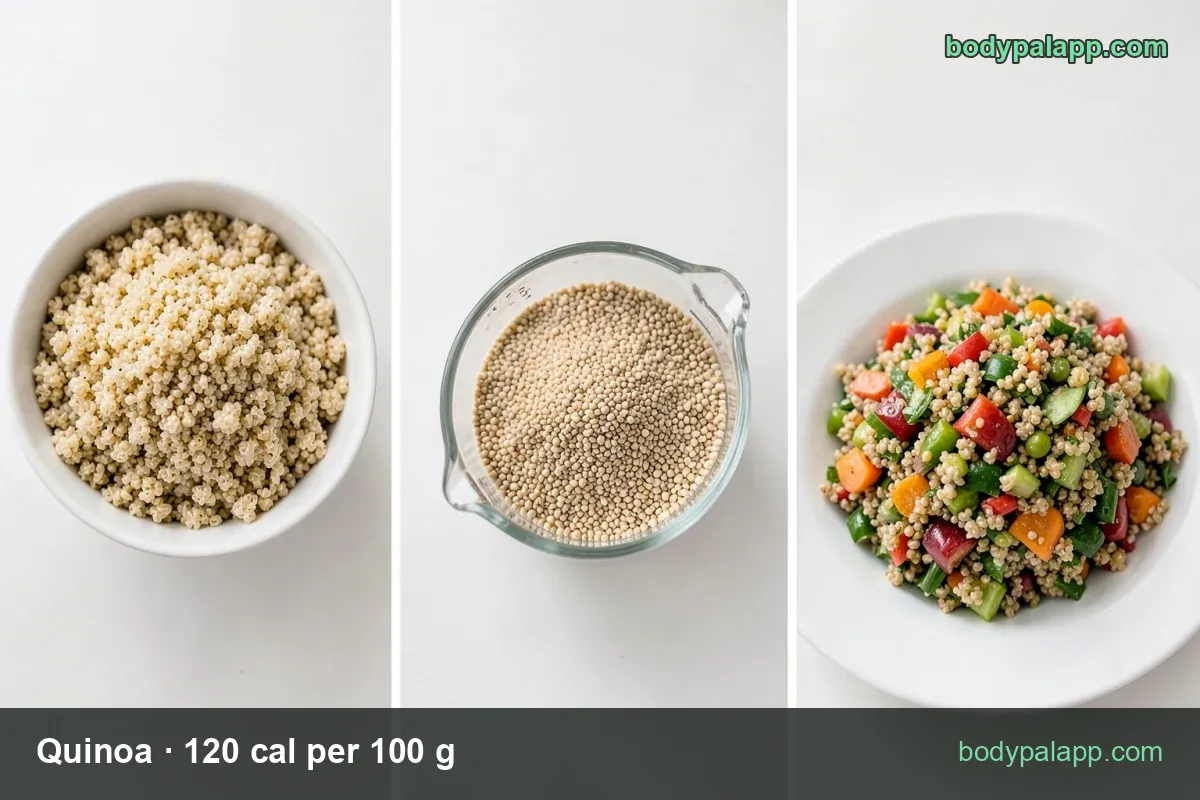
USDA holds seven quinoa records worth logging, six of them in the table below, and the spread between them is enormous, from 120 to 385 calories per 100 g. Nearly all of that spread is water, not ingredients.
| Version | Per 100 g | Typical portion | Calories |
|---|---|---|---|
| Cooked in plain water (main record) | 120 kcal | 1 cup cooked, 185 g | 222 kcal |
| Uncooked dry quinoa | 368 kcal | 1 cup dry, 170 g | 626 kcal |
| Cooked, no added fat | 120 kcal | 1 cup cooked, 170 g | 204 kcal |
| Cooked with added fat | 146 kcal | 1 cup cooked, 170 g | 248 kcal |
| Quinoa flour | 385 kcal | 100 g | 385 kcal |
| Quinoa pasta, corn and quinoa flour | 152 kcal | 1 cup spaghetti, 166 g | 252 kcal |
Dry versus cooked is the one distinction that decides whether your day adds up. A cup of dry quinoa is 626 calories; the cooked cup it turns into is 222. The grain roughly triples its weight in water, so measuring dry and logging cooked, or the reverse, is a several-hundred-calorie mistake in a single meal.
Cooking fat is the second lever. Plain water leaves quinoa at 120 calories per 100 g; a spoon of oil or butter in the pot moves the USDA record to 146, and a 170 g cup from 204 to 248. USDA also files a "not specified as to fat" record that carries the same 146 figure, which is a fair default if you ate quinoa someone else cooked.
Quinoa flour is the outlier at 385 calories per 100 g, slightly above dry grain, and its energy is calculated by the older Atwater method rather than measured, so treat it as close rather than exact. Quinoa pasta, blended with corn flour, lands at 152 calories per 100 g cooked, higher than cooked quinoa itself because pasta holds less water than a boiled grain.
Retail boxes are a category of their own. Roland White Quinoa lists 160 calories per quarter-cup dry serving and Wegmans Organic White Quinoa 170, while Near East's quinoa and brown rice blends run 200 to 250 per labeled serving. Every one of those numbers is for dry grain: 45 g dry is about 166 calories, our own arithmetic from the USDA 368 per 100 g figure, and cooks up to roughly three-quarters of a cup on the plate.
Fiber and protein are the rows to watch
For a 222-calorie serving, the cooked cup does unusual work on two lines of the label. Fiber comes in at 5.2 g, 18% of the 28 g Daily Value the FDA sets, and protein at 8.1 g, 16% of the 50 g value. Two quinoa cups across a day would cover more than a third of the fiber target on their own.
Quinoa is also a whole grain, and the Dietary Guidelines for Americans ask for at least half of grain servings to be whole. MyPlate counts a half cup of cooked quinoa as one ounce-equivalent from the grains group, so the 185 g cup is roughly two of them.
Sodium is where the record you choose matters most. Cooked in plain water, a cup is 13 mg, a rounding error at 1% of the Daily Value. Simmer the same quinoa in salted water and the USDA record reads 163 mg per 100 g, which works out to about 277 mg in a 170 g cup, 12% of the Daily Value, again our own arithmetic from the 100 g figure. That is roughly an eighth of a teaspoon of table salt, and if you are watching sodium it is the single change that matters here.
How does quinoa compare?
| Grain | Per 100 g | US serving | Calories |
|---|---|---|---|
| Quinoa, cooked | 120 kcal | 1 cup cooked, 185 g | 222 kcal |
| Pasta, cooked | 157 kcal | 100 g | 157 kcal |
| Barley, cooked | 139 kcal | 100 g | 139 kcal |
| Millet, cooked | 118 kcal | 100 g | 118 kcal |
Our take: of these four, only millet is lighter per 100 g, and by two calories, which is noise. If your goal is cutting calories, swapping a pasta base for quinoa saves 37 calories per 100 g at the same volume on the plate, and the fiber and protein come along free. If your goal is staying full through the afternoon, quinoa wins outright: 4.4 g of protein and 2.8 g of fiber per 100 g against 2.2 g of protein in barley and 3.5 g in millet. The only reason to weigh quinoa carefully is the dry measure, which is three times as concentrated and easy to log wrong.
Most popular quinoa brands in the United States
Ranked by how widely each product appears among foods sold in the United States, from the BodyPal food database of over 3.3 million products. Calories are the figures printed on each Nutrition Facts label, checked against USDA FoodData Central.
| Product | Calories (per 100 g) |
|---|---|
| Roland White Quinoa | 356 cal |
| Roland Pre-Washed White Quinoa | 378 cal |
| Yoga Organics Organic Light Brown Rice Plus Quinoa | 378 cal |
| Near East Original Quinoa & Brown Rice Blend | 357 cal |
| Near East Zesty Lemon Quinoa & Brown Rice | 357 cal |
| Wegmans Organic White Quinoa | 378 cal |
Brand popularity: BodyPal food database. Nutrition: manufacturer labels / USDA FoodData Central.
Quinoa FAQs
How many calories are in 1 cup of cooked quinoa?
One cup of cooked quinoa weighs 185 g and carries 222 calories, working out to 120 calories per 100 g. That cup also brings 8.1 g of protein, 5.2 g of fiber and 39.4 g of carbohydrate. Cooking it in salted water or with oil changes the number.
How many calories are in 100 g of quinoa?
Cooked quinoa is 120 calories per 100 g, which is about half a cup plus a spoonful. Dry quinoa is 368 calories per 100 g, because the water has not gone in yet. Always check which state a nutrition label or app entry is describing before you log it.
How many calories are in uncooked quinoa?
Uncooked quinoa is 368 calories per 100 g, so a level 1-cup dry measure of 170 g is 626 calories. That is nearly three times the 222 calories in a cooked cup, because dry grain triples its weight in water. Most box labels use a 45 g dry quarter cup, about 166 calories.
Is quinoa high in protein?
A cooked cup gives 8.1 g of protein, 16% of the Daily Value, from only 222 calories. Per 100 g it is 4.4 g, which beats barley at 2.2 g and millet at 3.5 g in the USDA records. That is high for a grain, though it is still not a protein food the way meat or beans are.
How much fiber is in a cup of quinoa?
A 185 g cooked cup holds 5.2 g of fiber, 18% of the 28 g Daily Value, from 2.8 g per 100 g. Two cups across a day would cover more than a third of the daily target. Dry quinoa is denser still at 7 g per 100 g.
How many carbs are in quinoa?
A cooked cup carries 39.4 g of carbohydrate, 14% of the Daily Value, of which 5.2 g is fiber and only 1.6 g is sugar. Per 100 g that is 21.3 g. Dry quinoa is 64.16 g per 100 g, so measure before or after cooking consistently, never both.
Does cooked quinoa have sodium?
Barely, if you cook it in plain water: 7 mg per 100 g, or 13 mg in a 185 g cup, which is 1% of the Daily Value. Quinoa simmered in salted water is a different record at 163 mg per 100 g, and a 170 g cup of that runs about 277 mg.
Is quinoa good for weight loss?
At 120 calories per 100 g cooked, quinoa is lighter than cooked pasta at 157 and barley at 139, and a cup costs 222 calories. The fiber and protein help a bowl feel like a meal. Swapping a pasta base for quinoa saves calories at the same volume.
Similar foods
- Rice — 205 cal per cup, cooked
- Wild Rice — 166 cal per cup, cooked
- Pasta — 168 cal per cup penne
- Penne pasta — 169 cal per cup
- Milk — 149 cal per cup
- Baba ganoush — 110 cal for 1/4 cup
Count it without the math
Point the camera at the bowl and BodyPal counts the quinoa for you, cooked cup or dry scoop.


How long does it take to burn off quinoa?
A 1-cup (185 g) cooked serving is 222 kcal. Enter your weight and the amount you ate to see how long it takes you to burn that off:
lb
| Activity | Time to burn 222 kcal |
|---|---|
| Walking, brisk | 44 min |
| Cycling, moderate | 28 min |
| Swimming, moderate | 32 min |
| Jogging | 26 min |
| Weight training, moderate | 49 min |
Times are for a 155 lb adult at a steady pace; change the weight to see yours. The amount is set to the portion in the text (185 g); change it to what you actually ate. BodyPal works this out from your steps automatically.
Burning it off is one side of it. The other is knowing your number: work out how many calories you need a day, with macros and a goal date.