
How Many Calories Are in One Cup of Rice?
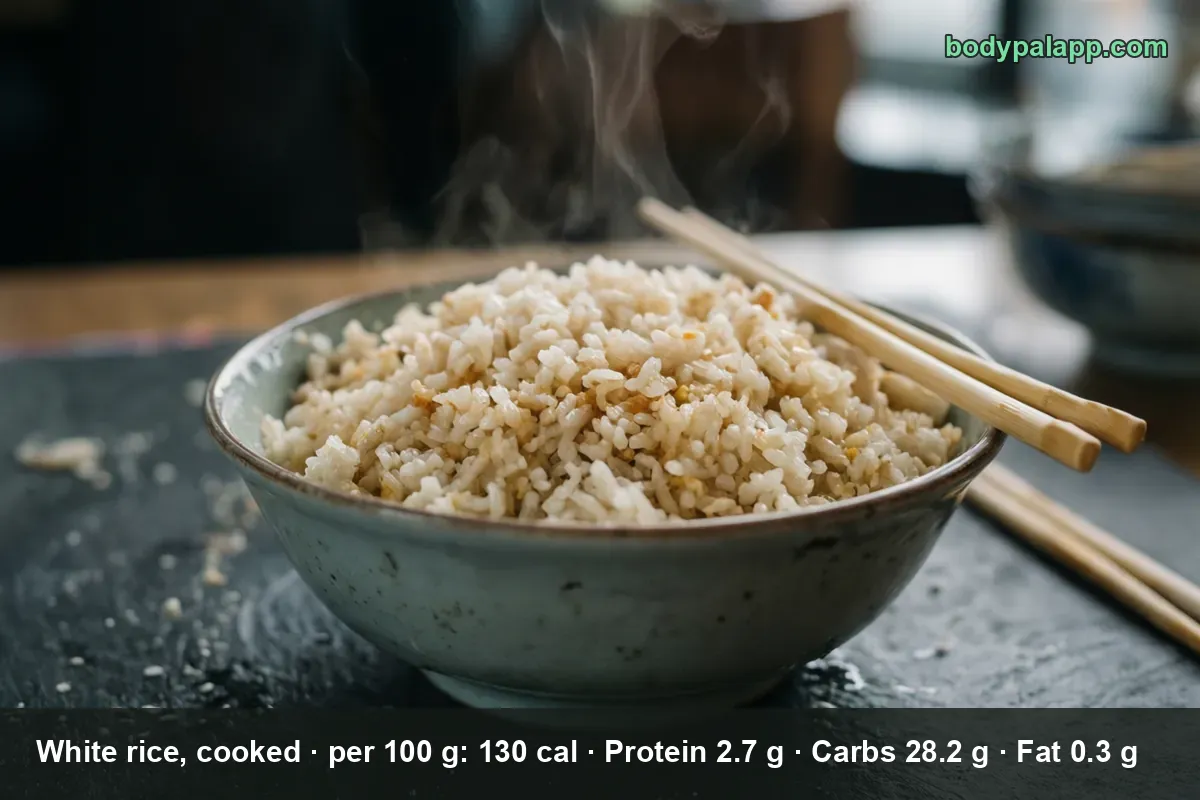
The calories in one cup of rice come to 205 for the American default: white long-grain, enriched, cooked without salt, 158 g sitting in the cup (USDA SR 168878). That same rice reads 130 calories per 100 g. Change the grain and the cup changes weight underneath you — brown rice packs 202 g into the identical measure and lands at 248.
On this page
- Rice quick facts
- A cup of rice is not one weight
- Serving sizes, dry and cooked
- The bag says 160, USDA says 205
- Brown rice costs more per cup, not less
- Jasmine, basmati and black rice
- Instant, parboiled and takeout rice
- Salt in the pot and the enrichment bonus
- How rice compares with other starches
- Most popular rice brands
- FAQ
Rice quick facts
The reference is the rice most American kitchens actually cook: white long-grain, enriched, simmered in unsalted water, then spooned into a standard dry measuring cup.
| Nutrient | Per 100 g | Per 1 cup cooked (158 g) | % Daily Value |
|---|---|---|---|
| Calories | 130 | 205 | — |
| Total fat | 0.3 g | 0.4 g | 1% |
| Saturated fat | 0.1 g | 0.1 g | 1% |
| Carbohydrate | 28.2 g | 44.5 g | 16% |
| Dietary fiber | 0.4 g | 0.6 g | 2% |
| Total sugars | 0.1 g | 0.1 g | — |
| Protein | 2.7 g | 4.3 g | 9% |
| Sodium | 1 mg | 2 mg | 0% |
% Daily Value is based on a 2,000-calorie diet.
Verified nutrition data
Numbers on this page come from USDA FoodData Central, the U.S. Department of Agriculture’s food composition database, and from manufacturer labels where a branded product is named. Last verified September 2026. How we verify our data →
Two lines are worth a second look, for opposite reasons. Sodium is 2 mg a cup — genuine zero, because this record is cooked in plain water, and every milligram you eventually log comes from your own hand on the salt box. Fiber is the weak spot: 0.6 g a cup, 2% of the day, which is the one thing brown rice really fixes.
The rest is close to pure starch. Total sugars are 0.1 g per 100 g, fat is 0.3 g, and there is no added sugar in the record at all, so that row does not belong on a plain rice label. What the cup does carry, thanks to a purely American rule, is 1.9 mg of iron and 92 µg of folate — more on that further down.
A cup of rice is not one weight
Here is the reason the internet answers this question with everything from 160 to 250. A measuring cup measures volume. USDA weighs what fits in it, record by record, and the weights are not close.
| Rice (USDA record) | Weight of 1 cup cooked | Calories, 100 g | Calories in the cup |
|---|---|---|---|
| Wild rice (SR 168897) | 164 g | 101 | 166 |
| Sticky or sushi rice (SR 169711) | 174 g | 97 | 169 |
| Steamed rice, Chinese restaurant (SR 169712) | 132 g, loosely packed | 151 | 199 |
| White, long-grain (SR 168878) | 158 g | 130 | 205 |
| Instant, prepared (SR 169710) | 165 g | 124 | 205 |
| White, medium- or short-grain (SR 168880 / 168882) | 186 g | 130 | 242 |
| Brown, long-grain (SR 169704) | 202 g | 123 | 248 |
| Fried rice (FNDDS 2708952) | 198 g | 174 | 345 |
Among the plain rices that is a spread of 82 calories between the lightest cup and the heaviest, and nothing on the plate looks different. Short-grain rice is the quiet one: identical to long-grain at 130 calories per 100 g, yet a cup of it is 186 g instead of 158, so the same scoop of the same calorie density is 37 calories heavier.
The two columns also disagree about who wins. Restaurant steamed rice is the densest plain entry at 151 calories per 100 g, yet its cup is one of the lightest, because it is served loose rather than pressed.
Serving sizes, dry and cooked
Cooked, from SR 168878 at 130 calories per 100 g:
| Serving | Weight | Calories |
|---|---|---|
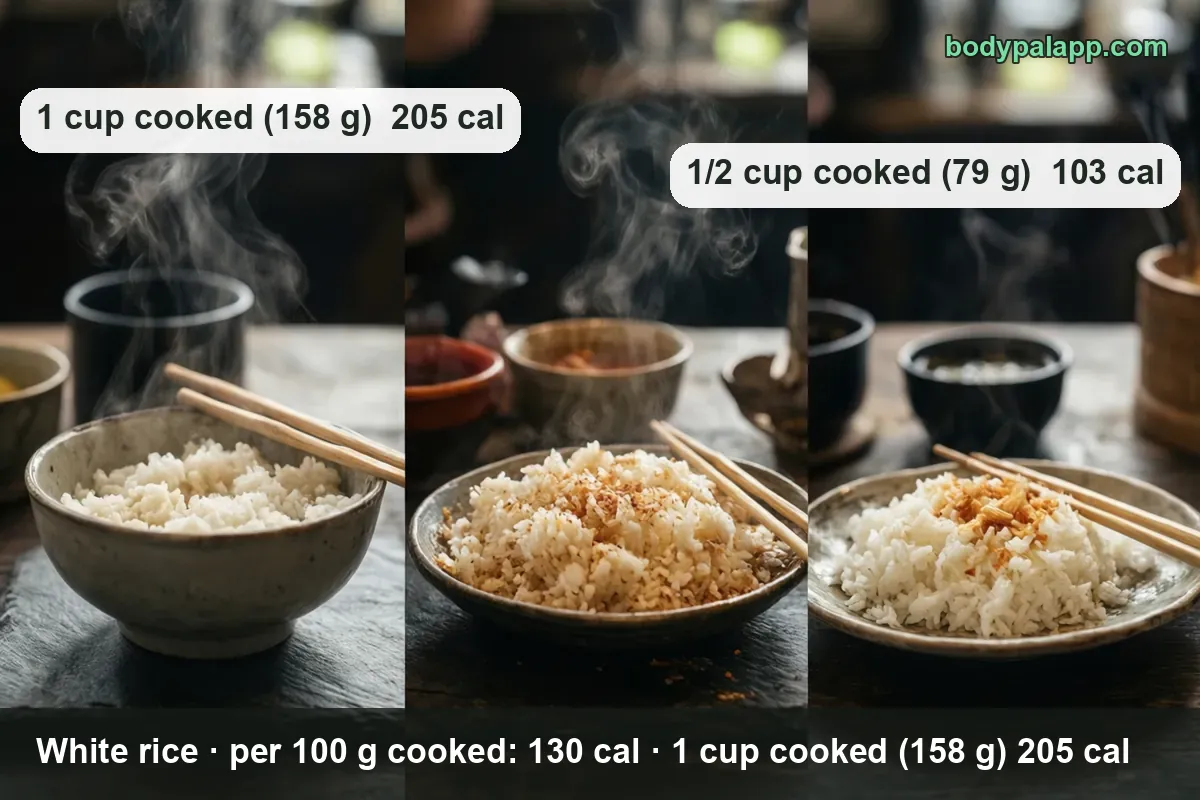
| 1 cup cooked | 158 g | 205 |
| ½ cup cooked | 79 g | 103 |
| ⅓ cup cooked | 52.7 g | 69 |
| ¼ cup cooked | 39.5 g | 51 |
| 1 oz cooked | 28.35 g | 37 |
| 100 g cooked | 100 g | 130 |
Dry, from SR 168877 at 365 calories per 100 g:
| Serving | Weight | Calories |
|---|---|---|
| 1 cup dry | 185 g | 675 |
| ½ cup dry | 92.5 g | 338 |
| ¼ cup dry (the serving on the bag) | 45 g | 164 |
| Rice cooker cup, 180 ml | 139 g | 506 |
| 1 oz dry | 28.35 g | 103 |
The rice cooker cup deserves its own line, because the little plastic scoop in the box is not a US cup. It holds 180 ml, three quarters of a 240 ml measure, so at the USDA density of 185 g per cup it carries 139 g of dry rice and 506 calories. You will also see 150 g quoted for that scoop; that figure comes from the Japanese market convention, not from USDA, and mixing the two sources would invent a number that describes neither.
Yield is the other thing worth pinning down. A cup of dry rice is 675 calories, and those calories do not change in the pot — only water moves. At the cooked density of 130 per 100 g, 675 calories works out to 519 g of cooked rice, or 3.3 cups. The familiar kitchen rule of "one cup dry makes three cups cooked" slightly undersells it: the grain nearly triples in weight and gains nothing in energy.
The bag says 160, USDA says 205
Every bag of American long-grain rice prints its serving as ¼ cup dry, 45 g, and then adds the helpful line "about 1 cup cooked". That serving is 160 calories on the label, and 164 by the USDA raw record. The USDA cooked record says a cup of rice is 158 g and 205 calories. Both are right, and together they cause more logging errors than any other pair of numbers on this page.
The arithmetic resolves it. Take 160 calories of cooked white rice at 130 per 100 g, and you get 123 g of rice — a cup that weighs about 125 g, not 158. Minute's ready-to-serve cup declares exactly that: 125 g, 200 calories. So the label's "cup" is a modest one, and USDA's is a full, well-filled dry measure.
The rule that keeps a diary honest is to pick your moment and stay there. Weighed the rice dry? Log 164 for a quarter cup. Measured the rice on your plate? Log 205 a cup. Do both in the same meal and you have counted the same grain twice.
Brown rice costs more per cup, not less
Per 100 g, brown rice is the lighter grain: 123 calories against 130 for white (SR 169704). Per cup, it is the heavier meal by a distance. Bigger, moister grains pack down harder, so the cup holds 202 g instead of 158, and 123 × 2.02 comes out at 248 calories — 43 more than white, from a switch most people make expecting the opposite.
The survey database agrees from a different direction: FNDDS record 2708414 puts a cup of cooked brown rice at 195 g and 240 calories. Two independent measurements, one conclusion.
Where brown rice earns its reputation is fiber. It carries 1.6 g per 100 g against 0.4 g in white, which is 3.2 g a cup, 12% of the Daily Value, against 0.6 g and 2%. A cup also brings 5.5 g of protein, 51.7 g of carbohydrate and 2.0 g of fat. MyPlate asks Americans to make half their grains whole, and this is the honest reason to do it — the fiber, not a calorie saving that does not exist.
Jasmine, basmati and black rice
This is where a lot of calorie pages start guessing, so here is what USDA actually holds: there is no cooked jasmine record and no cooked basmati record, not in SR Legacy, not in Foundation Foods, not in FNDDS. Zero matches across all three. Any site quoting a precise cooked number for either is quoting something else.
What does exist are dry labels, and they are unremarkable. Mahatma's Thai jasmine and its basmati both declare 356 calories per 100 g dry; USDA's generic raw long-grain is 365. Nine calories apart in 100 g of dry grain is not a difference you can taste, cook or count. Practically, a cup of cooked jasmine or basmati sits with plain white long-grain at roughly 205 calories, and the ¼ cup dry serving on the bag is 160.
Black rice is a firmer no. It has no record in any of the three databases, so this page will not print a figure for it. The closest thing USDA does measure is wild rice, another whole grain eaten the same way, at 101 calories per 100 g and 166 a cup.
Instant, parboiled and takeout rice
Instant rice is the surprise of the group. Prepared, SR 169710 is 124 calories per 100 g and its cup weighs 165 g, which comes to 205 calories — the stovetop number to the calorie. Dry is a different animal: instant rice is 380 calories per 100 g, but a dry cup of it weighs only 95 g because the pre-cooked grains are so airy, so a dry cup is 361 calories against 675 for regular dry rice.
Parboiled, or converted, rice comes in a little under: 123 calories per 100 g, a 158 g cup, 194 calories. Steamed white rice from a Chinese restaurant reads high at 151 per 100 g, and the reason is water rather than oil — fat is 0.27 g per 100 g. Because the cup is served loosely packed at 132 g, it works out at 199 calories, essentially what you would cook at home.
Fried rice is the real jump. FNDDS record 2708952 is 174 calories per 100 g and a cup weighs 198 g, so a cup of fried rice is 345 calories, 140 more than plain. The double hit is that oil raises the density and the add-ins pack the cup heavier. Meat barely moves it: with chicken a cup is 343, with shrimp 329. Sodium does move — 361 mg per 100 g means 715 mg a cup, 31% of the Daily Value. Spanish rice, the FNDDS record behind most Mexican-style sides, is gentler at 101 per 100 g, but its cup runs 243 g and lands at 245.
Salt in the pot and the enrichment bonus
Compare SR 168878 with SR 169753 and the two records are identical line by line — 130 calories, 2.69 g protein, 28.17 g carbohydrate — except in one place. Sodium goes from 1 mg per 100 g to 382 mg. On a cup that is 2 mg against 604 mg, or 26% of the Daily Value, which is roughly a quarter teaspoon of table salt dissolved into a side dish that started at zero.
That gap explains a number people often find confusing. FNDDS, which records what Americans actually eat rather than a laboratory recipe, lists plain cooked white rice at 245 mg of sodium per 100 g. It is not a contradiction; it is the survey assuming, correctly, that most cooks salt the water.
The other American-only line on this page is enrichment. White rice sold in the United States is enriched with iron, thiamin and folic acid, so SR 168878 shows 58 µg of folate and 1.20 mg of iron per 100 g — 92 µg of folate a cup, 23% of the Daily Value, plus 1.9 mg of iron at 11%. The unenriched version of the same rice, SR 169757, holds 4.7 µg of folate and 0.32 mg of iron in that cup, which is 1% and 2%. The NIH folate fact sheet explains why enriched grains carry so much of the American supply. All the percentages here follow the FDA Daily Values on a 2,000-calorie diet.
This is also the single nutrient where white beats brown. Brown rice is not enriched, and SR 169704 carries 9 µg of folate and 0.56 mg of iron per 100 g.
How rice compares with other starches
| Food (USDA record) | Per 100 g | US serving | Calories | Protein / carbs / fat |
|---|---|---|---|---|
| White rice, cooked (SR 168878) | 130 | 1 cup (158 g) | 205 | 4.3 / 44.5 / 0.4 |
| Brown rice, cooked (SR 169704) | 123 | 1 cup (202 g) | 248 | 5.5 / 51.7 / 2.0 |
| Quinoa, cooked (SR 168917) | 120 | 1 cup (185 g) | 222 | 8.1 / 39.4 / 3.6 |
| Pasta, cooked (SR 169737) | 158 | 1 cup spaghetti (124 g) | 196 | 7.2 / 38.3 / 1.2 |
| Baked potato with skin (SR 170093) | 93 | 1 medium (173 g) | 161 | 4.3 / 36.6 / 0.2 |
| White bread (SR 174924) | 266 | 1 slice (29 g) | 77 | 2.6 / 14.3 / 1.0 |
Our take: for the biggest plate per calorie, the baked potato wins outright at 93 per 100 g and 161 for a medium one, and it beats every grain here on volume for the money. For protein, quinoa is the pick — 8.1 g a cup for 222 calories, nearly double what white rice gives for a similar serving.
Rice sits in the middle and does one job better than the rest: it is the easiest of the six to portion the same way twice. Bread looks harmless in the calories column only because a slice weighs 29 g.
Most popular rice brands in the United States
Ranked by how widely each product appears among foods sold in the United States, from the BodyPal food database of over 3.3 million products. Calories are the figures printed on each Nutrition Facts label, checked against USDA FoodData Central.
| Product | Calories (per 100 g dry) |
|---|---|
| Mahatma Jasmine Long Grain Rice | 356 cal |
| Mahatma Naturally Fragrant Basmati Rice | 356 cal |
| Ben’s Original Enriched Parboiled Long Grain White Rice | 356 cal |
| Success Boil-in-Bag Precooked White Rice | 356 cal |
| Minute Light & Fluffy Enriched White Rice (instant) | 370 cal |
| Nishiki Premium Medium Grain Rice | 357 cal |
Brand popularity: BodyPal food database. Nutrition: manufacturer labels / USDA FoodData Central.
Rice FAQs
How many calories are in one cup of rice?
205 calories for one cup of cooked white long-grain rice, which USDA weighs at 158 g. Per 100 g that rice is 130 calories. The same cup filled with brown rice weighs 202 g and comes to 248 calories, so the grain you cook matters more than the scoop you use.
How many calories are in half a cup of rice?
103 calories for half a cup of cooked white rice, 79 g on the scale. A third of a cup is 69 calories and a quarter cup is 51. If you are portioning by ounce instead, one ounce of cooked rice is 37 calories.
How many calories are in a cup of brown rice?
248 calories, and the reason is weight rather than density. Brown rice is 123 calories per 100 g against 130 for white, but a cup of it holds 202 g instead of 158. It repays you in fiber: 3.2 g a cup, 12% of the Daily Value, against 0.6 g in white rice.
How many calories are in jasmine or basmati rice?
160 calories for the ¼ cup dry serving printed on the bag, which is the only figure USDA data supports. There is no cooked jasmine or basmati record in SR Legacy, Foundation Foods or FNDDS. Dry labels run 356 calories per 100 g against 365 for generic long-grain, so a cooked cup lands with plain white rice at about 205.
How many calories are in fried rice?
345 calories for a cup, using the FNDDS record at 174 calories per 100 g and a cup weight of 198 g. Chicken fried rice is 343 a cup and shrimp fried rice 329, so the oil rather than the meat drives the number. Sodium reaches 715 mg a cup, 31% of the Daily Value.
How many calories are in rice per 100 g?
130 calories per 100 g cooked and 365 per 100 g dry, for enriched white long-grain rice. The gap is water, not energy: 100 g of dry rice absorbs its way up to roughly 280 g on the plate. Brown rice is 123 cooked, and instant rice is 124 once prepared.
How many calories are in instant rice?
205 calories for a prepared cup, which weighs 165 g at 124 calories per 100 g — identical to stovetop rice. Dry is where it differs: instant rice is 380 calories per 100 g, but a dry cup weighs just 95 g, so it holds 361 calories against 675 for a dry cup of regular rice.
How many calories are in wild rice?
166 calories for a cup, at 101 calories per 100 g and a cup weight of 164 g. That makes it the lightest full cup of any rice USDA measures, with 4.0 g of protein and 1.8 g of fiber per 100 g. It is also the nearest measured stand-in for black rice, which has no USDA record.
Similar foods
- Quinoa — 222 cal per cup cooked
- Pasta — 168 cal per cup penne
- Penne pasta — 169 cal per cup
- Wild Rice — 166 cal per cup, cooked
- Baba ganoush — 110 cal for 1/4 cup
- Prosciutto — 55 cal for 3 thin slices
Skip the cup math
Point the camera at the bowl and BodyPal logs the rice at the weight it actually is, not the weight a measuring cup implies.


How long does it take to burn off one cup of rice?
One cup of cooked white long-grain rice (158 g) is 205 kcal. Enter your weight and the amount you ate to see how long it takes you to burn that off:
lb
| Activity | Time to burn 205 kcal |
|---|---|
| Walking, brisk | 41 min |
| Cycling, moderate | 26 min |
| Swimming, moderate | 29 min |
| Jogging | 24 min |
| Weight training, moderate | 46 min |
Times are for a 155 lb adult at a steady pace; change the weight to see yours. The amount is set to the portion in the text (158 g); change it to what you actually ate. BodyPal works this out from your steps automatically.
Want the bigger picture? Calculate your daily calorie needs — your maintenance figure, a target for losing or gaining, and the date you get there.