
How many calories are in penne pasta?
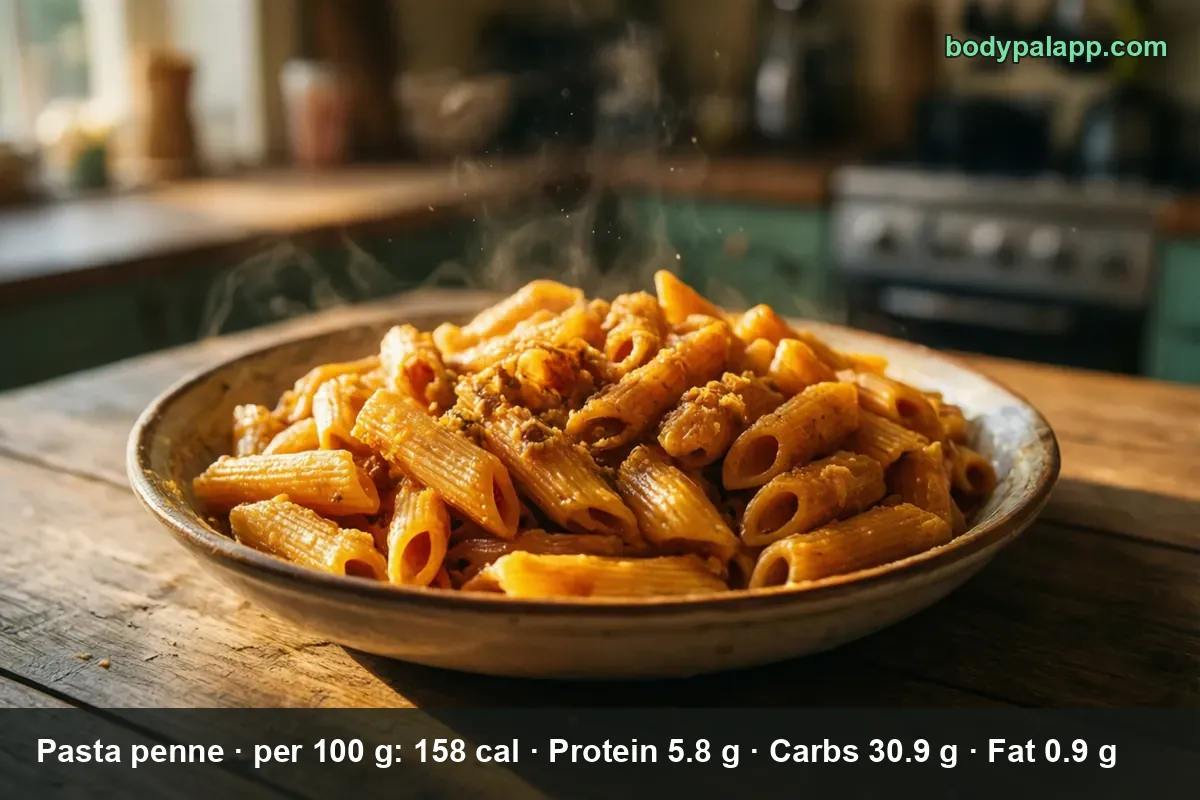
A cup of cooked penne weighs 107 g and carries 169 calories, which is 158 per 100 g. Out of the box the same pasta reads completely differently: dry penne is 371 calories per 100 g, and the 2 oz (57 g) serving printed on American pasta boxes comes to 211. One food, three numbers, and the only thing that changed is water.
On this page
- Penne quick facts
- Dry penne against cooked penne
- US servings, cup by cup
- Why one cup is not one number
- Salted water, whole grain and gluten free
- What the sauce adds
- How does penne compare?
- Most popular pasta penne brands
- FAQ
Penne quick facts
The reference record is SR Legacy 169737, "Pasta, cooked, enriched, without added salt". USDA attaches its own household measure to that record — one cup of penne, 107 g — so the serving column below is the agency's penne cup, not a generic pasta cup borrowed from another shape.
| Nutrient | Per 100 g | Per 1 cup (107 g) | % Daily Value |
|---|---|---|---|
| Calories | 158 | 169 | — |
| Total fat | 0.93 g | 1.0 g | 1% |
| Saturated fat | 0.18 g | 0.2 g | 1% |
| Carbohydrate | 30.86 g | 33.0 g | 12% |
| Dietary fiber | 1.8 g | 1.9 g | 7% |
| Total sugars | 0.56 g | 0.6 g | — |
| Protein | 5.8 g | 6.2 g | 12% |
| Sodium | 1 mg | 1 mg | 0% |
% Daily Value is based on a 2,000-calorie diet.
Verified nutrition data
Numbers on this page come from USDA FoodData Central, the U.S. Department of Agriculture’s food composition database, and from manufacturer labels where a branded product is named. Last verified September 2026. How we verify our data →
Two rows a packaged label would print are missing here, and neither is an oversight. This SR Legacy record publishes no added sugars figure at all, and its trans fat value is zero, which tells you nothing you did not already assume about boiled semolina. Total sugars carry no Daily Value on a US label, which is why that cell is a dash.
The sodium row is the one worth staring at. One milligram. Plain penne, cooked in unsalted water, is effectively a sodium-free food — 0% of the day. Everything salty that ends up in a pasta bowl arrives later, and the rest of this page is largely about where.
Two more values sit inside the same record without appearing on the label block: cholesterol at 0 mg and potassium at 44 mg per 100 g.
Dry penne against cooked penne
This is the mistake that costs the most calories, and it is made in the kitchen rather than at the table.
Dry penne is 371 calories per 100 g. Cooked penne is 158. That is a 213-calorie gap in the identical food, and not a single calorie went anywhere. Pasta roughly doubles its weight in the pot, so each gram of the finished bowl is a little less than half pasta and a little more than half water.
Now put that in the two places people actually read a number. The box says 2 oz, 57 g, 211 calories — that is dry weight, before the pot. The bowl in front of you is cooked, and a cup of it is 169. Weigh the cooked pasta, then look up "penne" and log the dry figure against it, and every 100 g in the bowl goes down as 371 calories instead of 158.
Which way you get it wrong depends on your habit. Measure dry and you are usually fine, because the box number and the dry USDA record agree. Measure cooked and reach for the box number, and you have more than doubled your dinner without eating any of it.
One useful anchor: 2 oz of dry penne, the standard box serving, comes out of the water at roughly a cup and a third. If you cook a cup of dry penne instead — 95 g of it — you are at 352 calories before anything is poured over it.
US servings, cup by cup
| Serving | Weight | Calories |
|---|---|---|
| 1 oz cooked | 28.35 g | 45 |
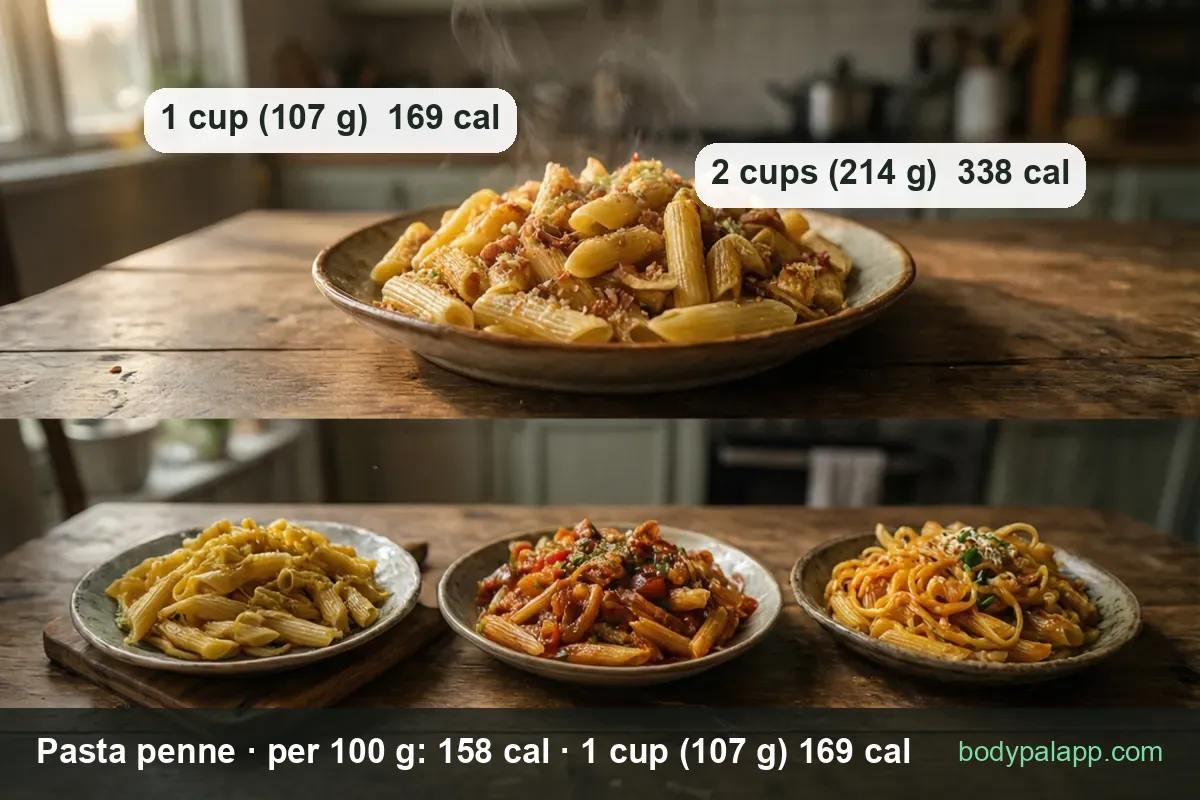
| 1 cup penne, cooked | 107 g | 169 |
| 2 cups penne, cooked | 214 g | 338 |
| Per 100 g cooked | 100 g | 158 |
| 1 oz dry | 28.35 g | 105 |
| 2 oz dry, the box serving | 57 g | 211 |
| 1 cup penne, dry | 95 g | 352 |
| Per 100 g dry | 100 g | 371 |
The two-cup row is the realistic one. A restaurant plate of penne, or a home bowl built to fill somebody up, is closer to 214 g than to 107 g, and that is 338 calories of bare pasta before the sauce, the cheese and the oil the pan was finished in.
Note the ounce trap that runs the opposite way to the usual one. An ounce of cooked penne is 45 calories, which sounds like a snack; an ounce of dry penne is 105, which is more than twice as much for the same word. Any pasta number you find online is meaningless until it says which side of the boil it is on.
Why one cup is not one number
A cup is a volume, and pasta is a pile of hollow tubes with air between them. Change the shape and you change how many grams fit in the cup — which changes the calories, even though the pasta is identical.
USDA's own measures for cooked pasta make the point better than any argument:
- Shells, 1 cup: 105 g — 166 calories
- Penne, 1 cup: 107 g — 169 calories
- Elbows, 1 cup, not packed: 120 g — 190 calories
- Cooked pasta, 1 cup, packed: 151 g — 239 calories
Same food, same 158 calories per 100 g, and the cup swings by 73 calories from the lightest reading to the heaviest. Pressing the pasta down into the measuring cup costs 70 calories on its own — more than the difference between a cup of penne and a cup of elbows, and it happens without a decision being made.
Spaghetti shows the same effect from the other direction. Long strands settle tighter than short tubes, so a cup of cooked spaghetti holds 124 g against penne's 107 g. Per 100 g the two are the same number. Per cup, spaghetti is 17 g more pasta.
The practical version: if you eat pasta often, a kitchen scale is worth more than a measuring cup, and grams are worth more than either. If you are going to use a cup, use it loosely and consistently, and know that "one cup" swings by 24 calories from shells to elbows before anything is pressed down.
Salted water, whole grain and gluten free
| Version | Per 100 g | Serving | Calories |
|---|---|---|---|
| Penne, cooked, unsalted water | 158 | 1 cup (107 g) | 169 |
| Penne, cooked in salted water | 157 | 1 cup (107 g) | 168 |
| Whole-grain penne, cooked | 156 | 1 cup (97 g) | 151 |
| Gluten-free penne, corn and quinoa, cooked | 152 | — | — |
| Penne, dry | 371 | 2 oz (57 g) | 211 |
| Whole-grain penne, dry | 361 | 1 cup dry (95 g) | 343 |
Salting the water does not add calories. It adds sodium, and quite a lot of it: the salted record runs 131 mg per 100 g against 1 mg for the unsalted one, which is 140 mg in a cup, or 6% of the 2,300 mg Daily Value. Calories move by a single point, 158 to 157, because a trace of the starch leaves with the water. If you are watching sodium rather than calories, that is where the first 140 mg of a pasta dinner comes from.
Whole-grain penne is the variant people expect to be lighter, and it barely is: 156 calories per 100 g against 158. Two calories. What it does change is fiber, from 1.8 g per 100 g to 4.5 g — two and a half times as much, which is the reason MyPlate and the Dietary Guidelines for Americans ask for at least half your grains to be whole. Buy it for the fiber, not for a calorie saving that does not exist.
Gluten-free penne made from corn and quinoa flour lands at 152 calories per 100 g, so it is not a lighter plate either. Protein is where it gives something up: 3.23 g per 100 g against 5.8 g for wheat penne, close to half. USDA holds no cup weight for that record, so it is quoted per 100 g only rather than guessed at.
What the sauce adds
The pasta is not what makes a pasta dish heavy. A cup of plain penne carries 1.0 g of fat, 1% of the 78 g Daily Value. Everything else in the bowl arrives with the sauce.
| Ready-to-heat dish | Per 100 g | Per 8 oz (227 g) | Sodium per 100 g |
|---|---|---|---|
| Pasta with vegetables, no sauce | 144 | 327 | 148 mg |
| Pasta with tomato-based sauce | 120 | 272 | 338 mg |
| Pasta with sauce, unspecified | 125 | 284 | 199 mg |
| Pasta with cream sauce | 167 | 379 | 401 mg |
USDA publishes no cup or bowl weight for these ready-to-heat dishes, so the 8 oz (227 g) column is our own scaling from the per-100 g figures.
Read the first column and something looks upside down: pasta with tomato sauce is 120 calories per 100 g, lower than plain penne at 158. Sauce is mostly water, so it dilutes the density while it enlarges the plate. Density is not what you eat. An 8 oz portion of it is 272 calories, and an 8 oz portion of the cream-sauce version is 379.
Fat is where the two sauces really separate. Tomato-based pasta is 2.98 g of fat per 100 g; the cream version is 9.35 g, with 4.35 g of it saturated. Per 100 g, swapping tomato for cream roughly triples the fat and takes saturated fat from a rounding error to 22% of its Daily Value — before any cheese is grated on top.
Sodium follows the same line. Plain penne is 1 mg per 100 g. The ready-to-heat cream dish is 401 mg, the tomato one 338 mg. In an 8 oz serving that is a serious fraction of the day's 2,300 mg, and all of it came out of a jar or a tub rather than out of the pasta.
How does penne compare?
| Item | Per 100 g | Serving | Calories | Protein | Carbohydrate | Fat |
|---|---|---|---|---|---|---|
| Penne, cooked | 158 | 1 cup (107 g) | 169 | 5.8 g | 30.86 g | 0.93 g |
| Penne, cooked in salted water | 157 | 1 cup (107 g) | 168 | 5.8 g | 30.59 g | 0.93 g |
| Whole-grain penne, cooked | 156 | 1 cup (97 g) | 151 | 5.67 g | 30.87 g | 1.48 g |
| Penne, dry | 371 | 2 oz (57 g) | 211 | 13.04 g | 74.67 g | 1.51 g |
| Whole-grain penne, dry | 361 | 1 cup dry (95 g) | 343 | 13.2 g | 73.3 g | 2.55 g |
Every cooked row in that table sits between 156 and 158 calories per 100 g. The refined pasta, the salted pasta and the whole-grain pasta are, for calorie-counting purposes, the same food. What separates them is 4.5 g of fiber against 1.8 g, and 131 mg of sodium against 1 mg.
Against other cooked starches penne is unremarkable rather than heavy: steamed white rice is 151 calories per 100 g and parboiled brown rice 147, both within a few calories of pasta. USDA carries no serving weights for those two rice records in our extract, so they are quoted per 100 g only.
Our take: cook whole-grain penne if you want the fiber, because it saves you two calories per 100 g and gives back two and a half times the fiber. Salt the water if you like it salted, because it costs nothing in calories and 140 mg of sodium in a cup. And if the calorie total is the thing you are managing, stop adjusting the pasta and adjust the bowl — going from one cup to two adds 169 calories, more than every choice on this page put together.
Most popular pasta penne brands in the United States
Ranked by how widely each product appears among foods sold in the United States, from the BodyPal food database of over 3.3 million products. Calories are the figures printed on each Nutrition Facts label, checked against USDA FoodData Central.
| Product | Calories (per 100 g) |
|---|---|
| Jovial 100% Organic Einkorn Whole Wheat Penne Rigate | 351 cal |
| Barilla Multigrain Penne | 339 cal |
| Maestri Pastai Artisan Penne Rigate | 350 cal |
| Tinkyada Brown Rice Penne | 382 cal |
| Riviana Foods Penne | 375 cal |
| Sam Mills 100% Corn Penne | 345 cal |
Brand popularity: BodyPal food database. Nutrition: manufacturer labels / USDA FoodData Central.
Penne FAQs
How many calories are in penne pasta?
169 calories in a 1-cup serving of cooked penne, which USDA weighs at 107 g. Per 100 g cooked penne is 158 calories. That cup also carries 6.2 g of protein, 33.0 g of carbohydrate, 1.9 g of fiber, 1.0 g of fat and 1 mg of sodium.
How many calories are in 2 oz of dry penne?
211 calories for the 2 oz (57 g) serving printed on the box, from 371 calories per 100 g of dry pasta. Cooking does not change that total, only the weight: the same 57 g comes out of the pot at roughly a cup and a third.
How many calories are in 2 cups of cooked penne?
338 calories for 214 g of cooked penne, at 158 calories per 100 g. That is a realistic dinner portion and it is bare pasta — no sauce, no cheese, no oil. A ready-to-heat pasta with cream sauce adds 379 calories in an 8 oz serving on its own.
How much fiber is in penne pasta?
1.9 g in a 1-cup serving, 7% of the 28 g Daily Value, from 1.8 g per 100 g. Whole-grain penne carries 4.5 g per 100 g cooked, two and a half times as much, and the dry whole-grain pasta is 11.3 g per 100 g before water is added.
Is penne or spaghetti higher in calories?
Neither, per 100 g: cooked pasta is 158 calories whatever shape it is cut into. The cup measure differs, because long strands pack tighter than short tubes. A cup of cooked spaghetti holds 124 g against 107 g for penne, so the same cup is 17 g more pasta.
How many calories are in penne with tomato sauce?
120 calories per 100 g for ready-to-heat pasta in a tomato-based sauce, or 272 calories in an 8 oz (227 g) serving. It reads lower per gram than plain penne at 158 because sauce is mostly water. Sodium is the real change: 338 mg per 100 g against 1 mg.
Does salting the pasta water add calories?
No — penne boiled in salted water is 157 calories per 100 g against 158 unsalted, a difference of one calorie that comes from starch, not salt. Sodium is what moves: 131 mg per 100 g instead of 1 mg, or 140 mg in a cup, about 6% of the 2,300 mg Daily Value.
Is whole-grain penne lower in calories?
Barely: 156 calories per 100 g cooked against 158 for regular penne, and 361 against 371 dry. The reason to cook it is fiber, which goes from 1.8 g to 4.5 g per 100 g. Protein is nearly identical at 5.67 g against 5.8 g.
Similar foods
- Pasta — 168 cal per cup penne
- Baba ganoush — 110 cal for 1/4 cup
- Rice — 205 cal per cup, cooked
- Prosciutto — 55 cal for 3 thin slices
- Quinoa — 222 cal per cup cooked
- Wild Rice — 166 cal per cup, cooked
Count it without the math
Point the camera at the bowl and BodyPal works out whether that is one cup of penne or two, sauce included.


How long does it take to burn off penne pasta?
A 1-cup (107 g) serving is 169 kcal. Enter your weight and the amount you ate to see how long it takes you to burn that off:
lb
| Activity | Time to burn 169 kcal |
|---|---|
| Walking, brisk | 34 min |
| Cycling, moderate | 21 min |
| Swimming, moderate | 24 min |
| Jogging | 20 min |
| Weight training, moderate | 38 min |
Times are for a 155 lb adult at a steady pace; change the weight to see yours. The amount is set to the portion in the text (107 g); change it to what you actually ate. BodyPal works this out from your steps automatically.
One food is easy to picture; a whole day is harder. See how many calories you need a day and what a deficit actually looks like.