
How Many Calories in Wild Rice?
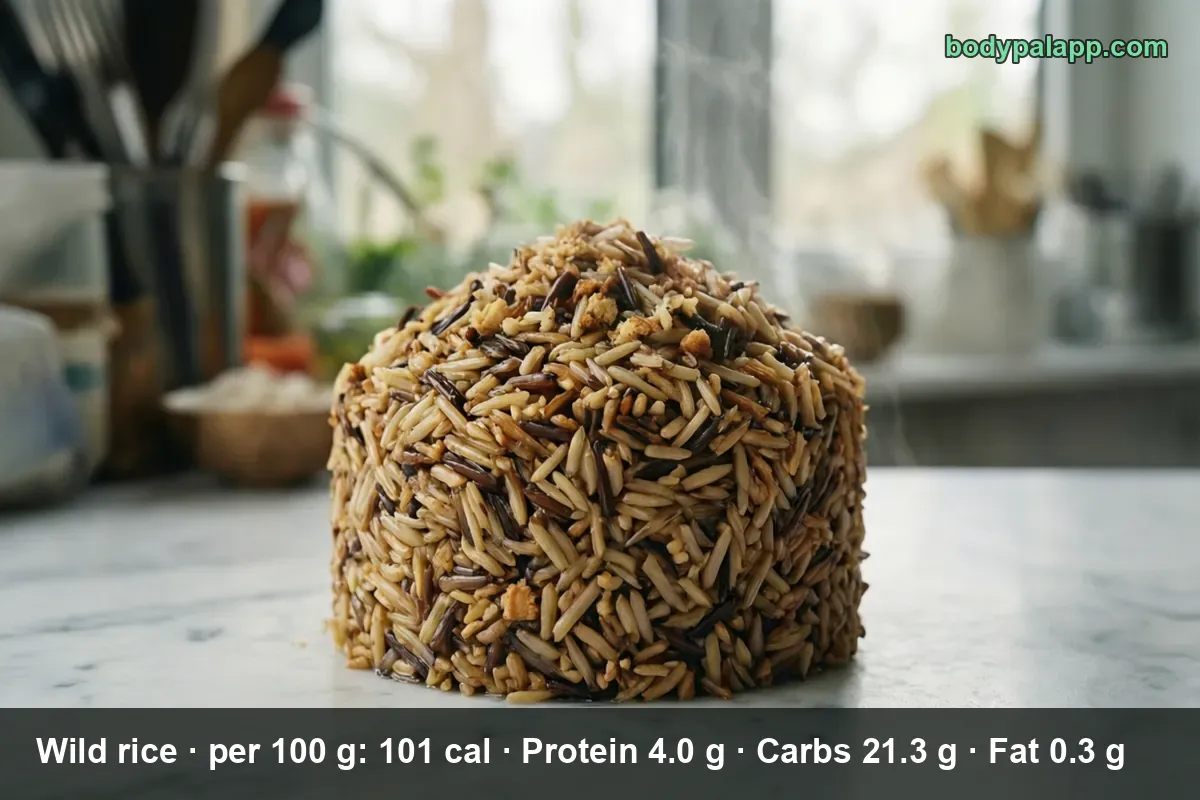
One cup of cooked wild rice is 166 calories — 101 calories per 100 g. Half a cup is 83. Measured dry instead, a quarter cup of uncooked grains (40 g) is 143 calories, and it swells into almost a full cup on the plate. That gap between dry and cooked is where most calorie counts go wrong.
On this page
- Wild rice quick facts
- US servings, cooked and dry
- Why dry wild rice quadruples in the pot
- Blends, butter, and boxed mixes
- The sodium gap nobody prints
- What a cup actually delivers
- How does wild rice compare?
- Most popular wild rice brands
- FAQ
Wild rice quick facts
The reference here is plain cooked wild rice, no salt and no fat added, from the USDA record SR 168897 "Wild rice, cooked". One cup of it weighs 164 g.
| Nutrient | Per 100 g | Per 1 cup cooked (164 g) | % Daily Value |
|---|---|---|---|
| Calories | 101 | 166 | — |
| Total fat | 0.3 g | 0.6 g | 1% |
| Saturated fat | 0.05 g | 0.1 g | 0% |
| Carbohydrate | 21.3 g | 35.0 g | 13% |
| Dietary fiber | 1.8 g | 3.0 g | 11% |
| Total sugars | 0.7 g | 1.2 g | — |
| Protein | 4.0 g | 6.5 g | 13% |
| Sodium | 3 mg | 5 mg | 0% |
% Daily Value is based on a 2,000-calorie diet.
Verified nutrition data
Numbers on this page come from USDA FoodData Central, the U.S. Department of Agriculture’s food composition database, and from manufacturer labels where a branded product is named. Last verified September 2026. How we verify our data →
There is no added sugars row, and that is not an omission. Wild rice is a bare grain: the USDA record carries 0.7 g of naturally occurring sugars per 100 g and nothing is added on the way to the pot, so the line the FDA reserves for added sugars simply reads zero.
Two things stand out. Calories are low for a cooked grain. Sodium, in the plain version, is essentially nothing — 5 mg in a full cup. Hold on to that second number, because it does not survive contact with a real kitchen.
US servings, cooked and dry
Cooked, straight from the pot:
| Serving | Weight | Calories |
|---|---|---|
| 1 cup cooked | 164 g | 166 |
| 3/4 cup cooked | 123 g | 124 |
| 1/2 cup cooked | 82 g | 83 |
| 1/3 cup cooked | 55 g | 56 |
| 1 oz cooked | 28.35 g | 29 |
The 3/4 cup row is the honest one. When the USDA asks Americans what they actually ate and they answer "some wild rice" without a measurement, the survey files score that answer at 123 g — three quarters of a cup, 124 calories. That is the real-world portion, not the tidy full cup.
Dry grains, before any water:
| Serving | Weight | Calories |
|---|---|---|
| 1/4 cup dry | 40 g | 143 |
| 1/2 cup dry | 80 g | 286 |
| 1 cup dry | 160 g | 571 |
| 1 oz dry | 28.35 g | 101 |
| 3 Tbsp dry | 28 g | 100 |
Now compare that quarter cup with the bag it came out of. USDA puts a cup of dry wild rice at 160 g, so a quarter cup is 40 g and 143 calories. American packages — Gourmet House, Reese, Haddon House, Hy-Vee — all print 1/4 cup as 45 g and 170 calories. Same grain, same measuring cup, a 19% difference in the number.
The gap is not a disagreement about wild rice. It is a disagreement about how tightly a quarter cup packs. If you scoop and level, USDA's 40 g is closer; if you scoop and shake, the label is. Weigh it once and you never have to pick a side.
Why dry wild rice quadruples in the pot
Here is the mistake that quietly ruins a day of logging. Someone measures 1/4 cup of dry wild rice, cooks it, sees a modest pile of grains, and logs "1/4 cup wild rice, 143 calories." The calories are right. The mental picture is not.
A cup of dry grains is 160 g and 571 calories. Cooked wild rice runs 101 calories per 100 g, so those same 571 calories now weigh 566 g — about 3.45 cups. Wild rice takes on roughly three times its own weight in water.
Scale it down and the quarter cup of dry grains becomes about 0.85 cup cooked. So the person who thinks they had a small side of rice ate nearly a full cup of it. The calorie total was never wrong. Only the sense of how much food it was.
This cuts the other way too, and in your favor. Dry wild rice, white rice, brown rice and quinoa are practically identical before water: 357, 365, 367 and 368 calories per 100 g. Every calorie difference you see between cooked grains is a water difference. Wild rice wins on the plate because it drinks more.
Blends, butter, and boxed mixes
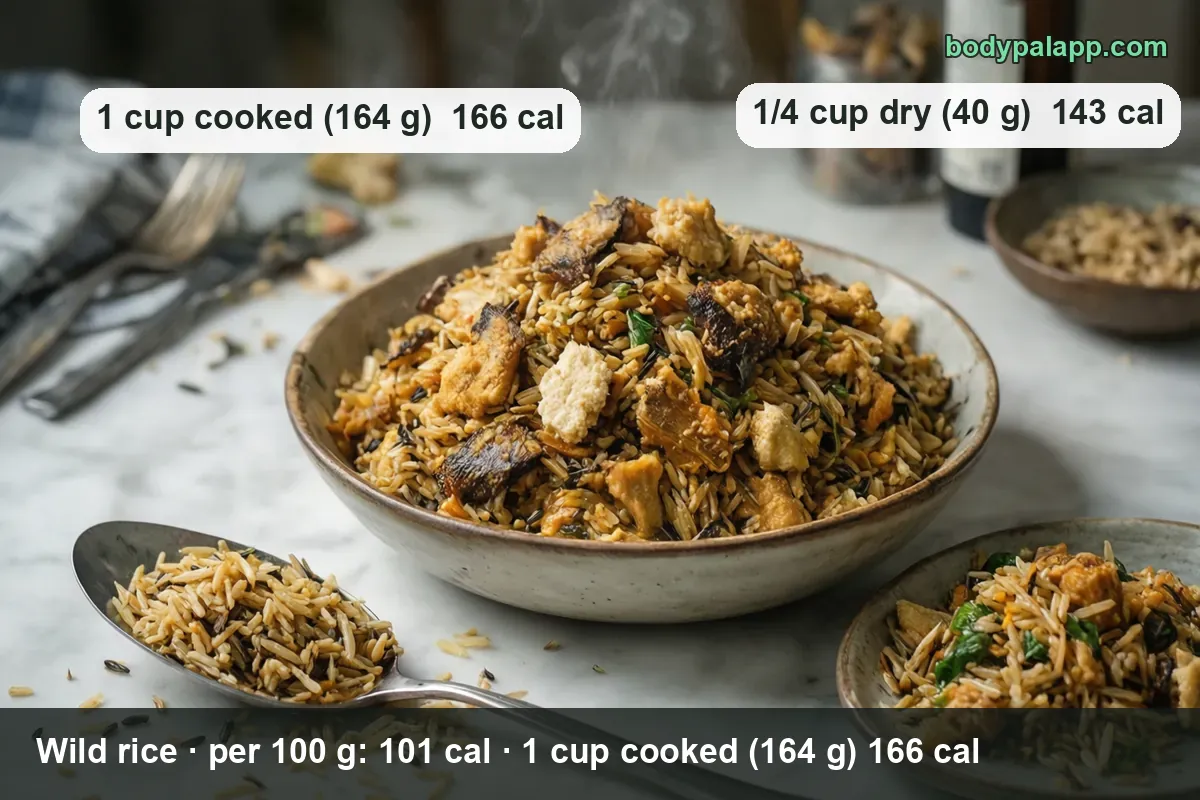
Most "wild rice" in American kitchens is not wild rice. It is a blend, or it has been cooked with fat, and both change the number.
| What was cooked | USDA record | Per 100 g | 1 cup | Calories |
|---|---|---|---|---|
| Wild rice, no fat added | SR 168897 | 101 | 164 g | 166 |
| Wild rice, cooked with fat | FNDDS 2708425 | 122 | 164 g | 200 |
| White and wild blend, no fat | FNDDS 2708426 | 79 | 166 g | 131 |
| White and wild blend, with fat | FNDDS 2708428 | 112 | 168 g | 188 |
| Brown and wild blend, no fat | FNDDS 2708427 | 120 | 151 g | 181 |
| Brown and wild blend, with fat | FNDDS 2708430 | 138 | 155 g | 214 |
A pat of butter or a slick of oil in the pot costs 34 calories a cup, taking wild rice from 166 to 200, and pushes saturated fat from 0.1 g to 0.7 g per cup. That is the single easiest number on this page to control.
The white-and-wild blend row is the interesting one, because it looks like a bargain and isn't. At 131 calories a cup it is the lightest thing in the table. It is also the emptiest: 1.8 g of protein per 100 g against 4.0 g for pure wild rice, and 0.5 g of fiber against 1.8 g. Those dark grains are a garnish in a bowl of white rice. Fewer calories, considerably less food.
The brown-and-wild blend goes the other direction — 181 calories a cup — and keeps most of the fiber. If a blend is what's in the pantry, that's the one worth buying.
The sodium gap nobody prints
Plain cooked wild rice carries 5 mg of sodium per cup. Nothing on the shelf resembles that.
Cook it the way people actually cook it, in salted water, and the USDA's survey record for wild rice (FNDDS 2708424, "Rice, wild, 100%, cooked, no added fat") reports 238 mg per 100 g — 390 mg a cup, or 17% of the Daily Value. Same grain, same "no fat added" label, 78 times the sodium of the unsalted version.
Boxed mixes go further. A 1/3 cup serving of Zatarain's long grain and wild rice carries 950 mg of sodium, 41% of the day, and Near East's original mix carries 720 mg, or 31%, per 56 g serving. A serving of dry mix that size cooks up to roughly one cup. So between a cup you salted lightly at home and a cup poured from the box, sodium moves from 5 mg to 950.
Calories barely move across that whole range. Sodium moves by a factor of about 190. The Dietary Guidelines for Americans put the ceiling at 2,300 mg a day for adults, which one boxed side dish spends 41% of. If wild rice is on your table for health reasons, the seasoning packet is the decision, not the grain.
White-and-wild blends deserve one more line here: at 401 mg per 100 g, a cup of that mix is 666 mg, 29% of the day — the lowest-calorie option in the previous table and the second-saltiest.
What a cup actually delivers
Wild rice gets sold as a fiber food. The numbers say it's a mineral food.
- Zinc: 2.2 mg per cup, 20% of the Daily Value. That is the standout, and it beats every other percentage on this page. The NIH Office of Dietary Supplements sets the adult recommendation at 8 to 11 mg a day.
- Magnesium: 52 mg per cup, 12% of the Daily Value.
- Potassium: 166 mg per cup, 4%.
- Protein: 6.5 g, 13%. Fiber: 3.0 g, 11%.
So the mineral columns outrun the macro columns. A cup of wild rice does more for your zinc than for your fiber, and if fiber is what you're chasing, quinoa delivers 5.2 g a cup against wild rice's 3.0 g.
Wild rice is a whole grain, which is the category MyPlate asks Americans to fill half their grain servings with. One cup covers two of the recommended six one-ounce grain equivalents for an adult eating 2,000 calories.
How does wild rice compare?
| Grain | Per 100 g | 1 cup cooked | Calories | Protein | Fiber |
|---|---|---|---|---|---|
| Wild rice | 101 | 164 g | 166 | 6.5 g | 3.0 g |
| White rice, long-grain, enriched | 130 | 158 g | 205 | 4.3 g | 0.6 g |
| Quinoa | 120 | 185 g | 222 | 8.1 g | 5.2 g |
| Brown rice, long-grain | 123 | 202 g | 248 | 5.5 g | 3.2 g |
Wild rice is the lightest grain on the American table, and it wins twice over — lowest per 100 g and lowest per cup. Against brown rice, the health-food default, a cup saves 82 calories while carrying a gram more protein.
Our take: for calorie control, wild rice, and it isn't close — swapping a daily cup of brown rice for wild rice is the same arithmetic as skipping a slice of bread. For protein and fiber per bowl, quinoa, which pays 56 extra calories for 1.6 g more protein and 2.2 g more fiber. White rice is the odd one out: it costs 39 more calories than wild rice per cup and returns 0.6 g of fiber, which is a fifth of what wild rice gives.
One caveat on that brown rice row. USDA weighs its cup of cooked brown rice at 202 g, which is generous; a lighter 195 g cup would put it at 240 calories instead of 248. Wild rice still wins by 74.
Most popular wild rice brands in the United States
Ranked by how widely each product appears among foods sold in the United States, from the BodyPal food database of over 3.3 million products. Calories are the figures printed on each Nutrition Facts label, checked against USDA FoodData Central.
| Product | Calories (per 100 g dry) |
|---|---|
| Bob’s Red Mill Wild Rice | 393 cal |
| Gourmet House 100% Minnesota Cultivated Wild Rice | 378 cal |
| Haddon House Extra Fancy Cultivated Wild Rice | 378 cal |
| Reese Wild Rice | 378 cal |
| Kowalski’s Markets Wild Rice | 378 cal |
| 365 Everyday Value Wild Rice (Whole Foods) | 354 cal |
Brand popularity: BodyPal food database. Nutrition: manufacturer labels / USDA FoodData Central.
Wild rice FAQs
How many calories are in 1 cup of cooked wild rice?
166 calories in one cup of cooked wild rice, which weighs 164 g. That comes with 6.5 g of protein, 35.0 g of carbohydrate, 3.0 g of fiber and just 0.6 g of fat. Per 100 g, cooked wild rice is 101 calories.
How many calories are in 1/2 cup of wild rice?
83 calories for half a cup of cooked wild rice, or 82 g. A third of a cup is 56 calories and three quarters of a cup is 124. All of those assume plain rice; cooked with butter or oil, half a cup rises to about 100 calories.
How many calories are in 1/4 cup of dry wild rice?
143 calories, using the USDA weight of 40 g for a quarter cup of dry grains. Most American packages print 45 g and 170 calories for the same measure. The difference is how densely the cup is filled, not the rice, so weighing settles it.
Is wild rice lower in calories than brown rice?
Yes, by a wide margin. A cup of cooked wild rice is 166 calories against 248 for a cup of cooked brown rice, and per 100 g it is 101 against 123. Wild rice also carries a gram more protein per cup, 6.5 g against 5.5 g.
How much protein is in wild rice?
6.5 g of protein in a cup of cooked wild rice, 13% of the Daily Value, from 4.0 g per 100 g. That is more than white rice at 4.3 g a cup and brown rice at 5.5 g, though quinoa is ahead at 8.1 g per cup.
How much cooked rice does 1 cup of dry wild rice make?
About 3.45 cups. A cup of dry grains is 160 g and 571 calories; cooked, those calories weigh 566 g, because wild rice absorbs roughly three times its weight in water. A quarter cup of dry grains makes about 0.85 cup cooked.
Wild rice or quinoa - which has fewer calories?
Wild rice, at 166 calories per cup against 222 for quinoa. Quinoa's cup is bigger, 185 g against 164 g, and it returns more of both nutrients that matter here: 8.1 g of protein and 5.2 g of fiber, against 6.5 g and 3.0 g for wild rice.
Is wild rice a good choice for weight loss?
It is the lowest-calorie grain in this comparison at 166 calories a cup, 82 fewer than brown rice and 39 fewer than white. It is also a whole grain, the category MyPlate asks Americans to fill half their grain servings with. Watch the seasoning packet rather than the grain.
Similar foods
- Quinoa — 222 cal per cup cooked
- Rice — 205 cal per cup, cooked
- Milk — 149 cal per cup
- Pasta — 168 cal per cup penne
- Penne pasta — 169 cal per cup
- Baba ganoush — 110 cal for 1/4 cup
Count it without the math
Point the camera at the bowl and BodyPal reads the calories, the protein and the sodium in one shot, cup or quarter cup.


How long does it take to burn off wild rice?
1 cup cooked (164 g) is 166 kcal. Enter your weight and the amount you ate to see how long it takes you to burn that off:
lb
| Activity | Time to burn 166 kcal |
|---|---|
| Walking, brisk | 33 min |
| Cycling, moderate | 21 min |
| Swimming, moderate | 24 min |
| Jogging | 20 min |
| Weight training, moderate | 37 min |
Times are for a 155 lb adult at a steady pace; change the weight to see yours. The amount is set to the portion in the text (164 g); change it to what you actually ate. BodyPal works this out from your steps automatically.
Burning it off is one side of it. The other is knowing your number: work out how many calories you need a day, with macros and a goal date.