
How many calories are in a cup of milk?
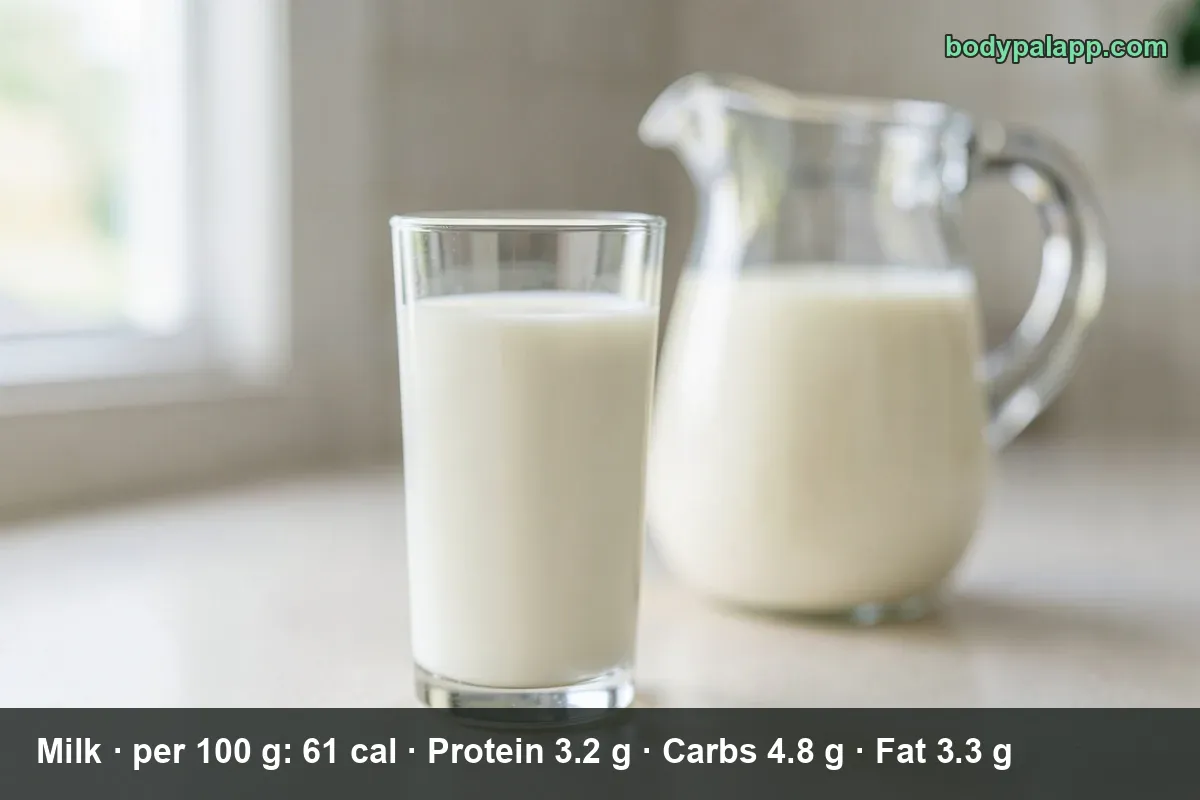
A 1-cup (244 g) glass of whole milk is 149 calories. Per 100 g, milk runs 61 calories, so the number on your log depends almost entirely on how big the glass is and how much fat was left in. Skim in the same glass is 83.
On this page
- Milk quick facts
- US servings from a fluid ounce to a quart
- Lower fat milks side by side
- Chocolate lactose free and evaporated milk
- Saturated fat is the row to watch in a glass of milk
- How does milk compare?
- Most popular milk brands
- FAQ
Milk quick facts
The record behind this page is SR Legacy 171265, "Milk, whole, 3.25% milkfat, with added vitamin D". That is the red-cap gallon in the average American refrigerator, and it is the only whole-milk entry with a complete profile: the newer Foundation measurement (60 calories per 100 g, one calorie lighter) leaves the sugar and fiber lines blank, so it cannot fill a label-style table.
All the serving weights below — the cup, the fluid ounce, the quart — belong to that same record, so nothing here is stitched together from two different sources.
| Nutrient | Per 100 g | Per 1 cup (244 g) | % Daily Value |
|---|---|---|---|
| Calories | 61 | 149 | — |
| Total fat | 3.25 g | 7.9 g | 10% |
| Saturated fat | 1.86 g | 4.5 g | 23% |
| Carbohydrate | 4.8 g | 11.7 g | 4% |
| Dietary fiber | 0 g | 0 g | 0% |
| Total sugars | 5.05 g | 12.3 g | — |
| Protein | 3.15 g | 7.7 g | 15% |
| Sodium | 43 mg | 105 mg | 5% |
% Daily Value is based on a 2,000-calorie diet.
Verified nutrition data
Numbers on this page come from USDA FoodData Central, the U.S. Department of Agriculture’s food composition database, and from manufacturer labels where a branded product is named. Last verified September 2026. How we verify our data →
Two rows you would see on a carton are missing here. Added sugars and trans fat are not published in this SR Legacy edition, so they are left out rather than guessed — though for plain milk the added-sugars line is 0 g anyway, since every gram of sugar in the glass is lactose. Cholesterol lands at 24 mg a cup (8% of the Daily Value) and potassium at 322 mg (7%), which is a quiet argument for milk that rarely makes the front of the carton.
The %DV figures come from the FDA's Daily Value table, the same reference the label on your milk uses.
US servings from a fluid ounce to a quart
| Serving | Weight | Calories |
|---|---|---|
| 1 fl oz | 30.5 g | 19 kcal |
| 1 oz | 28.35 g | 17 kcal |
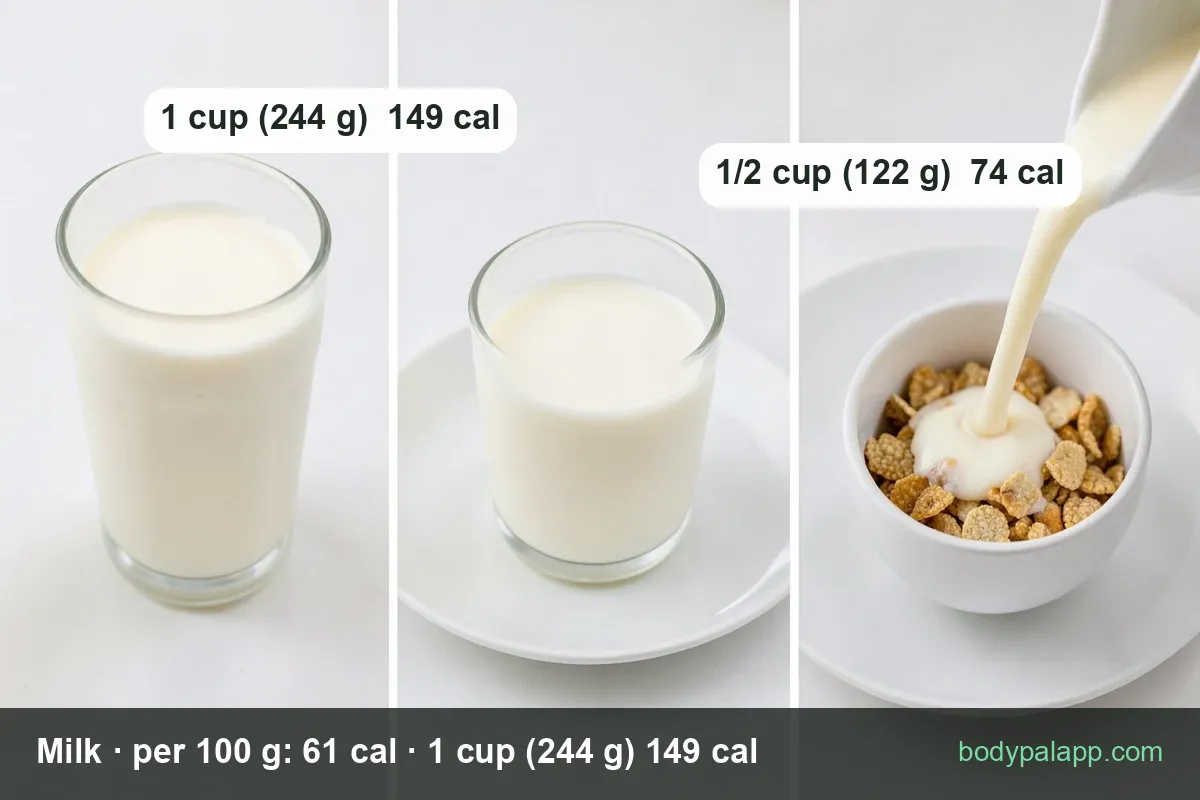
| 1/2 cup | 122 g | 74 kcal |
| 1 cup | 244 g | 149 kcal |
| 1 quart | 976 g | 595 kcal |
| Per 100 g | 100 g | 61 kcal |
The cup, the fluid ounce and the quart are USDA household measures for this record. The half cup and the dry ounce are our own arithmetic from the USDA 100 g figure, not USDA servings — useful because a splash in coffee and a scoop over cereal both live down at that end.
Watch the fluid ounce. A fluid ounce of milk weighs 30.5 g, a dry ounce is 28.35 g, and people log the wrong one constantly. The gap is only two calories a shot, but it compounds across a day of coffees. A quart, the carton most people buy for a household of one or two, is 595 calories before anything is poured on cereal.
Cartons agree with USDA more closely than you would expect. Horizon Organic, Organic Valley, Stonyfield and Great Value all print 149 calories for a 1-cup (240 mL) serving of whole milk; the 236 mL Horizon box works out to 151. The label's cup is measured in milliliters, USDA's cup is weighed at 244 g, and the calorie count still lands in the same place.
Lower fat milks side by side
| Version | Per 100 g | Serving | Calories | Protein |
|---|---|---|---|---|
| Whole, 3.25% milkfat | 61 kcal | 1 cup (244 g) | 149 kcal | 7.7 g |
| 2%, reduced fat | 50 kcal | 1 cup (244 g) | 122 kcal | 8.1 g |
| 1%, lowfat | 42 kcal | 1 cup (244 g) | 102 kcal | 8.2 g |
| Skim, fat free | 34 kcal | 1 cup (244 g) | 83 kcal | 8.2 g |
This is the whole story of milk calories in four rows. Take the fat out and the energy falls by 66 calories a cup from whole to skim, while the protein goes up, not down: 7.7 g in whole, 8.2 g in skim. Removing fat concentrates everything that is left, so the glass gets lighter without giving anything back on the protein line.
The middle rungs are smaller steps than people assume. Going whole to 2% saves 27 calories a cup; 2% to 1% saves another 20. If you drink one glass a day, switching from whole to 2% is a rounding error over a week. If milk is in three coffees plus a bowl of cereal, the same switch is worth a snack.
Chocolate lactose free and evaporated milk
| Version | Per 100 g | Serving | Calories |
|---|---|---|---|
| Lactose-free whole | 61 kcal | 1 cup (244 g) | 149 kcal |
| Chocolate, whole | 83 kcal | 1 cup (244 g) | 203 kcal |
| Evaporated, canned | 134 kcal | 1/2 cup (126 g) | 169 kcal |
Lactose-free whole milk is 61 calories per 100 g, exactly the same as ordinary whole milk. Nothing is taken out of the carton; an enzyme splits the lactose into glucose and galactose, which is why the milk tastes sweeter while the calorie and carbohydrate totals sit still. Buying it to save calories is buying it for the wrong reason.
Chocolate milk is a different drink. A cup is 203 calories and about 23.3 g of total sugars against 12.3 g in plain whole milk, so roughly 11 g of it is sugar that was stirred in — our own subtraction, since USDA does not publish an added-sugars figure for this record. That is around a fifth of the FDA's 50 g Daily Value for added sugars, in one glass.
Evaporated milk reads alarming at 134 calories per 100 g, but only because about 60% of the water is gone. Nobody drinks it by the cup. The half cup that goes into pumpkin pie or a pan sauce is 169 calories; a full cup, if a recipe calls for one, is roughly 338 by our own arithmetic from the 100 g figure.
Saturated fat is the row to watch in a glass of milk
The fat line on a cup of whole milk is 7.9 g, a modest 10% of the Daily Value. The saturated fat line is 4.5 g — 23%. That gap is the real finding on this page: milk is not a high-fat food, but it is a concentrated source of the specific fat the Dietary Guidelines for Americans ask people to keep under 10% of daily calories, roughly 22 g on a 2,000-calorie day.
Put that against a serving target and it gets concrete. MyPlate's dairy recommendation for adults is 3 cups a day. Three cups of whole milk is 447 calories and 13.5 g of saturated fat, 68% of the Daily Value, before any cheese or yogurt joins in. Three cups of skim is 249 calories and 0.4 g of saturated fat. Same protein, same calcium story, very different fat budget.
Sodium is a non-issue: 105 mg a cup, 5% DV, well under a tenth of a teaspoon of table salt. And the sugar figure that worries people — 12.3 g a cup — is lactose that arrived with the milk. Total sugars carry no Daily Value on the US label, and comparing that number to the 50 g added-sugars limit is comparing two different things.
How does milk compare?
| Drink | Per 100 g | US serving | Calories |
|---|---|---|---|
| Whole milk, 3.25% | 61 kcal | 1 cup, 244 g | 149 kcal |
| 2% reduced fat milk | 50 kcal | 1 cup, 244 g | 122 kcal |
| Skim milk | 34 kcal | 1 cup, 244 g | 83 kcal |
| Unsweetened almond milk | 15 kcal | 1 cup, 240 g | 36 kcal |
Our take: if the goal is fewer calories, skim is the honest answer — 83 a cup, 66 less than whole, with the protein untouched at 8.2 g. If the goal is staying full between meals, whole milk earns its 149, because the fat is what makes a glass feel like something rather than a drink you forget you had. Unsweetened almond milk is the lightest thing in the table at 36 calories a cup, under a quarter of whole milk, but it carries about 1.3 g of protein instead of 7.7, so it is a calorie decision, not a swap. Buy on what you want the glass to do.
Most popular milk brands in the United States
Ranked by how widely each product appears among foods sold in the United States, from the BodyPal food database of over 3.3 million products. Calories are the figures printed on each Nutrition Facts label, checked against USDA FoodData Central.
| Product | Calories (per 100 g) |
|---|---|
| Horizon Organic Organic Whole Milk | 62 cal |
| Organic Valley Whole Milk | 62 cal |
| Organic Valley Lactose Free Whole Milk | 62 cal |
| Stonyfield Organic Organic Whole Milk | 62 cal |
| Great Value Vitamin D Whole Milk | 62 cal |
| Horizon Organic Whole Milk Box | 64 cal |
Brand popularity: BodyPal food database. Nutrition: manufacturer labels / USDA FoodData Central.
Milk FAQs
How many calories are in a cup of milk?
A 1-cup (244 g) glass of whole milk is 149 calories, or 61 calories per 100 g. That cup also carries 7.7 g of protein, 11.7 g of carbohydrate and 7.9 g of fat. Pour it over cereal and you are adding a small snack's worth of calories to the bowl.
Is 2% milk better than whole milk for weight loss?
A cup of 2% milk is 122 calories against 149 for whole, a 27-calorie gap that only matters if you drink several glasses a day. Protein is slightly higher in 2% at 8.1 g per cup. If you want a real cut, skim at 83 calories saves 66 per cup.
How much protein is in a cup of milk?
A cup of whole milk has 7.7 g of protein, 15% of the FDA Daily Value of 50 g. Skim and 1% run a little higher at 8.2 g per cup because removing fat concentrates everything else. Calories move a lot between the fat levels; protein barely moves at all.
How much sugar is in milk?
A cup of whole milk holds 12.3 g of total sugars, 5.05 g per 100 g. All of it is lactose, the sugar that comes with the milk itself. Total sugars have no Daily Value on the US label, so that 12.3 g is not eating into any daily sugar allowance.
Does milk have added sugar?
Plain milk has 0 g of added sugars. Every one of the 12.3 g of sugar in a cup is lactose. Chocolate milk is the exception: a cup is 203 calories and about 23.3 g of total sugars, so roughly 11 g of that is sugar someone stirred in.
How many calories are in skim milk?
A cup of skim milk is 83 calories, 34 per 100 g. That is 66 fewer than whole milk for the same 244 g glass, and you keep 8.2 g of protein. The fat line drops to 0.2 g per cup, which is why skim tastes thinner.
Is lactose-free milk lower in calories?
No, lactose-free whole milk is 61 calories per 100 g and 149 per cup, the same as regular whole milk. The lactose is broken into glucose and galactose by an added enzyme, not removed, so the carbohydrate and calorie totals stay put. It tastes sweeter because those two sugars taste sweeter.
How many calories are in a gallon of milk?
A gallon of whole milk is roughly 2,380 calories, our own arithmetic from the USDA 100 g figure rather than a USDA serving: four quarts at 595 calories each. A gallon of skim comes to about 1,330. Most households drink it over a week, so the number is a shopping fact, not a sitting.
Similar foods
- Yogurt — 104 cal per container (6 oz)
- Full-Fat Plain Yogurt — 149 cal per cup
- Plain Yogurt — 149 cal per cup
- Glass Of Milk — 149 cal per glass
- Greek Yogurt — 89 cal for 5.3 oz cup
- Chocolate Milk — 161 cal per cup
Count it without the math
Point the camera at the glass and BodyPal counts the milk for you, fat level and all.


How long does it take to burn off milk?
A 1-cup (244 g) glass is 149 kcal. Enter your weight and the amount you ate to see how long it takes you to burn that off:
lb
| Activity | Time to burn 149 kcal |
|---|---|
| Walking, brisk | 30 min |
| Cycling, moderate | 19 min |
| Swimming, moderate | 21 min |
| Jogging | 18 min |
| Weight training, moderate | 33 min |
Times are for a 155 lb adult at a steady pace; change the weight to see yours. The amount is set to the portion in the text (244 g); change it to what you actually ate. BodyPal works this out from your steps automatically.
This table assumes you know your daily total. If you do not, the daily calorie calculator works it out from five numbers.