
How many calories are in a cup of yogurt?
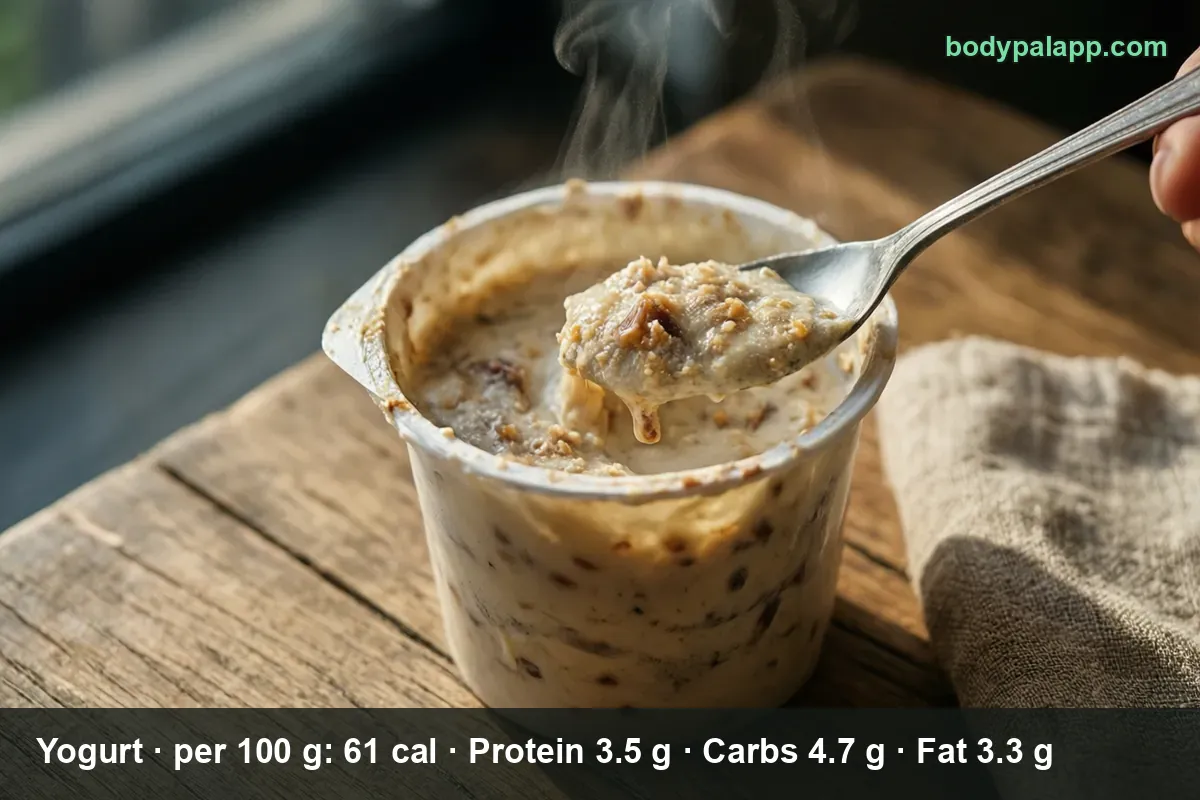
A 1-cup (245 g) serving of plain whole-milk yogurt carries 149 calories. Per 100 g the same yogurt runs 61 calories, one of the lowest numbers in the dairy case. The cup also brings 8.5 g of protein and 11.4 g of sugars, every gram of it lactose rather than anything stirred in.
On this page
- Cup of yogurt quick facts
- Cups, containers and ounces
- Greek, low-fat, nonfat and fruit yogurt
- Saturated fat is the row to watch
- How does a cup of yogurt compare?
- Most popular yogurt brands
- Cup of yogurt FAQs
Cup of yogurt quick facts
The row used here is SR Legacy 171284, "Yogurt, plain, whole milk". It is the record that matches what most people are holding: a plain, unsweetened cup, nothing on top. It is also the only version of that food with a complete set of numbers — sugars, fiber and sodium all filled in — plus a ready-made household measure of 1 cup (8 fl oz) at 245 g. The Foundation edition of the same food estimates its energy by calculation and leaves the sugar column empty, so it is not the one to build a page on.
| Nutrient | Per 100 g | Per 1 cup (245 g) | % Daily Value |
|---|---|---|---|
| Calories | 61 | 149 | — |
| Total fat | 3.25 g | 8.0 g | 10% |
| Saturated fat | 2.1 g | 5.1 g | 26% |
| Carbohydrate | 4.66 g | 11.4 g | 4% |
| Dietary fiber | 0 g | 0 g | 0% |
| Total sugars | 4.66 g | 11.4 g | — |
| Protein | 3.47 g | 8.5 g | 17% |
| Sodium | 46 mg | 113 mg | 5% |
% Daily Value is based on a 2,000-calorie diet.
Verified nutrition data
Numbers on this page come from USDA FoodData Central, the U.S. Department of Agriculture’s food composition database, and from manufacturer labels where a branded product is named. Last verified September 2026. How we verify our data →
Two rows you would see on a supermarket label are missing above. USDA does not publish added sugars or trans fat for this record — and in the case of added sugars there is nothing to publish, because plain yogurt is milk and cultures, so all 11.4 g of sugars in the cup is lactose. The cup also carries 32 mg of cholesterol (11% DV) and 380 mg of potassium (8% DV).
Cups, containers and ounces
| Serving | Weight | Calories |
|---|---|---|
| 1 oz | 28 g | 17 kcal |
| 1 container (4 oz) | 113 g | 69 kcal |
| 1 container (6 oz) | 170 g | 104 kcal |
| 1 container (8 oz) | 227 g | 138 kcal |
| 1 cup (8 fl oz) | 245 g | 149 kcal |
| Per 100 g | 100 g | 61 kcal |
Every weight here except the ounce is a USDA household measure for this record; the 1 oz line is our own arithmetic from the USDA 100 g figure, not a USDA serving. And that top block of numbers hides the trap on this food. A measuring cup of yogurt weighs 245 g, but the tub labeled 8 oz weighs 227 g, because one is a volume and the other is a weight — yogurt is denser than water. Same yogurt, 149 calories or 138.
The plastic cup you actually grab off the shelf is usually smaller still. A 6 oz container is 170 g and 104 calories, a full 45 calories under the measured cup most people mean when they log "a cup of yogurt." If you eat one of those at breakfast and log 149, you have overcounted by roughly a third of what you logged. The 4 oz kids' cup is 69 calories.
For scale, MyPlate counts 1 cup of yogurt as one cup-equivalent from the dairy group, so the measured cup is also the tidiest unit to think in — even if the container in your hand rarely matches it.
Greek, low-fat, nonfat and fruit yogurt
| Version | Per 100 g | Per 1 cup (245 g) | Protein per cup |
|---|---|---|---|
| Plain, whole milk | 61 kcal | 149 kcal | 8.5 g |
| Plain, low fat | 63 kcal | 154 kcal | 12.9 g |
| Plain, nonfat (skim) | 56 kcal | 137 kcal | 14.0 g |
| Greek, plain, whole milk | 97 kcal | 238 kcal | 22.1 g |
| Greek, plain, nonfat | 59 kcal | 145 kcal | 25.0 g |
| Fruit, low fat | 99 kcal | 243 kcal | 9.8 g |
| Vanilla, low fat | 85 kcal | 208 kcal | 12.1 g |
Each cup figure above is our own arithmetic, scaling the USDA 100 g value by 2.45, since only the whole-milk row ships with a packaged 1-cup measure.
Read the low-fat line twice. Plain low-fat yogurt is 154 calories per cup, five more than whole milk, because taking out fat leaves more room for milk solids: 7.04 g of carbohydrate per 100 g against 4.66 g. Cutting fat from yogurt does not automatically cut calories. Nonfat does, at 137 per cup, but only by 12 calories against the whole-milk version — and you give up the texture that makes the cup worth eating.
Greek yogurt is the real split. Straining pulls out whey and water, so plain whole-milk Greek concentrates to 97 calories per 100 g and 238 per cup, nearly 90 calories above regular. The protein concentrates too: 22.1 g a cup against 8.5 g. Nonfat Greek is the outlier worth knowing — 145 calories a cup with 25.0 g of protein, the most protein and nearly the fewest calories of anything on this page.
Fruit and vanilla are a different food. A cup of low-fat fruit yogurt is 243 calories with 45.7 g of total sugars, against 11.4 g in plain. USDA does not break those sugars into lactose and sweetener for this record, so we will not guess at the split — but the plain cup has roughly a quarter of the sugar of the fruit cup, and you can add real fruit yourself.
Brands land where you would expect. Per 100 g, Chobani plain nonfat Greek is 53 calories, siggi's plain skyr 67, FAGE plain lowfat Greek 73, and Oikos and Stonyfield plain Greek 84 each. Watch the label serving rather than the density, though: FAGE's 150 g container is 110 calories, Chobani's 170 g cup 90, and Stonyfield's 227 g cup 191.
Saturated fat is the row to watch
Calories are not the interesting column on a plain whole-milk cup. Saturated fat is. One 245 g cup delivers 5.1 g, which is 26% of the FDA Daily Value of 20 g — a quarter of the day's allowance from a breakfast most people file mentally under "light." The Dietary Guidelines for Americans put the same ceiling at under 10% of calories.
Set that against the carbohydrate row, which is only 4% DV, and the sodium row at 113 mg, 5% DV. If you are watching sodium, yogurt is an easy pick; if you are watching saturated fat, the whole-milk cup is a bigger line item than its 149 calories suggest, and plain nonfat drops it to about 0.3 g per cup.
Protein is the argument in yogurt's favor: 8.5 g in the plain cup is 17% DV before you touch a Greek tub. In BodyPal, plain yogurt is one of those foods people log at the same time every morning and then forget to weigh — which is exactly where the 45-calorie gap between the 6 oz container and the measured cup quietly adds up over a month.
How does a cup of yogurt compare?
| Yogurt | Per 100 g | US serving | Calories |
|---|---|---|---|
| Plain, whole milk | 61 kcal | 1 cup, 245 g | 149 kcal |
| Greek, plain, whole milk | 97 kcal | 1 cup, 245 g | 238 kcal |
| Plain, low fat | 63 kcal | 1 cup, 245 g | 154 kcal |
| Plain, skim milk | 56 kcal | 1 cup, 245 g | 137 kcal |
Our take: if you are counting calories, the whole-milk cup at 149 is already close to the floor, and the low-fat swap gains you nothing — it costs five calories more. Skim saves 12 calories and most of the saturated fat, which is the better reason to choose it. If you want the cup to hold you until lunch instead, ignore all four and take plain nonfat Greek: 145 calories with 25.0 g of protein is the best trade on this page.
Most popular yogurt brands in the United States
Ranked by how widely each product appears among foods sold in the United States, from the BodyPal food database of over 3.3 million products. Calories are the figures printed on each Nutrition Facts label, checked against USDA FoodData Central.
| Product | Calories (per 100 g) |
|---|---|
| Chobani Plain Nonfat Greek Yogurt | 53 cal |
| Dannon Plain Lowfat Yogurt | 62 cal |
| Oikos Plain Greek Yogurt | 84 cal |
| FAGE Plain Lowfat Greek Strained Yogurt | 73 cal |
| Stonyfield Organic Plain Greek Yogurt | 84 cal |
| siggi's Plain Skyr Non-Fat Yogurt | 67 cal |
Brand popularity: BodyPal food database. Nutrition: manufacturer labels / USDA FoodData Central.
Cup of yogurt FAQs
How many calories are in a cup of yogurt?
A 1-cup (245 g) serving of plain whole-milk yogurt is 149 calories, since the yogurt runs 61 calories per 100 g. That cup also carries 8.5 g of protein, 11.4 g of sugars, all of it lactose, and 8.0 g of fat. Greek versions of the same cup run higher.
How many calories in a 6 oz cup of yogurt?
About 104 calories. A 6 oz plastic container holds 170 g of plain whole-milk yogurt, which is 45 calories less than the 245 g measuring cup most people picture. The 8 oz tub sits between them at 227 g and 138 calories. Same yogurt, three different answers.
Is a cup of yogurt 245 g or 227 g?
Both numbers are right: 245 g by volume, 227 g by weight. USDA's household measure for 1 cup (8 fl oz) of plain yogurt is 245 g, or 149 calories. A supermarket 8 oz container is a weight, 227 g, or 138 calories. The cup is a volume, and yogurt is denser than water.
How much protein is in a cup of yogurt?
8.5 g in a cup of plain whole-milk yogurt, 17% of the Daily Value. Low-fat plain gives 12.9 g per cup and nonfat 14.0 g, because removing fat concentrates what is left. Plain whole-milk Greek yogurt more than doubles the base figure at 22.1 g per 245 g cup.
Does plain yogurt have added sugar?
No — all 11.4 g of sugars in a 245 g cup of plain yogurt is lactose from the milk. USDA does not publish an added sugars figure for this record, but nothing is sweetened in. Fruit yogurt is the contrast: 45.7 g of total sugars in the same size cup.
Greek yogurt vs regular yogurt: which has fewer calories per cup?
Regular, if both are whole milk: 149 calories per 245 g cup against 238 for plain whole-milk Greek. Straining removes whey and water, so Greek packs 97 calories per 100 g against 61. Flip to nonfat Greek and it drops to 145 per cup with 25.0 g of protein.
How many calories in a cup of low-fat yogurt?
154 calories per 245 g cup, at 63 calories per 100 g. That is five more than the whole-milk cup, which surprises people. Low-fat yogurt carries less fat, 1.55 g per 100 g against 3.25 g, but more carbohydrate, so the calories land in the same place.
Is yogurt with granola still low calorie?
The yogurt part is 149 calories per cup. USDA publishes no combined record for yogurt with granola, so we do not quote a number for the bowl in the photo above. Granola is dense and dry, unlike yogurt at 61 calories per 100 g, so log the topping as its own line and weigh it.
Similar foods
- Milk — 149 cal per cup
- Full-Fat Plain Yogurt — 149 cal per cup
- Plain Yogurt — 149 cal per cup
- Glass Of Milk — 149 cal per glass
- Greek Yogurt — 89 cal for 5.3 oz cup
- Chocolate Milk — 161 cal per cup
Count it without the math
Point the camera at the cup and BodyPal counts it for you, topping and all.


How long does it take to burn off a cup of yogurt?
A 1-cup (245 g) serving is 149 kcal. Enter your weight and the amount you ate to see how long it takes you to burn that off:
lb
| Activity | Time to burn 149 kcal |
|---|---|
| Walking, brisk | 30 min |
| Cycling, moderate | 19 min |
| Swimming, moderate | 21 min |
| Jogging | 18 min |
| Weight training, moderate | 33 min |
Times are for a 155 lb adult at a steady pace; change the weight to see yours. The amount is set to the portion in the text (245 g); change it to what you actually ate. BodyPal works this out from your steps automatically.
Want the bigger picture? Calculate your daily calorie needs — your maintenance figure, a target for losing or gaining, and the date you get there.