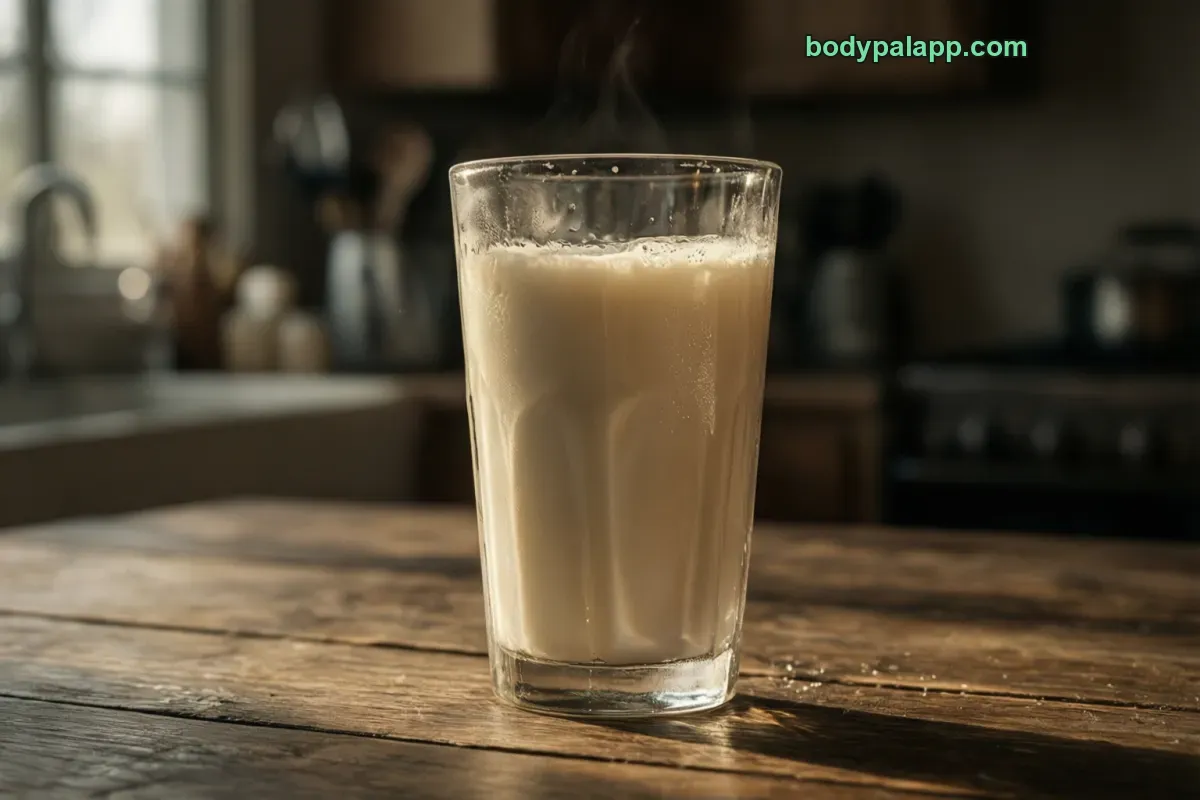
Glass of milk calories come to 149 for a 1 cup glass (249 g) of whole, 3.25% milkfat milk, which works out to 60 calories per 100 g. The detail to notice is fat: it supplies 48% of those calories, more than carbs or protein. Switch to chocolate and the same glass climbs to 206.
Skip the math. BodyPal counts these calories from your steps and workouts automatically.
Nutrition facts
Whole, 3.25% milkfat · per 249 g
Calories
149 kcal
Protein
8.1 g
Carbohydrate
11.5 g
Fat
8 g
Saturated fat
4.6 g
Cholesterol
30 mg
Sodium
95 mg
Potassium
374 mg
Iron
0 mg
Source: USDA FoodData Central
🛡️
Verified nutrition data
Numbers on this page come from USDA FoodData Central, the U.S. Department of Agriculture’s food composition database, and from manufacturer labels where a branded product is named. Last verified September 2026. How we verify our data →
Glass of milk: calories, protein and sodium by serving
Percent of daily value uses the FDA reference of 2,000 kcal a day.
Serving
kcal
Protein
Carbs
Fat
Sodium
% DV kcal
1 cup glass (249 g)
149
8.1 g
11.5 g
8 g
95 mg
7%
Chocolate, 1 cup (248 g)
206
7.9 g
25.6 g
8.4 g
149 mg
10%
100 g
60
3.3 g
4.6 g
3.2 g
38 mg
3%
3 × 1 cup glass (249 g)
448
24.4 g
284 mg
5 × 1 cup glass (249 g)
747
40.7 g
473 mg
Every extra glass adds about 149 calories
A standard 1 cup glass (249 g) of whole milk has 149 calories, which is 7% of the daily value for calories. It also brings 8.1 g of protein and 95 mg of sodium, just 4% of the sodium daily value. On its own, that is a modest number for a drink that does some of the work of a snack.
The catch is that milk rarely stops at one glass. Two glasses (498 g) come to 299 calories, three glasses (747 g) reach 448, and five glasses, about 1,245 g across a day, add up to 747 calories. Protein climbs right along with it, from 16.3 g for two glasses to 40.7 g for five. Sodium stays low even then, at 473 mg.
Glass size matters as much as the count. Many home glasses hold more than a measured cup, so a tall pour can sit well above 149 without ever looking like a second serving. If you track closely, measure your usual glass once and remember the rule of thumb: every 100 g you pour adds 60 calories.
Fat supplies nearly half of every glass
Whole milk splits its calories three ways: 48% from fat, 31% from carbs and 22% from protein. Per 100 g that is 3.2 g of fat, 4.6 g of carbs and 3.3 g of protein. The grams look close, but each gram of fat counts for more calories, so fat takes the biggest share of the total.
Scaled to a full glass, that becomes 8 g of fat, 11.5 g of carbs and 8.1 g of protein. In plain milk the carbs come from the milk itself, with nothing added. That is the main reason plain and flavored milk read so differently on a label, even when the fat and protein barely change.
Saturated fat is 1.9 g per 100 g, the bulk of the fat row, measured against a daily value of 20 g. Cholesterol is 12 mg per 100 g against a daily value of 300, and potassium is 150 mg per 100 g. If you watch saturated fat, the fat row is the one to keep an eye on with whole milk. Protein is the row that earns its place.
Chocolate milk turns a glass into 206 calories
A 1 cup (248 g) glass of chocolate milk has 206 calories, against 149 for plain whole milk. The difference is almost all carbs: 25.6 g per glass instead of 11.5 g, with 23.7 g of that listed as sugars. Same glass, same pour, a very different drink.
Protein barely moves. Chocolate milk carries 7.9 g a glass versus 8.1 g in plain, and both cover 16% of the protein daily value. Fat is close too, at 8.4 g against 8 g. What you gain is mostly sweetness and calories, along with 2 g of fiber that plain milk does not list.
Sodium rises to 149 mg, or 6% of the daily value, compared with 95 mg and 4% for plain. Calories go from 7% to 10% of the daily value. If you drink milk mainly for protein, plain gives you the same amount for fewer calories. Chocolate earns its place as a treat you chose on purpose, not as a default refill.
Count milk like food, not like water
A glass of whole milk covers 16% of the protein daily value for 7% of the calorie daily value, a better protein return than most drinks offer. That makes it fair to treat as part of a meal rather than something poured on the side. At breakfast it can carry some of the protein you would otherwise get from food.
Pair it with foods that bring what milk lacks. Plain milk shows no fiber in its row, so fruit, oats or whole-grain toast round out the plate. Coffee is the other common partner, and a splash there is a much smaller number than a full glass.
Logging is where milk tends to go missing. People record the cereal and forget the milk poured over it, or log one glass when they actually had two. BodyPal can log a glass from a photo, which helps catch those quiet pours. Brands such as Five Acre Farms Local Whole Milk and Hygeia Whole Milk Vitamin D sit in the same whole-milk category, so check the label if your carton reads differently.
How does glass of milk compare?
Here is how a glass of whole milk stacks up against milk coffee, milk tea and orange juice, per 100 g and per usual serving.
Verdict: For the fewest calories, orange juice at 117 a glass or milk tea at 122 a cup beats plain milk, but neither comes close on protein, with orange juice at just 0.8 g per 100 g against 3.3 g in milk. For staying full pick plain milk, and treat milk coffee, at 186 a cup and about 1.2 times the calories, as the heaviest option here.
Most popular glass of milk brands in the United States
Ranked by popularity in the BodyPal database
# Productkcal / 100 g
1Five Acre Farms Local Whole Milk8 fl oz · 240 ml62 kcal
A 1 cup glass of whole milk (249 g) has about 149 calories, or 60 calories per 100 g.
Is whole milk good for weight loss?
A glass of whole milk has 149 calories with 8.1 g of protein and 8.0 g of fat.
Whole milk vs skim milk: which has fewer calories?
Skim milk has 34 calories per 100 g, compared with 60 calories per 100 g for whole milk.
How much protein is in a glass of milk?
A 249 g glass of whole milk has 8.1 g of protein and 11.5 g of carbs.
How many carbs are in 1 glass of milk?
A 1 cup glass (249 g) of whole milk has 11.5 g of carbs, which supply 31% of its calories. Chocolate milk jumps to 25.6 g per cup, with 23.7 g of that counted as sugars.
How many calories are in a large glass of milk?
If your large glass holds two cups (498 g), it has 299 calories and 16.3 g of protein. A standard 1 cup glass is 149, so a big pour can double the count without feeling like a second serving.
How many calories are in a small glass of milk?
Every 100 g of whole milk has 60 calories, so a small glass below the 1 cup (249 g) standard lands under 149. Measure your glass once to see where it actually falls.
How many calories are in milk per 100 g?
Whole milk has 60 calories per 100 g, with 3.3 g of protein, 4.6 g of carbs and 3.2 g of fat. That is 3% of the daily calorie value and 7% of daily protein.