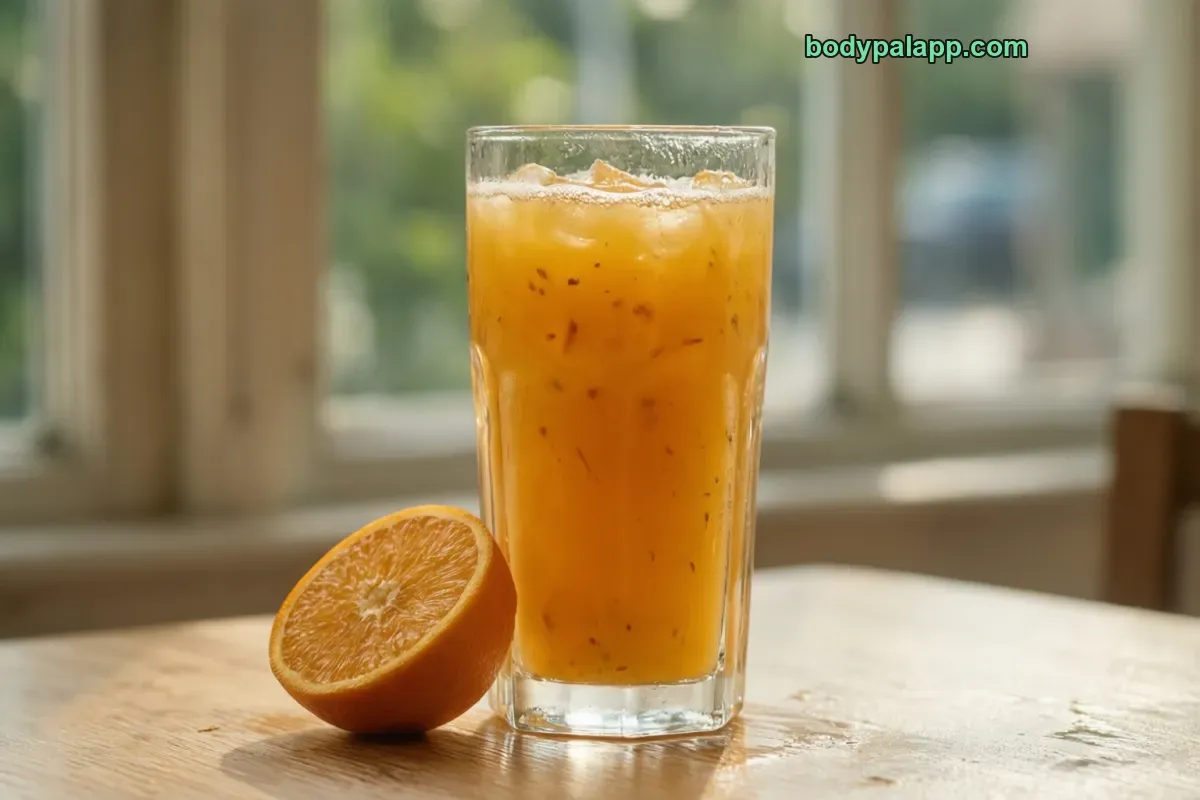
Glass of orange juice calories come to 117 for one 248 g glass, or 47 per 100 g. The number to notice is where those calories come from: 87% is carbohydrate, the glass carries 20.3 g of sugars, and there is only 0.7 g of fiber to go with them. Pour size moves the total fast.
117kcal
1 glass · 248 g, 100% juice
7%protein
1.9 gProtein
25 gCarbs
0.8 gFat
How to burn off 117 kcal
—Walking, brisk
—Jogging
—Cycling, moderate
—Swimming
Skip the math. BodyPal counts these calories from your steps and workouts automatically.
Nutrition facts
100% juice · per 248 g
Calories
117 kcal
Protein
1.9 g
Carbohydrate
25 g
Fat
0.8 g
Saturated fat
0 g
Cholesterol
0 mg
Sodium
5 mg
Potassium
449 mg
Iron
0.1 mg
Source: USDA FoodData Central
🛡️
Verified nutrition data
Numbers on this page come from USDA FoodData Central, the U.S. Department of Agriculture’s food composition database, and from manufacturer labels where a branded product is named. Last verified September 2026. How we verify our data →
Orange juice: calories, protein and sodium by serving
Percent of daily value uses the FDA reference of 2,000 kcal a day.
Serving
kcal
Protein
Carbs
Fat
Sodium
% DV kcal
1 glass (248 g)
117
1.9 g
25.2 g
0.8 g
5 mg
6%
Juice box, 6.75 fl oz (209 g)
98
1.6 g
21.3 g
0.7 g
4 mg
5%
Fun size box, 4.23 fl oz (131 g)
62
1 g
13.3 g
0.4 g
3 mg
3%
100 g
47
0.8 g
10.2 g
0.3 g
2 mg
2%
3 × 1 glass (248 g)
350
5.7 g
15 mg
5 × 1 glass (248 g)
583
9.5 g
25 mg
The size of the glass decides the total
A standard 248 g glass of 100% orange juice is 117 calories, about 6% of a 2,000-calorie day. That is a modest number on its own. The trouble is that juice glasses are rarely standard, and a drink goes down far faster than a piece of fruit you have to peel and chew.
Packaged sizes make the swing easy to see. A 6.75 fl oz juice box (209 g) comes to 98 calories, and the small 4.23 fl oz fun size box (131 g) is 62 calories, or about 3% of the daily value. If you want a fixed amount of juice without guessing, the boxes do the measuring for you.
Refills are where it adds up. Two glasses reach 233 calories, three glasses come to 350, and five glasses over a day land at 583, more than many full meals. None of that comes with much protein: even five glasses provide only 9.5 g. If you drink juice by the pitcher at breakfast or keep a carton open through the afternoon, count the glasses, not the occasion.
Carbs supply almost every calorie
The calorie split is lopsided: 87% of the energy in orange juice comes from carbohydrate, with protein and fat at about 7% each. Per 100 g that means 10.2 g of carbs against 0.8 g of protein and 0.3 g of fat. Saturated fat and cholesterol both sit at 0.
Most of those carbs are sugars. Per 100 g there are 8.2 g of sugars out of 10.2 g of total carbohydrate, so the bulk of what you drink is the fruit's natural sugar dissolved in water. A full glass delivers 25.2 g of carbs and 20.3 g of sugars.
Protein barely registers. One glass has 1.9 g, which is 4% of the 50 g daily value, and a juice box has 1.6 g. Orange juice is a carbohydrate drink, plain and simple. It is not a source of staying power, so treat it as part of a meal rather than the meal itself.
Fiber is the row that comes up short
The row worth watching in orange juice is not one that is high but one that is low. A glass has just 0.7 g of fiber against a daily value of 28 g, and 100 g holds 0.3 g. Pressing removes most of what makes fruit filling, which is why a glass of juice tends to feel lighter than its 117 calories suggest.
Pair that low fiber with 20.3 g of sugars per glass and you have a drink that is quick to absorb and quick to forget. If you are tracking sugar, the juice box is a useful ceiling at 17.1 g, and the fun size box keeps it to 10.7 g.
The other rows are mild. Sodium is just 2 mg per 100 g and 5 mg per glass, effectively 0% of the 2,300 mg daily value, so juice is not a concern if you watch salt. Potassium is the standout mineral at 181 mg per 100 g, against a daily value of 4,700 mg.
Juice works best as a side, not a snack
Because orange juice brings carbs and little else, it fits best next to foods that supply what it lacks. Eggs, Greek yogurt, cottage cheese or a slice of whole-grain toast with nut butter add the protein, fat and fiber that the juice does not have. The juice then reads as a flavor and a few carbs alongside a meal that actually holds you.
Drinking it alone between meals is the weakest use of the calories. A glass of 117 calories with almost no protein or fiber is unlikely to tide you over, and a second glass is easy to pour. If you like juice but want fewer calories, a smaller glass or a fun size box gets you the taste at 62 calories.
Brand choice changes little. Tropicana and Simply Orange are both sold as 100% juice, and the base numbers on this page reflect that style. If you pour from a carton at home, BodyPal can log the glass from a photo so the size you actually drank is the one that counts.
How does orange juice compare?
Here is how a glass of 100% orange juice compares with fresh, fresh squeezed, and single-orange juice, per 100 g and per usual serving.
Verdict: The differences are tiny: fresh and fresh squeezed juice come to 112 calories per cup and 45 per 100 g, against 47 per 100 g for a glass of carton juice, so pick by taste and price, not calories. If you want the smallest pour, the juice of one orange at 39 calories is the clear winner for keeping the total down.
Most popular orange juice brands in the United States
Ranked by popularity in the BodyPal database
# Productkcal / 100 g
1Tropicana 100% Orange Juice8 fl oz · 240 ml46 kcal
2Tropicana Orange Juice (10 oz bottle)10 fl oz · 296 ml47 kcal
3Simply Orange Orange Juice8 fl oz · 240 ml46 kcal
About 117 calories in a 248 g glass of 100% orange juice, and 98 in a 6.75 fl oz juice box (209 g).
Is orange juice good for weight loss?
Orange juice has 47 calories per 100 g and only 0.3 g of fiber, so a 248 g glass gives 117 calories with 0.7 g of fiber.
Orange juice vs fresh squeezed orange juice: which has fewer calories?
Per 100 g, orange juice has 47 calories and fresh squeezed orange juice has 45.
How much sugar is in a glass of orange juice?
A 248 g glass has 20.3 g of sugar and 25.2 g of carbs in total, from 8.18 g of sugar per 100 g.
How many calories are in a juice box of orange juice?
A 6.75 fl oz juice box (209 g) of orange juice has 98 calories, with 17.1 g of sugars. The smaller 4.23 fl oz fun size box (131 g) comes to 62 calories and 10.7 g of sugars.
How many calories are in two glasses of orange juice?
Two 248 g glasses of orange juice add up to 233 calories. Three glasses reach 350 calories, and five glasses come to 583, while protein stays low at just 9.5 g for all five.
Does orange juice have any protein?
Very little. A glass of orange juice has 1.9 g of protein, which is 4% of the daily value, and protein supplies only about 7% of its calories. Carbohydrate accounts for 87%.
Is orange juice high in sodium?
No. Orange juice has 2 mg of sodium per 100 g and 5 mg per 248 g glass, which rounds to 0% of the 2,300 mg daily value. It is effectively sodium free.
How much fiber is in orange juice?
A glass of orange juice has 0.7 g of fiber, and 100 g has 0.3 g. Against a daily value of 28 g, that is very little, which is why juice is less filling than whole fruit.