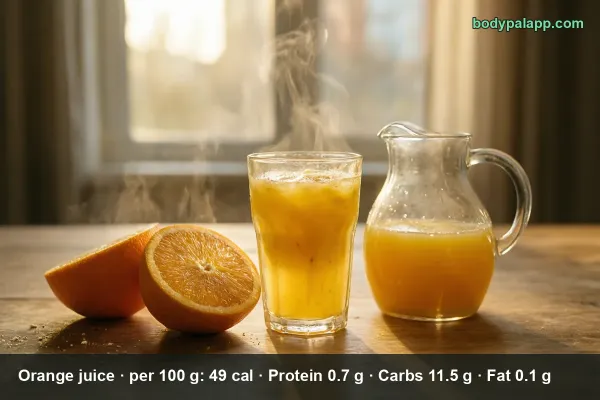
Juice of one orange calories come to 39 for the juice of 1 orange (86 g), or 45 per 100 g. The number to notice is the split: 90% of those calories come from carbohydrates, mostly sugars, with 7.2 g of sugars per orange and only 0.2 g of fiber. Portion size decides almost everything else.
39kcal
1 orange · 86 g, freshly squeezed, raw
6%protein
0.6 gProtein
9 gCarbs
0.2 gFat
How to burn off 39 kcal
—Walking, brisk
—Jogging
—Cycling, moderate
—Swimming
Skip the math. BodyPal counts these calories from your steps and workouts automatically.
Nutrition facts
Freshly squeezed, raw · per 86 g
Calories
39 kcal
Protein
0.6 g
Carbohydrate
8.9 g
Fat
0.2 g
Saturated fat
0 g
Cholesterol
0 mg
Sodium
1 mg
Potassium
172 mg
Iron
0.2 mg
Source: USDA FoodData Central
🛡️
Verified nutrition data
Numbers on this page come from USDA FoodData Central, the U.S. Department of Agriculture’s food composition database, and from manufacturer labels where a branded product is named. Last verified September 2026. How we verify our data →
Juice of one orange: calories, protein and sodium by serving
Percent of daily value uses the FDA reference of 2,000 kcal a day.
Serving
kcal
Protein
Carbs
Fat
Sodium
% DV kcal
1 orange (86 g)
39
0.6 g
8.9 g
0.2 g
1 mg
2%
1 cup (248 g)
112
1.7 g
25.8 g
0.5 g
2 mg
6%
1 fl oz (31 g)
14
0.2 g
3.2 g
0.1 g
0 mg
1%
100 g
45
0.7 g
10.4 g
0.2 g
1 mg
2%
3 × 1 orange (86 g)
116
1.8 g
3 mg
5 × 1 orange (86 g)
194
3 g
4 mg
One orange is 39 calories, a cup is 112
The juice of 1 orange (86 g) adds up to 39 calories, about 2% of the daily value for calories. On its own that is a small number, and a single squeezed orange rarely matters much in a day. The catch is that few people stop at one orange. A full glass is where the total climbs.
A cup (248 g) holds 112 calories, which is 6% of the daily value. That is close to what you get from squeezing three oranges: 3 × the single-orange serving is 258 g and 116 calories. Two oranges give 172 g and 77 calories. Squeeze 5 for a tall glass and you reach 430 g and 194 calories, a figure that starts to look like a snack rather than a side.
Small pours stay small. One fl oz (31 g) is 14 calories, so a splash in sparkling water or a marinade barely registers. If you are tracking, measure the glass rather than counting oranges. Fruit size varies a lot, and the cup figure is the steadier reference point for logging.
Nine tenths of the calories are carbs
The calorie split is lopsided: 90% from carbohydrates, 6% from protein and 4% from fat. Per 100 g, the juice carries 10.4 g of carbs, 0.7 g of protein and 0.2 g of fat. Saturated fat and cholesterol both read 0. This is a carb drink, plain and simple.
Most of those carbs are sugars. Of the 10.4 g of carbohydrate in 100 g, 8.4 g are sugars and just 0.2 g is fiber. In a cup that becomes 25.8 g of carbs and 20.8 g of sugars. The sugar here is the fruit's own, since this is fresh, raw juice with nothing added, but the label does not care where it came from: a cup is still 20.8 g of sugars.
Protein is a rounding error. The juice of one orange gives 0.6 g, and a cup gives 1.7 g, which is 3% of the daily value. Juice brings carbs and flavor and very little else. It works better next to food than in place of it.
Sugar is the row to watch, not sodium
Sodium is a non-issue. The juice of one orange has 1 mg, a cup has 2 mg, and both round to 0% of the 2300 mg daily value. If you watch salt, orange juice is not where it hides.
Sugar is the number that moves with the glass. One orange's juice has 7.2 g, a cup has 20.8 g, and even 1 fl oz carries 2.6 g. Fiber barely shows up next to it: 0.2 g per orange and 0.5 g per cup, against a daily value of 28 g. The juice delivers its sugars with almost no fiber to go with them, which is why the size of the pour matters more here than with most fruit servings.
Potassium is the quiet upside. Per 100 g, the juice has 200 mg, measured against a daily value of 4700 mg. If you want juice in your day, one cup gives you the flavor and some potassium. Refilling it mostly adds more sugar and calories.
Treat a glass as part of a meal
Because the juice is nearly all carbs, it pairs best with foods that bring what it lacks: protein and fat. Eggs, Greek yogurt, cottage cheese or whole-grain toast with nut butter round out a breakfast where the orange juice supplies the fruit and the sweetness. On its own, a glass is a quick drink, not a meal.
Portion is the lever you control. A small glass keeps the total near the single-orange figure of 39 calories, while a full cup at 112 calories counts like a light snack. If you are cutting calories, pour less, or stretch the juice with sparkling water so the flavor lasts longer for the same calories.
Logging is easier when you count the glass, not the fruit. BodyPal can log juice from a photo, and the cup and fl oz servings on this page make manual entries quick. Pick the serving that matches your glass and the numbers follow.
How does juice of one orange compare?
Here is how the juice of one orange compares with our other orange juice pages, per 100 g and per usual serving.
Verdict: Fresh squeezed and fresh orange juice match this page exactly at 45 calories per 100 g and 112 per cup, so squeezing your own changes nothing on the label. Generic orange juice runs a touch higher at 49 calories and 11.5 g of carbs per 100 g, about 1.1 times this page, so if you count tightly, fresh-squeezed is the slightly leaner pick.
Juice of one orange FAQs
How many calories are in the juice of one orange?
About 39 calories in the 86 g of juice one orange yields.
Is orange juice good for weight loss?
The juice of one orange is 39 calories, while a full cup (248 g) is 112 calories. It has only 0.2 g of fiber per 100 g.
Fresh squeezed vs store-bought orange juice calories?
Fresh raw orange juice has 45 calories per 100 g, and chilled orange juice from concentrate has 49 per 100 g.
How much sugar is in the juice of one orange?
About 7.2 g of sugar and 8.9 g of carbs, with 0.6 g of protein.
How many calories are in a cup of fresh orange juice?
A cup (248 g) of freshly squeezed orange juice has 112 calories, about 6% of the daily value. It also carries 25.8 g of carbs, 20.8 g of sugars and 1.7 g of protein.
How many calories are in the juice of two oranges?
The juice of two oranges (172 g) has about 77 calories and 1.2 g of protein. Three oranges' worth, 258 g, comes to 116 calories, a little more than a standard cup.
How many calories are in a fluid ounce of orange juice?
One fl oz (31 g) of fresh orange juice has 14 calories, with 3.2 g of carbs and 2.6 g of sugars. A splash in sparkling water or a dressing adds very little.
Does fresh orange juice have any fiber?
Very little: 0.2 g in the juice of one orange and 0.5 g in a cup, against a daily value of 28 g. Most of the carbs come as sugars, 8.4 g per 100 g.
How much potassium is in fresh orange juice?
Fresh orange juice has 200 mg of potassium per 100 g. The daily value used here is 4700 mg, so a glass contributes but covers only a modest share of it.
Is orange juice high in sodium?
No. The juice of one orange has 1 mg of sodium and a cup has 2 mg, both 0% of the 2300 mg daily value. Salt is not a concern with fresh juice.