
How many calories are in orange juice?
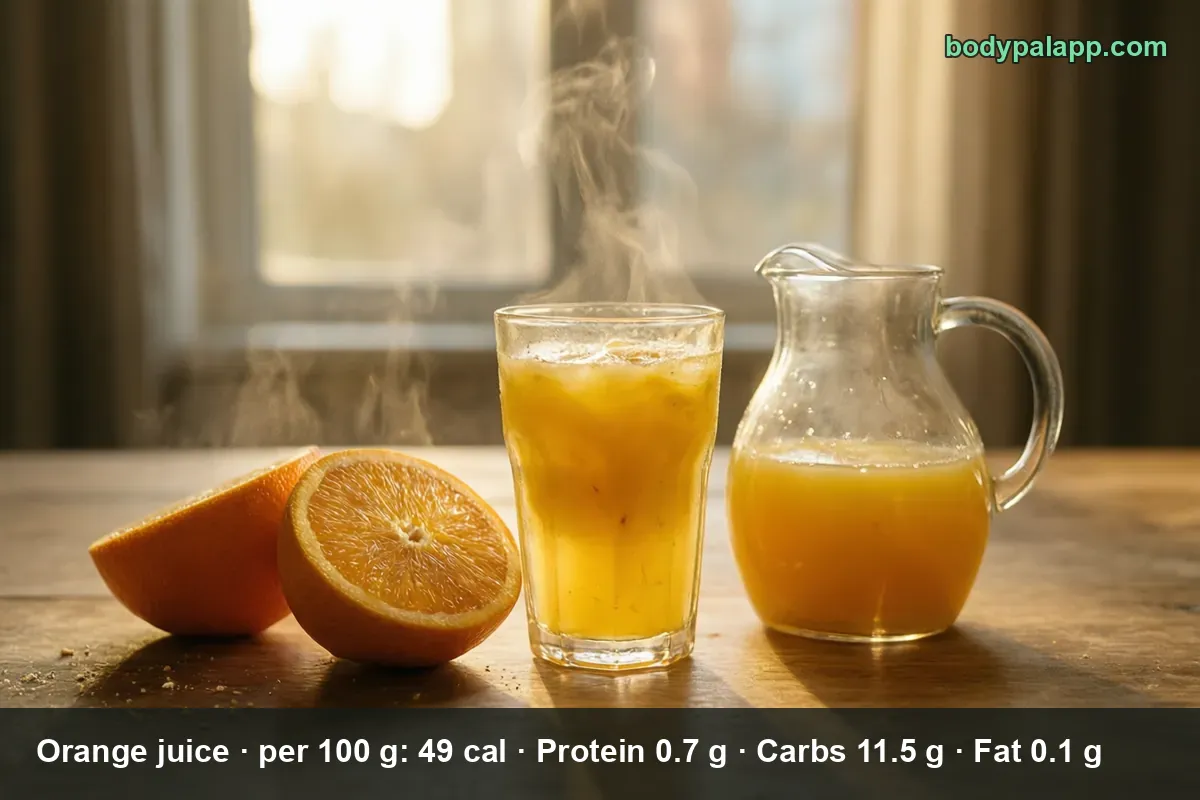
A 1-cup glass of chilled orange juice, the 8 fl oz kind you pour from the carton, weighs 249 g and carries 122 calories. Per 100 g the juice runs 49 calories, which makes it one of the lighter things in the fridge by weight and one of the easiest to overpour by volume.
On this page
- Orange juice quick facts
- US servings from a small glass to a tall one
- Concentrate calcium and light versions
- Sugar potassium and the rows that matter
- How does orange juice compare?
- Most popular orange juice brands
- FAQ
Orange juice quick facts
Almost nobody squeezes their own before work. The American glass of orange juice comes out of a chilled carton labeled 100% juice, most of it rebuilt from concentrate at the plant, so the row that matches your kitchen is USDA SR Legacy 169100, "Orange juice, chilled, includes from concentrate". It carries a full nutrient profile and a real household cup measure, which is why every number below is scaled from it.
| Nutrient | Per 100 g | Per 1 cup (249 g) | % Daily Value |
|---|---|---|---|
| Calories | 49 | 122 | — |
| Total fat | 0.12 g | 0.3 g | 0% |
| Saturated fat | 0.01 g | 0.0 g | 0% |
| Carbohydrate | 11.54 g | 28.7 g | 10% |
| Dietary fiber | 0.3 g | 0.7 g | 3% |
| Total sugars | 8.31 g | 20.7 g | — |
| Protein | 0.68 g | 1.7 g | 3% |
| Sodium | 2 mg | 5 mg | 0% |
| Potassium | 178 mg | 443 mg | 9% |
% Daily Value is based on a 2,000-calorie diet.
Verified nutrition data
Numbers on this page come from USDA FoodData Central, the U.S. Department of Agriculture’s food composition database, and from manufacturer labels where a branded product is named. Last verified September 2026. How we verify our data →
There is no added sugars row here, and that is not an oversight: the SR Legacy edition of this record does not publish the field, and 100% juice has no added sugar to publish. Cholesterol is 0 mg, as you would expect from a fruit.
US servings from a small glass to a tall one
| Serving | Weight | Calories |
|---|---|---|
| 1 fl oz | 31 g | 15 kcal |
| 1 oz by weight | 28 g | 14 kcal |
| Small glass, 6 fl oz | 187 g | 92 kcal |
| 1 cup, 8 fl oz | 249 g | 122 kcal |
| Tall glass, 12 fl oz | 374 g | 183 kcal |
| Per 100 g | 100 g | 49 kcal |
Only the 1-cup line is a USDA household measure. The 6 fl oz, 12 fl oz and ounce rows are our own arithmetic from the USDA 100 g figure, not USDA servings.
Notice how little the juice has to do with it. The liquid never changes; the glass does. A small juice glass costs 92 calories, the standard cup 122, and the tall tumbler you fill when you are thirsty 183. That last one is almost exactly two small glasses, and pouring the standard cup instead of the tumbler saves 61 calories a morning without changing what you drink.
The fluid ounce and the ounce also part ways here. Eight fluid ounces of juice weigh 249 g; eight ounces on a scale is 227 g. US cartons and glasses are sold by fluid ounce, so 122 is the figure that belongs on your log.
Brand labels land a shade under the generic row. Tropicana's cartons put 110 calories on an 8 fl oz serving, working from about 46 calories per 100 g, because the label pours 240 ml where USDA weighs 249 g. The 10 fl oz single-serve bottle is 139 and the 12 fl oz is 170.
Concentrate calcium and light versions
| Version | Per 100 g | Serving | Calories |
|---|---|---|---|
| Chilled with added calcium | 47 kcal | 1 cup (249 g) | 117 kcal |
| Chilled with calcium and vitamin D | 47 kcal | 1 cup (249 g) | 117 kcal |
| Chilled with calcium and vitamins A, D, E | 49 kcal | 1 cup (249 g) | 122 kcal |
| Frozen concentrate diluted with 3 volumes water | 37 kcal | 1 cup (249 g) | 92 kcal |
| Frozen, reconstituted (survey average) | 42 kcal | 1 cup (249 g) | 105 kcal |
| Light orange juice, no pulp | 21 kcal | 1 cup (249 g) | 52 kcal |
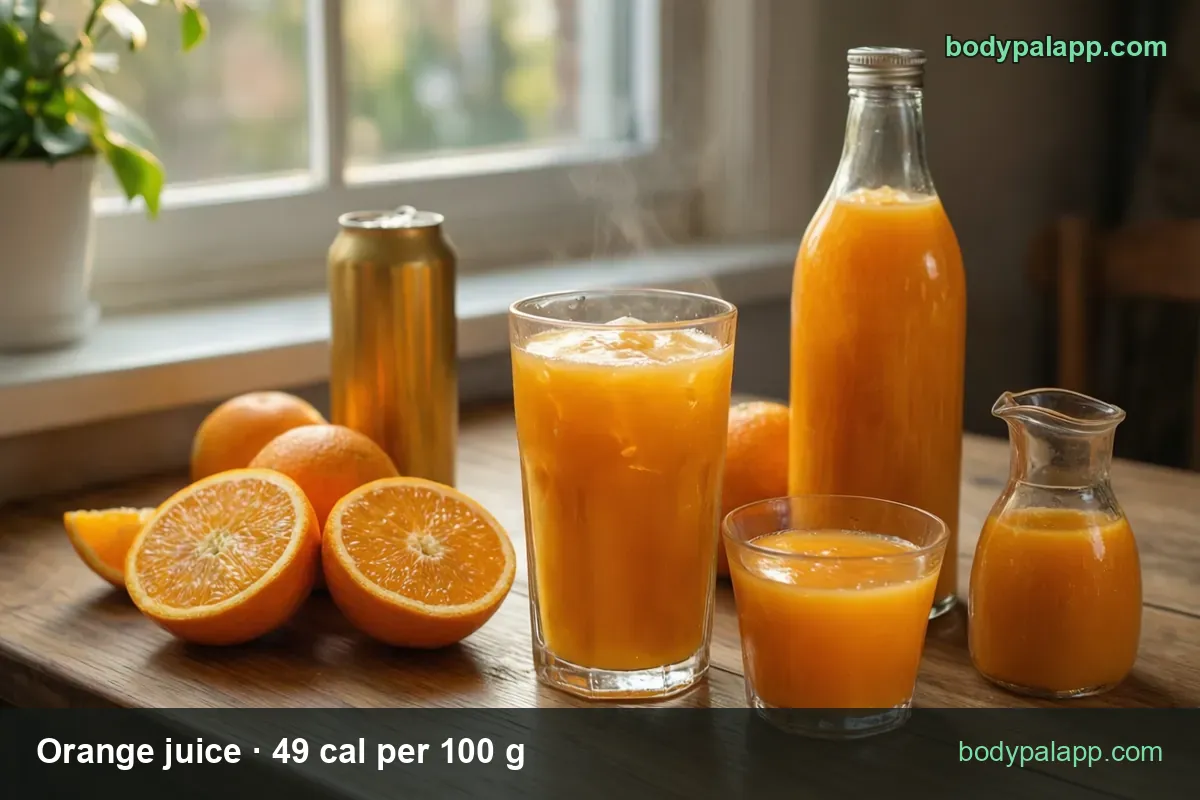
Fortification is a rounding error. Adding calcium, or calcium plus vitamins A, D and E, moves the cup by five calories at most, so pick the carton for what the minerals do for you, not for the count.
Frozen concentrate is where the trap sits. Mixed at home with three volumes of water it lands at 37 calories per 100 g and 92 a cup, lighter than the chilled carton because home mixing tends to run thinner than the plant's target. The survey average for reconstituted juice, 42, sits in between and is the honest number if you are not measuring your water.
Light juice, at 21 calories per 100 g, is the lightest row anywhere on this page and less than half the poured juice at 52 a cup. It gets there by dilution, not by magic, and it is a beverage rather than 100% juice, so it does not count as fruit.
Sugar potassium and the rows that matter
Twenty point seven grams of sugar in a cup sounds alarming until you see which line it lands on. Total sugars have no Daily Value on the FDA Nutrition Facts label, and the 50 g limit people quote is the Daily Value for added sugars, a different row entirely. Every gram in this glass came out of the orange, so the two numbers are not comparable and should not be added together.
The real story is the mineral split. A cup delivers 443 mg of potassium, 9% of the Daily Value, against 5 mg of sodium, which rounds to 0%. Very few drinks in an American refrigerator do that. Protein is negligible at 1.7 g and fat is effectively absent at 0.3 g, so the juice is carbohydrate, water, potassium and vitamin C, and that is the whole of it.
Fiber is the one thing the glass leaves behind: 0.7 g per cup, 3% of the Daily Value. That is why MyPlate counts one cup of 100% juice toward the fruit group but advises that most of your fruit come from whole fruit, and why the Dietary Guidelines for Americans treat juice as a partial substitute rather than a replacement. If you are watching sugar load at breakfast, the small glass with a piece of fruit beats the tall glass alone.
How does orange juice compare?
| Juice | Per 100 g | US serving | Calories |
|---|---|---|---|
| Chilled, includes from concentrate | 49 kcal | 1 cup (249 g) | 122 kcal |
| Canned, unsweetened | 47 kcal | 1 cup (249 g) | 117 kcal |
| Raw, freshly squeezed | 45 kcal | 1 cup (248 g) | 112 kcal |
| Frozen concentrate, undiluted | 148 kcal | 1 cup (262 g) | 388 kcal |
Our take: the first three are the same drink within ten calories a cup, and choosing between them on calories is wasted effort. Squeezing your own saves 10 calories over the carton, which is not a reason to own a juicer. The fourth row is the one to respect, because undiluted concentrate is more than three times the chilled juice per cup at 388 calories, and anyone spooning it straight into a smoothie is logging a dessert. Dilute it, then count it.
Most popular orange juice brands in the United States
Ranked by how widely each product appears among foods sold in the United States, from the BodyPal food database of over 3.3 million products. Calories are the figures printed on each Nutrition Facts label, checked against USDA FoodData Central.
| Product | Calories (per 100 g) |
|---|---|
| Tropicana Orange Juice | 46 cal |
| Tropicana 100% Orange Juice | 46 cal |
| Tropicana No Pulp 100% Orange Juice | 46 cal |
| Tropicana Orange Juice 10 fl oz | 47 cal |
| Tropicana 100% Orange Juice 12 fl oz | 48 cal |
| Tropicana Orange Juice 4.23 fl oz | 48 cal |
Brand popularity: BodyPal food database. Nutrition: manufacturer labels / USDA FoodData Central.
Orange juice FAQs
How many calories are in a glass of orange juice?
A standard 8 fl oz glass holds 249 g of chilled orange juice and 122 calories. A small 6 fl oz glass is 92 and a tall 12 fl oz pour is 183. The juice itself is fixed at 49 calories per 100 g, so the glass you grab decides the number.
How many calories in 8 oz of orange juice?
Eight fluid ounces is 249 g and 122 calories, using the USDA row for chilled juice including from concentrate. Eight ounces by weight is smaller at 227 g, which is 111 calories by our own arithmetic from the 100 g figure. Cartons and glasses in the US are sold by fluid ounce, so 122 is the number you want.
How much sugar is in orange juice?
A cup carries 20.7 g of total sugars, from 8.31 g per 100 g. All of it is fruit sugar that came with the orange, so the FDA gives total sugars no Daily Value. Only added sugars have one, at 50 g a day, and 100% juice has none.
Does orange juice have added sugar?
No, not in 100% orange juice. The USDA SR Legacy record for chilled juice does not publish an added sugars figure at all, because the category has none by definition. Every one of the 20.7 g of sugars in a cup came out of the fruit. Juice drinks and orangeades are a different product.
Is fresh squeezed orange juice lower in calories?
Slightly: raw squeezed juice is 45 calories per 100 g against 49 for the chilled carton, so a cup is 112 instead of 122. Ten calories is not much of a reason to buy a juicer, and the raw row is thinner in carbohydrate too, at 10.4 g against 11.54 g.
Is orange juice from concentrate higher in calories?
Not once it is poured: chilled juice from concentrate is the 49 per 100 g main row here, and reconstituted frozen concentrate is 42, or 105 a cup. The 148 you see on frozen concentrate is the syrup in the can before three volumes of water go in.
How much potassium is in orange juice?
A cup gives 443 mg, which is 9% of the 4,700 mg Daily Value, from 178 mg per 100 g. Sodium runs the other way, 5 mg a cup, or 0%. That mineral split is the strongest thing on the label, stronger than the 1.7 g of protein.
How many calories in a 12 oz glass of orange juice?
A 12 fl oz pour is 374 g and 183 calories, our own arithmetic from the USDA 100 g figure rather than a USDA serving. It is almost exactly two small 6 oz glasses, 92 each, and it brings 31.1 g of sugars and 666 mg of potassium with it.
Similar foods
- Mango Juice — 121 cal per glass
- Juice — 125 cal per cup
- Juice Box — 100 cal per box
- Chai Tea — 184 cal per tall glass, 12 fl oz
- Fruit Juice — 126 cal per cup
- Fruit Punch — 117 cal per cup
Count it without the math
Point the camera at the glass and BodyPal counts the juice for you, pour size and all.


How long does it take to burn off orange juice?
A 1-cup (249 g) serving is 122 kcal. Enter your weight and the amount you ate to see how long it takes you to burn that off:
lb
| Activity | Time to burn 122 kcal |
|---|---|
| Walking, brisk | 24 min |
| Cycling, moderate | 15 min |
| Swimming, moderate | 17 min |
| Jogging | 14 min |
| Weight training, moderate | 27 min |
Times are for a 155 lb adult at a steady pace; change the weight to see yours. The amount is set to the portion in the text (249 g); change it to what you actually ate. BodyPal works this out from your steps automatically.
Want the bigger picture? Calculate your daily calorie needs — your maintenance figure, a target for losing or gaining, and the date you get there.