Fruit punch calories come to 117 for 1 cup (248 g) and 47 per 100 g of the canned drink with added nutrients. Every one of those calories comes from carbohydrate, and nearly all of it is sugar: 28 g in a single cup. There is no protein, fat or meaningful fiber to slow it down.
117kcal
1 cup · 248 g, canned, with added nutrients
0%protein
0 gProtein
30 gCarbs
0 gFat
How to burn off 117 kcal
—Walking, brisk
—Jogging
—Cycling, moderate
—Swimming
Skip the math. BodyPal counts these calories from your steps and workouts automatically.
Nutrition facts
Canned, with added nutrients · per 248 g
Calories
117 kcal
Protein
0 g
Carbohydrate
30 g
Fat
0 g
Saturated fat
0 g
Cholesterol
0 mg
Sodium
94 mg
Potassium
77 mg
Iron
0.2 mg
Source: USDA FoodData Central
🛡️
Verified nutrition data
Numbers on this page come from USDA FoodData Central, the U.S. Department of Agriculture’s food composition database, and from manufacturer labels where a branded product is named. Last verified September 2026. How we verify our data →
Fruit punch: calories, protein and sodium by serving
Percent of daily value uses the FDA reference of 2,000 kcal a day.
Serving
kcal
Protein
Carbs
Fat
Sodium
% DV kcal
1 cup (248 g)
117
0 g
29.6 g
0 g
94 mg
6%
Juice box (210 g)
101
0 g
25.1 g
0 g
21 mg
5%
Powdered mix (262 g)
97
0 g
24.8 g
0 g
18 mg
5%
100 g
47
0 g
11.9 g
0 g
38 mg
2%
3 × 1 cup (248 g)
350
0 g
283 mg
5 × 1 cup (248 g)
583
0 g
471 mg
Refills turn 117 calories into 350
A single cup of fruit punch is 117 calories, about 6 percent of the daily value. That sounds modest, and it is, until the glass gets refilled. Fruit punch is a drink people pour without measuring, at parties, with lunch, from a jug in the fridge.
Two cups (496 g) bring the total to 233 calories. Three cups (744 g) reach 350. Five cups, which is roughly what a large pitcher shared between a couple of people can disappear into over an afternoon, add up to 583 calories from 1,240 g of drink. None of that comes with food you would chew, so it rarely registers as a meal.
Packaged formats keep the number smaller. A juice box (210 g) is 101 calories, about 5 percent of the daily value, and a serving made from powdered mix (262 g) is 97. If you want a built-in stopping point, the juice box does the portion control for you. The open jug does not.
Every calorie is carbohydrate
The calorie split is as lopsided as food data gets: 100 percent carbohydrate, 0 percent protein, 0 percent fat. Per 100 g, fruit punch carries 11.9 g of carbs, and 11.3 g of that is sugar. Fiber barely shows up at 0.2 g.
Scaled to a cup, that is 29.6 g of carbohydrate, 28 g of sugar and 0.5 g of fiber. Protein sits at 0 g, which is 0 percent of the daily value. In practical terms, fruit punch is flavored sugar water with some added nutrients, not a fruit serving.
That matters for fullness more than for the calorie count itself. A drink with no protein, fat or fiber does little to take the edge off hunger, so the 117 calories tend to stack on top of whatever you eat next rather than replace it.
Sugar is the row to watch, not sodium
The sugar line is the headline number. A cup holds 28 g, a juice box 23.7 g and a powdered-mix serving 24.2 g. Whichever format you buy, almost the whole drink by calories is sugar, so the formats differ mainly in how much of it you pour.
Sodium is not a concern here. One cup has 94 mg, about 4 percent of the daily value, and the juice box drops to 21 mg, roughly 1 percent. Even five cups land at 471 mg. If you watch salt closely, fruit punch is not where it is hiding.
Potassium is low too, at 31 mg per 100 g, and there is no cholesterol or saturated fat. The label is simple: carbohydrate in, very little else.
Drink it with food, not instead of it
Fruit punch works best as a deliberate treat rather than a default drink. Pour one cup, drink it with a meal that has protein and fiber, and switch to water or unsweetened drinks for refills. The meal does the filling; the punch is there for taste.
Brand bottles and cans vary in size, so check what you are actually holding. Arizona Fruit Punch, Gatorade Fruit Punch Thirst Quencher and Snapple Fruit Punch all sit in the same sweet-drink lane, and a large bottle can hold several cups at once. Counting cups rather than bottles keeps the total honest.
If you track what you drink, BodyPal can log fruit punch from a photo of the glass, which helps with the refills that are easy to forget. Treat the 117 per cup as your unit and add one for every pour.
How does fruit punch compare?
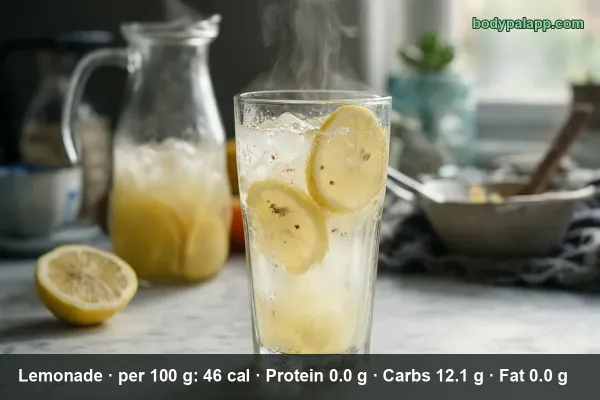
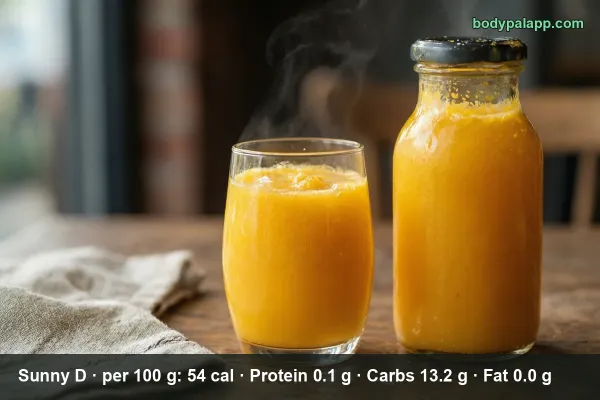
Here fruit punch sits next to lemonade, Sunny D and a fruit smoothie, compared per 100 g and per usual serving.
Verdict: For the fewest calories, fruit punch at 47 per 100 g and lemonade at 46 are effectively tied, while Sunny D adds calories and 61 mg of sodium for no real gain. If you want a drink that does some filling, pick the fruit smoothie: it runs about 1.4 times the calories at 66 per 100 g, but it is the only one with protein, at 2.3 g.
Most popular fruit punch brands in the United States
Ranked by popularity in the BodyPal database
# Productkcal / 100 g
1Arizona Fruit Punch8 fl oz · 240 g42 kcal
2Arizona Fruit Punch Fruit Juice Cocktail6.75 fl oz · 200 g30 kcal
3Arizona Fruit Punch Juice Cocktail8 fl oz · 240 g38 kcal
4Gatorade Fruit Punch Thirst Quencher1 bottle · 360 g22 kcal
5Snapple Fruit Punch8 fl oz · 240 g42 kcal
Bottled punches and sports drinks are sweetened to different strengths, so their labels read from 22 to 42 calories per 100 g instead of 47. Source: manufacturer labels / USDA FoodData Central.
Fruit punch FAQs
How many calories are in a cup of fruit punch?
A cup (248 g) has 117 calories and 29.6 g carbs, almost all of it sugar.
Is fruit punch good for weight loss?
A cup adds 117 calories and 28.0 g sugar with 0 g protein and 0 g fat, so the calories come only from sugar.
Fruit punch vs lemonade: which has more calories?
Fruit punch has 47 calories per 100 g and lemonade 46, so a cup of either lands near 117 calories.
How much sugar is in fruit punch?
There is 11.3 g of sugar per 100 g, which works out to 28.0 g in an 8 fl oz cup (248 g).
How many calories are in a fruit punch juice box?
A fruit punch juice box (210 g) has 101 calories, about 5 percent of the daily value. It carries 25.1 g of carbohydrate, 23.7 g of it sugar, with no protein or fat.
How many calories are in fruit punch made from powdered mix?
A 262 g serving made from powdered fruit punch mix has 97 calories. It holds 24.8 g of carbohydrate and 24.2 g of sugar, and only 18 mg of sodium.
Does fruit punch have any protein or fat?
No. Fruit punch has 0 g of protein and 0 g of fat per cup, so 100 percent of its calories come from carbohydrate, mostly sugar.
How much sodium is in fruit punch?
One cup of fruit punch has 94 mg of sodium, about 4 percent of the daily value. A juice box has 21 mg, so sodium is a minor row on this label.
How many calories are in 3 cups of fruit punch?
Three cups of fruit punch (744 g) contain 350 calories and 283 mg of sodium. Two cups come to 233 calories, so refills add up quickly.