
How many calories are in a fruit smoothie?
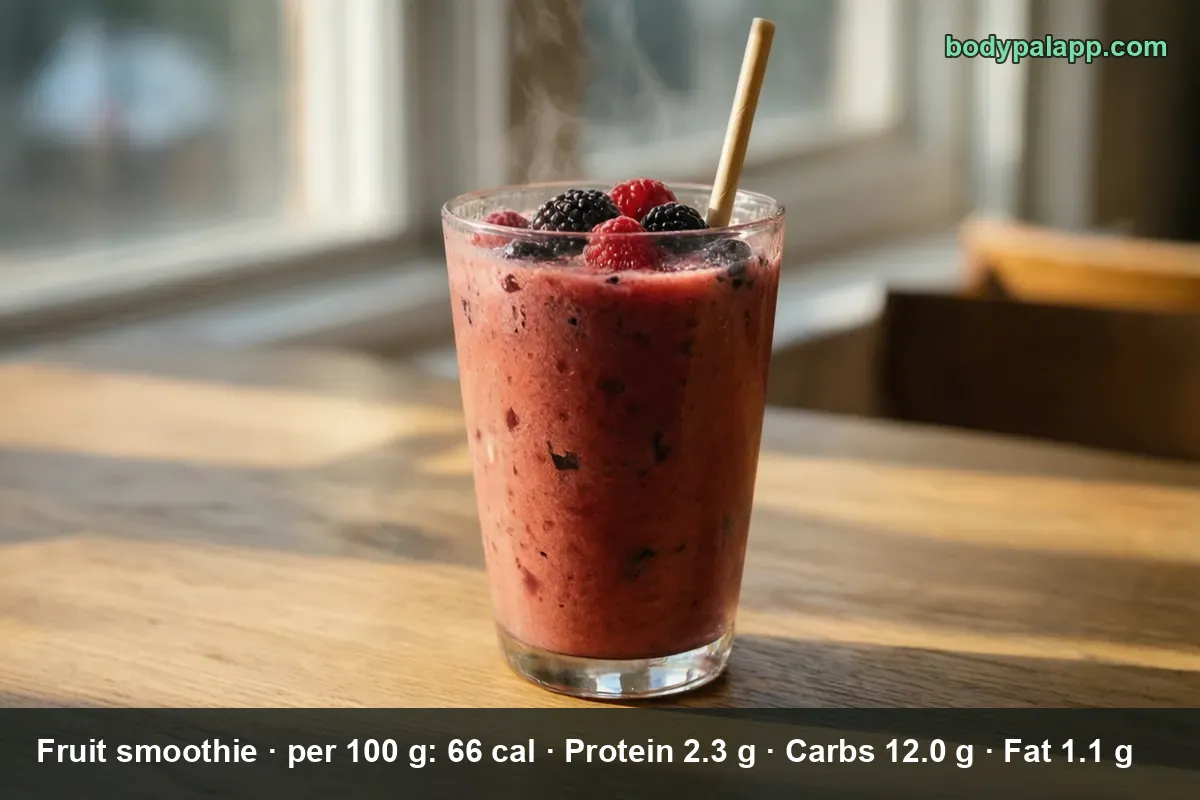
A 1-cup pour of fruit smoothie is 143 calories, and the blend itself runs 66 calories per 100 g — light for something that drinks like dessert. The catch is the cup. Order a medium at a smoothie counter and you are handed 864 g, which is 570 calories in one drink.
On this page
- Fruit smoothie quick facts
- US smoothie servings from one ounce to a large cup
- Light dairy-free and juice-based smoothies
- Sugar and fiber are the rows to watch
- How does a fruit smoothie compare
- Most popular fruit smoothie brands
- FAQ
Fruit smoothie quick facts
The record behind every number here is FNDDS 2705513, "Fruit smoothie, NFS", the USDA survey entry for a smoothie nobody has described further: fruit plus something dairy, blended. That is what most people actually hold — a cup from the blender at home, or a plastic cup from the counter, with no recipe attached.
One detail worth knowing: the separate USDA record for a smoothie "with whole fruit and dairy" (2705514) carries the exact same values, gram for gram. The unspecified entry is not a rough guess standing in for real data. It is the category's base profile.
| Nutrient | Per 100 g | Per 1 cup (216 g) | % Daily Value |
|---|---|---|---|
| Calories | 66 | 143 | — |
| Total fat | 1.1 g | 2.4 g | 3% |
| Saturated fat | 0.59 g | 1.3 g | 6% |
| Carbohydrate | 11.98 g | 25.9 g | 9% |
| Dietary fiber | 1.1 g | 2.4 g | 8% |
| Total sugars | 8.91 g | 19.2 g | — |
| Protein | 2.32 g | 5.0 g | 10% |
| Sodium | 28 mg | 60 mg | 3% |
% Daily Value is based on a 2,000-calorie diet.
Verified nutrition data
Numbers on this page come from USDA FoodData Central, the U.S. Department of Agriculture’s food composition database, and from manufacturer labels where a branded product is named. Last verified September 2026. How we verify our data →
Two rows you will not find above: added sugars and trans fat. USDA does not publish either one for the FNDDS smoothie records, so there is no honest way to split the 19.2 g of total sugars into fruit sugar, milk sugar and anything stirred in. The Daily Value reference amounts behind the percentages come from FDA.
Cholesterol and potassium do get published: 4 mg and 174 mg per 100 g, which works out to 9 mg cholesterol (3% DV) and 376 mg potassium (8% DV) in a cup. Potassium is the quiet win in a fruit smoothie — a cup covers nearly a tenth of the day on a nutrient most people fall short on.
US smoothie servings from one ounce to a large cup
| Serving | Weight | Calories |
|---|---|---|
| 1 oz | 28 g | 19 kcal |
| One cup, home blender | 216 g | 143 kcal |
| Small, smoothie counter | 540 g | 356 kcal |
| Medium, smoothie counter | 864 g | 570 kcal |
| Large, smoothie counter | 1080 g | 713 kcal |
| Per 100 g | 100 g | 66 kcal |
The cup, small, medium and large weights are USDA's own household portions for this record, not sizes we invented. The ounce row and the per-100-g row are our own arithmetic from the USDA 100 g figure, not USDA servings.
Look at the jump. A medium is exactly four times the cup by weight, and four times the calories: 143 becomes 570. Nothing about the drink changed. That is the single biggest reason smoothie logs go wrong — people picture the glass they make at home and log a drink that weighs almost a kilogram. If you buy rather than blend, weigh or ask, then log the cup size you were actually given.
For anyone converting from fluid ounces, a 16 fl oz cup is close to 432 g of smoothie, or about 285 calories by our arithmetic from the 100 g figure. A 32 fl oz cup lands right on the USDA medium at 864 g.
Light dairy-free and juice-based smoothies
| Version | Per 100 g | Typical serving | Calories |
|---|---|---|---|
| Fruit smoothie, NFS | 66 kcal | 1 cup (216 g) | 143 kcal |
| Light fruit smoothie | 53 kcal | 1 cup (216 g) | 114 kcal |
| With whole fruit, no dairy | 54 kcal | 1 cup (216 g) | 117 kcal |
| Juice-based, no dairy | 51 kcal | 1 cup (216 g) | 110 kcal |
| Juice-based with dairy | 65 kcal | 1 cup (216 g) | 140 kcal |
| With added protein | 79 kcal | 1 cup (216 g) | 171 kcal |
| Bottled fruit smoothie | 50 kcal | 1 cup (216 g) | 108 kcal |
The per-cup calories for the added-protein and bottled versions are our own arithmetic from their USDA 100 g figures rather than published USDA servings; the rest come straight from the 216 g cup portion.
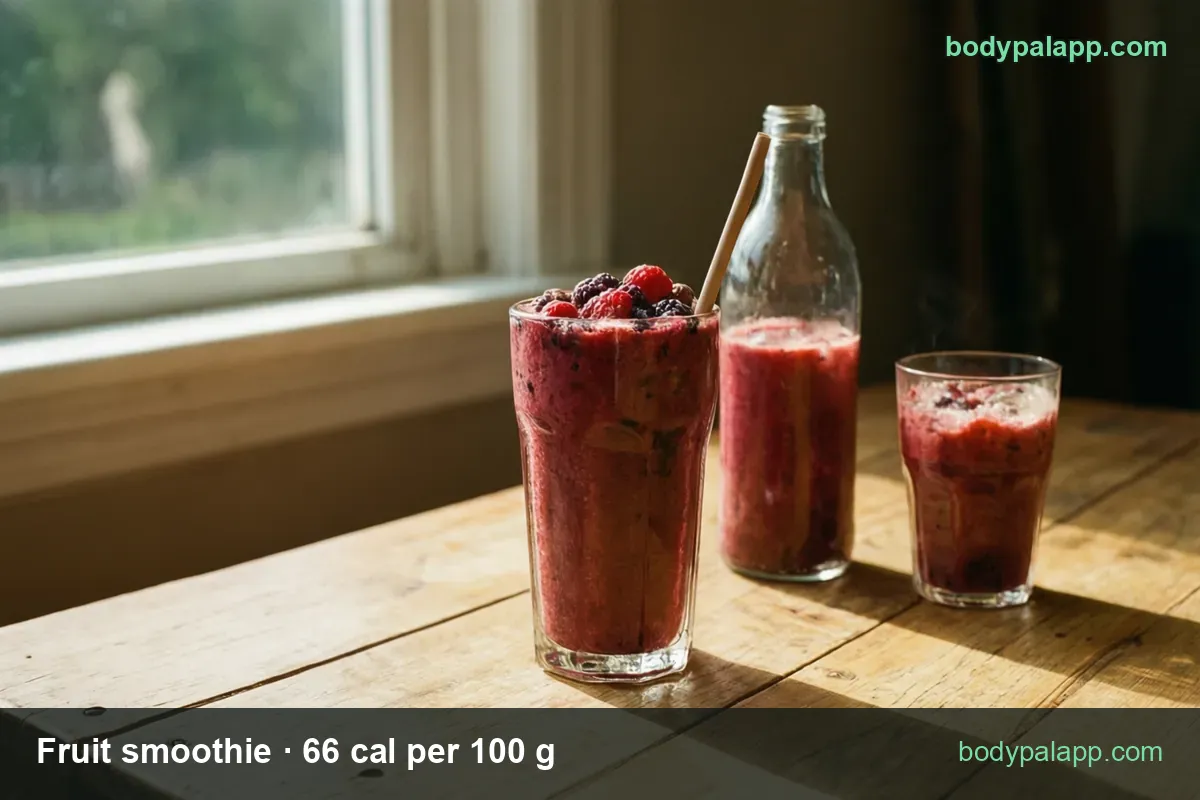
Here is the surprise in that table. Dropping the dairy saves far less than people expect — 66 falls to 54 per 100 g, a cut of 18%, worth 26 calories on a cup. What it does cut is protein, from 2.32 g to 0.61 g per 100 g. The light version does the opposite: it is the lowest-calorie whole-fruit record at 53 and carries more protein than the standard blend, 2.61 g against 2.32 g per 100 g, because the calories come out as fat and fruit while skim milk stays in.
Bottled is the lightest USDA fruit smoothie record at 50 per 100 g, with juice-based dairy-free next at 51. Bottled also has the thinnest fiber row of the group, 0.6 g per 100 g against 1.1 g for a fresh blend, and the second-highest sugars at 10.05 g. Light and cheap in calories does not mean the same drink.
Store brands sit in the same band. USDA's branded records put an 8 fl oz serving of Odwalla Mango Tango Fruit Smoothie Blend at 149 calories, Columbia Gorge Organic Blue Green Spirulina at 120 and the plain Odwalla Fruit Smoothie Blend at 130, while a Tree Top Banana Strawberry pouch is 101 and a Fruchi Island Splash pouch 69. Those per-serving figures are our arithmetic treating 1 ml of smoothie as 1 g.
Sugar and fiber are the rows to watch
A cup carries 19.2 g of total sugars and 2.4 g of fiber, or 8% of the fiber Daily Value. USDA does not publish added sugars for these records, so nobody — including us — can tell you what share of those 19.2 g was stirred in as syrup, honey or sweetened yogurt versus what came from the fruit and the milk. That matters, because the Dietary Guidelines cap applies to added sugars only, and naturally occurring fruit and dairy sugars do not count against it. If you are watching that limit, the sweetener you add at home is the part you control.
The fiber row is the genuine argument for blending over juicing. A juice-based smoothie without dairy holds 1 g of fiber per 100 g against 1.5 g for the whole-fruit dairy-free blend — blending keeps what juicing throws away. MyPlate counts 100% fruit juice and blended fruit toward the fruit group, but leans on whole fruit for exactly this reason.
Sodium is a non-issue at 60 mg a cup, 3% of the Daily Value. Saturated fat is 1.3 g, 6%. If you are cutting anything in a fruit smoothie, it is portion size and syrup, not salt or fat.
How does a fruit smoothie compare
| Drink | Per 100 g | USDA serving | Calories |
|---|---|---|---|
| Fruit smoothie, NFS | 66 kcal | 1 cup (216 g) | 143 kcal |
| Fruit and vegetable smoothie, with dairy | 64 kcal | 1 fl oz (27 g) | 17 kcal |
| Fruit and vegetable smoothie, bottled | 53 kcal | 1 fl oz (27 g) | 14 kcal |
| Licuado or batido | 75 kcal | 1 fl oz (27 g) | 20 kcal |
USDA lists those three by the fluid ounce, which is not how anyone drinks them. Poured into the same 216 g cup, our arithmetic from their 100 g figures gives 138 calories for the fruit-and-vegetable blend with dairy, 114 for the bottled one and 162 for a licuado.
Our take: adding vegetables to the blender barely moves the number — 64 against 66 per 100 g is a rounding error, so choose it for the fiber and potassium, not to save calories. The licuado is the densest drink here at 75 per 100 g, because it is built on milk and often sugar rather than on fruit and ice. For weight loss, the lever is the cup, not the recipe: a home-sized 216 g glass of any of these lands between 110 and 165 calories, while a bought medium of the plain fruit smoothie is 570. For staying full, keep the dairy in — a cup with it holds 5.0 g of protein, and the dairy-free version holds close to a quarter of that.
Most popular fruit smoothie brands in the United States
Ranked by how widely each product appears among foods sold in the United States, from the BodyPal food database of over 3.3 million products. Calories are the figures printed on each Nutrition Facts label, checked against USDA FoodData Central.
| Product | Calories (per 100 g) |
|---|---|
| Odwalla Mango Tango Fruit Smoothie Blend | 62 cal |
| Columbia Gorge Organic Fruit Smoothie Blue Green Spirulina | 51 cal |
| Odwalla Fruit Smoothie Blend | 54 cal |
| PepsiCo Mighty Mango Fruit Smoothie | 62 cal |
| Tree Top Fruit Smoothie Banana Strawberry | 75 cal |
| Fruchi Fruit Smoothie Island Splash | 62 cal |
Brand popularity: BodyPal food database. Nutrition: manufacturer labels / USDA FoodData Central.
Fruit smoothie FAQs
How many calories are in a fruit smoothie?
A 1-cup serving weighing 216 g is 143 calories, at 66 calories per 100 g. That is the USDA figure for an unspecified fruit smoothie made with fruit and dairy. A small from a smoothie counter weighs 540 g and is 356 calories, and a medium at 864 g is 570.
How many calories in a 16 oz fruit smoothie?
About 285 calories. A 16 fl oz cup holds roughly 432 g of smoothie, which is two USDA cup servings at 143 calories each — our own arithmetic from the USDA 100 g figure of 66 calories, not a published USDA serving. It also brings around 38 g of total sugars.
How much sugar is in a fruit smoothie?
19.2 g of total sugars in a 1-cup serving, from 8.91 g per 100 g. USDA does not publish added sugars for its smoothie records, so there is no way to say how much of that came from fruit and milk and how much from syrup or sweetened yogurt. Total sugars have no Daily Value.
How much protein is in a fruit smoothie?
5.0 g in a 1-cup serving, which is 10% of the Daily Value, from 2.32 g per 100 g. The dairy is doing that work. A smoothie with added protein runs 79 calories per 100 g, or about 171 a cup by our arithmetic from the USDA 100 g figure.
How many calories in a smoothie without dairy?
117 calories a cup, from 54 per 100 g for the USDA whole-fruit dairy-free record. That is only 18% below the standard blend, so it saves 26 calories on a cup. Protein falls much harder, from 2.32 g to 0.61 g per 100 g. A non-dairy milk version sits between them at 60 per 100 g.
Is a fruit smoothie good for weight loss?
A 143-calorie cup fits most days easily; a 570-calorie medium is a meal. The drink is not the problem, the cup is. If you are counting, blend at home to 216 g, keep the dairy for the 5.0 g of protein, and treat a bought medium as food rather than as a drink alongside food.
Are bottled smoothies less healthy than homemade?
Bottled is the lightest USDA record at 50 calories per 100 g, or 108 a cup by our arithmetic, so it is not worse on calories. It is thinner on fiber, 0.6 g per 100 g against 1.1 g for a fresh blend, and higher in sugars at 10.05 g. Lighter, but less of what you blended for.
Does a smoothie have more calories than whole fruit?
Blending adds nothing by itself; a 216 g cup is 143 calories. The dairy-free whole-fruit record is 54 calories per 100 g against 66 with dairy, and a juice-based version with dairy reaches 65 with 12.68 g of sugars. The real gap is volume, since drinking 864 g of fruit is far easier than eating it.
Similar foods
- Smoothie — 143 cal per cup
- Strawberry Banana Smoothie — 226 cal for 12 fl oz
- Mike's Hard Lemonade — 228 cal for 11.2 fl oz bottle
- Thai Tea — 227 cal per tall glass
- Mango Smoothie — 151 cal per glass
- Milk Coffee — 186 cal per cup
Count it without the math
Point the camera at the glass and BodyPal counts the smoothie for you, cup size and all.


How long does it take to burn off fruit smoothie?
A 1-cup (216 g) serving is 143 kcal. Enter your weight and the amount you ate to see how long it takes you to burn that off:
lb
| Activity | Time to burn 143 kcal |
|---|---|
| Walking, brisk | 29 min |
| Cycling, moderate | 18 min |
| Swimming, moderate | 20 min |
| Jogging | 17 min |
| Weight training, moderate | 32 min |
Times are for a 155 lb adult at a steady pace; change the weight to see yours. The amount is set to the portion in the text (216 g); change it to what you actually ate. BodyPal works this out from your steps automatically.
Want the bigger picture? Calculate your daily calorie needs — your maintenance figure, a target for losing or gaining, and the date you get there.