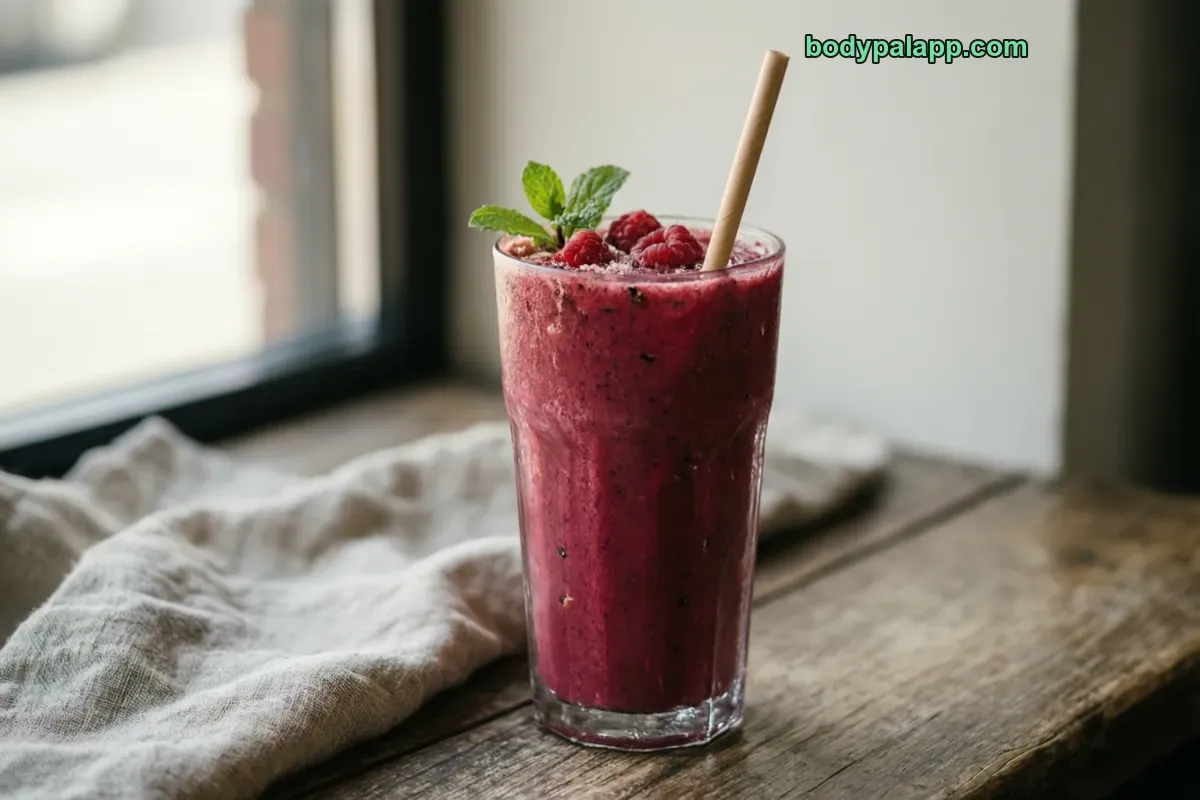
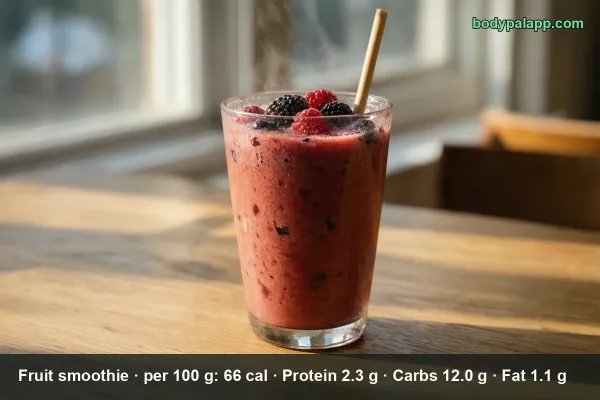
Smoothie calories come to 143 for a 1 cup (216 g) serving and 66 per 100 g of a fruit smoothie blended with dairy. The thing to notice is size: a small shop smoothie of 540 g reaches 356 calories, and 71% of the energy comes from carbs, much of it sugar.
143kcal
1 cup · 216 g, fruit, blended with dairy
14%protein
5 gProtein
26 gCarbs
2.4 gFat
How to burn off 143 kcal
—Walking, brisk
—Jogging
—Cycling, moderate
—Swimming
Skip the math. BodyPal counts these calories from your steps and workouts automatically.
Nutrition facts
Fruit, blended with dairy · per 216 g
Calories
143 kcal
Protein
5 g
Carbohydrate
26 g
Fat
2.4 g
Saturated fat
1.3 g
Cholesterol
9 mg
Sodium
60 mg
Potassium
376 mg
Iron
0.4 mg
Source: USDA FoodData Central
🛡️
Verified nutrition data
Numbers on this page come from USDA FoodData Central, the U.S. Department of Agriculture’s food composition database, and from manufacturer labels where a branded product is named. Last verified September 2026. How we verify our data →
Smoothie: calories, protein and sodium by serving
Percent of daily value uses the FDA reference of 2,000 kcal a day.
Serving
kcal
Protein
Carbs
Fat
Sodium
% DV kcal
1 cup (216 g)
143
5 g
25.9 g
2.4 g
60 mg
7%
Small (540 g)
356
12.5 g
64.7 g
5.9 g
151 mg
18%
Light (216 g)
114
5.6 g
21 g
1.3 g
67 mg
6%
100 g
66
2.3 g
12 g
1.1 g
28 mg
3%
3 × 1 cup (216 g)
428
15 g
181 mg
5 × 1 cup (216 g)
713
25.1 g
302 mg
Cup size decides the total, not the fruit
A smoothie has no fixed size, so the label on the cup matters more than the recipe. One cup of 216 g lands at 143 calories, about 7% of the daily value. A small shop smoothie of 540 g is 356 calories, or 18% of the daily value, in a drink you can finish in minutes.
Refills add up quickly. Two cups, or 432 g, come to 285 calories; three cups, 648 g, reach 428. Five cups, the 1,080 g you might blend as a full pitcher, total 713 calories. The math is linear: every 100 g adds 66.
If you buy smoothies, check the cup volume before the flavor. Pouring a homemade batch into a measured cup is the simplest way to keep the number near 143 rather than drifting toward 356. BodyPal can log the drink from a photo, which helps when the cup has no label.
Carbs supply 71% of the calories
The calorie split is lopsided: 71% from carbs, 15% from fat and 14% from protein. Per 100 g that is 12 g of carbs, 1.1 g of fat and 2.3 g of protein. The fruit drives the total, and the dairy adds a modest layer of protein and fat.
Protein is better than in juice but still light. A cup gives 5 g, 10% of the daily value, and a small gives 12.5 g, or 25%. That is enough to make the drink more than flavored sugar water, and not enough to call it a protein shake.
Fat stays low at 2.4 g per cup, with 0.6 g saturated per 100 g. Cholesterol is just 4 mg per 100 g. If you want the drink to hold you longer, protein is the row worth growing, not fat.
Sugar is the row to watch
Of the 12 g of carbs in every 100 g, 8.9 g are sugars. A cup carries 19.2 g of sugar and a small carries 48.1 g. Most of it comes from the fruit and the milk, but the format matters: a blended drink goes down much faster than the same fruit eaten whole.
Fiber does not keep pace. A cup has 2.4 g against a daily value of 28 g, and the small reaches 5.9 g. In every size the sugar line runs far ahead of the fiber line.
Sodium, by contrast, is a non-issue: 60 mg per cup is 3% of the daily value, and even the small sits at 151 mg, or 7%. Potassium is a quiet plus at 174 mg per 100 g. If you track sugar, size is the lever.
A light smoothie trims calories and fat
The light version, also 216 g per cup, comes in at 114 calories instead of 143. Carbs fall from 25.9 g to 21 g and fat from 2.4 g to 1.3 g, so the saving comes from both. Sugar drops too, to 16.1 g from 19.2 g.
Protein actually edges up, to 5.6 g per cup, or 11% of the daily value, compared with 5 g in the regular cup. Sodium rises slightly to 67 mg, still only 3% of the daily value. Fiber is close, 2.2 g against 2.4 g.
If a smoothie is a daily habit, the light recipe is the easier swap: same cup, fewer calories and a touch more protein. If it is an occasional treat, the regular cup at 143 is unlikely to move your day much; the small at 356 is the one that deserves a second look.
How does smoothie compare?
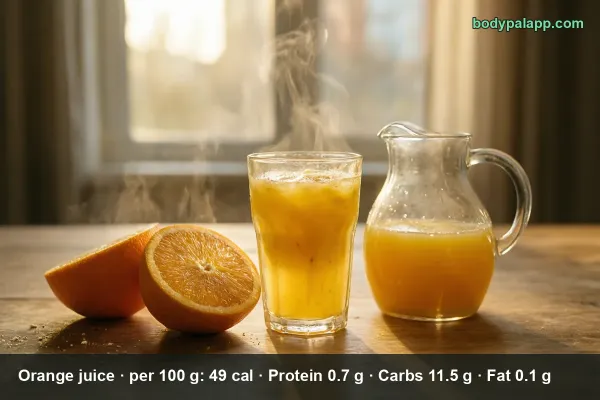
Here is how a smoothie compares with a fruit smoothie, orange juice and black coffee, per 100 g and per usual serving.
Verdict: If calories are the priority, orange juice at 49 per 100 g or black coffee at 5 per cup beats a smoothie at 66 per 100 g. If you want a drink with some staying power, the smoothie wins, with 2.3 g of protein per 100 g against 0.7 g in orange juice.
Smoothie cubes are labeled as frozen, undiluted blocks, so they read higher per 100 g than a blended smoothie, while the bottled yogurt drinks are already ready to drink. Source: manufacturer labels / USDA FoodData Central.
Smoothie FAQs
How many calories are in a smoothie?
About 143 calories in a 1 cup (216 g) fruit smoothie. A small 540 g smoothie is about 356 calories.
Is a smoothie good for weight loss?
A cup of a light smoothie is 114 calories against 143 for the regular version, while a small 540 g size reaches 356 calories.
Smoothie or orange juice: which has fewer calories?
A smoothie has 66 calories per 100 g and orange juice 49, so the smoothie is about 17 calories more per 100 g.
How much sugar is in a smoothie?
A 1 cup (216 g) smoothie has about 19.2 g of sugar out of 25.9 g of carbs, plus 5 g of protein.
How many calories are in a small smoothie?
A small smoothie of 540 g has 356 calories, 18% of the daily value. It also carries 48.1 g of sugar, 12.5 g of protein and 5.9 g of fiber, so it counts more like a light meal than a drink on the side.
How much protein is in a smoothie?
A 1 cup (216 g) smoothie has 5 g of protein, 10% of the daily value. A small of 540 g gives 12.5 g, or 25%. Protein supplies 14% of the calories, with carbs at 71%.
Is a smoothie high in sodium?
No. A cup has 60 mg of sodium, 3% of the daily value, and a small has 151 mg, or 7%. Per 100 g the figure is 28 mg, so sodium is not a concern in this drink.
How many calories are in a light smoothie?
A light smoothie has 114 calories per 216 g cup, compared with 143 for the regular version. It has 1.3 g of fat, 16.1 g of sugar and 5.6 g of protein per cup.
How much fiber is in a smoothie?
A cup of smoothie has 2.4 g of fiber, against a daily value of 28 g. A small of 540 g has 5.9 g. Per 100 g there is 1.1 g of fiber next to 8.9 g of sugars.