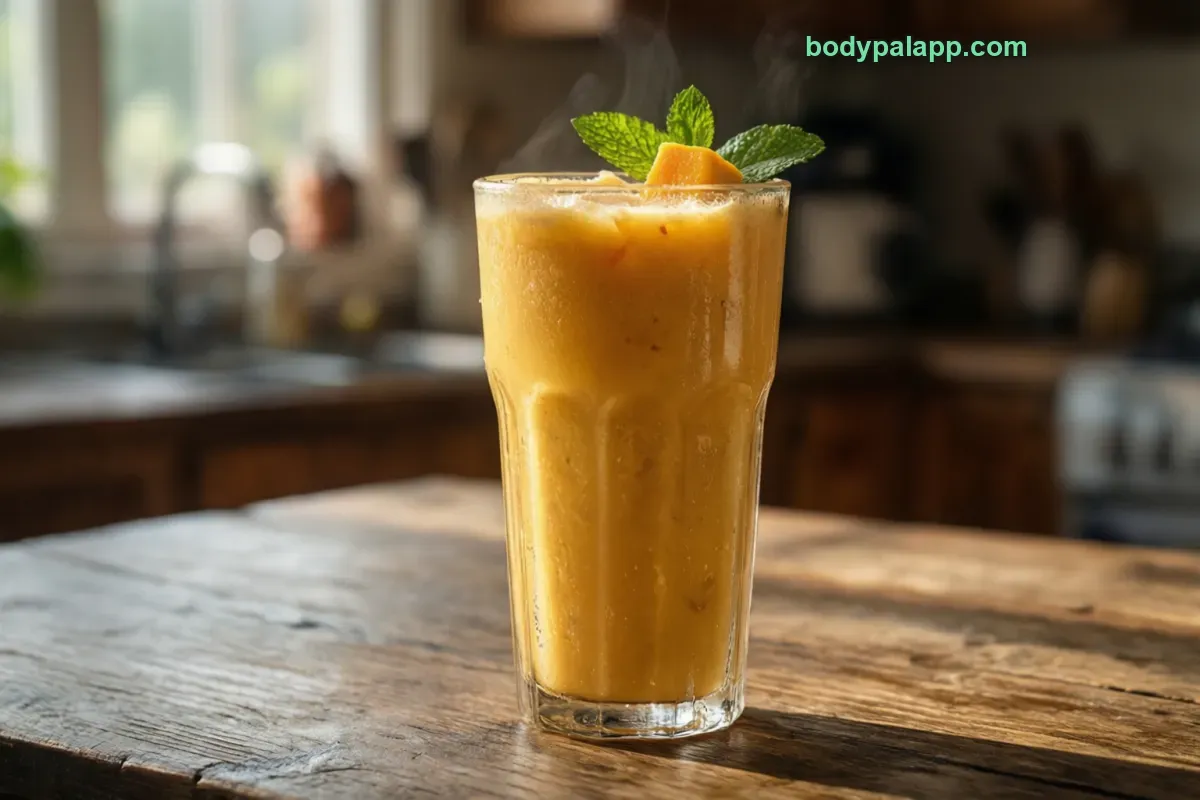
Mango smoothie calories come to 151 for one 240 g glass and 63 per 100 g, based on a bottled fruit juice smoothie. Almost every calorie is carbohydrate, and most of that is sugar: 30 g per glass. The real swing is size, because a 16 oz cup lands at 286.
151kcal
1 glass · 240 g, fruit juice smoothie, bottled
3%protein
1 gProtein
36 gCarbs
0 gFat
How to burn off 151 kcal
—Walking, brisk
—Jogging
—Cycling, moderate
—Swimming
Skip the math. BodyPal counts these calories from your steps and workouts automatically.
Nutrition facts
Fruit juice smoothie, bottled · per 240 g
Calories
151 kcal
Protein
1 g
Carbohydrate
36 g
Fat
0 g
Saturated fat
0 g
Cholesterol
0 mg
Sodium
10 mg
Potassium
341 mg
Iron
0.4 mg
Source: USDA FoodData Central
🛡️
Verified nutrition data
Numbers on this page come from USDA FoodData Central, the U.S. Department of Agriculture’s food composition database, and from manufacturer labels where a branded product is named. Last verified September 2026. How we verify our data →
Mango smoothie: calories, protein and sodium by serving
Percent of daily value uses the FDA reference of 2,000 kcal a day.
Serving
kcal
Protein
Carbs
Fat
Sodium
% DV kcal
1 glass (240 g)
151
1 g
36 g
0 g
10 mg
8%
16 oz cup (454 g)
286
1.9 g
68.1 g
0 g
18 mg
14%
100 g
63
0.4 g
15 g
0 g
4 mg
3%
3 × 1 glass (240 g)
454
3 g
29 mg
5 × 1 glass (240 g)
756
5 g
48 mg
A 16 oz cup nearly doubles the glass
The reference glass here is 240 g and carries 151 calories, about 8% of the daily value. Step up to a 16 oz cup, which weighs 454 g, and the count climbs to 286, or 14% of the daily value. That is close to double, for a size many people treat as one drink.
Refills scale in a straight line. Two glasses come to 302 calories, three reach 454, and five land at 756. A glass holds just 1 g of protein and 0 g of fat, so almost none of that energy comes from either. It is easy to drink 302 calories in a few minutes and barely notice.
If you are tracking, measure the pour instead of eyeballing a bottle. Check the size on the label: a bottle or cup marked 16 oz belongs to the 286-calorie row, not the 151-calorie one. Splitting a large bottle across two sittings keeps each serving close to the glass figure.
Carbs supply 97% of the calories
The calorie split is lopsided: 97% carbohydrate, 3% protein and 0% fat. Per 100 g that works out to 15 g of carbs, 0.4 g of protein and 0 g of fat for 63 calories. This is a fruit drink, and the numbers read exactly like one.
Most of the carbohydrate is sugar. Of the 15 g of carbs in 100 g, 12.5 g are sugars, and fiber sits at 0 g. Per 240 g glass that becomes 36 g of carbs with 30 g of sugars; the 16 oz cup carries 68.1 g of carbs and 56.8 g of sugars.
Protein barely registers. A glass gives 1 g, which is 2% of the daily value, and even the 16 oz cup reaches only 1.9 g, or 4%. If you want the drink to carry you to the next meal, the macros say it needs help from something else on the plate.
Sugar is the row to watch, sodium is not
With 30 g of sugars in one glass and 56.8 g in a 16 oz cup, sugar is the number that deserves your attention. These figures come from the USDA entry for Naked Juice Mighty Mango, a bottled fruit juice smoothie. Fiber is 0 g per 100 g, so the sugar arrives without any fiber alongside it.
Sodium, by contrast, is a non-issue. A glass has 10 mg, 0% of the daily value, and the 16 oz cup has 18 mg, or 1%. Potassium is the quiet plus at 142 mg per 100 g. If you watch sodium, this is one of the easier drinks to fit in; if you watch sugar, the cup size matters far more.
Packaged versions such as F'real Mango Smoothie, Meijer Organic Mango Smoothie or Ceres Mango Smoothie To Go print their own labels. Read the sugars line on the one you actually buy, because recipes and bottle sizes differ from brand to brand.
Pair it with protein to make it a meal
On its own, a glass of mango smoothie is a sweet drink with 151 calories and 1 g of protein. It works best as one part of a breakfast or snack rather than the whole thing. Foods with protein and some fat fill the gaps it leaves: eggs, Greek yogurt, a handful of nuts or whole-grain toast with nut butter.
If you keep it as a snack, the 240 g glass is the size to stick with. Save the 16 oz cup for days when it replaces something else, so its 286 calories do not stack on top of a full meal.
A mango shake made with milk, yogurt or ice cream is a different drink from this bottled juice smoothie, and its count depends on what goes in. Snap a photo of whatever you blend and BodyPal can log it for you.
How does mango smoothie compare?
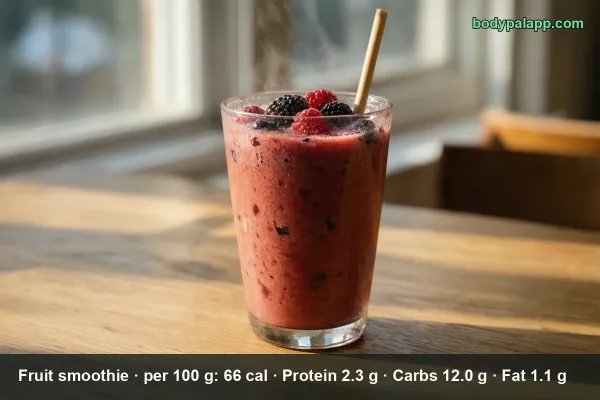
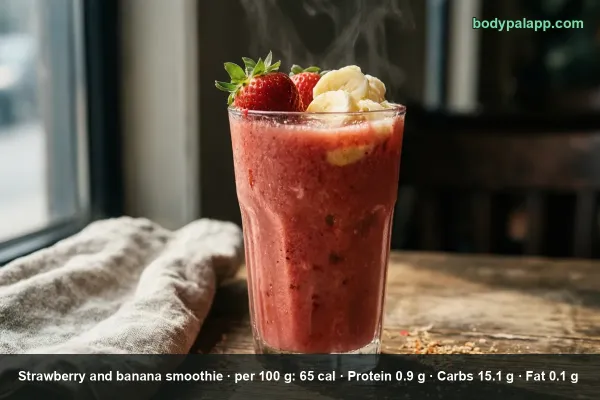
Here is how a mango smoothie stacks up against a generic smoothie, a fruit smoothie and a strawberry and banana smoothie, per 100 g and per usual serving.
Verdict: On calories it is a wash: mango's 63 per 100 g sits right next to 65 and 66 for the others, so choose by taste. If you want some protein, the smoothie or fruit smoothie at 2.3 g per 100 g beats mango's 0.4 g; if you watch sodium, mango's 4 mg per 100 g is the lowest here.
Most popular mango smoothie brands in the United States
Bottled smoothies vary in how much juice, yogurt or ice they contain, so their per-100 g calories land on either side of the number above. Source: manufacturer labels / USDA FoodData Central.
Mango smoothie FAQs
How many calories are in a mango smoothie?
An 8 oz glass (240 g) is about 151 calories, and a 16 oz cup is about 286. Per 100 g a mango smoothie is 63 calories.
Is a mango smoothie good for weight loss?
An 8 oz glass is 151 calories with 36 g carbohydrate and 30 g sugars, and no fat. It lands closer to a snack than to a zero-calorie drink.
Mango smoothie vs strawberry banana smoothie: which has fewer calories?
A mango smoothie is 63 calories per 100 g and a strawberry banana smoothie is 65, so the two sit within 2 calories per 100 g of each other.
How much sugar is in a mango smoothie?
About 12.5 g of sugars per 100 g, which is 30 g in an 8 oz glass (240 g), out of 36 g total carbohydrate.
How many calories are in a 16 oz mango smoothie?
A 16 oz cup of mango smoothie, about 454 g, has 286 calories. That is 14% of the daily value, with 68.1 g of carbs, 56.8 g of sugars and just 1.9 g of protein.
How many calories are in one glass of mango shake?
One 240 g glass of bottled mango smoothie has 151 calories. Two glasses come to 302 and three to 454, so refills add up quickly. A shake blended with milk or ice cream will differ, so log what you actually use.
Does a mango shake with sugar have more calories?
The 151 calories per glass here already include 30 g of sugars from the bottled fruit juice blend. Stirring in sugar, milk or ice cream adds calories on top of that, so log each extra separately.
What are the nutrition facts for a mango smoothie per 100 g?
Per 100 g, a mango smoothie has 63 calories, 15 g of carbs, 12.5 g of sugars, 0.4 g of protein and 0 g of fat. It also brings 4 mg of sodium and 142 mg of potassium, with 0 g of fiber.